A red cardinal is most often read as a sign that a loved one who has died is near, and as a sign of hope and of Christmas: beliefs, not biology. The Farmers' Almanac says the loved-one belief can't be traced to a single source. The real bird is a year-round neighbor that rarely moves far from home.
Red cardinal meanings at a glance
Each meaning below is a belief people hold, not a fact about the bird. The last column says what we could find in the record.
| Meaning | What people believe | What the record shows |
|---|---|---|
| A visit from a loved one | A cardinal at the window is someone you've lost, close by | Common folklore in many parts of the South and Midwest; no single source, says the Farmers' Almanac |
| "When cardinals appear, angels are near" | Angels, or the dead, are close | A saying of comfort; we found no record of who first said it, or when |
| A sign from God | God's care in a hard time | A matter of faith; one priest's view in a 2023 interview |
| Hope | Color and song on a bleak winter day | A folk meaning the Farmers' Almanac lists as "hope in hard seasons" |
| Love and loyalty | A pair at the feeder stands for faithful love | A folk meaning; real cardinal pairs are monogamous |
| Christmas | The red bird of the holiday season | It stays all winter and the male keeps his red, so it's on cards and ornaments |
| A wish, or luck | Make a wish when you see one | Old North Carolina folk belief, gathered mostly between 1912 and 1943 |
| An omen | A death, rain or a cold snap is coming | The same North Carolina collection |
| The daughter of the Sun | The redbird is the Sun's daughter, lost on the way back from the land of the dead | A Cherokee story, published in 1900 |
What does it mean when you see a cardinal?
For many people, it means someone they have lost is close by: a visit, a hello, a sign that they're all right. That's folklore, held with real feeling, and nothing about the bird can prove it or rule it out. The Farmers' Almanac calls it common folklore that a cardinal's visit is a sign from a loved one who has passed. It says the belief "cannot be traced to a single source," and places it in many parts of the American South and Midwest.
The Almanac ties it to the "persistent memorial market" in cardinal cards, ornaments and figurines given in someone's memory. Timing is part of it too: Fox News, writing about the belief in 2023, said many people have noticed a cardinal when they bury a loved one or in times of great sorrow.
There's a plainer meaning as well. Cardinals don't migrate, and most live within a mile of where they were born, says the Chesapeake Bay Program. The cardinal at your window is almost certainly a neighbor, so it's often there on the days that matter.
Do cardinals appear when angels are near?
"When cardinals appear, angels are near" is a saying of comfort, not something anyone can show; we found no reliable source for who first said it, or when. It isn't in the Farmers' Almanac's long survey of cardinal lore.
In a first-person story in Guideposts, a husband says it to his wife as a flock of cardinals fills their backyard, not long before he dies of cancer. She remembers the words after his funeral. It shows how the saying is used, not where it began.
Much of what turns up for the saying is for sale. When we searched it on October 22, 2026, most of Google's first page was shops selling it on gifts and keepsakes. We won't guess at its age or its author.
What is the old saying about seeing a cardinal?
Today it's "When cardinals appear, angels are near," but the older sayings were about wishes, weather and death. In North Carolina, Frank C. Brown and the North Carolina Folklore Society gathered folk beliefs, mostly between 1912 and 1943; Duke University Press published them in 1964, in the seventh volume of The Frank C. Brown Collection of North Carolina Folklore. More than a dozen are about the redbird, the old Southern name for the cardinal.
- Wishes: see a redbird, make a wish and keep it to yourself, and it will come true. Other versions say to kiss your thumb first, or to throw the bird a kiss before it flies.
- Weather: "Redbirds bring cold weather," one entry says, and another calls a redbird "a sign of rain."
- Death: "To see a redbird is a sign you are going to hear of a death." A redbird that came into the house meant a death in the family. The editor also cites an Illinois collection in which a redbird lighting on the windowsill "means death."
So the redbird was tied to death long before it became a comfort. We found no source linking those old omens to today's belief in cardinal visits.
Is it good luck to see cardinals?
In old Southern folk belief, often yes: a redbird was something to wish on, though the same collections also read it as a warning. A Tennessee collection cited in the Brown volume says that seeing a redbird and making a wish before it flies "will bring good luck." A Texas collection says a redbird seen on a Friday means bad luck, where a North Carolina entry makes Friday the day to wish. In North Carolina, the same bird could mean a wish come true, rain, a cold snap or a death, depending on whom you asked.
No study shows that a cardinal changes anyone's luck. The Farmers' Almanac, surveying cardinal lore today, doesn't list luck at all, and says of the meanings it does list: "None is proven."
When God sends you a cardinal: what do people believe?
Many Christians take a cardinal that comes in a hard time as a sign of God's care; it's a matter of faith, not something the bird can confirm. In 2023, Fox News asked Fr. Jeffrey Kirby, pastor of Our Lady of Grace in Indian Land, South Carolina, about it. He pointed to Matthew 10:29–31, the verses about sparrows, and said: "If God could use a sparrow, he could certainly use a cardinal."
Kirby also called the cardinal's red a symbol of the blood of Jesus Christ. And he described a cultural link between the birds and "hope and the presence of our loved ones who have died."
That is one priest's view, given in an interview. We found no church teaching that cardinals carry messages. The Bible doesn't mention cardinals, a bird of the Americas; Kirby's argument runs through the sparrow.
What is the spiritual message of a cardinal?
The message people most often take is that someone they've lost is near, and that there is hope; the Farmers' Almanac adds love and family loyalty. Its list of what a sighting can mean has four entries: a visit from a loved one, romance, family and loyalty, and hope in hard seasons. "These are folk meanings, not facts," its own answer says.
The Almanac ties the love and loyalty readings to the bird's real life. Cardinal pairs are monogamous, says the Chesapeake Bay Program. In courtship, the Pennsylvania Game Commission says, the male offers the female a bit of food and "the two touch beaks as she accepts the morsel." Hope, in the Almanac's telling, comes from the color on a bleak winter day; Audubon magazine calls the cardinal "a welcomed splash of color during snowy eastern winters."
The red carries meaning of its own. The bird is named after the cardinals of the Roman Catholic Church: its plumage reminded people of their crimson robes and caps, says Audubon magazine. Vatican News, reporting on new cardinals in 2020, said their red symbolizes a readiness to sacrifice themselves "to the point of shedding their own blood."
Is there a Native American cardinal legend?
Yes: the best documented is a Cherokee story in which the redbird is the daughter of the Sun. James Mooney heard it from storytellers of the Eastern Band of Cherokee, among them Swimmer and John Ax, and published it in 1900 in Myths of the Cherokee, for the Bureau of American Ethnology. He called it one of the principal myths of the Cherokee.
In the story, the Sun's daughter has died, and seven men go to the Ghost country, in the Darkening land of the west, to bring her back. They take her from a dance of the dead and carry her home in a box they've been told never to open. On the way she begs to be let out, then for food, water and air. Near home they lift the lid a little. Something flutters out into the bushes, and they hear a redbird cry. When they reach home, the box is empty. "So we know the Redbird is the daughter of the Sun," the story says, and because the box was opened, the dead can't be brought back.
Mooney recorded a second, shorter story from Cornelius Boudinot of Tahlequah. A little brown bird pecks the plaster from a Wolf's eyes and is paid with red paint from a rock, and that's how the redbird got its color. Mooney noted that it differs from the standard Cherokee myth.
Many websites list "Native American cardinal meanings" without naming a nation, a story or a source. We don't repeat them. And though the Cherokee story ties the redbird to the dead, we found no source that connects it to today's belief in cardinal visits.
What no source supports
These claims are common online. We looked for a reliable source for each, and found none:
- who first said "When cardinals appear, angels are near," or when;
- where the belief in cardinal visits from the dead began (the Farmers' Almanac says no single source);
- cardinal "meanings" credited to Native Americans in general, with no nation or story named;
- any church teaching about the bird;
- any evidence that seeing a cardinal brings luck, good or bad.
Why is a cardinal red?
Because of what it eats: the red comes from carotenoids, pigments in its food, and the bird can also turn yellow ones into red. Audubon magazine names wild grapes, dogwood berries and mulberries among the fruits that supply them. Birds can't make carotenoids themselves, so they have to eat them. A 2001 study led by Kevin McGraw gave captive cardinals no red pigments in their food, and they still grew red feathers, only paler ones. The cardinal's ability to convert yellow pigments from its food "contributes to the bright red plumage," the authors concluded.
The rare yellow cardinal shows the other side. Audubon magazine says it comes from a genetic mutation that leaves the bird without the enzyme it needs to turn yellow pigments into red. Seeing one, the magazine says, is "truly a once-in-a-lifetime event."
Why do you see cardinals in winter?
Because they never leave: cardinals don't migrate, and the male keeps his red all winter. The Audubon field guide calls the Northern Cardinal a "permanent resident throughout its range." The National Wildlife Federation counts it among the most commonly seen backyard birds in winter across much of the United States, and says males keep their colorful plumage all season. The bird has also spread north for decades, the Audubon field guide says, and feeders stocked with sunflower seeds may have helped.
That's how it became the bird of Christmas. "No other bird symbolizes Christmas quite like the northern cardinal," the National Wildlife Federation says. The Farmers' Almanac puts its place in holiday decorations down to its red. It's the state bird of seven states for much the same reasons: it's there all year, and it's easy to know. Our guide to the seven states that chose the cardinal tells how each one picked it.
Male or female: which cardinal did you see?
A bright red bird with a black face is a male; a brownish bird with red tints on her wings, tail and crest is a female. The Pennsylvania Game Commission describes the female as yellowish brown with those red tints, and the Chesapeake Bay Program as brownish-gray with a reddish crest, wings and tail. Both have a crest and an orange-red bill, and both are 8 to 9 inches long, a little smaller than a robin, says the Game Commission. Both sing, too, says the Chesapeake Bay Program, so the song you hear may be hers.
How long do cardinals live?
About 3 years on average, and up to 15, says the Chesapeake Bay Program. The oldest known wild cardinal was a female, banded in Pennsylvania on March 16, 1956, and found again there on March 17, 1971: at least 15 years and 9 months old, by the USGS Bird Banding Laboratory's records. That's a record, not a typical life. Our guide to how long birds live compares it with other backyard birds.
What attracts cardinals to your yard?
Sunflower or safflower seed on a sturdy, open feeder, fresh water, and thick shrubs close by. The National Wildlife Federation suggests sunflower or safflower seeds, cracked corn or apples, on a sturdy platform or hopper feeder near shrubs or other cover.
- Food: the Farmers' Almanac adds peanut hearts, berries and suet crumbles, on broad, open feeders.
- Water: a broad basin 1 to 2 inches deep, cleaned weekly, says the Almanac. A heated birdbath keeps it open in a freeze, the National Wildlife Federation adds.
- Cover: dense shrubs, vines and evergreens. Pennsylvania's Game Commission says pairs hide their nests in "the thickest, thorniest scrub" on their territory.
- Plants: the National Wildlife Federation suggests native shrubs such as serviceberry, flowering dogwood and arrowwood viburnum, and trees such as eastern red cedar, white pine and elm.
Expect visits at the glass in spring. Cardinals defend their territory so hard that they attack their own reflection in windows and mirrors, says the Chesapeake Bay Program, and Audubon magazine says it happens in spring and early summer and can go on for weeks. A cardinal tapping at your window is fighting a rival it thinks it sees.
Audubon's cardinal
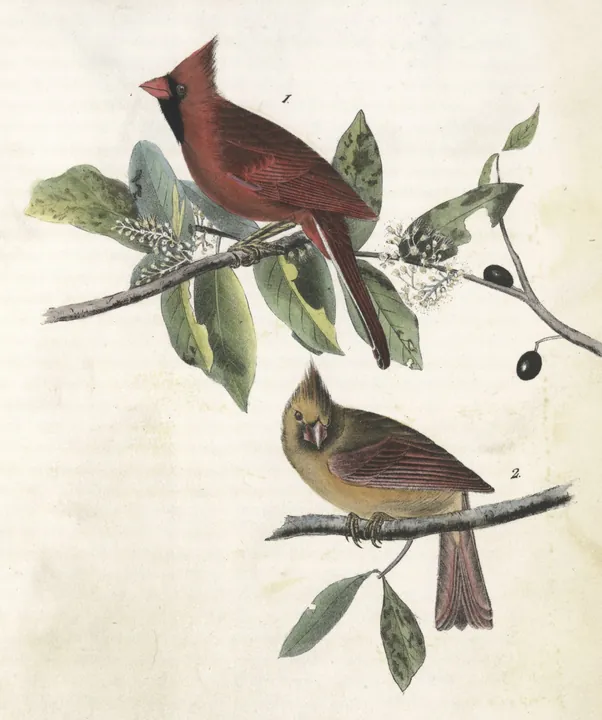
The painting at the top is John James Audubon's "Common Cardinal Grosbeak," plate 203 of the octavo edition of The Birds of America: a red male and a brown female on a branch of wild almond. More classic portraits of the bird are on our Northern Cardinal painting page.
If a cardinal is one of the birds that matter to you, a Birdfolio prints every bird you've seen beside a classic painting: page through a Birdfolio.
Questions people ask
Is seeing a cardinal a sign from heaven?
Many people believe so, and no one can prove it either way. It's a matter of faith and folklore, not a fact about the bird.
Why does a cardinal keep coming back to my yard?
Most likely because it lives there. Cardinals stay all year, and most live within a mile of where they were born, says the Chesapeake Bay Program.
Why is it called a cardinal?
After the cardinals of the Roman Catholic Church. Its red plumage reminded people of their crimson robes and caps, says Audubon magazine.
What does it mean when a cardinal taps on your window?
Usually that it's fighting its own reflection, defending its territory in spring or early summer. In old North Carolina folklore, a redbird that came into the house was an omen of death.