Classic bird paintings
Eastern Bluebird painting: Audubon's plate and other classic portraits
John James Audubon painted the Eastern Bluebird as plate 113 of The Birds of America (1827–38), a male, a female and a young bird on great mullein, under the name Blue-bird. That plate, dated 1831 on its engraver's line, is the painting shown here; a free high-resolution scan is on Audubon.org.
Updated
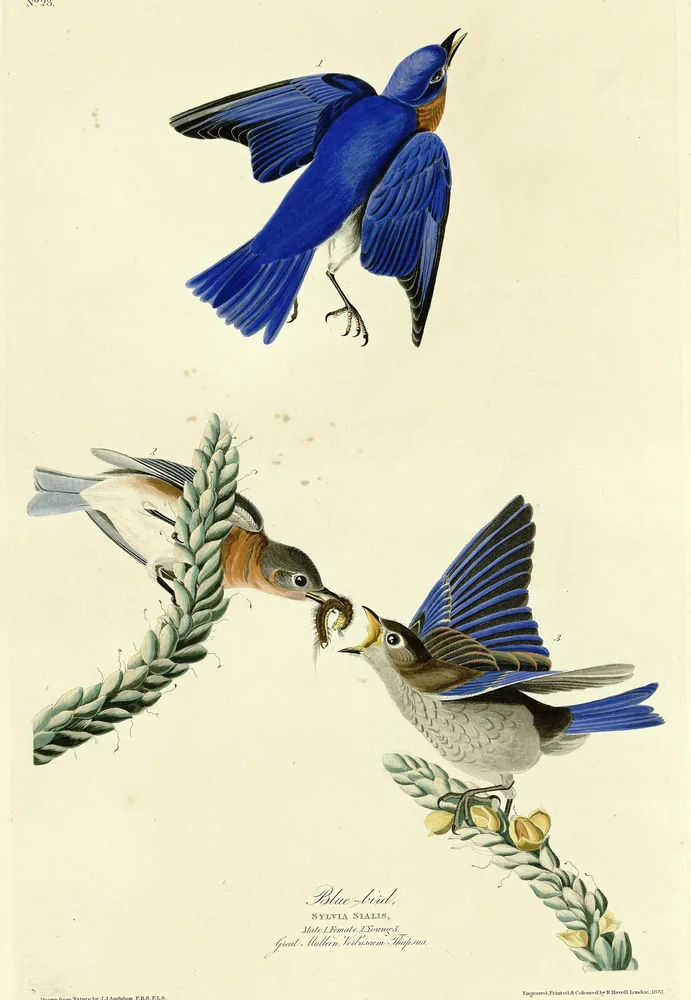
Audubon’s plate: plate 113, “Blue-bird”
One winter Audubon put up several small boxes near his house to invite bluebirds to nest. In spring the Purple Martins, which had a large house of their own on a pole nearby, moved into the boxes and drove the bluebirds out. One male bluebird held on until heavier blows forced him from a box where his nest was nearly finished, and kept harassing the intruder afterward.
Audubon took sides. He climbed the tree, caught the martin and clipped its tail; it flew straight back to the box. He caught it again and clipped its wingtips, with the same result. In the end, he wrote, he “disposed of him in such a way that he never returned to the neighbourhood.”
A bluebird could be fierce too. Near Philadelphia, his friend Dr. Richard Harlan watched a pair nesting in a hole cut for them in the cornice above a friend's porch. When a hen and her chicks came too close, the male flew at her until she hid under a distant shrub, then went back to his nest and “carolled his victory with great animation.”
The plate shows a male, a female and a young bird on great mullein, the tall weed of old fields from whose tops, he wrote, bluebirds pounce on grasshoppers in autumn.
Story: Audubon, Ornithological Biography, vol. 2 (1834), pp. 84–87; vol. 1 (1831), pp. 117–118. See plate 113 free at Audubon.org.
More classic portraits, free to see
- John James Audubon, The Birds of America, octavo edition (1840–44), plate 134: “Common Blue Bird”. Free scan (New York Public Library Digital Collections)
- Louis Agassiz Fuertes, for Elon H. Eaton’s Birds of New York (1910–14), plate 106: “Bluebird”, with the American Robin. Free scan (Internet Archive)
About the Eastern Bluebird
- Eastern Bluebirds often watch from a low perch, then flutter down to catch insects. (Source: National Audubon Society)
Where do Eastern Bluebirds live in Texas?
All year in the eastern half of the state. They nest mostly east of the 99th meridian and north of the 29th parallel, from the Pineywoods and Post Oak Savannah to the Blackland and Coastal Prairies, and along the Canadian River in the Panhandle, the Texas Breeding Bird Atlas says. In winter migrants join them, and they are common to uncommon east of the Pecos River.
Nesting starts early, in mid-February, with young in a nest as early as March 6, and runs to late July. Survey counts in Texas rose about 1.5% a year from 1980 to 2007, close to the 2.3% for the whole continent, so the atlas calls the bluebird's future here reasonably secure.
Source: Texas Breeding Bird Atlas, Eastern Bluebird (Tweit, 2009).
Which bluebirds live in Texas?
All three kinds. The Eastern nests across the eastern half; the Western Bluebird nests only in the Davis and Guadalupe Mountains and, in some winters, spreads across the Trans-Pecos from late October to mid-March, the Texas Breeding Bird Atlas says. Where their ranges nearly meet, the bright males are easy to sort out, but the plainer females can be hard to tell apart.
A male Western has a blue throat and a gray belly, where the Eastern's throat is reddish brown and its belly white. The third, the sky-blue Mountain Bluebird, is a wanderer: its winter range shifts from year to year with the food supply, and flocks sometimes drift east onto the Great Plains. It hovers over open fields to hunt more than the other two do, says National Audubon's guide, which lists Texas in its range. Other blue birds with orange chests are in our guide to birds by color.
Sources: Texas Breeding Bird Atlas, Western Bluebird (Tweit, 2007); National Audubon Society, Western Bluebird; National Audubon Society, Mountain Bluebird; National Audubon Society, Eastern Bluebird.
Do bluebirds use nest boxes in Texas?
Yes, and boxes helped bring them back. Eastern Bluebirds nest in natural tree holes, old woodpecker holes or birdhouses, the Texas Breeding Bird Atlas says, and when starlings competing for holes cut their numbers in the mid-1900s, volunteers turned the decline around with hundreds of thousands of nest boxes.
A high share of North America's Eastern Bluebirds now nest in boxes put up for them along bluebird trails, National Audubon's guide says. In one, the female builds a loose cup of grasses in four or five days while the male brings material, then lays four or five pale blue eggs, one a day. The young hatch after about 14 days and leave about 19 days later, and a pair usually raises two broods a year, sometimes three. Not every chick is the male's own: in one study, 20% had a different father.
Sources: Texas Breeding Bird Atlas, Eastern Bluebird (Tweit, 2009); National Audubon Society, Eastern Bluebird.
How long does an Eastern Bluebird live?
Bluebirds live an average of 2 years in the wild, Texas Parks and Wildlife says. The oldest known wild Eastern Bluebird was at least 10 years and 6 months old (USGS Bird Banding Laboratory): it was banded in New York in 1989 and found in South Carolina in 1999.
Sources: Texas Parks and Wildlife Department; USGS Bird Banding Laboratory. A banding record is the minimum age of one bird when it was found again, not a typical lifespan. How long do wild birds live?
How can you tell if a plate 113 print is an original?
By its size: an original plate 113 is a hand-colored sheet about 26 by 38 inches, dated 1831; the Eastern Bluebird’s octavo version, plate 134, is book-size, from 1840–44. Many prints sold today are reproductions: how to tell an original from a reproduction. Rather have every plate in one book? Here’s which Birds of America book to buy.
In a Birdfolio hardcover, this painting sits beside the date and place you first saw a Eastern Bluebird. See your own list as a book, free.