Reference
How many bird species are in New York?
New York has 519 bird species on its official list (New York State Avian Records Committee, November 7, 2026), the 11th highest count of the 49 states with a verified count. It includes 2 extinct species, 8 introduced ones and 2 no longer found in New York, plus 2 introduced species that have since died out there.
New York’s state bird is the Eastern Bluebird: our New York state bird page tells how it was chosen.
Updated
What are the most common birds in New York?
In summer, the 25 most common birds in New York are led by the Red-winged Blackbird, at about 105 birds per survey route, then the European Starling and the Canada Goose, by the USGS Breeding Bird Survey’s counts for 2021–2025. Together these 25 made up 77% of all the birds counted on New York’s 67 survey routes.
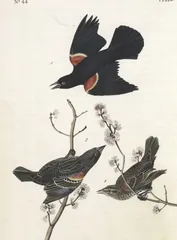
John James Audubon, The Birds of America (1840–44) about 105 per routeon 97% of routesno clear trend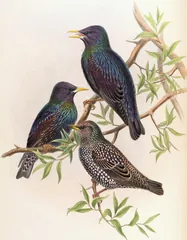
John Gould and Henry Constantine Richter, The Birds of Asia, vol. 5 (1850–83) 2 European Starlingabout 104 per routeon 99% of routesno clear trendintroduced species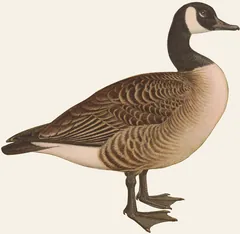
Marinus Adrianus Koekkoek, E. D. van Oort's Ornithologia Neerlandica (1922) about 89 per routeon 90% of routesno clear trend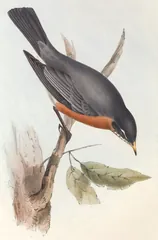
John and Elizabeth Gould, The Birds of Europe (1832–37) about 68 per routeon 100% of routesno clear trend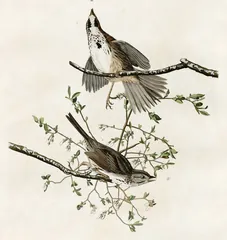
John James Audubon, The Birds of America (1827–38) about 45 per routeon 100% of routesno clear trend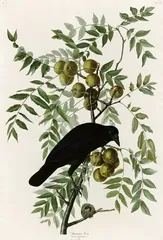
John James Audubon, The Birds of America (1827–38) about 42 per routeon 100% of routesfalling since 2015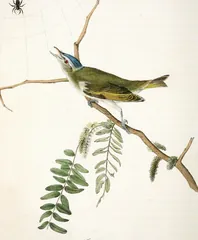
John James Audubon, The Birds of America (1840–44) 7 Red-eyed Vireoabout 38 per routeon 100% of routesno clear trend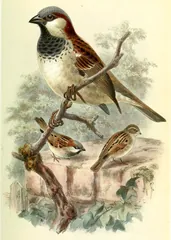
John Gerrard Keulemans, Lord Lilford’s Coloured Figures of the Birds of the British Islands (1885–97) 8 House Sparrowabout 35 per routeon 84% of routesno clear trendintroduced species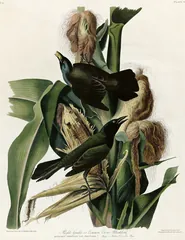
John James Audubon, The Birds of America (1827–38) 9 Common Grackleabout 28 per routeon 100% of routesfalling since 2015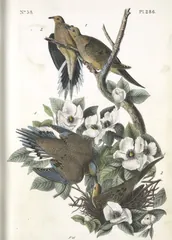
John James Audubon, The Birds of America (1840–44) about 26 per routeon 96% of routesno clear trend
Show all 25
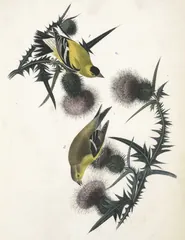
John James Audubon, The Birds of America (1840–44) about 22 per routeon 99% of routesno clear trend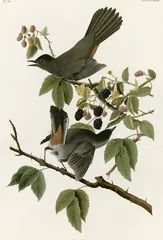
John James Audubon, The Birds of America (1827–38) 12 Gray Catbirdabout 22 per routeon 97% of routesno clear trend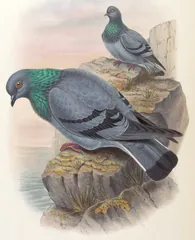
John Gould and William Matthew Hart, The Birds of Asia (1850–83) 13 Rock Pigeonabout 22 per routeon 82% of routesno clear trendintroduced species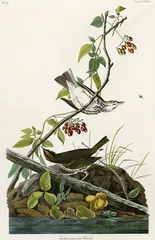
John James Audubon, The Birds of America (1827–38) 14 Ovenbirdabout 20 per routeon 87% of routesno clear trend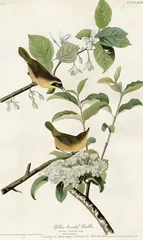
John James Audubon, The Birds of America (1827–38) 15 Common Yellowthroatabout 20 per routeon 99% of routesfalling since 2015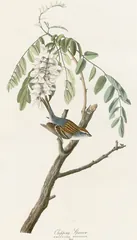
John James Audubon, The Birds of America (1827–38) 16 Chipping Sparrowabout 19 per routeon 100% of routesfalling since 2015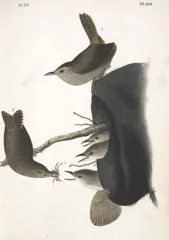
John James Audubon, The Birds of America (1840–44) 17 Northern House Wrenabout 19 per routeon 97% of routesrising since 2015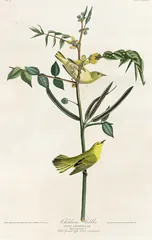
John James Audubon, The Birds of America (1827–38) 18 Northern Yellow Warblerabout 18 per routeon 96% of routesno clear trend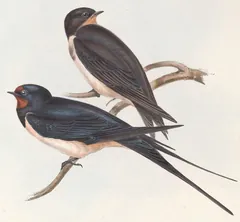
John and Elizabeth Gould, The Birds of Europe (1832–37) 19 Barn Swallowabout 17 per routeon 94% of routesfalling since 2015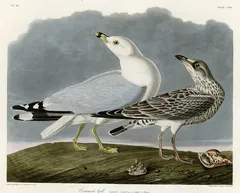
John James Audubon, The Birds of America (1827–38) 20 Ring-billed Gullabout 17 per routeon 36% of routesno clear trend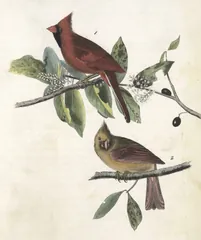
John James Audubon, The Birds of America (1840–44) about 14 per routeon 96% of routesrising since 2015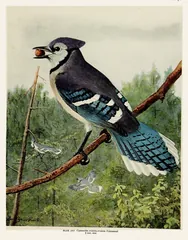
Louis Agassiz Fuertes, Elon H. Eaton's Birds of New York (1910–14) 22 Blue Jayabout 13 per routeon 100% of routesno clear trend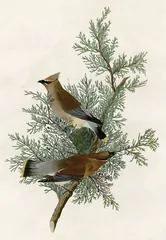
John James Audubon, The Birds of America (1827–38) about 12 per routeon 96% of routesfalling since 2015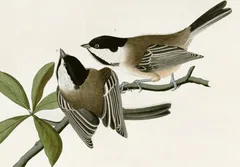
John James Audubon, The Birds of America (1827–38) about 12 per routeon 100% of routesfalling since 2015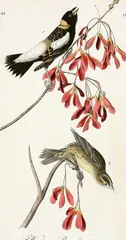
John James Audubon, The Birds of America (1840–44) 25 Bobolinkabout 8.8 per routeon 78% of routesfalling since 2015
From the Red-winged Blackbird to the Bobolink, these are New York’s common summer birds; for the rest of its 519 species, our guide to the best bird books of 2026 compares the five big North American guides, Sibley’s and Peterson’s among them.
What is the most common bird in New York?
The Red-winged Blackbird leads New York’s summer survey: about 105 a route on average in 2021–2025, ahead of the European Starling at about 104, seen on 97% of the 67 routes. USGS finds no clear rise or fall in its New York numbers since 2015.
The American Robin has often been the most abundant species in New York's breeding bird atlases, NYC Bird Alliance says, and it was the most common nesting bird in Central Park in both 1998 and 2008, with 205 and 193 pairs. In winter, the Blue Jay was reported on every one of the state's 72 Christmas Bird Counts in 2012-13, and the Northern Cardinal turned up on all 72 for the first time.
Sources: NYC Breeding Bird Surveys (NYC Bird Alliance); 113th CBC New York Regional Summary (National Audubon Society), read October 10, 2026.
How was this list made?
Each of New York’s 67 routes is a roadside count, 50 stops along about 25 miles, run once a year in early summer by a volunteer. We took USGS’s yearly estimate for each species in New York, the number of birds a typical route records, averaged it over the five latest survey years (there was no survey in 2020) and ranked the birds by it. To keep the list to birds you’re likely to meet across New York, we left out species recorded on fewer than one in five of its routes, and those USGS can only estimate very roughly, which usually means big flocks or colonies on a few routes.
The share of routes is our own count from USGS’s route data for New York, using only counts that met the survey’s standards; “rising” and “falling” are USGS’s trends for the state since 2015, named only where it finds a clear change. Roadside counts on early-summer mornings miss most of New York’s owls and waterbirds, and its winter visitors aren’t here at all.
New York’s counts come from two USGS data releases, the North American Breeding Bird Survey Analysis Results 1966–2025 (Hostetler et al., 2026) and its Dataset 1966–2025 (Ziolkowski et al., 2026), gathered by volunteer observers and free for anyone to use; Birdfolio isn’t connected with the USGS.
How many bird species are in New York?
| Official count | 519 species |
|---|---|
| List’s date | November 7, 2026 |
| Kept by | New York State Avian Records Committee (New York State Ornithological Association) |
| Introduced species | 8 |
| Extinct or gone | 2 extinct, 2 no longer found, 2 introduced and since gone |
| Review species | 205 of the 519, 153 of them anywhere in the state (our count, November 2026) |
| Records committee since | 1977 |
| Newest species | Prairie Willet, counted since the Willet split (November 2026) |
| Among US states | 11th highest of the 49 states with a verified count |
| Official list | Checklist of the Birds of New York State |
What does New York’s count include?
- Species accepted on a specimen, a photo or a written description.
- 2 extinct species and 8 introduced species.
- 2 species no longer found in New York, and 2 introduced species that have since disappeared from the state.
- 249 species known to nest in New York now or in the past.
Why do other sources give a different number?
New York's bird totals go back to DeKay's book of 1844, and the state's environmental agency still uses a round number, so these are the figures you'll meet:
- 518. The list from May 2026 until November 7, 2026, when the association brought it into line with the American Ornithological Society's 67th Supplement. The Willet is now two species, the Prairie Willet and the Saltmarsh Willet, and both have been recorded in New York, so the total rose by one. Source: Checklist of the Birds of New York State, last updated online November 7, 2026, with its changes per the AOS 67th Supplement (New York State Ornithological Association).
- Over 450. The New York State Department of Environmental Conservation's birding page, for the species the state's habitats support. It doesn't say what it counts; the committee's 519 takes in every accepted stray as well as the extinct and vanished species. Source: Birding (New York State Department of Environmental Conservation).
- 451. The species covered by Bull's Birds of New York State, the 1998 revision of John Bull's 1974 book, which gave an account of every species then on the official checklist. Source: Bull's Birds of New York State (New York State Ornithological Association).
- 416. The committee's starting point in 1978, when it began keeping the official list: the species accepted by Bull's book and its 1976 supplement, or by the committee's first report. Source: NYSARC Annual Report 1978 (New York State Avian Records Committee).
- 411 and 301. Elon Howard Eaton's count in Birds of New York (New York State Museum, 1910), and the number known 64 years earlier, when DeKay's Ornithology of New York appeared in 1844. Source: Birds of New York, Part 1, by Elon Howard Eaton (New York State Museum Memoir 12, 1910), full text at the Internet Archive.
New York’s list follows its own committee’s rules, and so does every other state’s: see why the counts differ from state to state.
Lost birds and firsts, from Fulton Market to Lake Ontario
- Labrador Ducks were once sold at Fulton Market in Manhattan. Eaton's 1910 state museum book quotes a naturalist who saw six fine males hang there “till spoiled for want of a purchaser,” and gives the last specimens as taken at Grand Manan in 1871 and on Long Island in 1875. The species is one of New York's 2 extinct birds. Sources: Birds of New York, Part 1, by Elon Howard Eaton (New York State Museum Memoir 12, 1910), full text at the Internet Archive; Checklist of the Birds of New York State (New York State Ornithological Association), read October 5, 2026.
- New York holds the only North American record of the Azure Gallinule: one found dead at Fort Salonga, Suffolk County, on December 14, 1986, killed by a domestic cat. After a claim that it had escaped from a private collection, the American Birding Association dropped the species from its list; in 2005 the state committee found no verifiable new information and let its acceptance stand. Sources: NYSARC Annual Report 1987 (New York State Avian Records Committee); NYSARC Annual Report 2005 (New York State Avian Records Committee), read October 5, 2026.
- An adult Gray-hooded Gull spent 12 days on Coney Island Beach in Brooklyn, July 24 to August 3, 2011: the state's first and the second for the US and Canada. Hundreds of birders came from across the country to see it, steps from the boardwalk. The same year Tropical Storm Irene left six White-tailed Tropicbirds in the state. Source: NYSARC Annual Report 2011 (New York State Avian Records Committee), read October 5, 2026.
- New York's first Limpkin turned up on the Niagara River at Lewiston in November 2022. Badly underweight, it was caught by wildlife rehabilitators on the evening of November 18 ahead of a snowstorm, and released in South Carolina on Thanksgiving morning. Source: Special Report of NYSARC: Addition of 17 New Species to the New York Checklist, September 2024 (New York State Avian Records Committee), read October 5, 2026.
- On November 7, 2023, a Short-tailed Shearwater, a seabird that nests on islands off Tasmania and southern Australia, shot past the Derby Hill hawkwatch on Lake Ontario in Oswego County, a first for the state. Source: Special Report of NYSARC: Addition of 17 New Species to the New York Checklist, September 2024 (New York State Avian Records Committee), read October 5, 2026.
Our guide to rare bird alerts shows where New York's rare birds are reported, from the NYC alert to NYSARC, and how to report a sighting to the committee.
Questions people ask about New York’s birds
What are common birds in New York?
Around homes, feeders and town parks, American Robins, crows, Blue Jays and sparrows, the state's Department of Environmental Conservation tells its young readers; in the fields, Bobolinks and Eastern Meadowlarks, which nest on the ground. Peregrine Falcons, cliff nesters in the wild, nest on skyscrapers and under bridges in the cities, and the Eastern Bluebird has been the state bird since 1970.
Source: Birds Are Everywhere! (Conservationist for Kids, New York State Department of Environmental Conservation), read October 10, 2026.
What is the rarest bird in New York?
Among birds that nest here, the Spruce Grouse is one of the rarest: researchers estimate New York's breeding population at 175 to 315 birds, in scattered patches of the Adirondacks, and in August 2025 the state released 50 grouse caught in Ontario to strengthen it. The official list keeps two extinct species, the Labrador Duck and Passenger Pigeon, and two that no longer occur in the state, the Greater Prairie-Chicken and Eskimo Curlew.
Among strays, a Bermuda Petrel seen from a boat at Hudson Canyon, far offshore, on October 17, 2022, was an outstanding first record for New York, the committee wrote.
Sources: Spruce Grouse (New York State Department of Environmental Conservation); Checklist of the Birds of New York State, updated May 22, 2026 (New York State Avian Records Committee); NYSARC Annual Report 2022 (New York State Avian Records Committee, The Kingbird), read October 10, 2026.
Which US state has the most bird species?
California, with 696 species on its official list as of October 27, 2026, is followed by Texas with 682. New York's 519 rank 11th among the 49 states with a verified count, just behind Massachusetts with 524 and Colorado with 522 (our table).
Sources: Official California Checklist, 696 species, updated 27 October 2026 (California Bird Records Committee, Western Field Ornithologists); Texas State List, 682 species, last updated October 24, 2026 (Texas Bird Records Committee, Texas Ornithological Society); Checklist of the Birds of New York State, last updated online November 7, 2026, with its changes per the AOS 67th Supplement (New York State Ornithological Association), read November 19, 2026.
What is the most famous bird in New York City?
Probably Pale Male, a Red-tailed Hawk Audubon magazine called the most famous in the world. First seen in Central Park in the summer of 1991, he nested on a building at 927 Fifth Avenue, in view of the park, one of the first Red-tailed Hawks ever seen nesting on a building. When the co-op removed the nest in December 2004, New Yorkers who wrote letters, called and stood in the cold on Fifth Avenue prevailed.
Never banded, he is presumed to have died in 2023. Flaco, a Eurasian Eagle-Owl, came close in fame: he got out when his exhibit at the Central Park Zoo was vandalized on February 2, 2023, learned to hunt in the park, and died on February 23, 2024, after hitting a building on West 89th Street; tests found a severe pigeon herpesvirus and exposure to four kinds of rat poison.
Sources: Pale Male Is a Legend, But Is He Still Alive? (Audubon magazine, June 7, 2019); Red-tailed Hawks in New York City (NYC Bird Alliance); An Update on Eurasian Eagle Owl (Central Park Zoo, Wildlife Conservation Society, February 12, 2023); Flaco, the Eurasian Eagle Owl, Has Died (Central Park Zoo, Wildlife Conservation Society, February 23, 2024); Central Park Zoo Releases Postmortem Testing Results for Flaco, the Eurasian Eagle Owl (Wildlife Conservation Society, March 25, 2024), read October 11, 2026.
What is the official bird of NY?
The Eastern Bluebird, New York's state bird since 1970. A small thrush that nests in tree holes and nest boxes in meadows, fields and forest openings, it declined steeply when European Starlings and House Sparrows, cavity nesters brought from abroad, competed for its nest holes. In the 1970s conservationists formed the North American Bluebird Society and put up wooden nest boxes, and bluebirds are now commonly seen in pastures, farm fields and suburban parks.
Why New York waited until 1970 for its bluebird law, and how the bluebirds came back
Sources: Celebrate the Empire State With the Symbols of New York State Scavenger Hunt (New York State Parks, September 19, 2025); Birds of New York, an online exhibition (New York State Museum), read October 11, 2026.
What are the little brown birds in NYC called?
Most often House Sparrows: small brown birds with a black bib on the throat, which NYC Parks says you'll probably see around its parks. They were one of the first birds to make a success of city life, and none lived in North America until New Yorkers brought them over from England in the 1850s, a story told further down this page.
In winter, look for White-throated Sparrows too, among the city's most common birds, NYC Bird Alliance says; the 120th Central Park Christmas Bird Count tallied 924 of them and 747 House Sparrows. The striped Song Sparrow, with a dark spot on its chest, nests in all five boroughs.
Sources: House Sparrows, Audubon Playground highlights (NYC Parks), the Internet Archive's copy of August 11, 2022; Bird Collision Monitoring, Project Safe Flight (NYC Bird Alliance); Recapping the 120th Central Park Audubon Christmas Bird Count (NYC Bird Alliance), read October 11, 2026.
Which birds live in New York?
Seabirds and shorebirds on Long Island, boreal birds in the Adirondacks, grassland birds in the farm country, hawks and waterfowl along Lake Ontario and the Finger Lakes, and migrants by the hundreds of species in New York City's parks. Its specialty is Bicknell's Thrush, which in New York nests only in mountaintop forests of balsam fir and red spruce above about 3,000 feet in the Adirondacks and Catskills; the Adirondacks hold perhaps a quarter of all its known breeding pairs.
Adirondacks: the endangered Spruce Grouse, mainly where Franklin and St. Lawrence counties meet in the foothills. The state's checklist asks for reports of the Spruce Grouse, Black-backed Woodpecker, Canada Jay and Boreal Chickadee only when they turn up outside the Adirondacks.
Long Island and the city's shores: Piping Plovers and American Oystercatchers on the bay-side flats of Fire Island National Seashore, where staff counted more than 750 nesting terns in 2014, and more than 330 species at Jamaica Bay Wildlife Refuge in Queens.
Grasslands: the endangered Short-eared Owl and the threatened Upland Sandpiper and Henslow's Sparrow, in farm country such as the western Lake Plains, the St. Lawrence Valley and Jefferson County; Bobolinks nest in the fields of Saratoga National Historical Park.
Lake Ontario and the Finger Lakes: on average 40,000 hawks, eagles and other raptors of 15 species pass Derby Hill each spring, and the Montezuma wetlands, with more than 240 species, lie on one of the busiest migration routes of the Atlantic Flyway.
New York City: more than 210 species turn up in Central Park each year, from Northern Cardinals and Red-tailed Hawks that live there all year to spring warblers, vireos and tanagers.
Sources: Bicknell's Thrush (New York Natural Heritage Program); Spruce Grouse (New York State Department of Environmental Conservation); Checklist of the Birds of New York State, updated May 22, 2026 (New York State Avian Records Committee); Beach and Wetland Birds, Fire Island National Seashore (National Park Service); Jamaica Bay Wildlife Refuge (New York State Department of Environmental Conservation); Short-eared Owl (New York Natural Heritage Program); Upland Sandpiper (New York Natural Heritage Program); Henslow's Sparrow (New York Natural Heritage Program); Saratoga National Historical Park (New York State Department of Environmental Conservation); Derby Hill Bird Observatory (New York State Department of Environmental Conservation); Montezuma Wetlands Complex (New York State Department of Environmental Conservation); Birdwatching Guide (Central Park Conservancy); Central Park, Manhattan Bird Guide (NYC Bird Alliance), read October 10, 2026.
How did House Sparrows and starlings reach America through New York?
Both were let go on purpose, and both are among the 8 introduced species on New York's list. A US Department of Agriculture bulletin of 1889 traces the House Sparrow to the Brooklyn Institute, which brought eight pairs from England in 1850 and freed them in spring 1851; they didn't thrive. A bigger shipment ordered in Liverpool in 1852 followed: fifty sparrows were let loose at the Narrows, and the rest, kept indoors over the winter, were released in Brooklyn's Green-Wood Cemetery in spring 1853, with a man hired to watch them. They multiplied.
The European Starling came later. A 1921 USDA bulletin lists releases in Central Park in 1877, 1887, 1890 and 1891 and concludes that the 1890 and 1891 birds founded the starlings spread over the northeastern United States; as late as 1896 they nested only in New York City, Brooklyn and Staten Island. Eaton's Birds of New York (1914) names Eugene Schieffelin as the man who freed the 1890 birds, and warned that starlings might become a pest in the grape regions of central and western New York.
Sources: The English Sparrow in North America, by Walter B. Barrows (U.S. Department of Agriculture, Bulletin 1, 1889), full text at the Internet Archive; Economic Value of the Starling in the United States, by E. R. Kalmbach and I. N. Gabrielson (U.S. Department of Agriculture, Bulletin 868, 1921), full text at the Internet Archive; Birds of New York, Part 2, by Elon Howard Eaton (New York State Museum Memoir 12, 1914), full text at the Internet Archive; Checklist of the Birds of New York State (New York State Ornithological Association), read October 5, 2026.
Why has New York added so many new bird species lately?
The committee itself calls the pace hard to fathom. Over two decades of annual reports New York averaged more than two new species a year; then 2021 brought five, Tundra Bean-Goose and Ferruginous Hawk among them, and 2022 six more, eleven in two years, for 508 species at the end of 2022. The 2021 report suggests a warming climate likely plays a part. The 2022 report credits birders with cameras everywhere, and the internet and text alert apps that let more of them see and document these birds.
Some arrivals were long shots. A Gray-breasted Martin, a tropical martin, found at Prospect Lake in Brooklyn's Prospect Park on April 1, 2021, had until then been on the North American list only through two specimens taken in Texas in the late 1800s. An American Flamingo spent much of June and the first half of July 2024 at Georgica Pond in East Hampton; the committee thinks it was one of the flamingos Hurricane Idalia scattered across the East in 2023, which wintered farther south and wandered up the coast. The committee had set the species aside as unproven in 1978, and this time it voted unanimously to accept.
Sources: NYSARC Annual Report 2021 (New York State Avian Records Committee); NYSARC Annual Report 2022 (New York State Avian Records Committee); Special Report of NYSARC: Addition of 17 New Species to the New York Checklist, September 2024 (New York State Avian Records Committee); NYSARC Annual Report 1978 (New York State Avian Records Committee), read October 5, 2026.
Who painted the birds in Eaton's Birds of New York?
Louis Agassiz Fuertes, of Ithaca. Elon Howard Eaton's Birds of New York came out in two parts, in 1910 and 1914, as Memoir 12 of the New York State Museum, with color plates prepared by Fuertes. In a note in the first part, Fuertes explains why he painted from living or freshly taken birds: the rich colors of bills, legs and feet change as a skin dries, and the rosy tinge on some gulls, terns and mergansers fades from even the most carefully prepared skin.
Eaton's book also records birds New York has since lost. His Heath Hen, the bird the official list now calls the Greater Prairie-Chicken and marks as gone from the state, was common at New Amsterdam and Fort Orange (Albany) in 1639, colonial writers reported, and the last specimen recorded from the state was shot in 1836.
Sources: Birds of New York, Part 1, by Elon Howard Eaton (New York State Museum Memoir 12, 1910), full text at the Internet Archive; Checklist of the Birds of New York State (New York State Ornithological Association), read October 5, 2026.
Where is the official New York bird list, and how often is it updated?
Online, on the New York State Ornithological Association's website: the Checklist of the Birds of New York State, last updated online November 7, 2026, with 519 species in 24 orders and 69 families. It is updated online as the committee adds species and as the American Ornithological Society renames or splits them; it now follows the society's 67th supplement (October 2026). The newest additions are the Taiga Bean-Goose and Red-footed Booby (November 2025), the Vega Gull (2026) and the Prairie Willet, counted since the Willet split. The association first published it in 1989.
The New York State Avian Records Committee was set up in 1977 by the Federation of New York State Bird Clubs, which first met in 1947 with 13 clubs and became the New York State Ornithological Association in 2003. It has seven voting members and a non-voting secretary, on three-year terms. An ordinary record passes if all members, or all but one, accept it; a new species needs a unanimous vote, and one observer's sighting can't add a species without an unequivocal photo, video, sound recording or specimen. Its territory runs out to sea as far as 200 nautical miles. Results, rejected reports included, appear at least once a year in The Kingbird, and its online database lists more than 3,800 reports it reviewed from 1977 through 2023. Rare sightings go to the committee on its PDF reporting form, by email or by mail.
Sources: Checklist of the Birds of New York State, last updated online November 7, 2026, with its changes per the AOS 67th Supplement (New York State Ornithological Association); Aims of NYSARC (New York State Avian Records Committee); History of the NYS Ornithological Association (New York State Ornithological Association); NYSARC Authorization, Procedures and Guidelines, approved June 5, 2024 (New York State Ornithological Association); NYSARC Annual Reports and Past Records (New York State Avian Records Committee); List of Species to be Reported to NYSARC (New York State Avian Records Committee), read October 5, 2026.
How do you count your own New York list?
Your New York list is every species you’ve seen in New York. eBird can filter your life list to New York, and your eBird data download gives the state of every sighting. On paper, count the species you’ve seen in New York; what is a life list? explains how birders keep their lists.
To print your whole list, New York birds and all, see how to print your bird life list, or let Birdfolio make it a hardcover book.
New York’s state bird
New York’s state bird is the Eastern Bluebird (officially, the “bluebird (Sialia sialis)”), the state bird since 1970. Its story, the state flower and animal, and a free picture card for a report are on our New York state bird page.
Birding festivals in New York
Our birding festivals calendar lists 7 in New York, with dates from each festival’s own website:
- Teatown Hudson River EagleFest, Croton-on-Hudson: dates not announced yet; expected in February 2027 (2026 festival: February 14, 2026)
- Bird of Prey Days, Greece: dates not announced yet; expected in April 2027 (2026 festival: April 18–19, 2026)
- Adirondack Boreal Birding Festival, Hamilton County: June 3–6, 2027
- Great Adirondack Birding Celebration, Saranac Lake: June 4–6, 2027
- Jamaica Bay Shorebird Festival, New York City (Queens): dates not announced yet; expected in August 2027 (2026 festival: August 16, 2026)
- Cornell Lab Migration Celebration, Ithaca: dates not announced yet; expected in September 2027 (2026 festival: September 12, 2026)
- Raptorama at Jamaica Bay, New York City (Queens): dates not announced yet; expected in November 2027 (2026 festival: November 7, 2026)
Christmas Bird Count in New York
New York had 80 Christmas Bird Count circles on Audubon’s map last winter, each counted on a single day between December 14 and January 5. Our guide shows where to find New York’s counts and lists 18 New York count dates already announced for this winter; it’s free, and beginners are welcome.
More about bird counts
- How many bird species are in each state: New York beside all 50 states, DC and Canada.
- Bird lists of nearby states: Connecticut, Massachusetts, New Jersey, Pennsylvania and Vermont.
- State birds of all 50 states, New York’s Eastern Bluebird among them
- How many bird species are in the US and Canada
- Bird splits and lumps
If you’re shopping for a birder in New York, our gift guide for birders and our pick of coffee table bird books are good places to start.