Reference
How many bird species are in Michigan?
Michigan has 466 bird species on its official list (Michigan Bird Records Committee, July 7, 2025), the 21st highest count of the 49 states with a verified count. It includes 1 extinct species, 1 that is probably extinct and 2 no longer found in Michigan, along with regular birds and rare visitors.
Michigan’s state bird is the American Robin: our Michigan state bird page tells how it was chosen.
Updated
What are the most common birds in Michigan?
In summer, the 25 most common birds in Michigan are led by the Red-winged Blackbird, at about 93 birds per survey route, then the Canada Goose and the American Robin, by the USGS Breeding Bird Survey’s counts for 2021–2025. Together these 25 made up 70% of all the birds counted on Michigan’s 54 survey routes.
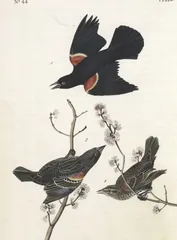
John James Audubon, The Birds of America (1840–44) about 93 per routeon 100% of routesno clear trend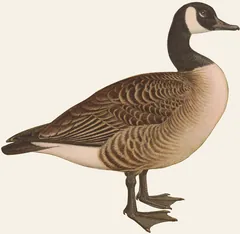
Marinus Adrianus Koekkoek, E. D. van Oort's Ornithologia Neerlandica (1922) about 76 per routeon 72% of routesno clear trend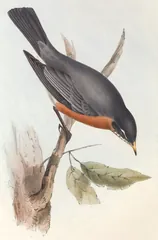
John and Elizabeth Gould, The Birds of Europe (1832–37) about 64 per routeon 100% of routesno clear trend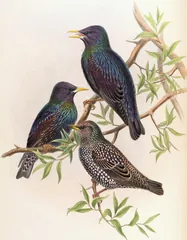
John Gould and Henry Constantine Richter, The Birds of Asia, vol. 5 (1850–83) 4 European Starlingabout 60 per routeon 98% of routesno clear trendintroduced species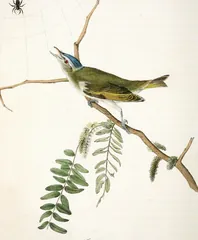
John James Audubon, The Birds of America (1840–44) 5 Red-eyed Vireoabout 42 per routeon 98% of routesno clear trend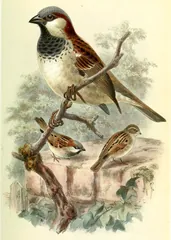
John Gerrard Keulemans, Lord Lilford’s Coloured Figures of the Birds of the British Islands (1885–97) 6 House Sparrowabout 41 per routeon 69% of routesno clear trendintroduced species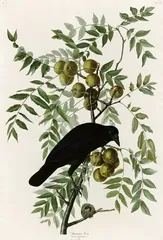
John James Audubon, The Birds of America (1827–38) about 37 per routeon 100% of routesfalling since 2015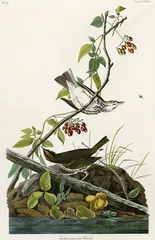
John James Audubon, The Birds of America (1827–38) 8 Ovenbirdabout 35 per routeon 72% of routesno clear trend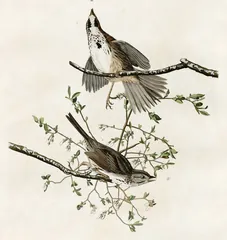
John James Audubon, The Birds of America (1827–38) about 30 per routeon 100% of routesno clear trend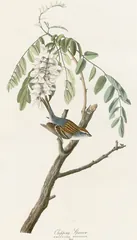
John James Audubon, The Birds of America (1827–38) 10 Chipping Sparrowabout 25 per routeon 100% of routesfalling since 2015
Show all 25
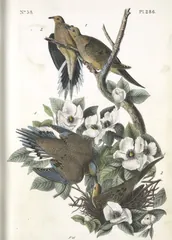
John James Audubon, The Birds of America (1840–44) about 24 per routeon 98% of routesno clear trend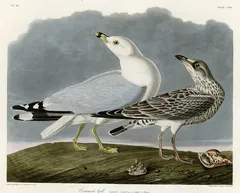
John James Audubon, The Birds of America (1827–38) 12 Ring-billed Gullabout 19 per routeon 41% of routesno clear trend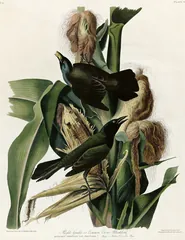
John James Audubon, The Birds of America (1827–38) 13 Common Grackleabout 19 per routeon 100% of routesno clear trend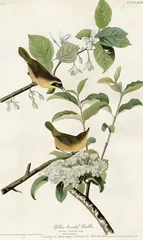
John James Audubon, The Birds of America (1827–38) 14 Common Yellowthroatabout 17 per routeon 100% of routesno clear trend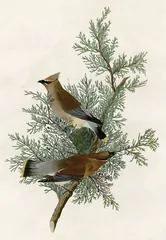
John James Audubon, The Birds of America (1827–38) about 16 per routeon 98% of routesno clear trend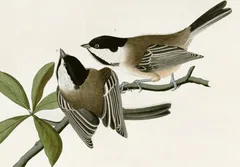
John James Audubon, The Birds of America (1827–38) about 15 per routeon 96% of routesno clear trend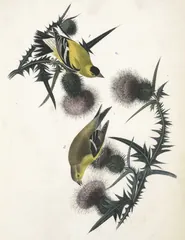
John James Audubon, The Birds of America (1840–44) about 15 per routeon 100% of routesno clear trend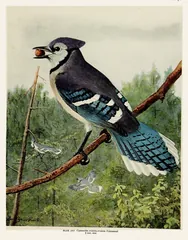
Louis Agassiz Fuertes, Elon H. Eaton's Birds of New York (1910–14) 18 Blue Jayabout 14 per routeon 100% of routesrising since 2015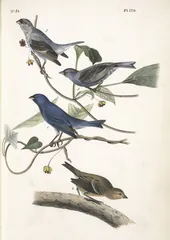
John James Audubon, The Birds of America (1840–44) 19 Indigo Buntingabout 14 per routeon 100% of routesrising since 2015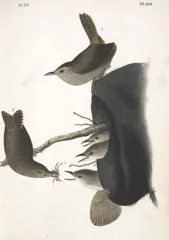
John James Audubon, The Birds of America (1840–44) 20 Northern House Wrenabout 13 per routeon 96% of routesrising since 2015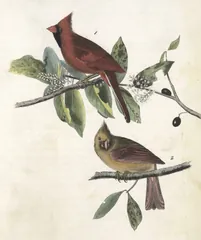
John James Audubon, The Birds of America (1840–44) about 11 per routeon 81% of routesrising since 2015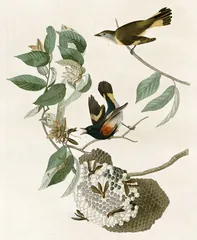
John James Audubon, The Birds of America (1827–38) 22 American Redstartabout 11 per routeon 87% of routesrising since 2015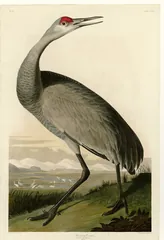
John James Audubon, The Birds of America (1827–38) about 11 per routeon 93% of routesrising since 2015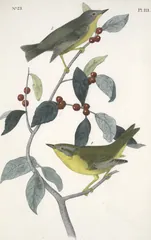
John James Audubon, The Birds of America (1840–44) 24 Nashville Warblerabout 10 per routeon 54% of routesno clear trend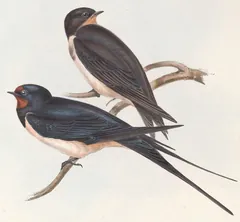
John and Elizabeth Gould, The Birds of Europe (1832–37) 25 Barn Swallowabout 9.8 per routeon 80% of routesno clear trend
If the Red-winged Blackbird, first on this list, or the Barn Swallow, last on it, has you curious about the rest of Michigan’s 466 species, see our comparison of the best bird books of 2026, from the friendliest for beginners to the newest.
What is the most common bird in Michigan?
The Red-winged Blackbird leads Michigan’s summer survey: about 93 a route on average in 2021–2025, ahead of the Canada Goose at about 76, seen on every one of the 54 routes. USGS finds no clear rise or fall in its Michigan numbers since 2015.
In winter, the European Starling: on Michigan's 2023-24 Christmas Bird Count it was the most numerous bird on 39 of the 75 counts, more than any other species. The Canada Goose led on 14 counts, mostly in the northern Lower Peninsula, and the Black-capped Chickadee on 5, among them Drummond Island, where chickadees made up more than half of all the birds counted. On the Olivet count Sandhill Cranes did, with 50.4 percent.
Source: The 124th Christmas Bird Count in Michigan (National Audubon Society, November 7, 2024), read October 10, 2026.
How was this list made?
Each of Michigan’s 54 routes is a roadside count, 50 stops along about 25 miles, run once a year in early summer by a volunteer. We took USGS’s yearly estimate for each species in Michigan, the number of birds a typical route records, averaged it over the five latest survey years (there was no survey in 2020) and ranked the birds by it. To keep the list to birds you’re likely to meet across Michigan, we left out species recorded on fewer than one in five of its routes, and those USGS can only estimate very roughly, which usually means big flocks or colonies on a few routes.
The share of routes is our own count from USGS’s route data for Michigan, using only counts that met the survey’s standards; “rising” and “falling” are USGS’s trends for the state since 2015, named only where it finds a clear change. Roadside counts on early-summer mornings miss most of Michigan’s owls and waterbirds, and its winter visitors aren’t here at all.
Michigan’s counts come from two USGS data releases, the North American Breeding Bird Survey Analysis Results 1966–2025 (Hostetler et al., 2026) and its Dataset 1966–2025 (Ziolkowski et al., 2026), gathered by volunteer observers and free for anyone to use; Birdfolio isn’t connected with the USGS.
How many bird species are in Michigan?
| Official count | 466 species |
|---|---|
| List’s date | July 7, 2025 |
| Kept by | Michigan Bird Records Committee |
| Gone or probably gone | Passenger Pigeon (extinct), Eskimo Curlew (probably extinct), Greater Prairie-Chicken and Northern Bobwhite (no longer found) |
| Rare visitors | 39 casual and 102 accidental species (our count) |
| Review list | 152 species and 12 subspecies (June 5, 2025; our count) |
| Records committee since | 1988 |
| Among US states | 21st highest of the 49 states with a verified count |
| Official list | Michigan Checklist (MBRC) |
What does Michigan’s count include?
- Michigan's regular birds and its rare visitors alike.
- 1 extinct species, 1 probably extinct, and 2 no longer found in Michigan.
- A tag on each rare species: casual for more than 3 but no more than 30 records in the last 10 years, accidental for 3 or fewer.
Why do other sources give a different number?
Michigan's list has grown by a few species a year, and the state's natural resources department sticks to round numbers, so you'll see several figures:
- More than 450 and 400-plus. Both appear on the Michigan Department of Natural Resources' birding page (in the Internet Archive's copy of June 6, 2026), for the species on the state's birding trails and the state's species in general. Neither is the committee's count. Source: Birding (Michigan Department of Natural Resources), the Internet Archive's copy of June 6, 2026.
- 459. The official list at the end of 2022, according to the committee's report for that year. The list has grown by 7 since. Source: Actions of the Michigan Bird Records Committee for 2022.
- 326 and 336. Walter B. Barrows's Michigan Bird Life (1912) treated 326 species and subspecies against 336 in A. J. Cook's Birds of Michigan (1893): Barrows dropped 30 of Cook's birds and added 20. He set 62 more aside because their Michigan records were in doubt. Source: Michigan Bird Life, by Walter B. Barrows (Michigan Agricultural College, 1912), full text at the Internet Archive.
Michigan’s list follows its own committee’s rules, and so does every other state’s: see why the counts differ from state to state.
Michigan firsts, comebacks and a long memory
- Five species joined the list in 2022 alone: a Bar-tailed Godwit at Whitefish Point on October 16, a Common Redshank at Pointe Mouillee State Game Area in Monroe County on July 4, a Red-cockaded Woodpecker at a Muskegon County golf club on July 1, a Variegated Flycatcher at Port Austin in Huron County on October 15-30, and a Cassin's Kingbird at Sleeping Bear Dunes National Lakeshore on June 1. Source: Actions of the Michigan Bird Records Committee for 2022, read October 5, 2026.
- A Southern Lapwing stayed in Iosco County from June 29 to December 22, 2022, and an American Flamingo was seen in Huron County on October 11, 2023; the committee accepted both in its 200th round of votes. Source: Round 200 Results (Michigan Bird Records Committee), read October 5, 2026.
- In November 2024 the committee announced two more gulls: Michigan's first Black-tailed Gull, in Mackinac and Schoolcraft counties from June 8 to July 9, 2024, and its first Common Gull, in Baraga County on May 2, 2024. Sources: Recent News (Michigan Bird Records Committee); Round 205 Results (Michigan Bird Records Committee), read October 5, 2026.
- Old claims still come up for a vote. In its 204th round the committee did not accept a Northern Wheatear said to have been seen in Washtenaw County on October 4, 1894. Source: Round 204 Results (Michigan Bird Records Committee), read October 5, 2026.
- Michigan's Eskimo Curlews survive as two specimens: one taken near Kalamazoo on October 28, 1879, now at the University of Michigan Museum of Zoology, and one from Detroit in the autumn of 1834, in a Berlin museum. Source: A Distributional Checklist of the Birds of Michigan, 2001 online revision (University of Michigan Museum of Zoology), read October 5, 2026.
- By 1990 the Great Lakes had only about a dozen pairs of Piping Plovers, all in northern Michigan. In 2026, 99 pairs nested in the region and 184 chicks fledged, the most successful year since the population was listed as endangered in 1986, says the US Fish and Wildlife Service. Source: Record-breaking season for endangered Great Lakes piping plovers, September 3, 2026 (U.S. Fish and Wildlife Service), the Internet Archive's copy of October 1, 2026, read October 5, 2026.
Questions people ask about Michigan’s birds
What is the rarest bird in Michigan?
Kirtland's Warbler, which nests almost nowhere but Michigan, is one of the rarest: the 2025 census counted 1,477 breeding pairs in the state, home to 98 percent of the world's population, and the decline, blamed partly on a shortage of young jack pine to nest in, is expected to continue for a few years.
The state lists seven birds as endangered: the Barn Owl, Henslow's Sparrow, the King Rail, the Long-eared Owl, the migrant Loggerhead Shrike, the Piping Plover and the Short-eared Owl.
Sources: Kirtland's Warbler Conservation Team addresses decline in songbird's population, July 28, 2025 (Michigan Department of Natural Resources), the Internet Archive's copy of July 28, 2025; Threatened and endangered species list (Michigan Department of Natural Resources), the Internet Archive's copy of February 8, 2025, read October 10, 2026.
What are common birds in Michigan?
At winter feeders, American Goldfinches in their duller winter feathers, sometimes joined by Pine Grosbeaks, Pine Siskins or Redpolls, Dark-eyed Juncos feeding on the ground, and Downy and Hairy Woodpeckers, the most common visitors to suet, says the state's natural resources department. Away from backyards, Snowy Owls, Bald Eagles and Snow Buntings are regular winter residents, the owls only in years when food runs short on their breeding grounds.
Michigan's most common woodpecker, and the other 11 on the state list
Source: Winter Birding Opportunities (Michigan Department of Natural Resources), the Internet Archive's copy of March 9, 2026, read October 10, 2026.
Which US state has the most bird species?
California, with 696 species on its official checklist of September 8, 2026, then Texas with 682 (our table); Michigan's committee counts 466, the most of any Great Lakes state but New York.
Sources: Official California Checklist, updated 8 September 2026 (California Bird Records Committee); Michigan Checklist, updated July 7, 2025 (Michigan Bird Records Committee), read October 10, 2026.
What bird is only found in Michigan?
None, strictly, but Kirtland's Warbler comes closest. It nests on the ground, and only in young, dense stands of jack pine in Michigan, Wisconsin and Ontario, and it spends the winter in the Bahamas. When its numbers fell below 200 pairs in the 1970s and 1980s, the whole population was confined to 14 townships in six counties of Michigan's northern Lower Peninsula; Wisconsin first detected one in 2008.
Sources: Kirtland's warbler census shows once-endangered songbird continues to thrive, October 25, 2021 (Michigan Department of Natural Resources), the Internet Archive's copy of March 14, 2026; Kirtland's Warbler Conservation Team addresses decline in songbird's population, July 28, 2025 (Michigan Department of Natural Resources), the Internet Archive's copy of July 28, 2025; Partners celebrate successful recovery of beloved songbird (U.S. Fish and Wildlife Service, October 8, 2019), the Internet Archive's copy of July 20, 2026, read October 11, 2026.
What is Michigan's biggest bird?
The Trumpeter Swan: 4 feet tall, more than 25 pounds and wings over 7 feet across, by the Michigan Department of Natural Resources' figures. By 1933 only 66 were left in the United States; Michigan raised young swans and released them at 2 years old through the 1980s and 1990s, and by 2016 more than 750 lived in the state, staying all year.
The introduced Mute Swan, brought to Michigan in 1919, is just as big, up to 5.5 feet tall and 30 pounds by Wisconsin's figures, and the state calls it invasive. Sandhill Cranes stand about 4 feet tall on wings of 6.5 feet, and only the Whooping Crane is taller in North America. The Bald Eagle has wings of about 6.5 feet but weighs only 7 to 10 pounds, about as much as a house cat.
Sources: The trumpeter swan: July's Migratory Bird Treaty Centennial featured bird (Michigan Department of Natural Resources, July 21, 2016); Invasive Species: Mute Swan (State of Michigan), the Internet Archive's copy of May 14, 2026; Mute swans (Michigan Department of Natural Resources), the Internet Archive's copy of June 17, 2026; Swans in Wisconsin (Wisconsin Department of Natural Resources); The sandhill crane: October's Migratory Bird Treaty Centennial featured bird (Michigan Department of Natural Resources, October 28, 2016); Threatened and endangered species feature: bald eagle (Michigan Department of Natural Resources, July 30, 2014), read October 11, 2026.
Which birds live in Michigan?
Birds of the Great Lakes shores, of the northern forests and bogs of the Upper Peninsula and the north, and of the farms and marshes of the south. Michigan's specialty is Kirtland's Warbler, 98 percent of which nest in the state, in young jack pine.
North woods: at Seney National Wildlife Refuge, Common Loons, Trumpeter Swans and Canada Geese return each spring to nest, and Sandhill Cranes and Sharp-tailed Grouse put on their mating dances. On Isle Royale, in Lake Superior, loons nest both on the Great Lakes shore and on inland lakes; surveyors found at least 126 breeding territories in 2019. The island's Sharp-tailed Grouse, common after a big fire in 1936, have faded as the forest grew back, while Sandhill Cranes now nest across it.
Lake Superior cliffs: Pictured Rocks National Lakeshore has recorded more than 180 species. Peregrine Falcons released there in 1989 and 1991 have nested on its cliffs since, and several pairs of Bald Eagles nest in the lakeshore.
Lake Erie marshes: Pointe Mouillee State Game Area, 4,040 acres on the western shore of Lake Erie and one of the largest freshwater marsh restoration projects in the world, is home through the year to Bald Eagles, Black-bellied Plovers, Glossy Ibises, Ospreys and Hudsonian Whimbrels.
Sources: Kirtland's Warbler Conservation Team addresses decline in songbird's population, July 28, 2025 (Michigan Department of Natural Resources), the Internet Archive's copy of July 28, 2025; Species, Seney National Wildlife Refuge (U.S. Fish and Wildlife Service), the Internet Archive's copy of July 18, 2026; Common Loon, Isle Royale National Park (National Park Service); Birds, Isle Royale National Park (National Park Service); Birds, Pictured Rocks National Lakeshore (National Park Service); Pointe Mouillee State Game Area (Michigan Department of Natural Resources), the Internet Archive's copy of February 7, 2025, read October 10, 2026.
Where does Kirtland's Warbler nest, and how did it recover?
Almost entirely in Michigan's northern Lower Peninsula, in young jack pine on a sandy soil called Grayling sand. Michigan's first known nest was found in Oscoda County in 1903, and in 1912 Walter Barrows called the bird the rarest of North American warblers, known to nest only on the jack pine plains of Oscoda and Crawford counties. More than 98% of the singing males counted since monitoring began in 1951 were in the northern Lower Peninsula, with the core of the range in five counties: Ogemaw, Crawford, Oscoda, Alcona and Iosco. The birds spend eight months of the year in the Bahamas.
The census counts singing males: 432 in 1951, record lows of 167 in 1974 and again in 1987, then a record 2,383 in 2015. The species, federally listed as endangered since 1967, came off the list on November 8, 2019, because it had recovered. Mio, in northern Michigan, has a monument to it: a yellow and slaty gray songbird set in stone and mortar.
Sources: Conservation efforts lead to revival of rare Kirtland's warbler, July 26, 2012 (Michigan Department of Natural Resources); Michigan Bird Life, by Walter B. Barrows (Michigan Agricultural College, 1912), full text at the Internet Archive; Removing the Kirtland's Warbler From the Federal List of Endangered and Threatened Wildlife, final rule (U.S. Fish and Wildlife Service, Federal Register, October 9, 2019); Charting a course for recovery: the Kirtland's warbler in Michigan, July 29, 2021 (Michigan Department of Natural Resources), read October 5, 2026.
Why do so many migrating birds pass Whitefish Point?
Whitefish Point is a peninsula stretching into Lake Superior, hemmed in by water on either side, so it works as a natural corridor that funnels migrants through in spring and fall, and thousands rest there before crossing the lake. More than 340 species have been seen at the Point, says the Whitefish Point Bird Observatory, formally created in 1979 after Michigan Audubon set up a committee for the Point in 1976.
Counting there began on July 6, 1912, when Norman Wood of the University of Michigan's Museum of Zoology arrived; his trips that year and in 1914 found 163 species. In spring 2026 the observatory's counters tallied 19,594 raptors, among them 10,905 Sharp-shinned Hawks and 985 Bald Eagles, the second-highest Bald Eagle season on record, plus 34,297 other migrants of 175 species. Michigan Audubon, organized in 1904, calls itself the state's oldest conservation organization.
Sources: About (Whitefish Point Bird Observatory, Michigan Audubon); Spring Raptor Count Blog, May 26-31: The End of the Season, June 2, 2026 (Whitefish Point Bird Observatory); About Us (Michigan Audubon), the Internet Archive's copy of May 1, 2026, read October 5, 2026.
Which birds has Michigan lost?
Four species on the official list no longer live wild in the state. The Passenger Pigeon is extinct; the largest nesting in Michigan's history, near Petoskey in 1878, covered about 150,000 acres, and one writer quoted in 1912 put that summer's rail shipments at 1,500,000 dead birds, with as many again sent by steamer from lake ports. The last large nesting was near Traverse City in spring 1881, and the last known Michigan pigeon was shot near Detroit on September 14, 1898. The Eskimo Curlew, last recorded in 1879, is marked probably extinct.
The other two are gone from Michigan only. The Greater Prairie-Chicken once lived in both peninsulas, vanished from the Upper Peninsula by the late 1950s, and was last seen near Marion, Osceola County, in 1981. In 2020 the committee moved the Northern Bobwhite from regular to extirpated, though it still reviews any report of a wild one.
Sources: Michigan Checklist, updated July 7, 2025 (Michigan Bird Records Committee); Passenger Pigeons at Mackinac (Mackinac State Historic Parks); Michigan Bird Life, by Walter B. Barrows (Michigan Agricultural College, 1912), full text at the Internet Archive; A Distributional Checklist of the Birds of Michigan, 2001 online revision (University of Michigan Museum of Zoology); Actions of the Michigan Bird Records Committee for 2020, read October 5, 2026.
Where is the official Michigan bird list, and how often is it updated?
On the Michigan Bird Records Committee's website: the Michigan Checklist, a web page updated July 7, 2025, with a downloadable Excel version. Each species carries its status, with its last record for the lost ones. The review list, updated June 5, 2025, names 152 species and 12 subspecies for which the committee wants documentation, plus any possible first state record.
The committee has met since 1988, after an earlier Michigan Ornithological Records Committee, and advises Michigan Audubon's research program. Seven members and two alternates serve three-year terms. In a first round a record passes 7-0 or 6-1, goes round again at 5-2 or 4-3, and fails at 3-4 or worse; in a second round 5-2 is enough, first state records included. Reports go in on its Rare Bird Form, and a decision can take a year or more. Its posted annual reports run through 2022, when it decided 238 records and accepted 64%; newer decisions are posted round by round. The University of Michigan Museum of Zoology keeps the specimens, photos, recordings and written reports.
Sources: Michigan Checklist, updated July 7, 2025 (Michigan Bird Records Committee); Review List, updated June 5, 2025 (Michigan Bird Records Committee); Past Committee Members (Michigan Bird Records Committee); Bylaws and Policies (Michigan Bird Records Committee); Rare Bird Form (Michigan Bird Records Committee); Actions of the Michigan Bird Records Committee for 2022, read October 5, 2026.
How do you count your own Michigan list?
Your Michigan list is every species you’ve seen in Michigan. eBird can filter your life list to Michigan, and your eBird data download gives the state of every sighting. On paper, count the species you’ve seen in Michigan; what is a life list? explains how birders keep their lists.
To print your whole list, Michigan birds and all, see how to print your bird life list, or let Birdfolio make it a hardcover book.
Michigan’s state bird
Michigan’s state bird is the American Robin (officially, the “robin redbreast”), the state bird since 1931. Its story, the state flower and animal, and a free picture card for a report are on our Michigan state bird page.
Birding festivals in Michigan
Our birding festivals calendar lists one festival in Michigan, with dates from its own website:
- Tawas Point Bird Migration Days, Tawas Point State Park: dates not announced yet; expected in May 2027 (2026 festival: May 15–16, 2026)
Christmas Bird Count in Michigan
Michigan had 81 Christmas Bird Count circles on Audubon’s map last winter, each counted on a single day between December 14 and January 5. Our guide shows where to find Michigan’s counts and lists 5 Michigan count dates already announced for this winter; it’s free, and beginners are welcome.
More about bird counts
- How many bird species are in each state: Michigan beside all 50 states, DC and Canada.
- Bird lists of nearby states: Illinois, Indiana, Minnesota, Ohio and Wisconsin.
- State birds of all 50 states, Michigan’s American Robin among them
- How many bird species are in the US and Canada
- Bird splits and lumps
If you’re shopping for a birder in Michigan, our gift guide for birders and our pick of coffee table bird books are good places to start.