Classic bird paintings
Black-capped Chickadee painting: Audubon's plate and other classic portraits
John James Audubon painted the Black-capped Chickadee on plate 353 of The Birds of America (1827–38), which he titled with three birds, among them the Black-capt Titmouse. A free high-resolution scan is on Audubon.org. The picture shown here is a detail of that plate: its two Black-capped Chickadees.
Updated
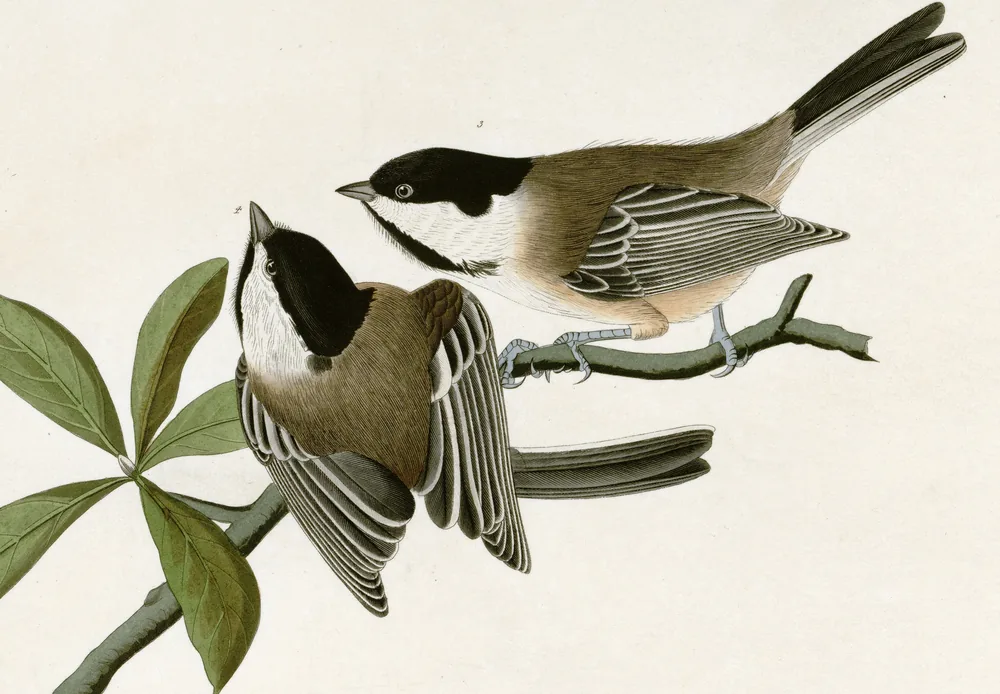
Audubon’s plate: plate 353, “Chesnut-backed Titmouse; Black-capt Titmouse; Chesnut-crowned Titmouse”
“Hardy, smart, restless, industrious, and frugal”: so Audubon summed up the Black-capped Chickadee. Sitting one morning under a crab-apple tree, he saw a pair flutter about as if they wanted him gone. He moved twenty paces off, and watched one slip into a hole at the base of a big branch and come out with a chip in its bill, again and again for half an hour. The hole was about three inches deep, and he had seen both birds at the work. Some writers said a titmouse's bill could not dig; he left sure that it could.
A woodcutter in Maine told him of a flock that raided the basket of food he had hung up, lifting their heads after every peck at a piece of cold beef. Then they perched above his fire, out of the smoke, fluffing their feathers in the warmth, and begged beside him when he sat down to eat.
Audubon called the bird the Black-cap Titmouse, and noted that in the Eastern States it usually went by Chickadee. On plate 353 the pair are figures 3 and 4. The sheet's other two birds were new to science, he wrote, from specimens he bought out of J. K. Townsend's collection from the Rocky Mountains and the Columbia River.
Story: Audubon, Ornithological Biography, vol. 4 (1838), p. 371; vol. 4 (1838), pp. 374–381. See plate 353 free at Audubon.org.
Which Audubon plate shows the Carolina Chickadee?
Plate 160, which he made before he knew it was a different bird. He drew it near New Orleans late in 1820, and only after the plate had been engraved and sent to his patrons did he notice the difference.
It came to him at Eastport, Maine, in May 1833, when a friend in the army showed him a titmouse he had just collected: its large size, next to the southern ones, “instantly struck me.” Back in Charleston, the Reverend John Bachman said he had suspected the same. They collected southern birds, friends in Massachusetts, Maine and Maryland sent northern ones preserved in spirits, and comparing many of both satisfied them that these were two species.
Audubon named the southern one the Carolina Titmouse, partly in thanks to the people of that state for their hospitality. It was shyer than the northern bird, he wrote, kept to swamps and never came to orchards, gardens or farmers' woodpiles. AviList calls it the Carolina Chickadee.
Sources: AviList v2026; Audubon, Ornithological Biography, vol. 2 (1834), p. 341; vol. 2 (1834), p. 342.
More classic portraits, free to see
- John James Audubon, The Birds of America, octavo edition (1840–44), plate 126: “Black cap Titmouse”. Free scan (New York Public Library Digital Collections)
- Louis Agassiz Fuertes, for Elon H. Eaton’s Birds of New York (1910–14), plate 103: “Chickadee”, with 4 other birds. Free scan (Internet Archive)
About the Black-capped Chickadee
- Black-capped Chickadees store food for later, tucking seeds into cracks in bark. (Source: National Audubon Society)
Chickadees at your feeder can count for science too: on the Christmas Bird Count, December 14 to January 5, feeder watchers inside a count circle report every bird they see. Find a Christmas Bird Count near you.
If two chickadees visit at breakfast and four at noon, Project FeederWatch has you report four, the most you saw at one time. That is the project's key rule, and the counting runs every year from November 1 to April 30. Try the chickadee example.
Which chickadee lives in Texas?
The Carolina Chickadee. In the words of the Texas Breeding Bird Atlas, the Black-capped is only accidental in Texas, and the Mountain Chickadee nests here only in the Davis and Guadalupe Mountains.
Carolinas live all year across east and central Texas, nesting from February to July in a tree hole, a nest box or even a hole in a fence post, usually with six eggs. One survey route, at Caledonia in Rusk County, averaged 47.3 chickadees a year, the second-highest count in the United States. Texas and Oklahoma mark the western edge of the species' range, which reaches north to New Jersey.
The Black-capped belongs farther north: it is a popular feeder bird across the northern United States and southern Canada, National Audubon's guide says.
Sources: Texas Breeding Bird Atlas, Carolina Chickadee (Tweit, 2006); National Audubon Society guide, Black-capped Chickadee.
How can you tell a Carolina Chickadee from a Black-capped?
Mostly by where you are. The two look almost the same, and National Audubon's guide says each is best identified by its range.
Up close, the Carolina is a little smaller, with a neater edge to its black bib and less white edging on its wing feathers. Its song is four whistled notes, see-dee, see-dee, where the Black-capped whistles two or three, fee-bee, and its chick-a-dee call is higher and faster.
Where their ranges meet, the two often interbreed and can learn each other's songs, so there even the song can fool you. A Carolina disturbed on its nest makes a loud hiss, like a snake.
Sources: National Audubon Society guide, Black-capped Chickadee; National Audubon Society guide, Carolina Chickadee.
How long does a Black-capped Chickadee live?
The US Forest Service's species review puts the average Black-capped Chickadee's life at about 2.5 years, adding that 5-year-olds were not unusual in northwestern Connecticut. Most deaths are thought to come from going hungry in winter, which leaves a bird less able to stand the cold and fight off disease. The oldest known wild Black-capped Chickadee was at least 11 years and 9 months old (USGS Bird Banding Laboratory): it was banded in New York in 2009 and found there again in 2021.
Sources: US Forest Service; USGS Bird Banding Laboratory. A banding record is the minimum age of one bird when it was found again, not a typical lifespan. How long do wild birds live?
How can you tell if a plate 353 print is an original?
By its size: an original plate 353 is a hand-colored sheet about 26 by 38 inches; the Black-capped Chickadee’s octavo version, plate 126, is book-size, from 1840–44. Many prints sold today are reproductions: how to tell an original from a reproduction. Modern editions print all 435 plates, from pocket size to coffee-table size: which Birds of America book to buy.
In a Birdfolio hardcover, this painting sits beside the date and place you first saw a Black-capped Chickadee. See your own list as a book, free.