Classic bird paintings
Song Sparrow painting: Audubon's plate and other classic portraits
John James Audubon painted the Song Sparrow as plate 25 of The Birds of America (1827–38), under the same name: a pair on a twig of huckleberry in blossom, the male above with his tail spread. That plate is the painting shown here, and a free high-resolution scan is on Audubon.org.
Updated
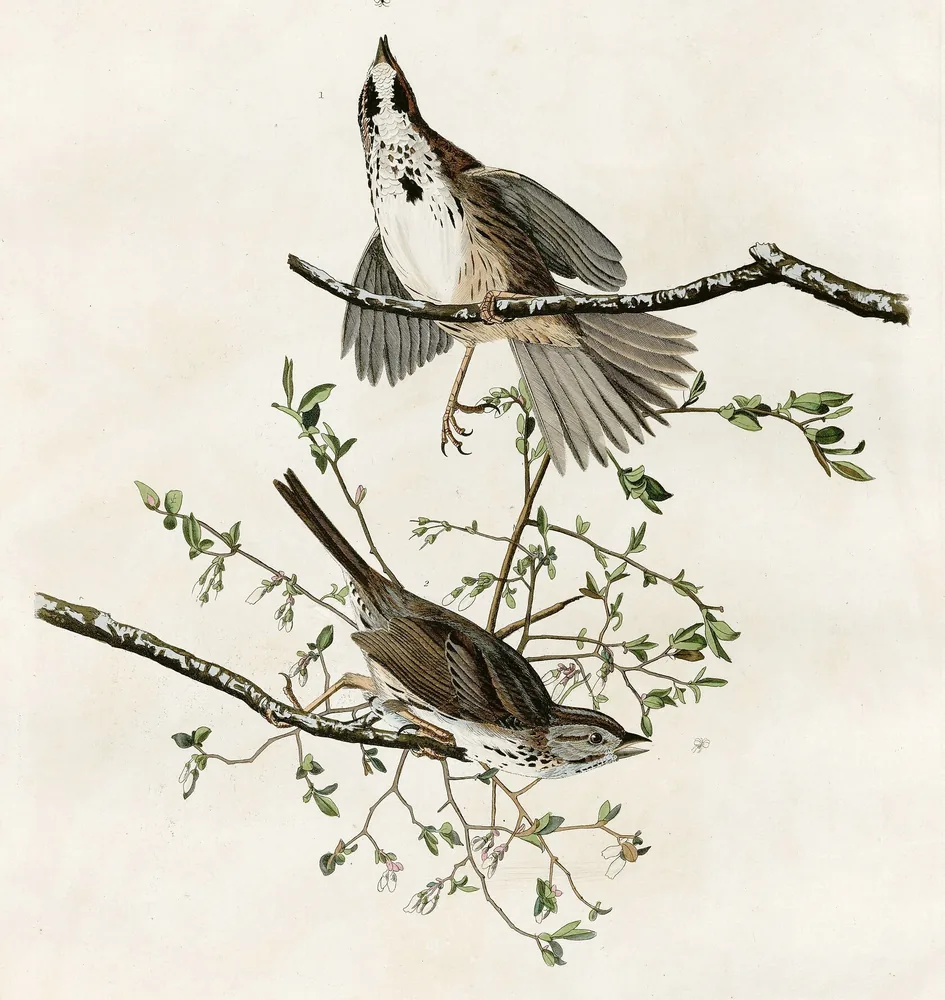
Audubon’s plate: plate 25, “Song Sparrow”
Audubon left his readers a puzzle with this bird. A pair raised three broods a year, he wrote, and built a fresh nest for each, though the old one stayed as clean after the young had flown as a new one would be; Ospreys and some swallows raise brood after brood in a single nest. “Can you, reader, solve the question?” he asked.
He counted fourteen young a year from one pair, in broods of six, five and three, and admitted being partial to the bird for all its plain dress: in the Middle States it sang earlier in spring and later in autumn than almost any other, at every hour of the day. The male helped incubate the eggs, and at that season he often sang from the top of a nearby bush, low tree or fence rail. He guessed that pairs moved their nests from the ground into bushes because crows so often ate the eggs.
Most wintered in the South, where myriads of sparrows of many kinds filled the low, swampy places, the White-throated Sparrow among them. In Louisiana he watched Song Sparrows climb to the tops of large trees to sing, then dive back into the weeds by the streams. He painted the pair on a huckleberry in blossom, a bush whose berries women and children picked for the eastern markets; he liked them best eaten fresh.
Story: Audubon, Ornithological Biography, vol. 1 (1831), pp. 126–128; vol. 1 (1831), p. 42. See plate 25 free at Audubon.org. See plate 390 free at Audubon.org.
How many times did Audubon paint the Song Sparrow?
Twice. Besides the pair on plate 25, he painted a western bird as the Brown Song Sparrow, one of three birds on plate 390, as a species of its own; Audubon.org now lists it as a Song Sparrow.
For its story he printed Thomas Nuttall's notes. The brown bird lived in the woods of the Columbia River country out to the sea and south to Upper California, and sang from a low bush “for hours together,” sweeter and more varied than the eastern bird; its nest and eggs were hardly different. It kept to low ground among rank weeds and brambles, hopping after insects like a wren, and sang through the summer and on fine days until November.
That range of looks runs right through the species: Song Sparrows go from large dark birds on the Aleutian Islands to small pale ones in the desert Southwest, the National Audubon Society's guide says.
Sources: Audubon.org, plate 390; Audubon, Ornithological Biography, vol. 5 (1839), p. 22; National Audubon Society guide, Song Sparrow.
More classic portraits, free to see
- John James Audubon, The Birds of America, octavo edition (1840–44), plate 189: “Song Finch”. Free scan (New York Public Library Digital Collections)
- Louis Agassiz Fuertes, for Elon H. Eaton’s Birds of New York (1910–14), plate 84: “Song Sparrow”, with Swamp Sparrow, Lincoln's Sparrow and Eastern Towhee. Free scan (Internet Archive)
About the Song Sparrow
- A backyard study made it famous among scientists: from 1928, Margaret Morse Nice banded and watched Song Sparrows near her home in Columbus, Ohio, for eight years, writing probably the most detailed life history of any North American animal of its time. Ornithology's Margaret Morse Nice Medal carries her name. (Source: National Audubon Society)
- Its song is three short notes and a varied trill, sometimes put into words as Madge-Madge-Madge, put-on-your-tea-kettle-ettle-ettle. (Source: National Audubon Society)
- Some coastal Song Sparrows live in salt marshes, where they may also eat small crustaceans and mollusks. (Source: National Audubon Society)
- Males often defend only small territories, so good habitat can hold a great many Song Sparrows. (Source: National Audubon Society)
- It is among the most familiar birds of the Northeast and Midwest; seen flying from bush to bush, it pumps its tail. (Source: National Audubon Society)
- Many stay all year, but birds from the northern interior move south for the winter, as far as the southern United States or northern Mexico. (Source: National Audubon Society)
How long does a Song Sparrow live?
Wildlife-agency guides give Song Sparrows no typical lifespan; the best figure we have is a banding record. The oldest known wild Song Sparrow was at least 11 years and 4 months old (USGS Bird Banding Laboratory): it was banded in Colorado in 1963 and found there again in 1973.
Fear alone can shrink their families. On British Columbia's southern Gulf Islands, Song Sparrows whose nests were fenced off from predators, but which heard recordings of predator calls all season, raised 40% fewer young than birds that heard harmless sounds, Western University reported in 2011.
Sources: Western University; USGS Bird Banding Laboratory. A banding record is the minimum age of one bird when it was found again, not a typical lifespan. How long do wild birds live?
How can you tell if a plate 25 print is an original?
By its size: an original plate 25 is a hand-colored sheet about 26 by 38 inches; the Song Sparrow’s octavo version, plate 189, is book-size, from 1840–44. Many prints sold today are reproductions: how to tell an original from a reproduction. Rather have every plate in one book? Here’s which Birds of America book to buy.
In a Birdfolio hardcover, this painting sits beside the date and place you first saw a Song Sparrow. See your own list as a book, free.