Reference
How many bird species are in Pennsylvania?
Pennsylvania has 448 bird species on its official list (Pennsylvania Ornithological Records Committee, 7th edition, 2024), the 32nd highest count of the 49 states with a verified count. Each species is backed by a specimen, a clear photo or a recording; 10 provisional species without that proof bring the full list to 458.
Pennsylvania’s state bird is the Ruffed Grouse: our Pennsylvania state bird page tells how it was chosen.
Updated
What are the most common birds in Pennsylvania?
In summer, the 25 most common birds in Pennsylvania are led by the European Starling, at about 122 birds per survey route, then the American Robin and the Red-winged Blackbird, by the USGS Breeding Bird Survey’s counts for 2021–2025. Together these 25 made up 75% of all the birds counted on Pennsylvania’s 97 survey routes.
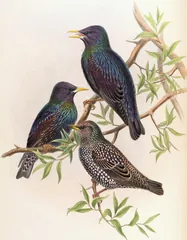
John Gould and Henry Constantine Richter, The Birds of Asia, vol. 5 (1850–83) 1 European Starlingabout 122 per routeon 99% of routesno clear trendintroduced species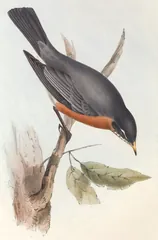
John and Elizabeth Gould, The Birds of Europe (1832–37) about 92 per routeon 100% of routesno clear trend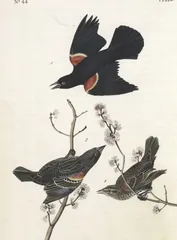
John James Audubon, The Birds of America (1840–44) about 80 per routeon 100% of routesno clear trend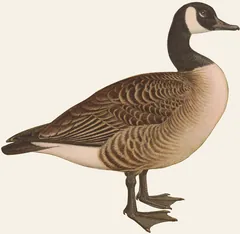
Marinus Adrianus Koekkoek, E. D. van Oort's Ornithologia Neerlandica (1922) about 67 per routeon 79% of routesno clear trend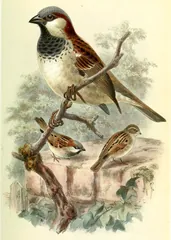
John Gerrard Keulemans, Lord Lilford’s Coloured Figures of the Birds of the British Islands (1885–97) 5 House Sparrowabout 44 per routeon 93% of routesfalling since 2015introduced species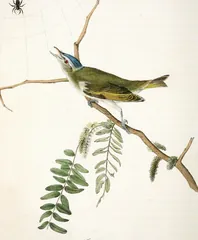
John James Audubon, The Birds of America (1840–44) 6 Red-eyed Vireoabout 44 per routeon 99% of routesno clear trend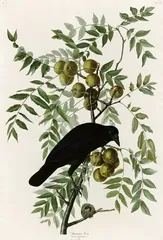
John James Audubon, The Birds of America (1827–38) about 43 per routeon 100% of routesfalling since 2015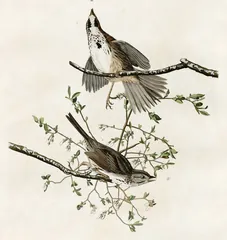
John James Audubon, The Birds of America (1827–38) about 43 per routeon 99% of routesrising since 2015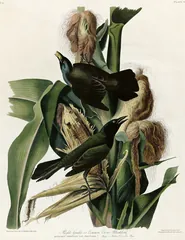
John James Audubon, The Birds of America (1827–38) 9 Common Grackleabout 38 per routeon 100% of routesfalling since 2015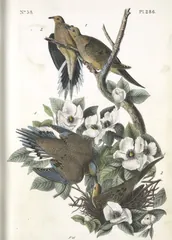
John James Audubon, The Birds of America (1840–44) about 29 per routeon 100% of routesno clear trend
Show all 25
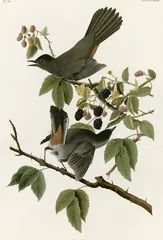
John James Audubon, The Birds of America (1827–38) 11 Gray Catbirdabout 28 per routeon 100% of routesno clear trend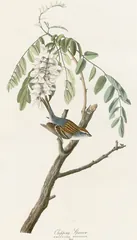
John James Audubon, The Birds of America (1827–38) 12 Chipping Sparrowabout 22 per routeon 100% of routesfalling since 2015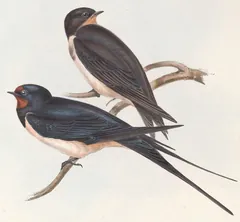
John and Elizabeth Gould, The Birds of Europe (1832–37) 13 Barn Swallowabout 20 per routeon 99% of routesfalling since 2015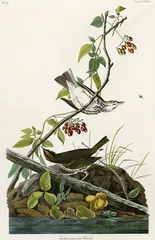
John James Audubon, The Birds of America (1827–38) 14 Ovenbirdabout 20 per routeon 90% of routesno clear trend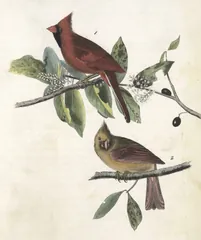
John James Audubon, The Birds of America (1840–44) about 19 per routeon 100% of routesrising since 2015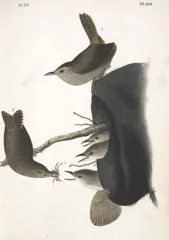
John James Audubon, The Birds of America (1840–44) 16 Northern House Wrenabout 19 per routeon 100% of routesno clear trend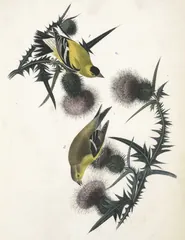
John James Audubon, The Birds of America (1840–44) about 16 per routeon 100% of routesno clear trend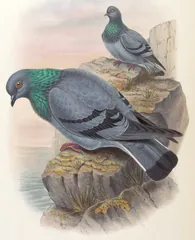
John Gould and William Matthew Hart, The Birds of Asia (1850–83) 18 Rock Pigeonabout 15 per routeon 84% of routesno clear trendintroduced species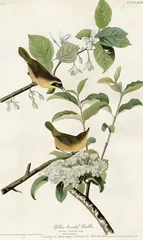
John James Audubon, The Birds of America (1827–38) 19 Common Yellowthroatabout 14 per routeon 99% of routesfalling since 2015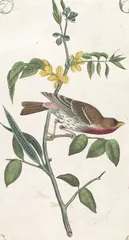
John James Audubon, The Birds of America (1840–44) 20 House Finchabout 12 per routeon 93% of routesno clear trend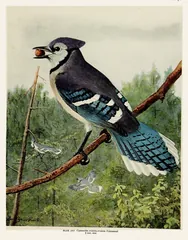
Louis Agassiz Fuertes, Elon H. Eaton's Birds of New York (1910–14) 21 Blue Jayabout 11 per routeon 100% of routesno clear trend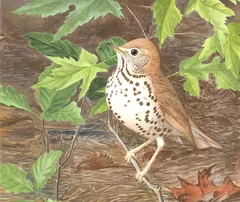
Louis Agassiz Fuertes, Annual Reports of the New York Forest, Fish and Game Commission (1901–12) 22 Wood Thrushabout 11 per routeon 100% of routesno clear trend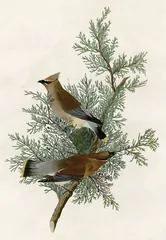
John James Audubon, The Birds of America (1827–38) about 11 per routeon 100% of routesfalling since 2015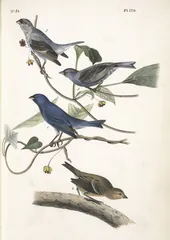
John James Audubon, The Birds of America (1840–44) 24 Indigo Buntingabout 10 per routeon 100% of routesfalling since 2015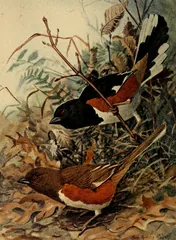
Louis Agassiz Fuertes, True Bird Stories from My Note-Books (1903) 25 Eastern Towheeabout 9.8 per routeon 98% of routesno clear trend
These 25, led by the European Starling and the American Robin, are a small part of the 448 species on Pennsylvania’s official list; to name the rest, our comparison of the best bird books of 2026 shows which field guide suits a beginner.
What is the most common bird in Pennsylvania?
The European Starling, a bird people brought to North America, leads Pennsylvania’s summer survey: about 122 a route on average in 2021–2025, ahead of the American Robin at about 92, seen on 99% of the 97 routes. USGS finds no clear rise or fall in its Pennsylvania numbers since 2015.
In winter the biggest totals in the state's Christmas Bird Count belong to geese: the 2024-25 count found about 135,000 Canada Geese and 118,000 Snow Geese, 76,000 of them in the Lehigh Valley, ahead of 56,900 American Crows and 43,000 Herring Gulls. Canada Geese ran higher in 1998-2017, when their totals passed 200,000 several times.
Source: The 125th Christmas Bird Count in Pennsylvania (National Audubon Society, November 11, 2025), read October 10, 2026.
How was this list made?
Each of Pennsylvania’s 97 routes is a roadside count, 50 stops along about 25 miles, run once a year in early summer by a volunteer. We took USGS’s yearly estimate for each species in Pennsylvania, the number of birds a typical route records, averaged it over the five latest survey years (there was no survey in 2020) and ranked the birds by it. To keep the list to birds you’re likely to meet across Pennsylvania, we left out species recorded on fewer than one in five of its routes, and those USGS can only estimate very roughly, which usually means big flocks or colonies on a few routes.
The share of routes is our own count from USGS’s route data for Pennsylvania, using only counts that met the survey’s standards; “rising” and “falling” are USGS’s trends for the state since 2015, named only where it finds a clear change. Roadside counts on early-summer mornings miss most of Pennsylvania’s owls and waterbirds, and its winter visitors aren’t here at all.
Pennsylvania’s counts come from two USGS data releases, the North American Breeding Bird Survey Analysis Results 1966–2025 (Hostetler et al., 2026) and its Dataset 1966–2025 (Ziolkowski et al., 2026), gathered by volunteer observers and free for anyone to use; Birdfolio isn’t connected with the USGS.
How many bird species are in Pennsylvania?
| Official count | 448 species |
|---|---|
| List’s date | 7th edition, 2024 |
| Kept by | Pennsylvania Ornithological Records Committee (Pennsylvania Society for Ornithology) |
| Provisional species | 10, known from sight records only (458 with them) |
| Review list | 156 species: 150 rarities and 6 extinct or gone from the state (November 2024, our count) |
| Records committee since | November 1988 |
| Next revision | Begins in 2028 |
| Among US states | 32nd highest of the 49 states with a verified count |
| Official list | Official List of the Birds of Pennsylvania, 7th edition (2024) |
What does Pennsylvania’s count include?
- Only species backed by a specimen, a photo clear enough to identify it, or a recording (the list's Class I).
- Extinct species, and species no longer found in Pennsylvania.
- Not counted: 10 provisional species, listed separately (458 in all).
- The 7th edition as the committee posts it online, which adds the Vega Gull to the edition printed in 2024 with records through April 27, 2024.
Why do other sources give a different number?
Pennsylvania's committee rewrites its official list about every five years, and the state Game Commission keeps a figure of its own:
- 458. The whole official list, counting the 10 provisional species too.
- 457. The same 7th edition as printed in the journal Pennsylvania Birds in 2024, with records through April 27, 2024: 447 species with physical evidence and 10 provisional. The list online has one more, the Vega Gull. Source: The Official List of the Birds of Pennsylvania, 7th edition (Pennsylvania Birds 38:2, 2024).
- 436. The Pennsylvania Game Commission's figure for the state's wild bird species, on its birding page, with no date or method given. Source: Birding and Bird Conservation (Pennsylvania Game Commission).
- 414. The Game Commission's older Current List of Wild Birds in Pennsylvania (January 26, 2011): 285 regular, 37 casual and 92 accidental species known since about 1600. It has no Passenger Pigeon or Carolina Parakeet, extinct birds the committee's list keeps. Source: Current List of Wild Birds in Pennsylvania, January 26, 2011 (Pennsylvania Game Commission), the Internet Archive's copy of October 17, 2020.
- 353 to 426. The first official list, published in 1990, had 353 species. The third, in 2000, had 389 plus 7 provisional, and a later edition brought the total to 426, 8 of them provisional. Source: PORC Purpose (Pennsylvania Ornithological Records Committee).
- 142. The species B. H. Warren treated in the first edition of his Report on the Birds of Pennsylvania (1888). A reviewer in The Auk noted that he left out rare stragglers for lack of room. Source: Recent Literature: Warren's Birds of Pennsylvania (The Auk, April 1889), full text at the Internet Archive.
Pennsylvania’s list follows its own committee’s rules, and so does every other state’s: see why the counts differ from state to state.
Pennsylvania firsts and near misses, from a Philadelphia vireo to a Berks County oriole
- The Philadelphia Vireo is named for the city because John Cassin shot the first one known to science in Bingham's woods near Philadelphia in September 1842. Describing it as a new species in the Academy of Natural Sciences' Proceedings, he added that he had never seen another. Source: Sketch of the Birds composing the genera Vireo and Vireosylvia, by John Cassin (Proceedings of the Academy of Natural Sciences of Philadelphia 5), full text at the Internet Archive, read October 5, 2026.
- Not every crowd-pleaser counts. The committee's first report, in 1990, could list a Fulvous Whistling-Duck seen by many at Middle Creek on March 16-17, 1975, only as hypothetical, because the one photograph of it no longer existed. Source: First Report of the P.O.R.C., May 1990 (Pennsylvania Ornithological Records Committee), read October 5, 2026.
- Hurricane Sandy scattered rare birds inland on an unprecedented scale in 2012. A dying Trindade Petrel was found under a mailbox in Hollidaysburg, Blair County, on November 3, the state's first, and its specimen went to a museum collection. Source: Twenty-first Report of the Pennsylvania Ornithological Records Committee, 2012 and 2013 records (August 2017), read October 5, 2026.
- 2015 brought a Kelp Gull to The Point and Duck Hollow in Pittsburgh on January 17-18 and a European Robin to a feeder in Yardley, Bucks County, on February 21-22. The committee accepted the robin as wild partly because Iceland had at least 31 that winter, against 1 to 8 in a normal one. Source: Twenty-second Report of the Pennsylvania Ornithological Records Committee, 2015 records (January 2018), read October 5, 2026.
- A male Black-backed Oriole visited a feeder in Sinking Spring, Berks County, from February 2, 2017. After long research and debate the committee accepted it 5-1 as the state's first and, in its words, a first record for North America; the American Birding Association's checklist committee later accepted it too. Source: Twenty-fourth Report of the Pennsylvania Ornithological Records Committee, 2017 records (Pennsylvania Birds 33:2, April 2019), read October 5, 2026.
- Piping Plovers, about 15 pairs on Gull Point at Presque Isle State Park until the mid-1950s, stopped nesting in Pennsylvania after 1955. Their beach was restored in 2011 and 2012, two pairs nested there in 2017, and they have nested every year since. Source: Piping Plover (Pennsylvania Game Commission), read October 5, 2026.
Questions people ask about Pennsylvania’s birds
What is the rarest bird in Pennsylvania?
Among nesting birds, the Yellow-bellied Flycatcher is one of the rarest: the Game Commission lists it as endangered in the state, and since 1987 nesting pairs have turned up only in isolated conifer swamps and mossy streamside woods in Luzerne, Lycoming, McKean, Sullivan and Wyoming counties. Great Egrets nest at only two places in Pennsylvania.
The Ruffed Grouse has grown scarce on the winter counts as well: the 2024-25 Christmas Bird Count found just 16, at eight sites, the second-lowest total in many decades.
Sources: Yellow-bellied Flycatcher (Pennsylvania Game Commission); Birding and Bird Conservation (Pennsylvania Game Commission); The 125th Christmas Bird Count in Pennsylvania (National Audubon Society, November 11, 2025), read October 10, 2026.
What are common birds in Pennsylvania?
At winter feeders, the ones in the Game Commission's field guide to common winter birds: the American Goldfinch, Black-capped Chickadee, American Tree Sparrow, Blue Jay, Dark-eyed Junco, White-throated Sparrow, Tufted Titmouse, Northern Cardinal, White-breasted Nuthatch and the Downy, Red-bellied and Pileated Woodpeckers. The 2024-25 Christmas Bird Count set new statewide highs for the Bald Eagle, the Merlin, the Eurasian Collared-Dove and the Common Raven, with 1,118 ravens.
Sources: Common Winter Birds of Pennsylvania, a field guide (Pennsylvania Game Commission); The 125th Christmas Bird Count in Pennsylvania (National Audubon Society, November 11, 2025), read October 10, 2026.
Which US state has the most bird species?
California, with 696 species on its official checklist dated September 8, 2026, comes first and Texas, with 682, second (our table); Pennsylvania's committee counts 448 species backed by physical evidence, and 458 with its provisional ones.
Sources: Official California Checklist, updated 8 September 2026 (California Bird Records Committee); The Official List of the Birds of Pennsylvania (Pennsylvania Ornithological Records Committee), read October 10, 2026.
What's the biggest bird in PA?
By weight, a big male Wild Turkey: gobblers weigh up to 25 pounds, 16 on average, and stand two and a half to three feet tall, the Game Commission says, more than its heaviest Bald Eagle at 14 pounds (our comparison). By wingspan, the Bald Eagle, with wings of five and a half to eight feet; it also builds the largest nest of any North American bird, which can pass eight feet across and weigh more than two tons.
The Golden Eagle is about as long, 28 to 40 inches, with wings of 6 to more than 7 feet. Of the swans, the Tundra Swan, four to five feet long and 10 to 18 pounds, is markedly smaller than the Trumpeter Swan and the feral Mute Swan.
Sources: Wild turkey (Pennsylvania Game Commission); Bald eagles (Pennsylvania Game Commission); Golden Eagle (Pennsylvania Game Commission); Tundra Swan, a Wildlife Note (Pennsylvania Game Commission), read October 11, 2026.
What Pennsylvania birds do not migrate?
Many of the familiar ones stay all year. The Game Commission calls the Wild Turkey a permanent resident of Pennsylvania's woods and mountains, and the Great Horned Owl, Barred Owl and Eastern Screech-Owl permanent residents too. The Downy Woodpecker is a common resident in all seasons, the Hairy a fairly common year-round one, and Pileated Woodpecker pairs stay on and defend the same territory all year.
Black-capped and Carolina Chickadees mostly stay where they nest, and the Carolina Wren, at 5.5 to 6 inches the largest of the state's wrens, is a permanent resident wherever it breeds. Others leave: the Barn, Long-eared, Short-eared and Northern Saw-whet Owls nest in Pennsylvania but migrate, and the sapsucker is the most migratory of its woodpeckers.
Sources: Wild turkey (Pennsylvania Game Commission); Owls (Pennsylvania Game Commission); Woodpeckers (Pennsylvania Game Commission); Chickadees (Pennsylvania Game Commission); Wrens (Pennsylvania Game Commission), read October 11, 2026.
What birds make noise at night in PA?
Owls above all. The Great Horned Owl, the hoot owl, gives three to eight deep, booming hoots, and pairs duet on many nights from fall into early winter; the Barred Owl, the most vocal of Pennsylvania's owls, calls who-cooks-for-you early in the night and at dawn; and the Eastern Screech-Owl's quavering whistle carries in spring and again in late summer.
From late April through June, male Eastern Whip-poor-wills repeat their name after dark, a call that carries about half a mile, though their numbers fell 42 percent between the 1980s and the 2010s. At dusk and dawn in spring, male American Woodcocks call peent from the ground and spiral down from 200 to 300 feet, singing, and an unmated Northern Mockingbird may sing during the night from a hidden perch.
Sources: Owls (Pennsylvania Game Commission); Common Nighthawk and Eastern Whip-poor-will, a Wildlife Note, revised March 2022 (Pennsylvania Game Commission); American Woodcock (Pennsylvania Game Commission); Gray Catbird, Northern Mockingbird and Brown Thrasher (Pennsylvania Game Commission), read October 11, 2026.
Which birds live in Pennsylvania?
Birds of big forests above all, with farm valleys, rivers and a short stretch of Lake Erie shore. Pennsylvania's specialty is the Scarlet Tanager: about 13 percent of the world's Scarlet Tanagers nest in its mature hardwood forests, more than in any other state, Audubon says. The second statewide breeding bird atlas, from 2004 to 2009, found 190 species nesting in Pennsylvania.
Forests and game lands: the Game Commission counts 1.5 million acres of State Game Lands, 20 State Forests and 86 Important Bird Areas. Bald Eagles have come back from three nests in the late 1970s to more than 300, and the 2024-25 Christmas Bird Count set a new statewide high for them.
Farm valleys in winter: within the last three decades the Lehigh, lower Delaware and lower Susquehanna valleys have become part of the Snow Goose's main eastern wintering grounds. At Middle Creek Wildlife Management Area, in Lancaster County, the staff counted 100,000 Snow Geese on February 18, 2025, and 1,350 Tundra Swans that February.
Lake Erie: in winter nearly all the state's scaup gather at Erie, 11,473 of the 11,562 counted in 2024-25, and that year the only scoters on Pennsylvania's Christmas Bird Counts were there too.
Sources: Audubon Supports New Bill to Designate Scarlet Tanager as Pennsylvania's Official Migratory Bird (Audubon Mid-Atlantic, March 30, 2026); Second Atlas of Breeding Birds in Pennsylvania, edited by Andrew M. Wilson, Daniel W. Brauning and Robert S. Mulvihill (Penn State University Press, 2012), at The Cupola, Gettysburg College; Birding and Bird Conservation (Pennsylvania Game Commission); The 125th Christmas Bird Count in Pennsylvania (National Audubon Society, November 11, 2025); Snow Goose and Waterfowl Migration Update, Middle Creek Wildlife Management Area (Pennsylvania Game Commission), read October 10, 2026.
How did Hawk Mountain become the world's first refuge for birds of prey?
By ending a shoot. In 1929 the Pennsylvania Game Commission put a $5 bounty on the goshawk, and gunners on the mountain shot hundreds of passing hawks for sport. In 1934 Rosalie Edge, a New York conservation activist, leased 1,400 acres there and installed a warden; the shooting stopped at once, and the next year she opened the sanctuary to the public.
Edge also had her warden, Maurice Broun, record every hawk that passed, and that 1934 tally became the first systematic count of raptors anywhere. The count still runs daily from August 15 to December 15 at the North Lookout and averaged 17,827 raptors a season from 1934 to 2023; on September 14, 1978, 21,496 passed in a single day, 21,448 of them Broad-winged Hawks. Pennsylvania had once paid for the opposite: under its Scalp Act of 1885 counties paid 50 cents for every hawk and most owls killed, and Warren's 1890 state bird book reckoned that probably at least $75,000 went on hawks and owls in about 18 months.
Sources: Who We Are (Hawk Mountain Sanctuary); State Historical Marker Dedicated at Hawk Mountain, September 5, 2019 (Hawk Mountain Sanctuary); Migration Data, autumn counts 1934-2023 (Hawk Mountain Sanctuary); Report on the Birds of Pennsylvania, 2nd edition, by B. H. Warren (Commonwealth of Pennsylvania, 1890), full text at the Internet Archive, read October 5, 2026.
Did Audubon band the first birds in North America in Pennsylvania?
The US Geological Survey's Bird Banding Laboratory dates the first notable scientific marking of birds in America to the early 1800s, when John James Audubon tied silver thread around the legs of Eastern Phoebes nesting on his farm in Pennsylvania and saw the same birds return the following year. The farm was Mill Grove, now a Montgomery County historic site and his first American home: he arrived in 1803, aged 18, and lived there until 1806.
Audubon told the story himself in his Ornithological Biography (1834). Phoebes, which he called Pewees, nested in a small cave above Perkiomen Creek; when the young were about to leave the nest he fixed a light silver thread to each one's leg. At the season when the phoebes returned, he caught several on their nests up the creek, and two still had “the little ring on the leg.” The federal bird banding office followed in 1920.
Sources: The U.S. Bird Banding Laboratory: an overview of its history and current practices (U.S. Geological Survey); Historic House at Mill Grove (John James Audubon Center at Mill Grove, National Audubon Society); The Pewee Flycatcher, in Ornithological Biography, vol. 2, by John James Audubon (1834), full text at the Internet Archive, read October 5, 2026.
How did a Bahama Woodstar end up at a Pennsylvania feeder?
Nobody can say exactly, but the experts ruled out the easy answers. An adult male Bahama Woodstar, a tiny hummingbird, visited a backyard feeder in Denver, Lancaster County, from April 20 to 24, 2013. The species rarely travels far: before it, the US had four records, all from south Florida between 1961 and 1981.
The authors of its write-up in Pennsylvania Birds checked whether it could have escaped or ridden a ship. No zoo or collection in the country listed woodstars, and the nearest port where cruise ships from the Bahamas routinely dock is Baltimore, about 115 km (71 miles) away, after a 40 to 60 hour passage from Nassau that didn't fit the bird's excellent condition. They concluded it was a genuine wild stray, and the committee accepted it 7-0 as Pennsylvania's first.
Sources: Bahama Woodstar in Lancaster County (Pennsylvania Birds 27:2, 2013); Twenty-first Report of the Pennsylvania Ornithological Records Committee, 2012 and 2013 records (August 2017), read October 5, 2026.
Where is the official Pennsylvania bird list, and how often is it updated?
On the Pennsylvania Society for Ornithology's website, as the Official List of the Birds of Pennsylvania: a web page giving each species with an abundance code. The society also posts the PDF of the edition printed in its journal, Pennsylvania Birds. The committee revises the list about every five years for that journal; the 7th edition was compiled in 2023 and 2024, and the next revision begins in 2028. Only Class I species count, those backed by a specimen, a diagnostic photo or a diagnostic recording; species known from sight records by two or more observers (Class II) or one (Class III) wait on the Provisional List.
The Pennsylvania Ornithological Records Committee was organized in November 1988 under the Pennsylvania Biological Survey, met for the first time in April 1989 and joined the society in 2012. Seven members vote, on three-year terms; a record passes 7-0 or 6-1 (6-0 if a member abstains), while 5-2 or 4-3 sends it to a second round, and second-hand reports aren't accepted. Every decision appears in an annual report in Pennsylvania Birds. The review list, revised in November 2024, names 156 species by our count, and the committee also wants reports of any species new to the state, sent through the form on its website.
Sources: The Official List of the Birds of Pennsylvania (Pennsylvania Ornithological Records Committee); The Official List of the Birds of Pennsylvania, 7th edition (Pennsylvania Birds 38:2, 2024); PORC Purpose (Pennsylvania Ornithological Records Committee); PORC History (Pennsylvania Ornithological Records Committee); PORC Policies and Procedures (Pennsylvania Ornithological Records Committee); PORC Review List, revised November 2024 (Pennsylvania Ornithological Records Committee); Welcome (Pennsylvania Ornithological Records Committee), read October 5, 2026.
How do you count your own Pennsylvania list?
Your Pennsylvania list is every species you’ve seen in Pennsylvania. eBird can filter your life list to Pennsylvania, and your eBird data download gives the state of every sighting. On paper, count the species you’ve seen in Pennsylvania; what is a life list? explains how birders keep their lists.
To print your whole list, Pennsylvania birds and all, see how to print your bird life list, or let Birdfolio make it a hardcover book.
Pennsylvania’s state bird
Pennsylvania’s state bird is the Ruffed Grouse, the state bird since 1931. Its story, the state flower and animal, and a free picture card for a report are on our Pennsylvania state bird page.
Birding festivals in Pennsylvania
Our birding festivals calendar lists 2 in Pennsylvania, with dates from each festival’s own website:
- Kettle Creek's Annual Birding Festival, Kettle Creek State Park (Renovo): May 8, 2027
- Festival of the Birds at Presque Isle, Erie: dates not announced yet; expected in May 2027 (2026 festival: May 15–17, 2026)
Christmas Bird Count in Pennsylvania
Pennsylvania had 87 Christmas Bird Count circles on Audubon’s map last winter, each counted on a single day between December 14 and January 5. Our guide shows where to find Pennsylvania’s counts and lists 5 Pennsylvania count dates already announced for this winter; it’s free, and beginners are welcome.
More about bird counts
- How many bird species are in each state: Pennsylvania beside all 50 states, DC and Canada.
- Bird lists of nearby states: Delaware, Maryland, New Jersey, New York, Ohio and West Virginia.
- State birds of all 50 states, Pennsylvania’s Ruffed Grouse among them
- How many bird species are in the US and Canada
- Bird splits and lumps
If you’re shopping for a birder in Pennsylvania, our gift guide for birders and our pick of coffee table bird books are good places to start.