Classic bird paintings
Wild Turkey painting: Audubon's plate and other classic portraits
John James Audubon painted the Wild Turkey as plate 1 of The Birds of America (1827–38), the plate that opens the book, titled Great American Cock. That plate is the painting shown here; a free high-resolution scan is on Audubon.org. The hen and her young are plate 6.
Updated
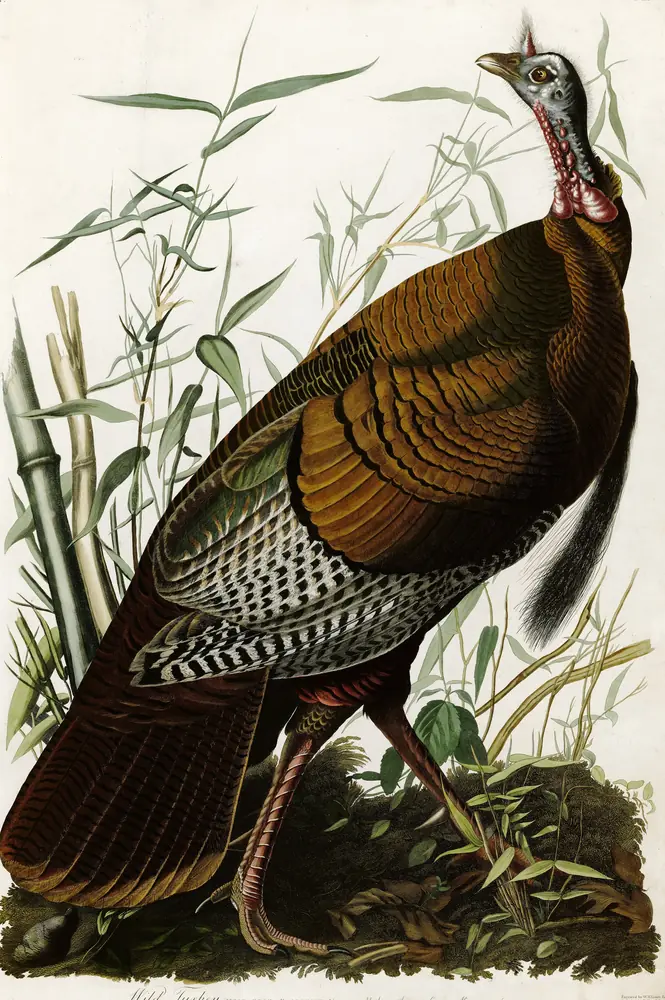
Audubon’s plate: plate 1, “Great American Cock (Wild Turkey)”
Plate 1 shows a single adult male. The engraver's line at its foot names W. H. Lizars, of Edinburgh. Audubon wrote that the Wild Turkey was the origin of the farmyard turkey, and that when he moved to Kentucky, a 10- to 12-pound bird could be had for three pence.
At Henderson, Kentucky, he raised a wild male caught when only two or three days old. It roosted on the roof of the house, never with the tame turkeys, and one day left for the woods. A few days later, near Green River, his dog Juno chased a big gobbler and both stopped short: it was his own bird, and it knew the dog. On plate 6, the hen leads her downy chicks through the forest; “one is picking its sprouting plumelets, while another is ridding itself of a tick.”
Story: Audubon’s Ornithological Biography, vol. 1 (1831). See plate 1 free at Audubon.org. See plate 6 free at Audubon.org.
More classic portraits, free to see
About the Wild Turkey
- Wild Turkeys often scratch through fallen leaves to find food. (Source: National Audubon Society)
- A Wild Turkey hen usually lays 10 to 15 eggs. (Source: National Audubon Society)
Buying a print?
An original plate 1 is a hand-colored sheet about 26 by 38 inches, printed in Britain in 1827–38; many prints sold today are reproductions or small 1840s octavo prints. How to tell an original from a reproduction.
In a Birdfolio, the hardcover book of your own life list, this painting sits beside the Wild Turkey with the date and place you first saw one. See your own list as a book, free.