Classic bird paintings
Red-tailed Hawk painting: Audubon's plate and other classic portraits
John James Audubon painted the Red-tailed Hawk as plate 51 of The Birds of America (1827–38), under the same name: a male and a female fighting in the air over a young hare. That plate is the painting shown here, and a free high-resolution scan is on Audubon.org. His dark Black Warrior is plate 86.
Updated
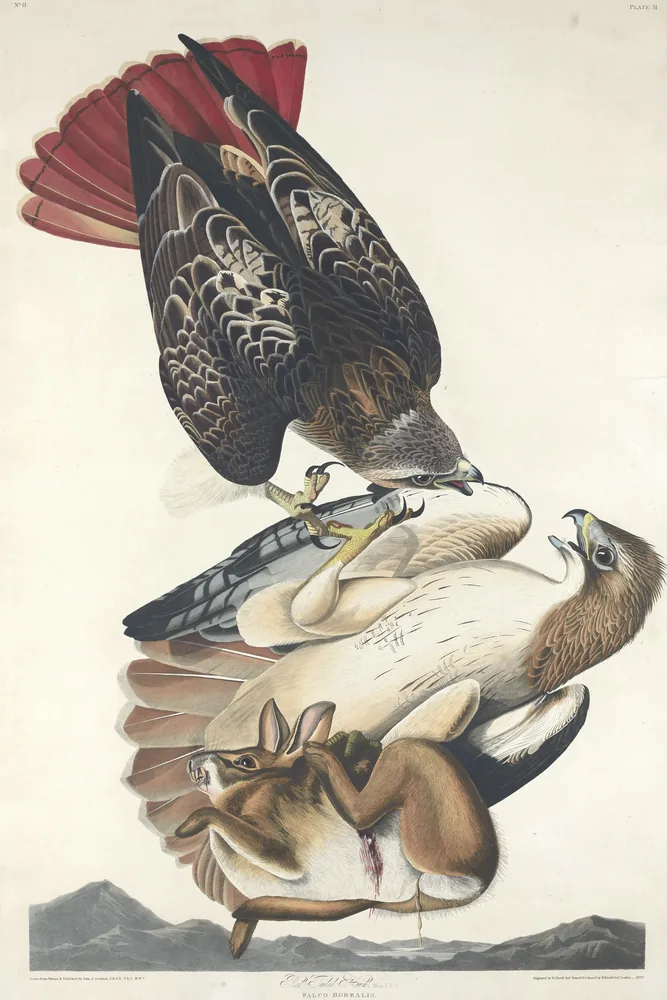
Audubon’s plate: plate 51, “Red-tailed Hawk”
Audubon made this drawing after watching two Red-tailed Hawks fight hard over a young hare. In the plate the male has the upper hand, and the female, driven toward the ground with her breast turned up, still grips the hare in one foot. Once a pair had raised their young, he wrote, they grew as shy of each other as if they had never met, and chased and robbed each other of their prey.
Over Louisiana plantations he heard its long cry, which he spelled kae, and watched it sail across a whole field without a flap of its wings, or circle so high it looked like a white dot in the sky before plunging on its prey. He described how a farmer whose poultry it had taken might spend an hour felling the nest tree with an axe, shooting the mother bird when she came to her young. “The work of revenge is now accomplished,” he wrote. Farmers called it the Hen-hawk, he noted; what that name and its cousin chicken hawk cost the hawks is a story of its own.
Plate 86, the Black Warrior, shows the dark bird now counted as the Harlan's form of the Red-tailed Hawk. He named it for his friend Dr. Richard Harlan of Philadelphia, after shooting the female as she flew over him in a cotton field near St. Francisville, Louisiana. He drew her while she was still alive, and gave her skin to the British Museum.
Story: Audubon, Ornithological Biography, vol. 1 (1831), pp. 265–272; vol. 1 (1831), pp. 441–442. See plate 51 free at Audubon.org. See plate 86 free at Audubon.org.
More classic portraits, free to see
- John James Audubon, The Birds of America, octavo edition (1840–44): plate 7: “Red-tailed Buzzard”; plate 8: “Harlan's Buzzard”. (Free scans: New York Public Library Digital Collections)
- Louis Agassiz Fuertes, for Elon H. Eaton’s Birds of New York (1910–14): plate 46: “Red-tailed Hawk”, with the Cooper's Hawk; plate 47: “Red-tailed Hawk”, with the Red-shouldered Hawk. (Free scans: Internet Archive)
About the Red-tailed Hawk
- A Red-tailed Hawk often watches for prey from a high perch, then swoops down to catch it. (Source: National Audubon Society)
When are Red-tailed Hawks most common in Texas?
In winter, from mid-October to mid-March, when hawks from the north join the ones that stay all year, the Texas Breeding Bird Atlas says. Then they are common throughout the state.
Red-tails of Alaska, Canada and the northern Great Plains move south for the winter, the atlas explains. Many adults at central and southern latitudes never leave home, and most migrants travel late in the fall and early in spring, National Audubon's guide adds.
As nesting birds they are common almost everywhere in Texas, though fewer on the High Plains, in the Pineywoods and in the lower Rio Grande Valley. Atlas workers confirmed nesting at 196 sites from 1987 to 1992, and survey counts in Texas rose about 2.5% a year from 1980 to 2006, a little faster than across North America. The other hawks, kites and falcons of Texas, and when each is here, are in our guide to Texas birds of prey.
Sources: Texas Breeding Bird Atlas, Red-tailed Hawk (Tweit, 2007); National Audubon Society guide, Red-tailed Hawk.
Why do Red-tailed Hawks in Texas look so different?
Because the species varies a great deal. Western Red-tails range from blackish to rufous-brown to nearly white, National Audubon's guide says, while most birds east of the Mississippi have a white chest and a dark belly-band of streaks.
The Texas Breeding Bird Atlas notes dark and light phases and as many as 16 subspecies; in a dark bird the belly-band may be faint or hidden. Some dark ones are Harlan's Hawks, from Alaska and northwest Canada, once thought a species of their own: usually dark-bodied, with a whitish tail marbled in dark. Young birds have a brown tail with dark bars, not a red one.
On calm, sunny winter days, Audubon noticed, a Red-tail would sit for hours facing the sun, its white breast seen from far off, glittering “as if possessed of a silky gloss.”
Sources: Texas Breeding Bird Atlas, Red-tailed Hawk (Tweit, 2007); National Audubon Society guide, Red-tailed Hawk; Audubon, Ornithological Biography, vol. 1 (1831), p. 269.
Where do Red-tailed Hawks build their nests in Texas?
High up, with a wide view. The nest is usually at the top of a tall tree or structure, the Texas Breeding Bird Atlas says, made or mended by both birds from sticks and lined with bark strips and fresh green sprigs.
On the Coastal Sand Plain of South Texas, nests were in woods next to savannas, in trees averaging 34 feet tall; in the Panhandle, in canyons. Nesting runs from late February to late June. The female lays two or three eggs, both parents sit on them for 28 to 35 days, and the young stay in the nest 42 to 46 days, then another seven or eight weeks with their parents.
In Louisiana, Audubon wrote, a pair began building early in February on the tallest tree around, carrying sticks for eight or ten days and finishing the flat nest, set in a three-way fork, with slender twigs and grass or Spanish moss. He wrote that the female lays four or five eggs.
Sources: Texas Breeding Bird Atlas, Red-tailed Hawk (Tweit, 2007); Audubon, Ornithological Biography, vol. 1 (1831), p. 267; vol. 1 (1831), p. 268.
How long does a Red-tailed Hawk live?
A Red-tailed Hawk that survives to adulthood lives 6 to 7 years on average, according to the US Forest Service's species review. The oldest known wild Red-tailed Hawk was at least 30 years and 8 months old (USGS Bird Banding Laboratory): it was banded in Michigan in 1981 and found there again in 2011.
Sources: US Forest Service; USGS Bird Banding Laboratory. A banding record is the minimum age of one bird when it was found again, not a typical lifespan. How long do wild birds live?
How can you tell if a plate 51 print is an original?
By its size: an original plate 51 is a hand-colored sheet about 26 by 38 inches, dated 1829; the Red-tailed Hawk’s octavo versions, plates 7 and 8, are book-size, from 1840–44. Many prints sold today are reproductions: how to tell an original from a reproduction. For all 435 plates at a fraction of an original’s price, see which edition of The Birds of America to buy.
In a Birdfolio hardcover, this painting sits beside the date and place you first saw a Red-tailed Hawk. See your own list as a book, free.