Classic bird paintings
House Finch painting: Audubon's plate and other classic portraits
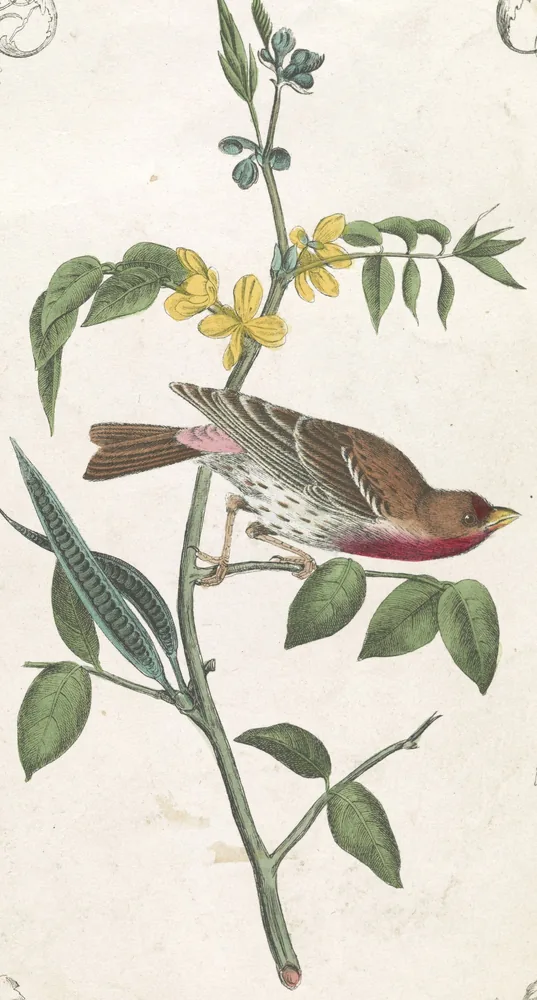
John James Audubon painted the House Finch on plate 424 of The Birds of America (1827–38), which he titled with six birds, among them the Crimson-necked Bull-Finch. A free high-resolution scan is on Audubon.org. Shown here is plate 197 of his smaller octavo edition (1840–44), where it is the Crimson-fronted Purple Finch.
Updated
About this painting
Our picture is the octavo version, plate 197, from the smaller edition Audubon issued between 1840 and 1844. There the male House Finch has a page to himself, on a stem with yellow flowers and long seed pods, under a new name: the Crimson-fronted Purple Finch. On the big plate 424 he shares the sheet with five other birds, among them the Lazuli Bunting and the Evening Grosbeak.
Audubon’s House Finch: plate 424, “Lazuli Finch; Crimson-necked Bull-Finch; Grey-crowned Linnet; Cow-pen Bird; Evening Grosbeak; Brown Longspur”
Audubon never saw a House Finch alive. Thomas Say had first described it from the Long expedition to the Rocky Mountains, and Audubon painted his bird from a specimen lent by John Gould of London, said to come from California. As far as he knew, he wrote, no one had yet described its habits.
He noted how closely it resembles the Purple Finch, and told the two apart by the House Finch's more bulging bill and its longer, less deeply notched tail.
Story: Audubon’s Ornithological Biography, vol. 5 (1839). See plate 424 free at Audubon.org.
More classic portraits, free to see
- John James Audubon, The Birds of America, octavo edition (1840–44), plate 197: “Crimson-fronted Purple Finch” (the painting shown above). Free scan (New York Public Library Digital Collections)
About the House Finch
- House Finches usually feed in flocks outside the nesting season, and readily come to seed feeders. (Source: National Audubon Society)
- House Finches released from New York pet shops in 1940 started the population that spread across the eastern United States. (Source: National Audubon Society)
The oldest known wild House Finch lived at least 11 years and 7 months: it was banded in Maryland in 1969 and found there again in 1980. That is a record from bird banding, not a typical lifespan. (Source: USGS Bird Banding Laboratory, 2025 longevity table.) How long do wild birds live?
Buying a print?
An original plate 424 is a hand-colored sheet about 26 by 38 inches, printed in Britain in 1827–38; many prints sold today are reproductions or small 1840s octavo prints. How to tell an original from a reproduction.
In a Birdfolio, the hardcover book of your own life list, this painting sits beside the House Finch with the date and place you first saw one. See your own list as a book, free.