Reference
Old bird nicknames: 59 folk names and the birds they mean today
Here are 59 old North American folk names for birds, from the hell-diver to the potato chip bird, each with the bird it means today, who used it, why it got the name, and the old bird book or study that records it. Farmers, hunters and sailors named birds this way long before field guides settled on one name each; ten of the names have pages of their own.
None of them was ever a bird's official name, apart from four old hawk names near the end of this page. Names that were official and later changed, like the Upland Plover, have their own pages among our old bird names.
Updated
The 59 nicknames, by kind of bird
Each row gives the old name, the bird it means today as a Birdfolio prints it, who used the name and why, and the page of the book or study that records it. A name in a link has a page of its own; a bird in a link has its painting or its story on another of our pages.
Grebes, seabirds, herons and rails
| Nickname | The bird today | Who said it, and why | Recorded in |
|---|---|---|---|
| Hell-diver | Pied-billed Grebe, Horned Grebe | The name for nearly every grebe: it dived at the flash of a gun and stayed under so long that, the joke went, it had been to hell. | McAtee 1959, p. 111; Pearson 1917, part I, p. 8 |
| Water witch | Pied-billed Grebe, Horned Grebe | For the grebe's way of sinking out of sight as if by magic, with only its head left showing; New England also said dabchick. | McAtee 1959, p. 110; Forbush 1925, pp. 11–12 |
| Gooney bird | Laysan Albatross, Black-footed Albatross | Pacific sailors' name for the albatrosses; gooney meant much the same as booby, a bird tame enough to be caught by hand. | McAtee 1956, p. 48; Honolulu Star-Bulletin 2002 |
| Mother Carey's chicken | Wilson's Storm Petrel, Leach's Storm Petrel | Sailors' name on the northeastern coast for the little storm-petrels, taken as signs of a coming storm; who Mother Carey was is still argued. | McAtee 1959, p. 113; Pearson 1917, part I, p. 84 |
| Sea parrot | Atlantic Puffin | For the puffin's “parrot-like bill,” which Forbush likened in 1925 to “a great, highly-colored Roman nose.” | Forbush 1925, pp. 31–32 |
| Snakebird | Anhinga | It swims with its body under water and only its head and long, thin neck showing, much like a water snake. | Pearson 1917, part I, p. 93 |
| Thunder pumper | American Bittern | Used nearly everywhere for the bittern's spring call, which people likened to an old wooden suction pump; bog pumper and slough pumper too. | McAtee 1959, pp. 119–120 |
| Stake driver | American Bittern | Its call sounds like a stake being driven into the ground, and it carries a long way. | Pearson 1917, part I, p. 181; McAtee 1959, p. 119 |
| Indian hen | American Bittern | Heard from eastern Canada and Minnesota south to Georgia and Texas; folk names often made big wild birds into poultry. | McAtee 1959, p. 117 |
| Fly-up-the-creek | Green Heron | A well-known heron nickname by 1917; from Wisconsin to Arkansas and California it could mean the bittern instead. | Pearson 1917, part I, p. 192; McAtee 1959, p. 116 |
| Shypoke, poke | Green Heron | Shypoke is a Carolina folk name; New Englanders said plain poke in 1925. Neither book says why. | Seriff 2018, Green Heron; Forbush 1925, p. 334 |
| Quawk | Black-crowned Night Heron | For its call, “a hoarse, abrupt quock”; Audubon titled his plate of it Night Heron or Qua bird. | Forbush 1925, pp. 336–337 |
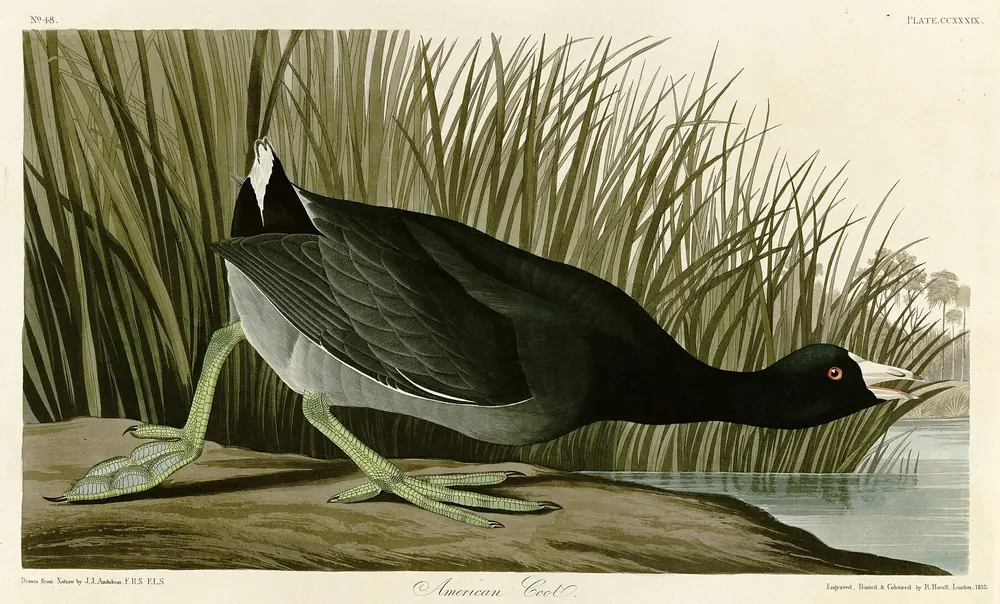
| Marsh hen | Clapper Rail, King Rail | Salt-water and fresh-water marsh hen were the two rails; more on our mud hen page. | Pearson 1917, part I, pp. 203–204 |
| Mud hen | American Coot | Most often the coot, a rail that swims like a duck; Toledo's baseball team took the name in 1896. | Pearson 1917, part I, p. 214 |
Ducks and geese
| Nickname | The bird today | Who said it, and why | Recorded in |
|---|---|---|---|
| Butterball | Bufflehead | So fat at times, Pearson's book said, that in the Middle States it was the butterball or the butter-box. | Pearson 1917, part I, p. 140 |
| Spirit duck | Bufflehead, Common Goldeneye | A northern name since at least 1831: the ducks vanished “at the flash of a gun or the twang of a bow.” | McAtee 1959, p. 110 |
| Whistler, whistler duck | Black-bellied Whistling Duck, Fulvous Whistling Duck, Common Goldeneye | On the Gulf Coast today, the whistling ducks, for their whistled calls; to old-time gunners, the goldeneye, whose wings whistle before the bird can be made out. | Delta Waterfowl; Pearson 1917, part I, p. 138 |
| Sawbill | Common Merganser, Red-breasted Merganser, Hooded Merganser | For the mergansers' bills, edged with hooked, saw-like teeth. | Forbush 1925, p. 176 |
| Hairy-head | Hooded Merganser | For the high crest that both male and female wear; hunters also said hairy-crown and moss-head. | Pearson 1917, part I, p. 112; Forbush 1925, p. 187 |
| Spoonbill, spoonbill duck | Northern Shoveler | For its long bill, “broadened at the tip” like a spoon; not the pink Roseate Spoonbill. | Pearson 1917, part I, p. 126 |
| Sea coot | Black Scoter, Surf Scoter, White-winged Scoter | The scoters were “commonly called coots alongshore” in New England, though they are ducks, seen mostly on salt water. | Forbush 1925, p. 370; Pearson 1917, part I, p. 148 |
| Skunk-head | Surf Scoter | For the white patches on the drake's black head, one on the forehead and one down the back of the neck. | Forbush 1925, p. 277 |
| Bluebill | Greater Scaup, Lesser Scaup | American gunners hardly knew the scaup by any other name in 1917, Pearson's book said; broadbill was the other. | Pearson 1917, part I, p. 136 |
| Honker | Canada Goose | For its call; Forbush wrote in 1925 that it was “said to be a honk,” though he never could hear the h or the k. | Forbush 1925, p. 292 |
Hawks, owls and vultures
| Nickname | The bird today | Who said it, and why | Recorded in |
|---|---|---|---|
| Chicken hawk | Cooper's Hawk, Sharp-shinned Hawk | Farmers' name for the hawks blamed for raiding the henhouse, above all the Cooper's Hawk. | Pearson 1917, part II, pp. 66–67 |
| Hen hawk | Red-tailed Hawk, Red-shouldered Hawk | The farm name of the bigger hawks, which in fact took little poultry; their story is on the chicken hawk page. | Pearson 1917, part II, p. 71 |
| Fish hawk | Osprey | For the live fish it catches; Audubon's plate 81 is titled Fish Hawk. | Pearson 1917, part II, p. 94 |
| Blue darter | Cooper's Hawk, Sharp-shinned Hawk | Big blue darter was the Cooper's Hawk and little blue darter the Sharp-shin, a hawk “dark bluish-slate” above. | Pearson 1917, part II, pp. 66–67 |
| Turkey buzzard | Turkey Vulture | Its bare head is reddish, like a turkey's; Audubon's plate 151 is titled Turkey Buzzard. | Pearson 1917, part II, p. 56; Seriff 2018, Turkey Vulture |
| Carrion crow | Black Vulture | A black bird that lives on carrion; Audubon's plate 106 is the Black Vulture or Carrion Crow. | Pearson 1917, part II, p. 57 |
| Hoot owl | Barred Owl | First among the Barred Owl's other names in 1917, though careless listeners, Pearson's book complained, gave it to any owl that hoots. | Pearson 1917, part II, p. 103; Pearson 1917, part II, p. 114 |
| Cat owl | Great Horned Owl | For a catlike squall among its calls, or for the ear tufts that make its head look like a cat's. | Pearson 1917, part II, p. 114 |
Grouse, quail, the roadrunner and shorebirds
| Nickname | The bird today | Who said it, and why | Recorded in |
|---|---|---|---|
| Fool hen | Spruce Grouse, Dusky Grouse | A hunters' name across the West and North for grouse so tame they let a person walk up and kill them. | McAtee 1956, pp. 46–47; Pearson 1917, part II, p. 16 |
| Partridge | Ruffed Grouse, Northern Bobwhite | New England's name for the Ruffed Grouse (“patridge,” or even pheasant); the Bobwhite was a partridge to others. | Forbush 1927, p. 26; Pearson 1917, part II, p. 2 |
| Chaparral cock | Greater Roadrunner | One of the roadrunner's many names in 1917, along with snake killer, lizard bird and paisano. | Pearson 1917, part II, p. 126 |
| Timberdoodle | American Woodcock | The woodcock's best-known nickname, with bogsucker and night partridge; where the doodle came from, nobody knows. | Pearson 1917, part I, p. 225 |
| Teeter-tail, peetweet | Spotted Sandpiper | Teeter-tail, teeter and tip-up for its nervous habit of tilting its body up and down; peetweet for its call. | Pearson 1917, part I, p. 250 |
Cuckoos, nightjars and woodpeckers
| Nickname | The bird today | Who said it, and why | Recorded in |
|---|---|---|---|
| Rain crow | Yellow-billed Cuckoo, Black-billed Cuckoo | Farmers believed its guttural call foretold rain; in Maine it was even blamed for souring the milk. | Pearson 1917, part II, p. 130; McAtee 1959, p. 114 |
| Bull bat | Common Nighthawk | The common name in the South in 1917, when nobody could say why; it heads the Carolina folk names in 2018. | Pearson 1917, part II, p. 173; Seriff 2018, Common Nighthawk |
| Goatsucker | Eastern Whip-poor-will, Chuck-will's-widow, Common Nighthawk | From an old European superstition that nightjars milked goats, probably because they were seen flying near goats at night. | Pearson 1917, part II, p. 166 |
| Yellowhammer | Northern Flicker | For the bright yellow under its wings; Alabama's state bird goes by the name. | Pearson 1917, part II, pp. 163–165; Seriff 2018, Northern Flicker |
| Logcock, Lord God bird | Pileated Woodpecker | Logcock was among its most widespread folk names; Lord God bird, McAtee thought, grew from mishearing it. | McAtee 1959, p. 113; Pearson 1917, part II, p. 154 |
Songbirds
| Nickname | The bird today | Who said it, and why | Recorded in |
|---|---|---|---|
| Butcher bird | Loggerhead Shrike, Northern Shrike | The shrikes, songbirds that hang their prey on thorns the way a butcher hangs meat. | Pearson 1917, part III, p. 99 |
| Bee martin | Eastern Kingbird | Blamed for eating honeybees; of 634 stomachs examined, 22 held bees, 61 in all, and 51 of those were drones. | Pearson 1917, part II, p. 193 |
| Whiskey jack | Canada Jay | Nothing to do with whiskey: our Canada Jay page traces it to a Cree trickster. | Pearson 1917, part II, p. 225 |
| Camp robber | Canada Jay | Campers' name for a jay that takes bacon or potatoes “from under your very nose”; moose bird and meat bird too. | Pearson 1917, part II, pp. 225–226 |
| Jaybird | Blue Jay | A Carolina folk name; Southern folklore had the jay carrying sticks to the Devil every Friday. | Seriff 2018, Blue Jay; McAtee 1959, p. 112 |
| Redbird | Northern Cardinal | Southerners called it the winter redbird, to tell it from the Summer Tanager, the summer redbird; our guide has what the state laws call it. | Pearson 1917, part III, p. 82; Seriff 2018, Northern Cardinal |
| Wild canary | American Goldfinch | Bright yellow with black wings, and a canary-like song; Iowa's state bird goes by it. Pearson's book called it “incorrect” for the Yellow Warbler. | Pearson 1917, part III, p. 14; Pearson 1917, part III, p. 126 |
| Thistle bird | American Goldfinch | For its habit of feeding on thistle seed. | Pearson 1917, part III, p. 15 |
| Potato chip bird | American Goldfinch | For its flight call, a bright per-chick-o-ree that bird guides also write as potato-chips; a Carolina folk name. | Audubon field guide, songs and calls; Seriff 2018, American Goldfinch |
| Peabody bird | White-throated Sparrow | New England heard its song as “Old Sam Peabody, Peabody, Peabody.” | Pearson 1917, part III, pp. 37–38 |
| Teacher bird | Ovenbird | John Burroughs wrote its song, which grows louder as it goes, as “Teacher, Teacher, Teacher.” | Pearson 1917, part III, pp. 151–152 |
| Preacher bird | Red-eyed Vireo | For its ceaseless singing, the same few notes over and over; the nickname came from Wilson Flagg. | Pearson 1917, part III, pp. 102–103 |
| Chippy | Chipping Sparrow | For its chip note, and a song that is a string of dry chips. | Forbush 1929, p. 78; Seriff 2018, Chipping Sparrow |
| Chewink, joree | Eastern Towhee | Named for its call, which people wrote as chewink, towhee or joree; joree heads the Carolina list. | Forbush 1929, p. 107; Seriff 2018, Eastern Towhee |
| Snowbird | Dark-eyed Junco | The welcome winter visitor that comes near barns and kitchen doors; in 1917 Pearson's book regretted that scientists had put junco in its place. Audubon's plate 13 is Snow Bird. | Pearson 1917, part III, p. 46 |
| Cherry bird | Cedar Waxwing | Its fondness for cherries gave it the name, and much complaint from fruit growers. | Pearson 1917, part III, p. 96 |
| Ricebird, reedbird | Bobolink | In the South it raided the ripening rice; in the fall marshes it was the reedbird, shot for “reed-birds on toast.” | Pearson 1917, part II, pp. 242–243 |
Why do birds have so many nicknames?
Because people named the birds they knew long before anyone agreed on one name for each. Farmers, hunters and sailors named a bird for what it did, how it sounded, what it ate or what they believed about it, and every region kept its own words. In 1917 Birds of America, edited by T. Gilbert Pearson of the National Association of Audubon Societies, printed a list of “other names” under nearly every bird, and the lists ran long: seventeen for the Common Goldeneye alone.
Some patterns repeat. Big wild birds became poultry: marsh hens, Indian hens and mud hens, a habit the bird-name collector W. L. McAtee called a folk conceit. Calls became names: chewink, quawk, peetweet. Birds that let hunters walk right up became fools and boobies; birds that slipped away under water became witches and spirits.
Many of these names have faded. A 2018 book on the birds of the Carolinas lists each bird's folk names and says plainly that only a handful are in use today; it keeps them for history and interest.
What is a hell-diver bird?
A grebe, most often the Pied-billed Grebe: hell-diver is the old name for nearly all the grebes, wherever they live. McAtee explained it in 1959: these birds stay under so long and come up so far away that “salty observers” said they had been to hell.
Gunners knew the trick. A grebe could dive at the flash of the gun and be safely under the water before the shot arrived, Pearson's Birds of America said in 1917. The same name went to the Common Loon and the Bufflehead, and in Maine the grebes were devil-divers as well.
The Pied-billed Grebe is a small brown water bird, about 13 inches long, with a short, thick bill and no crest.
What bird is known as a rain crow?
The Yellow-billed Cuckoo, and its cousin the Black-billed Cuckoo. Farmers believed their guttural call meant rain was on the way, Pearson's Birds of America explained in 1917, and McAtee noted that cuckoos croak more before storms.
Neither is a crow: the Yellow-billed Cuckoo is grayish-brown above and white below, and much heard but seldom seen. Its other names say the same thing: rain dove and storm crow. Hot, heavy air before a storm was said to sour milk, and in Maine the cuckoo itself got the blame, and the name milk-sourer. What the call sounds like, and whether it means anything, is on our rain crow page.
What bird is called a bull bat?
The Common Nighthawk. Bull-bat was “the name by which he is commonly known in the South,” Pearson's Birds of America said in 1917, calling the reason one of the profound mysteries of popular names. A 2018 book on the birds of the Carolinas still lists bullbat first among its folk names.
The nighthawk isn't a hawk either. It belongs to the goatsuckers, or nightjars, the family of the Whip-poor-will, birds with a small bill and a huge mouth that take their food in the air; its other old names include mosquito hawk and goatsucker. Why the South called it a bull bat, and shot it for sport, has a page of its own.
What bird is called a thunder pumper?
The American Bittern, a brown heron of the marshes. People likened its spring call to an old wooden suction pump, and the names followed: thunder pumper, bog pumper, slough pumper, even hell-pumper in Iowa. McAtee and two friends, listening to one on a May evening in Virginia, decided it sounded most like plunk-a-lunk.
Others heard a stake being driven, so it became the stake driver, or a bull, so it was the bog bull. After a long acquaintance with the names of North American birds, McAtee wrote in 1959 that if he could write about the names of just one bird, he would choose the bittern. The bird is thought to gulp air and force it out under pressure to make the sound.
Why is an albatross called a gooney bird?
Because sailors thought albatrosses foolish: gooney, McAtee wrote, means much the same as booby, a name sailors gave seabirds tame enough to be caught by hand. In the Pacific it went to the albatrosses; on Midway Atoll, to the Laysan and Black-footed Albatrosses.
Nobody knows exactly who first said it, an Associated Press reporter found on Midway in 2002, though the refuge manager supposed it dated from the island's military days. More than 400,000 pairs of the two albatrosses come back to Midway every November to nest, Smithsonian magazine reported in 2001, and one of the island's most prominent statues is a 20-foot gooney bird. The Navy's long fight with the gooney birds, and the oldest of them, have a page of their own.
What bird is called a camp robber?
The Canada Jay, the bird long called the Gray Jay. Pearson's Birds of America warned in 1917 that it would steal your bacon or potatoes “from under your very nose,” and listed its other names: whiskey jack, moose bird, meat bird.
Lumbermen had stranger names for it: McAtee recorded lumberjack, old logger and woodman's ghost, from the belief that these jays were the spirits of dead woodsmen. Why whiskey jack has nothing to do with whiskey is on our Canada Jay page.
What is a fool hen?
A grouse so tame it lets a hunter walk up and kill it, most often the Dusky Grouse or the Spruce Grouse. McAtee found fool hen for the Dusky Grouse from Manitoba and South Dakota to Colorado, Idaho and Utah, and for the Spruce Grouse and its western form, Franklin's Grouse. He pointed out what the name says about people: we call a bird a fool for trusting us.
Pearson's Birds of America gave fool hen to “various other species of northern Grouse” as well, and to Mearns's Quail of the Southwest, which would let itself be killed “with a stick or stone.” The Dusky Grouse is half of the old Blue Grouse, split in 2006.
What bird says potato chip?
The American Goldfinch. Its flight call, given with each dip of its bouncing flight, is a bright per-chick-o-ree that Audubon's field guide also writes as potato-chips, and potato-chip bird is one of its folk names in the Carolinas.
Its older nicknames are about its looks and its food. Wild canary came from the male's bright yellow and his canary-like song, and thistle bird from its habit of feeding on thistle seed, Pearson's Birds of America said in 1917.
Which bird nicknames did Audubon use?
Plenty: more than a dozen plate titles in The Birds of America use names that are nicknames now. The junco is his Snow Bird, the goldfinch the Yellow Bird, the Osprey the Fish Hawk, the Turkey Vulture the Turkey Buzzard and the Black Vulture the Carrion Crow.
The two rails are his Fresh Water and Salt Water Marsh Hens, the Black-crowned Night Heron his Qua bird, the Northern Shrike his Butcher Bird, the Cedar Waxwing his Cedar Bird and the Merlin his Pigeon Hawk. Audubon's birds then and now matches every plate to the bird's name today.
Which old hawk names were once official?
Four hawk names that sound like nicknames were official: duck hawk, pigeon hawk, sparrow hawk and marsh hawk. The American Ornithologists' Union's check-list of 1931 used all four; by its 1983 edition the birds were the Peregrine Falcon, the Merlin, the American Kestrel and the Northern Harrier.
Our guide to hawks and their other names sorts out the rest, from chicken hawk to buzzard.
| Old name | Official in 1931 | The bird today |
|---|---|---|
| Duck hawk | Duck Hawk | Peregrine Falcon |
| Pigeon hawk | Eastern Pigeon Hawk | Merlin |
| Sparrow hawk | Eastern Sparrow Hawk | American Kestrel |
| Marsh hawk | Marsh Hawk | Northern Harrier |
Whatever your old notebook calls them, a Birdfolio prints every bird on your life list under the name it has today; see the pages.