Old bird nickname
Butcher bird: the shrikes of North America, and Australia's butcherbirds
A butcher bird is a shrike: a gray, black-masked songbird that hunts like a small hawk and hangs its catch on thorns or barbed wire, the way a butcher hangs meat. North America has two, the Loggerhead Shrike and the Northern Shrike. Australia's butcherbirds are different birds, named for the same habit.
Updated
Why are they called butcher birds?
Because they store their prey the way a butcher hangs meat: spiked on a thorn or a barb of wire, to be eaten later. Audubon's field guide says the Loggerhead Shrike stores uneaten prey “by impaling it on thorn or barbed wire,” and the male sometimes brings food from that store to the female on the nest.
There is a practical reason. Shrikes are songbirds, without a hawk's strong feet, and Alexander Wilson saw in 1808 that their feet were not up to grasping and tearing prey “like those of the Owl.” They kill with the bill instead: it has a pair of sharp points called tomial teeth, and a bite to the back of the neck probably paralyzes the prey, the Smithsonian's National Zoo says.
The name is old. Merriam-Webster dates butcher-bird, “any of various shrikes,” to 1668, and the scientific name says the same thing: lanius is Latin for butcher. Butcher itself, Skeat's etymological dictionary says, first meant a man who killed goats.
Are there butcher birds in America?
Yes, two. The Loggerhead Shrike, 8.3 to 9.4 inches long, is the one most of the country has; it is now “essentially gone from the northeastern United States,” Audubon's field guide says. The Northern Shrike, 9.1 to 10.2 inches, summers in the far north and comes to southern Canada and the lower 48 only in winter.
How far south the Northern Shrike comes changes from year to year: some winters bring many more, and the American Ornithological Society's 2017 description takes it, irregularly, as far as northern California, northern Arizona, northern Texas, Kansas, Illinois, Ohio, Pennsylvania and New Jersey. The male is a mimic: its song includes imitations of other birds.
What is another name for a butcher bird?
Shrike is the usual one; Skeat's dictionary ties the word to Icelandic words meaning shrieker. The National Zoo gives the Loggerhead's nicknames as butcherbird and thorn bird.
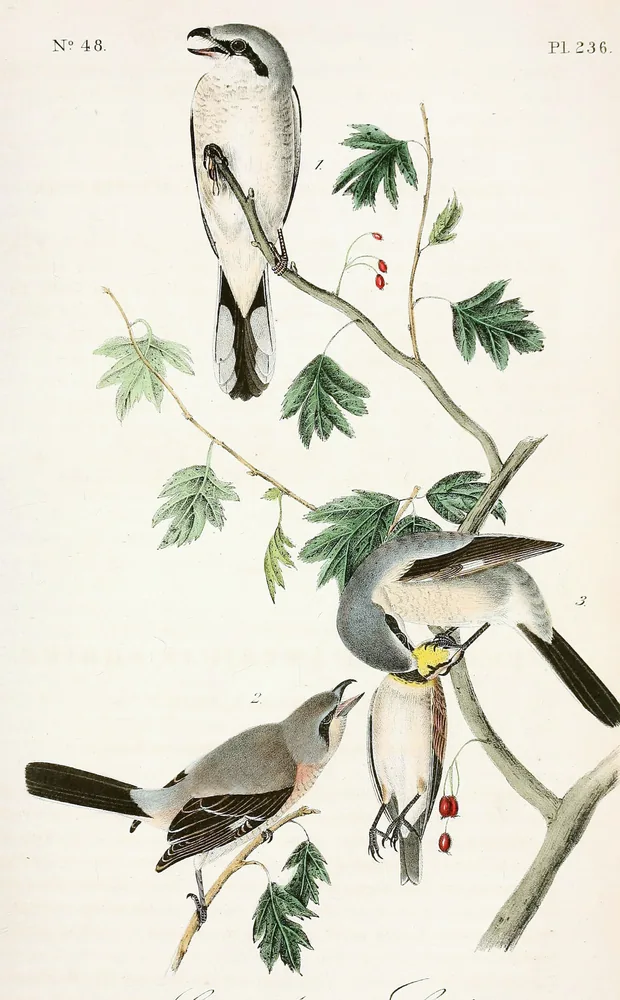
The old books add more. Wilson titled the bird “Great American Shrike, or Butcher-bird” in 1808, and Audubon's big plate 192 is the Great American Shrike or Butcher Bird, though his 1834 chapter calls it the Great Cinereous Shrike. German settlers in Pennsylvania called it the Nine-killer.
Its official names moved too. The American Ornithologists' Union listed the Northern Shrike as Lanius borealis in 1886, merged it with Europe's Great Gray Shrike as Lanius excubitor in 1957, and parted them again in 2017, when the genes showed the American bird was closer to our Loggerhead Shrike than to the European one. Excubitor is Latin for a watchman, so the old name meant roughly “butcher watchman.” The Loggerhead's western birds were once called the White-rumped Shrike.
The nine-killer story
An old belief said the shrike set its grasshoppers out as bait. After a visit to an orchard on December 17, 1795, John Heckewelder of Bethlehem, Pennsylvania, passed on the German settlers' name for the bird, Nine-killer: it was said to stick nine grasshoppers a day on thorns to lure small birds within reach.
Wilson printed the story in 1808 and called it “a very pretty fanciful theory.” The little birds about in winter eat seeds, not grasshoppers, he pointed out, and the shrike was fast enough to catch them anyway.
He told, too, of a shrike in Bartram's garden that chased a snowbird into an open cage, killed it, and got itself shut in. Wilson admired the bird all the same: it was brave, and it attacked hawks and eagles to defend its young.
Audubon's Butcher Bird
Audubon painted the Northern Shrike for plate 192 of The Birds of America and watched it hunt. In Mississippi he heard it imitate the cries of small birds in distress, he suspected to lure others out of cover, before diving on them like a hawk. In Boston, shrikes got into rooms where canaries were kept in cages and killed them.
The impaling he could not explain: it was “quite a mystery to me.” He was sure, too, that the American bird was the same as Europe's Great Gray Shrike; the official list decided otherwise in 2017.
The Loggerhead Shrike, his plate 57, he knew from the South, where it killed field mice for the planters. Its voice reminded him of a “rusty hinge,” and he never once saw it attack a bird or stick its prey on a thorn, the habit it is best known for today. His plate shows a pair quarreling over a mouse.
How butcher birds hunt
A shrike behaves like a bird of prey in a songbird's body, the National Zoo says, and young ones make clumsy impaling movements before they can do it properly. Zoos that keep shrikes give them thorns and barbed wire to skewer their food on.
The impaling has a clever use in Florida. Lubber grasshoppers are poisonous, and a shrike that catches one eats the head and the abdomen and leaves the poisonous middle part, the thorax, the Zoo says.
Shrikes have not always been welcome. In the 1870s a warden was hired to shoot Northern Shrikes on Boston Common in winter, to protect the newly introduced House Sparrows; up to 50 shrikes were killed in a single winter, Audubon's field guide says.
Are butcher birds rare?
The Loggerhead Shrike is in trouble. It is listed as threatened or endangered in 14 states and as endangered in Canada, the National Zoo says; New York lists it as endangered, and the IUCN rates it Near Threatened worldwide.
Nobody is sure why. The decline coincides with pesticide use from the 1940s to the 1970s, and the loss of fencerows and small farms is suspected, the Zoo says.
One island race came close to the end. The San Clemente Loggerhead Shrike, the race of San Clemente Island off southern California, has been on the federal endangered list since 1977.
The oldest Loggerhead on record was banded as a nestling in California in 1998 and caught again there in 2010, 11 years and 9 months later; the oldest Northern Shrike, a female banded in Wisconsin in 2006, was seen there in 2013.
How to tell a Loggerhead from a Northern Shrike
Season helps most: a shrike in the lower 48 in summer is a Loggerhead. In winter look at the mask. On a Loggerhead the black mask meets over the base of the bill; on a Northern it is narrower in front of the eye and doesn't meet, and the Northern has a longer bill, faint barring below and a paler base to the lower bill. First-winter Northern Shrikes look brownish.
The usual mix-up is with the Northern Mockingbird, which has no black mask; our Arkansas page shows how to tell a mockingbird from a Loggerhead Shrike.
Where do butcher birds live?
In North America, the shrikes above. In Australia, butcherbird means a different bird altogether: not a shrike, but a relative of the Australian Magpie and the currawongs, the group BirdLife Australia calls woodswallows, currawongs, butcherbirds and magpie.
They earned the name the same way. Butcherbirds hang their prey on a hook or wedge it in a tree fork or a crevice, a larder that holds prey while they eat, stores it, or perhaps attracts a mate, BirdLife Australia says. The Gray Butcherbird has had plenty of names of its own, among them Collared Crow-shrike, Jackass and Whistling Dick.
Are butcher birds friendly to humans?
Australia's butcherbirds live close to people but aren't always friendly. The Pied Butcherbird often comes near houses and parks, BirdLife Australia says, while a Gray Butcherbird near its nest or a new fledgling will swoop straight at your face with a “maniacal cackle,” sometimes drawing blood.
Their songs make up for it. The Pied Butcherbird's flute-like song, heard by day and on moonlit nights, has been called “one of the finest in the world.” The researcher Hollis Taylor wrote a whole book about this one bird, Is Birdsong Music? (Indiana University Press, 2017), and found that both sexes sing in duos, trios and larger choirs, and change their songs every year.
A shrike you've seen goes on your list as a Loggerhead or a Northern Shrike, never a butcher bird; if Merlin keeps your sightings, here's how to turn a Merlin list into a book.