Classic bird paintings
Turkey Vulture painting: Audubon's plate and other classic portraits
John James Audubon painted the Turkey Vulture as plate 151 of The Birds of America (1827–38), an adult and a young bird, under the name Turkey Buzzard. That plate is the painting shown here; its engraver's line is dated 1832. A free high-resolution scan is on Audubon.org.
Updated
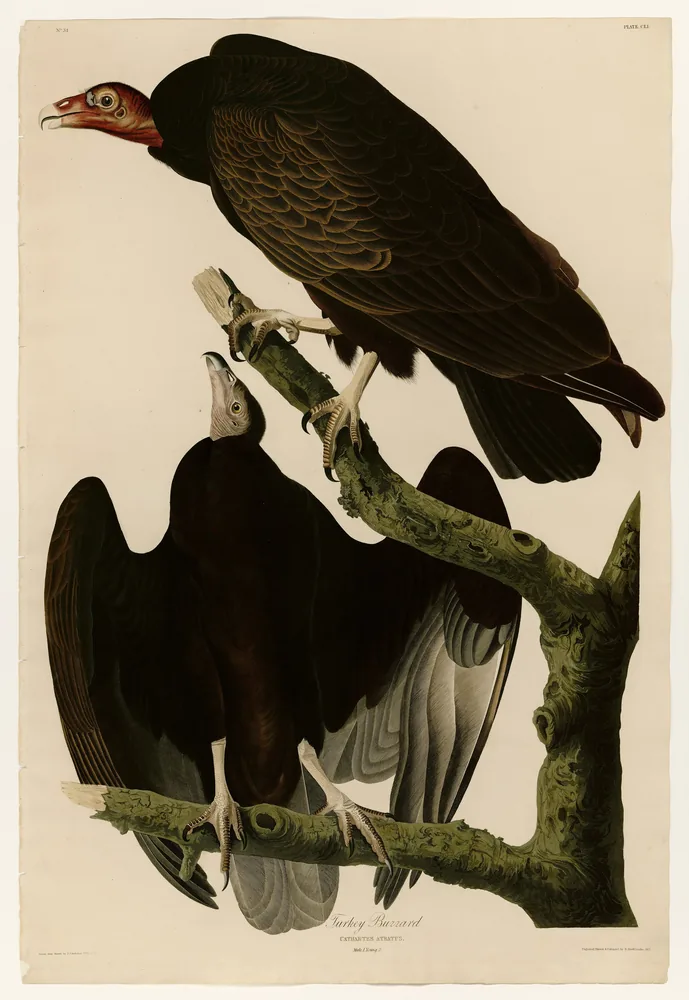
Audubon’s plate: plate 151, “Turkey Buzzard”
Audubon laid a deer skin, stuffed hard with dried grass, on its back in an open field, legs in the air as if the animal had died, and walked about a hundred yards off. Within minutes a vulture landed, pecked at the eyes, which were balls of painted clay, then tore open the stitches at the other end and pulled out hay. It found no meat, flew off, and suddenly wheeled down to kill a small garter snake. He concluded that “his ocular powers were much better than his sense of smell.”
The test comes from a paper read in Edinburgh, arguing that the Turkey Buzzard and other vultures find their food by sight, not smell. He reprinted it in his chapter on the Black Vulture, which holds most of what he wrote about both birds. Yet the dissection printed in his fifth volume, in 1839, found the Turkey Buzzard's olfactory nerve and nasal cavity large, and granted that, if those measure the sense, “the Turkey Buzzard must possess it in a high degree.”
His own chapter on plate 151 is short. In Florida, he wrote, Turkey Buzzards followed him when he went shooting, to see where he put down his game, and ate it if he didn't cover it well. The plate shows an adult male in full plumage and a young bird in the autumn of its first year.
Story: Audubon, Ornithological Biography, vol. 2 (1834), pp. 33–35; vol. 2 (1834), pp. 296–298; vol. 5 (1839), pp. 339–345. See plate 151 free at Audubon.org.
Was Audubon right that vultures find food by sight alone?
Not about the Turkey Vulture: it finds food by smell as well. Reviewing the old quarrel in 1964, Kenneth Stager judged that Audubon's tests mostly measured the birds' eyesight, and that the aggressive birds he described behaved like Black Vultures, not the shy Turkey Vulture.
Stager's own tests, published by the Los Angeles County Museum, settled it. A mounted deer drew no Turkey Vultures; a fresh carcass of the same size and look drew them fast, and they circled until they caught its scent before landing.
Ralph Openshaw, retired from the Union Oil Company of California, told him how in 1938 and 1939 the company found leaks in a 42-mile gas line on the advice of a company engineer in Texas: pump a heavy dose of ethyl mercaptan into the line, then patrol it for vultures circling or sitting on the ground. Where they gathered, the smell was strong and the leaks were found. The company's engineers had long since credited the bird with “a well-developed sense of smell.”
Sources: Stager, Contributions in Science, no. 81 (1964), p. 7; p. 9; p. 55; p. 27; p. 28.
More classic portraits, free to see
- John James Audubon, The Birds of America, octavo edition (1840–44), plate 2: “Red-headed Turkey Vulture”. Free scan (New York Public Library Digital Collections)
About the Turkey Vulture
- Turkey Vultures can find dead animals by smell. (Source: National Audubon Society)
What are the big black birds circling over Texas?
Most often Turkey Vultures, which nest all over Texas, in the forests and swamps of the east, on the prairies and in the high, dry Trans-Pecos, the Texas Breeding Bird Atlas says. Black Vultures, common in the eastern two-thirds, often roost and feed with them. The hawks and eagles that soar beside them are in birds of prey in Texas.
A Turkey Vulture soars with its wings held in a shallow V, and from below its gray flight feathers stand out against black wing linings. The adult's head is red, a young bird's gray, National Audubon's guide says. For telling it from its cousin, see the Black Vulture.
Easy to see in flight, it is secretive at the nest: of 1,549 atlas records, only 79 confirmed nesting. It builds none, laying two eggs in a dark spot on the ground, in a cave, a hollow log or an empty building. The downy white young have black heads and first fly at 70 to 80 days.
Sources: Texas Breeding Bird Atlas, Black Vulture (Telfair, 2007); Texas Breeding Bird Atlas, Turkey Vulture (Buckley, posted 2006); National Audubon Society guide, Turkey Vulture.
Do Turkey Vultures leave Texas in winter?
Those in the west mostly do. In winter Turkey Vultures stay largely east of a line from Wichita Falls south to Del Rio, the Texas Breeding Bird Atlas says, though Big Bend National Park has records in every month but January.
Texas is also a highway for vultures from the north, which leave country where a carcass would freeze. From October 12 to November 12, 1992, counters at Anzalduas County Park in the lower Rio Grande Valley saw 3,785 head south; from March 11 to April 16, 1993, 4,866 passed Bentsen Rio Grande State Park going north, believed to be a record. They travel in flocks and can go a long way without feeding, National Audubon's guide says.
In the 19th century they and Black Vultures were notorious scavengers in city dumps. With modern sanitation they now keep almost entirely out of big cities, except for migrants, and a Dallas County checklist once listed them as rare.
Sources: Texas Breeding Bird Atlas, Turkey Vulture (Buckley, posted 2006); National Audubon Society guide, Turkey Vulture.
How long does a Turkey Vulture live?
Turkey Vultures have no typical lifespan we could confirm in a wildlife agency's guide. The oldest known wild Turkey Vulture was at least 23 years and 4 months old (USGS Bird Banding Laboratory): it was banded in California in 1997 and found there again in 2019.
Source: USGS Bird Banding Laboratory. A banding record is the minimum age of one bird when it was found again, not a typical lifespan. How long do wild birds live?
How can you tell if a plate 151 print is an original?
By its size: an original plate 151 is a hand-colored sheet about 26 by 38 inches, dated 1832; the Turkey Vulture’s octavo version, plate 2, is book-size, from 1840–44. Many prints sold today are reproductions: how to tell an original from a reproduction. Rather have every plate in one book? Here’s which Birds of America book to buy.
In a Birdfolio hardcover, this painting sits beside the date and place you first saw a Turkey Vulture. See your own list as a book, free.