Classic bird paintings
Hooded Merganser painting: Audubon's plate and other classic portraits
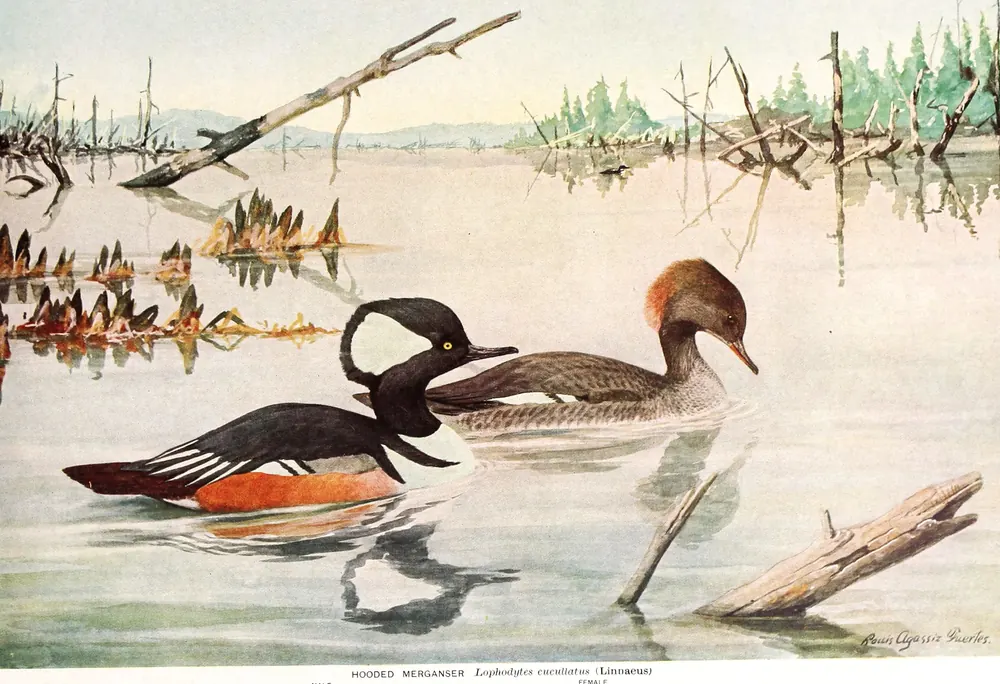
The Hooded Merganser is plate 232 of John James Audubon's The Birds of America (1827–38), a male and a female under the same name, and Audubon.org has a free high-resolution scan of it. The swimming pair shown here is Louis Agassiz Fuertes's plate 11 for Elon H. Eaton's Birds of New York (1910–14), signed in the corner.
Updated
The story of this painting
It is a beautiful sight, Elon H. Eaton wrote, to watch a company of Hooded Mergansers swim briskly among the lily pads, “all flashing and closing their crests in time to their advance.” Disturbed, they patter off downstream, leaving a long line of dimples on the water, then rise, wheel and shoot past overhead with a slight whir of wings, “like so many winged arrows.”
He gave its other names as Swamp Sheldrake, Hairy-head and Water Pheasant. It lived on sluggish wooded ponds and streams, the haunts of the Wood Duck and the herons, ate many water insects, and so did less harm to fish than the other mergansers. Eaton counted it among the four wild ducks that bred to any extent in New York, and thought it should be encouraged and protected.
In the book the picture is printed sideways, so you turn the volume to see it: plate 11, signed by Louis Agassiz Fuertes in the lower corner, with the drake and the duck at a quarter of life size among dead trees standing in still water. Eaton's description fits the female, whose crest is tinged with cinnamon and quite conspicuous.
Story: Eaton, Birds of New York, part 1 (1910), pp. 181–182; part 1 (1910), plate 11.
Audubon’s Hooded Merganser: plate 232, “Hooded Merganser”
On moonlit fall nights Audubon liked to stand on the bank of the Ohio, which he called la belle rivière, and listen. First came the whistle of wings, then a rush like an eagle stooping, as five or ten Hooded Mergansers swept low over the water and shot into the mouth of a creek. There, he wrote, they wash with short plunges, preen, grunt softly with pleasure and dive for minnows, then sleep on a clean sand beach until day.
They were hard to shoot. A wounded one, he warned, sinks its body and swims off with only the tip of its bill above water. Flushed on a narrow creek, it flies straight for the mouth, even over someone standing knee-deep in the middle, so fast that a hit is unlikely. When he moved from Pennsylvania to Kentucky he found them near Louisville in summer, and told Alexander Wilson so. He caught young ones with a partridge net and insisted they were very dark brown, not yellow, as some writers claimed.
Seven or eight times he found a nest in a hollow tree, like a Wood Duck's, and he wrote that the mother carries her young to the water in her bill. In April 1838 John Bachman came on a female with five young on a small pond by the Santee River in South Carolina: she sank until only a little of her back showed, and the young dived in all directions like grebes.
Story: Audubon, Ornithological Biography, vol. 3 (1835), pp. 246–250; vol. 5 (1839), p. 619. See plate 232 free at Audubon.org.
More classic portraits, free to see
- John James Audubon, The Birds of America, octavo edition (1840–44), plate 413: “Hooded Merganser”. Free scan (New York Public Library Digital Collections)
- John Gould’s The Birds of Europe (1832–37), plate 386: “Hooded Merganser” (Mergus cucullatus). Free scan (University of Kansas Libraries)
- John Gould’s The Birds of Great Britain (1862–73), vol. 5, plate 36: “Hooded Merganser” (Mergus cucullatus). Free scan (University of Kansas Libraries)
- Louis Agassiz Fuertes, for Elon H. Eaton’s Birds of New York (1910–14), plate 11: “Hooded Merganser” (the painting shown above). Free scan (Internet Archive)
About the Hooded Merganser
- Hooded Mergansers find their food by sight, diving and swimming underwater. (Source: National Audubon Society)
What does a female Hooded Merganser look like?
Dark gray-brown and smaller than the other mergansers, with a bushy, paler crest at the back of a long, flat head, the National Audubon Society's guide says. Audubon described her crest as yellowish brown, her bill as brownish-black turning orange toward the base, her back and sides blackish-brown and her wing patch grayish white.
Not every brown bird in a flock is a hen, though. Young drakes, Audubon found, “resemble the females for the first year” and reach their full dress only in the third spring; after the first molt they still look like her, but with pure white underparts and wing patch. Hens also lay eggs in one another's nests, and in Wood Ducks' nests too, the guide adds.
Sources: National Audubon Society guide, Hooded Merganser; Audubon, Ornithological Biography, vol. 3 (1835), pp. 249–250.
What are the key differences between a Bufflehead and a Hooded Merganser?
The head first, then the size. A drake Bufflehead wears a white scarf on a round black head, above white sides; a drake Hooded Merganser's white is a fan-shaped crest edged in black, which he can raise high or lay flat, and in the Fuertes painting above his sides are rusty. The hens differ the same way: a Bufflehead hen has a gray head with one white ear spot, a merganser hen a bushy crest on a long, flat head. A Bufflehead is smaller, too, 13 to 15 inches long against 16 to 19, and the National Audubon Society's guide tells you to compare each with the other.
Sources: National Audubon Society guide, Bufflehead; National Audubon Society guide, Hooded Merganser.
How long does a Hooded Merganser live?
Agency guides we checked give no clearly typical lifespan for the Hooded Merganser. The oldest known wild Hooded Merganser was at least 14 years and 4 months old (USGS Bird Banding Laboratory): it was banded in Minnesota in 1995 and found in Mississippi in 2009.
Source: USGS Bird Banding Laboratory. A banding record is the minimum age of one bird when it was found again, not a typical lifespan. How long do wild birds live?
How can you tell if a plate 232 print is an original?
By its size: an original plate 232 is a hand-colored sheet about 26 by 38 inches; the Hooded Merganser’s octavo version, plate 413, is book-size, from 1840–44. Many prints sold today are reproductions: how to tell an original from a reproduction. Rather have every plate in one book? Here’s which Birds of America book to buy.
In a Birdfolio hardcover, this painting sits beside the date and place you first saw a Hooded Merganser. See your own list as a book, free.