Classic bird paintings
White-throated Sparrow painting: Audubon's plate and other classic portraits
John James Audubon painted the White-throated Sparrow as plate 8 of The Birds of America (1827–38), under the same name: the female above and the male below on a twig of flowering dogwood in early spring. That plate is the painting shown here, and a free high-resolution scan is on Audubon.org.
Updated
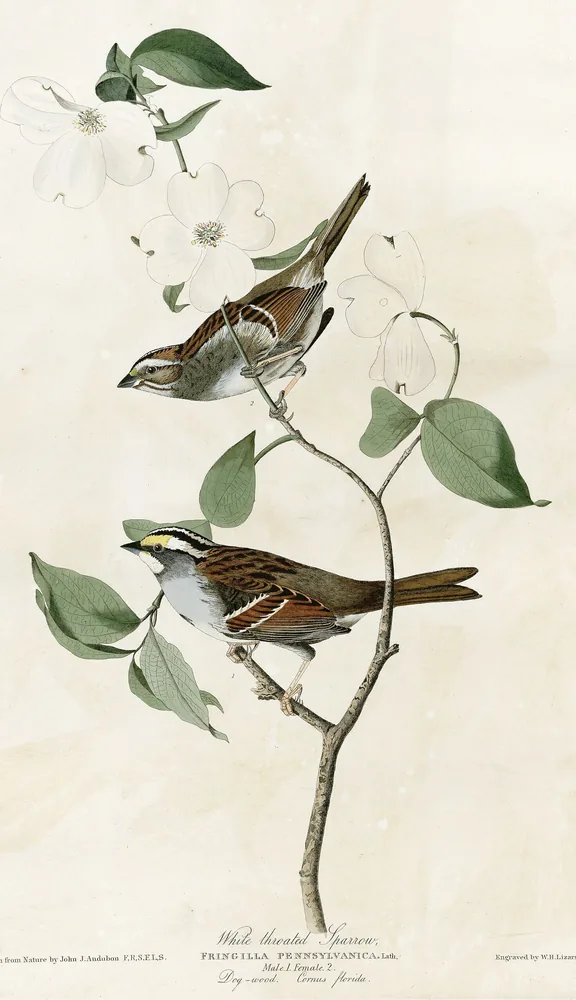
Audubon’s plate: plate 8, “White Throated Sparrow”
To Audubon this sparrow was a winter mystery. It reached Louisiana in early November and left in the first days of March, and how it came and went, he wrote, was quite unknown to him. All of a sudden the hedges along creeks and swamps would be full of them, in flocks of thirty to fifty.
They spent the day slipping out to scratch for seeds in silence and diving back into the thickest briars at the least alarm. Reassured, they climbed to the highest twigs for a short, sweet concert he wished he could describe. On warmer days they moved partly into the woods, climbing hollies and vine-covered trees for a berry or a winter grape. Their worst enemy by day was the Marsh Hawk, which passed over their little groups so lightly and so unexpectedly that it seldom failed to take one. At nightfall each flock repeated a sharp twit until an owl's hoot silenced it, and on fine nights a stray twit came now and then, as if to say “all's well.”
When the dogwoods bloomed, the sparrows left. “Where it spends the summer I know not,” he admitted, guessing it was beyond the States, and he painted the pair on a twig of dogwood in early spring. In Louisiana, he added, many of the plump birds were killed for the table with blowguns that Native Americans made from straight canes, their darts tufted with squirrel hair instead of feathers.
Story: Audubon, Ornithological Biography, vol. 1 (1831), pp. 42–44. See plate 8 free at Audubon.org.
Was the White-throated Sparrow one of Audubon's first plates?
Yes. Plate 8 belongs to the first ten, which William Lizars engraved in Edinburgh; Robert Havell of London, who engraved, printed and hand-colored most of the 435, finished some of those ten himself, the University of Pittsburgh's library says.
Subscribers got the plates five at a time, one large bird, one medium and three small, between 1827 and 1838, paying about $1,000 in all. No more than 120 complete sets are thought to exist today; owners usually had theirs bound into four big volumes of sixty pounds or more each.
Audubon wrote the bird's story for the first volume of his Ornithological Biography, which also came out in Edinburgh, in 1831.
More classic portraits, free to see
- John James Audubon, The Birds of America, octavo edition (1840–44), plate 191: “White-throated Finch”. Free scan (New York Public Library Digital Collections)
- Louis Agassiz Fuertes, for Elon H. Eaton’s Birds of New York (1910–14), plate 82: “White-throated Sparrow”, with Vesper Sparrow, White-crowned Sparrow and Dark-eyed Junco. Free scan (Internet Archive)
About the White-throated Sparrow
- Within living memory, its song has changed. Sometime before 2000 a version ending Cana, Cana, Cana appeared in western Canada, and by 2019 it had spread east across Canada to New England; researchers suspect birds learned it from each other on shared wintering grounds. (Source: National Audubon Society)
- Its head stripes are white in some birds and tan in others, which effectively makes four “sexes”: white-striped and tan-striped males and females. White-striped birds pair with tan-striped ones. (Source: National Audubon Society)
- It can't make the yellow spot between its bill and eye on its own: the color comes from plant pigments in its food, such as wild cranberries, blueberries and grapes. (Source: National Audubon Society)
- It sometimes pairs with a Dark-eyed Junco; the young look like grayer White-throated Sparrows and sing a mix of the junco's trill and the sparrow's Canada notes. (Source: National Audubon Society)
- They nest in Canada and along the northern edge of the United States, in a cup on the ground, often in forests growing back after logging, fire or insect damage. (Source: National Audubon Society)
- It migrates mostly at night, and in fall it travels late, moving south a little at a time. (Source: National Audubon Society)
- White-striped males are usually more aggressive and sing more than tan-striped males, and tan-striped adults tend to feed their young more often. (Source: National Audubon Society)
How long does a White-throated Sparrow live?
A wild White-throated Sparrow lives 2 to 10 years, according to the Smithsonian's National Zoo. The oldest known wild White-throated Sparrow was at least 14 years and 11 months old (USGS Bird Banding Laboratory): it was banded in Alberta in 1995 and found there again in 2010.
One almost 10 years old was recovered in Fairfax, Virginia, killed by a cat, Audubon magazine reports.
Sources: Smithsonian's National Zoo & Conservation Biology Institute; Audubon magazine, National Audubon Society; USGS Bird Banding Laboratory. A banding record is the minimum age of one bird when it was found again, not a typical lifespan. How long do wild birds live?
How can you tell if a plate 8 print is an original?
By its size: an original plate 8 is a hand-colored sheet about 26 by 38 inches; the White-throated Sparrow’s octavo version, plate 191, is book-size, from 1840–44. Many prints sold today are reproductions: how to tell an original from a reproduction. Plate 8 and the other 434 also come bound in one modern book: which Birds of America book to buy.
In a Birdfolio hardcover, this painting sits beside the date and place you first saw a White-throated Sparrow. See your own list as a book, free.