Classic bird paintings
Cedar Waxwing painting: Audubon's plate and other classic portraits
John James Audubon painted the Cedar Waxwing as plate 43 of The Birds of America (1827–38), a male and a female in a red cedar, under the name Cedar Bird. That plate is the painting shown here, and a free high-resolution scan is on Audubon.org.
Updated
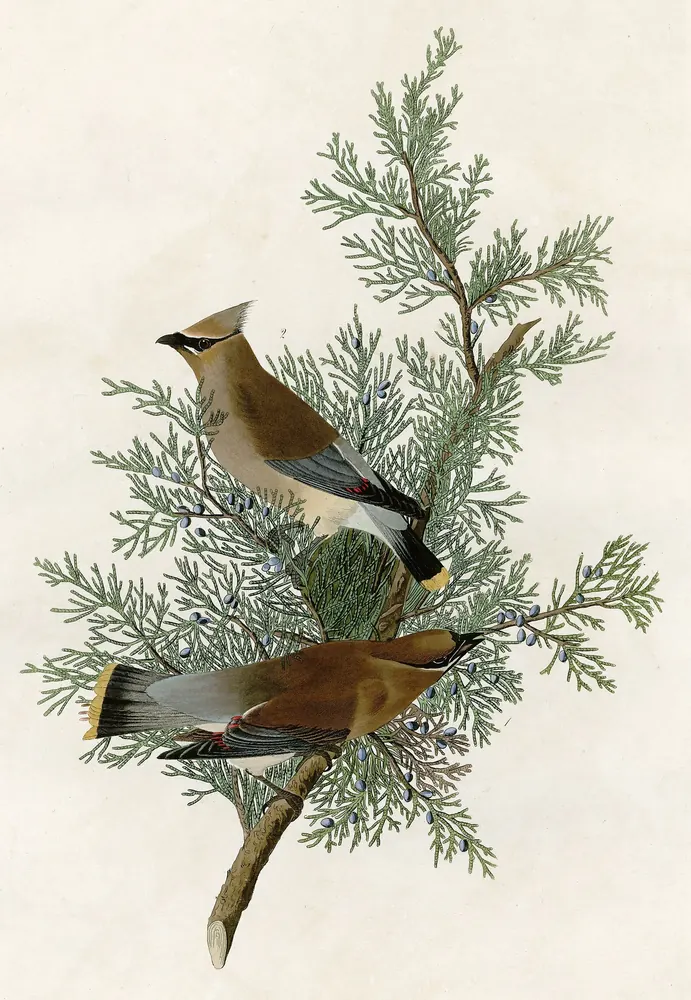
Audubon’s plate: plate 43, “Cedar Bird”
Audubon showed the pair in a red cedar, Juniperus virginiana. In Louisiana, where the birds stayed from about November to March and grew fat on holly, persimmon and other winter fruit, they were prized as food. He knew of a basket of them sent to New Orleans as a Christmas present that never arrived, because “the steward of the steamer, in which they were shipped, made pies of them.”
He noticed that a passing flock that hears their thin, lisping call will drop onto the same tree, and in a few hours strip it of fruit. He thought Fruit-devourers would suit them better than the naturalists' name, Chatterers.
Story: Audubon’s Ornithological Biography, vol. 1 (1831). See plate 43 free at Audubon.org.
More classic portraits, free to see
- John James Audubon, The Birds of America, octavo edition (1840–44), plate 246: “Cedar bird, or Cedar Wax-wing”. Free scan (New York Public Library Digital Collections)
- Louis Agassiz Fuertes, for Elon H. Eaton’s Birds of New York (1910–14), plate 89: “Cedar Waxwing”, with the Bohemian Waxwing. Free scan (Internet Archive)
About the Cedar Waxwing
- Cedar Waxwings eat fleshy fruit all year, and outside the nesting season they usually feed in flocks. (Source: National Audubon Society)
The oldest known wild Cedar Waxwing lived at least 7 years and 2 months: it was banded in Maryland in 2008 and found there again in 2014. That is a record from bird banding, not a typical lifespan. (Source: USGS Bird Banding Laboratory, 2025 longevity table.) How long do wild birds live?
Buying a print?
An original plate 43 is a hand-colored sheet about 26 by 38 inches, printed in Britain in 1827–38; many prints sold today are reproductions or small 1840s octavo prints. How to tell an original from a reproduction.
In a Birdfolio, the hardcover book of your own life list, this painting sits beside the Cedar Waxwing with the date and place you first saw one. See your own list as a book, free.