Classic bird paintings
Great Horned Owl painting: Audubon's plate and other classic portraits
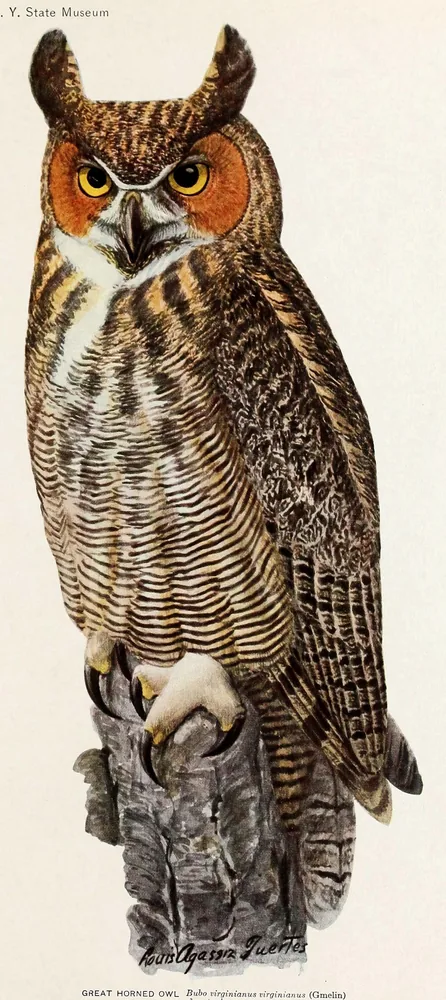
John James Audubon painted the Great Horned Owl as plate 61 of The Birds of America (1827–38), a male and a female, under the same name. A free high-resolution scan is on Audubon.org. The owl shown here was painted by Louis Agassiz Fuertes for Elon H. Eaton's Birds of New York (1910–14), plate 57.
Updated
The story of this painting
Among Elon H. Eaton's earliest memories were moonlit nights of early March in the sugar bush, where he was sometimes allowed to stay up and watch the sap boil while Great Horned Owls called and answered between the hills. Their usual cry, six hoots on one note, earned the bird the name six hooter in parts of New York, and he often mistook it for a big dog baying far off, or a freight engine tooting in the valley.
Eaton called it a “feathered pirate.” He had seen many grown hens killed in its night raids, and once lost a hen turkey attacked while brooding her young; a steel trap set by the body the next night caught a large female owl. It also ate rabbits, muskrats, woodchucks and, above all, skunks. By then it was no longer common in New York outside wooded country.
Louis Agassiz Fuertes signed his name in full across the stump of plate 57. A dried skin, he explained in a note at the front of the book, gives no hint of the colors of a living bird's eyes, bill and feet, which can change within moments, so for ten years he had made careful color notes of them “at the first possible moment after the capture of the bird.” Eaton gave the owl's eyes as yellow, larger than those of any other native bird.
Story: Eaton, Birds of New York, part 2 (1914), pp. 123–126; part 2 (1914), plate 57; Fuertes, “Illustrator’s Note,” Birds of New York, part 1 (1910), pp. 9–10.
Audubon’s Great Horned Owl: plate 61, “Great Horned Owl”
On a still summer night, Audubon wrote, the steersman of a boat drifting downriver may watch a Great Horned Owl glide across the water and circle over a squatter's new clearing. There a turkey hen roosts in a tree with her young under her wings. She rises, spreads her tail and calls so loudly that the hens wake; the settler steps out with his rifle, shoots the owl as it lands on a dead branch, and leaves it for some prowling opossum.
Its cries ranged from something like a cur dog's bark to a horrid shriek, and its usual hoo, hoo, hoo-e, given in an undertone, could sound more than a mile off when the owl sat fifty yards away. Running toward one he had shot on a willow bar, he sank in quicksand up to his armpits. His boatmen freed him by making a bridge of oars and driftwood while he kept perfectly still.
He told the story, he said, to show the difficulties every student of nature meets, and added that “could I renew the lease of my life,” he would spend it no other way. His plate shows a male and a female, to give a better idea of the owl's size and form than any description could.
Story: Audubon, Ornithological Biography, vol. 1 (1831), pp. 313–318. See plate 61 free at Audubon.org.
More classic portraits, free to see
- John James Audubon, The Birds of America, octavo edition (1840–44), plate 39: “Great Horned-Owl”. Free scan (New York Public Library Digital Collections)
- Louis Agassiz Fuertes, for Elon H. Eaton’s Birds of New York (1910–14), plate 57: “Great Horned Owl” (the painting shown above). Free scan (Internet Archive)
About the Great Horned Owl
- Great Horned Owls usually hunt at night, watching from a perch and then swooping down onto their prey. (Source: National Audubon Society)
How long does a Great Horned Owl live?
For most wild Great Horned Owls, 13 is a ripe old age, in the Missouri Department of Conservation's words, though the species may live to nearly 30. Half of all young Great Horned Owls die within their first year, says the Government of Newfoundland and Labrador. The oldest known wild Great Horned Owl was at least 28 years and 10 months old (USGS Bird Banding Laboratory): it was banded in Ohio in 1997 and found there again in 2025.
Sources: Missouri Department of Conservation; Government of Newfoundland and Labrador; USGS Bird Banding Laboratory. A banding record is the minimum age of one bird when it was found again, not a typical lifespan. How long do wild birds live?
How can you tell if a plate 61 print is an original?
By its size: an original plate 61 is a hand-colored sheet about 26 by 38 inches; the Great Horned Owl’s octavo version, plate 39, is book-size, from 1840–44. Many prints sold today are reproductions: how to tell an original from a reproduction. Plate 61 and the other 434 also come bound in one modern book: which Birds of America book to buy.
In a Birdfolio hardcover, this painting sits beside the date and place you first saw a Great Horned Owl. See your own list as a book, free.