Classic bird paintings
American Kestrel painting: Audubon's plate and other classic portraits
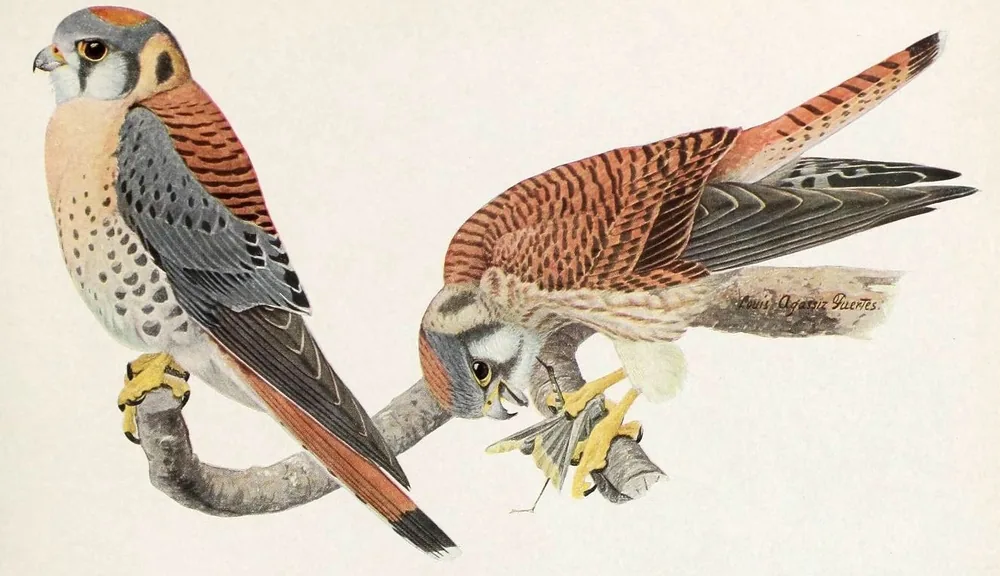
John James Audubon painted the American Kestrel as plate 142 of The Birds of America (1827–38), under the name American Sparrow Hawk. A free high-resolution scan is on Audubon.org. The pair shown here was painted by Louis Agassiz Fuertes for a New York State Museum report of 1912.
Updated
The story of this painting
The female, leaning low on the branch, holds a grasshopper in one foot. Elon H. Eaton, whose Birds of New York used this painting, knew the bird as the Sparrow Hawk: a hunter of open pastures, half-cleared hillsides and stream bottoms that watches from a dead branch or a telegraph pole, or hovers, looking for “its humble prey of mice and grasshoppers.”
Its high, quick killy, killy, killy was probably an alarm call, he thought, given fast when the nest was in danger. It nested in old woodpecker holes, usually a Flicker's. In winter some stayed on in New York City, Albany, Rochester, Buffalo and other towns, living mostly on House Sparrows, which he believed were plentiful enough to keep them from migrating. It took a small bird now and then, but he judged it “mostly a harmless and certainly an interesting neighbor.”
In Birds of New York this pair fills the top half of Louis Agassiz Fuertes's plate 52, at half life size, above two Pigeon Hawks, today's Merlins. Fuertes explained in a note at the front of the book that there was no room for a plate per species, so several often share one, at times “bringing birds together that seldom see each other.”
Story: Eaton, Birds of New York, part 2 (1914), pp. 103–105; part 2 (1914), plate 52; Fuertes, “Illustrator’s Note,” Birds of New York, part 1 (1910), pp. 9–10.
Audubon’s American Kestrel: plate 142, “American Sparrow Hawk”
Nero was a young male Sparrow Hawk that Audubon found lying near a log, crying for food, after it had fallen from the nest before it could fly. He took it home and fed it small birds, tearing the flesh for it at first. After a few weeks it was eating so many birds a day that he turned it out to fend for itself. It hunted grasshoppers, and when he came back from his walks he threw a dead bird high in the air, which Nero sometimes caught before it reached the ground.
Nero slept behind a window shutter, refused to eat woodpeckers, and liked to drop onto the back of a tame duck, which waddled off quacking in alarm with the hawk still on her. His end came when he went for a chicken and the mother hen fought back harder than he did.
Audubon thought it the most abundant hawk in the country, and one of the most beautiful. Standing on a fence stake, a broken treetop, a grain stack or the corner of a barn, it waits for a mole, a field mouse, a cricket or a grasshopper, then drops on it. His plate 142 shows two males and a female among the leaves and green nuts of a butternut, or white walnut, with a small bird caught as prey.
Story: Audubon, Ornithological Biography, vol. 2 (1834), pp. 246–252. See plate 142 free at Audubon.org.
More classic portraits, free to see
About the American Kestrel
- Where it has no good perch, an American Kestrel may hover over a field to look for prey. (Source: National Audubon Society)
Volunteers on the Christmas Bird Count picked up the American Kestrel's decline decades before other monitoring programs did, according to Audubon. Join this winter's count to keep the record going. (Source: National Audubon Society)
How long does an American Kestrel live?
An American Kestrel survives 12.6 months on average, by a figure cited in the US Forest Service's species review, and most never come near the maximum. The oldest known wild American Kestrel was at least 14 years and 8 months old (USGS Bird Banding Laboratory): it was banded in Utah in 1987 and found there again in 2001.
Sources: US Forest Service; USGS Bird Banding Laboratory. A banding record is the minimum age of one bird when it was found again, not a typical lifespan. How long do wild birds live?
How can you tell if a plate 142 print is an original?
By its size: an original plate 142 is a hand-colored sheet about 26 by 38 inches; the American Kestrel’s octavo version, plate 22, is book-size, from 1840–44. Many prints sold today are reproductions: how to tell an original from a reproduction. Rather have every plate in one book? Here’s which Birds of America book to buy.
In a Birdfolio hardcover, this painting sits beside the date and place you first saw a American Kestrel. See your own list as a book, free.