Classic bird paintings
Black-crowned Night Heron painting: Audubon's plate and other classic portraits
John James Audubon painted the Black-crowned Night Heron as plate 236 of The Birds of America (1827–38), an adult male and a young bird, under the name Night Heron or Qua bird. That plate is the painting shown here, and a free high-resolution scan is on Audubon.org.
Updated
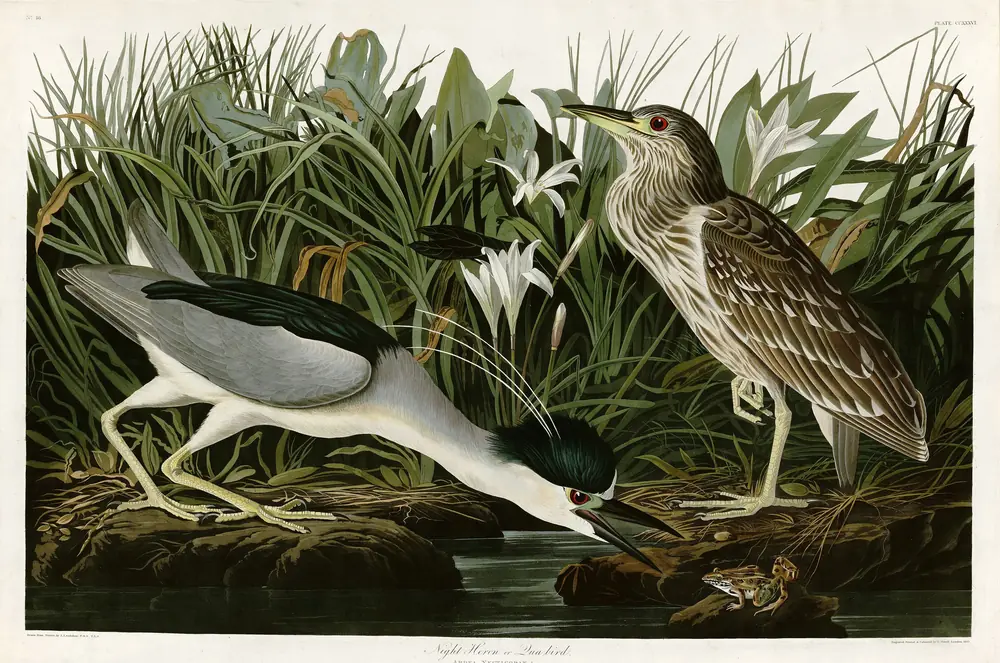
Audubon’s plate: plate 236, “Night Heron or Qua bird”
In January, on a bayou off the Halifax River in East Florida, about six miles below his friend John Bulow's plantation, Audubon found several hundred pairs of Night Herons already mated, among nests left standing from earlier years. Some European writers had called the bird scarce in the United States. “I wish these people had been with me,” he answered, to see a boatload of them shot in a few hours, in winter.
He recorded what people called it: Indian Pullet in South Carolina, Gros-bec among the Creoles of Louisiana, Indian Hen in East Florida, and Qua Bird in the Eastern States, from the loud, hoarse qua it gives on its night flights. On the ground, he noticed, it never stands still waiting for prey like the true herons, but walks about stooping, then shoots out its neck.
The plate shows an adult male in spring and a young bird after its first autumn molt; it takes three yearly changes of plumage, he wrote, to reach full dress. The frog beside them is one the heron often eats in the swamps. A tame Night Heron raised by Dr. Brewer of Boston hid when a cat came near, then rose up with a frightful cry.
Story: Audubon, Ornithological Biography, vol. 3 (1835), pp. 275–282; vol. 5 (1839), pp. 600–601. See plate 236 free at Audubon.org.
More classic portraits, free to see
- John James Audubon, The Birds of America, octavo edition (1840–44), plate 363: “Black-Crowned Night Heron or Qua Bird”. Free scan (New York Public Library Digital Collections)
- John Gould’s The Birds of Europe (1832–37), plate 279: “Common Night Heron” (Nycticorax europaeus). Free scan (University of Kansas Libraries)
- John Gould’s The Birds of Great Britain (1862–73), vol. 4, plate 26: “Night-Heron” (Nycticorax griseus). Free scan (University of Kansas Libraries)
- Louis Agassiz Fuertes, for Elon H. Eaton’s Birds of New York (1910–14), plate 24: “Black-crowned Night Heron”, with Great Egret, Sandhill Crane and Great Blue Heron. Free scan (Internet Archive)
About the Black-crowned Night Heron
- Black-crowned Night Herons usually feed from late evening through the night, though they also hunt by day. (Source: National Audubon Society)
How long does a Black-crowned Night Heron live?
The Black-crowned Night Heron's typical lifespan isn't given in any agency guide we checked. The oldest known wild Black-crowned Night Heron was at least 21 years and 5 months old (USGS Bird Banding Laboratory): it was banded in California in 1992 and found there again in 2012.
Source: USGS Bird Banding Laboratory. A banding record is the minimum age of one bird when it was found again, not a typical lifespan. How long do wild birds live?
How can you tell if a plate 236 print is an original?
By its size: an original plate 236 is a hand-colored sheet about 26 by 38 inches; the Black-crowned Night Heron’s octavo version, plate 363, is book-size, from 1840–44. Many prints sold today are reproductions: how to tell an original from a reproduction. Plate 236 and the other 434 also come bound in one modern book: which Birds of America book to buy.
In a Birdfolio hardcover, this painting sits beside the date and place you first saw a Black-crowned Night Heron. See your own list as a book, free.