Old bird nickname
Mud hen: the American Coot, and the Toledo Mud Hens
A mud hen is, most often, the American Coot: a plump, slate-gray water bird with a white bill that swims like a duck but belongs to the rail family. Dictionaries stretch the name to other marsh birds, but Toledo's baseball team means the coot, and so did Audubon, who wrote in 1835 that outside Louisiana the coot was “known by the names of Mud Hen and Coot.”
Updated
What is a mud hen?
Usually an American Coot, Fulica americana: about 15 inches long, charcoal gray with a blacker head, a thick white bill and a white-and-chestnut shield running up the forehead, says Audubon's field guide. Its eyes are red, and its toes carry lobed flaps instead of webs, Alabama's wildlife agency adds.
Watch one swim and its head nods in time with its feet, as Audubon noticed in 1835. It can't spring straight into the air: it runs pattering along the water to take off, which is why some Carolinians once called coots Flusterers. Coots gather on the water in big groups called rafts.
The name covers more than one bird. Merriam-Webster sends mud hen to marsh hen, “any of various American rails,” and Alabama's agency lists the coot's own other names: water hen, marsh hen, moor-head, water chicken, pull-doo and poule d'eau.
Why are they called Mud Hens?
Because Toledo's baseball team played beside a marsh full of coots. In 1896 the club, then called the Swamp Angels, played its Sunday games at the new Bay View Park, outside the city limits, because Toledo's Blue Laws banned sports on Sundays, MiLB.com's history of the name says. The coots' “guttural clucks and grunts” carried over the games, and the field stayed wet and muddy.
Fans began calling the players mud hens, and Charles J. Strobel, the club's new owner that year, made the name official. The team's own page still explains it as a marsh bird, the kind “known as marsh hens, rails, coots, or mud hens,” and links to the American Coot.
Toledo had tried plenty of names before: the Blue Stockings in 1883, the Avengers, the Black Pirates and the White Stockings. The teams of 1916 to 1918 were the Iron Men, but in the International League the club has been the Mud Hens since 1965. Its mascots, Muddy the Mud Hen and Muddonna, “look more like chickens than mud hens,” MiLB.com admits.
The bird had the name long before the team. The last volume of Alexander Wilson's American Ornithology, finished by George Ord after Wilson's death, says the coot is “known in Pennsylvania by the name of the Mud-hen.”
What level of baseball are the Mud Hens?
Triple-A: the Toledo Mud Hens are the Detroit Tigers' Triple-A affiliate and play at Fifth Third Field, the team says.
Television made them famous. Toledo native Jamie Farr played Corporal Maxwell Klinger on M\A*S*H*, and when the team's general manager, Gene Cook, sent “Max Klinger” a care package of Mud Hens gear, Klinger and other characters wore the caps and jerseys on the show, and souvenir sales soared, the team's FAQ says. Readers of Baseball America have voted it the most popular nickname.
Is a mud hen a chicken?
No, and it isn't a duck either. The official check-list puts the coot with the cranes and rails, in the order Gruiformes and the rail family, while chickens belong to the Galliformes and ducks to the Anseriformes.
The “hen” is easy to understand. The coot's bill is “triangular shaped like a chicken's beak,” Alabama's wildlife agency says, and Wilson's book found its gizzard like a hen's. When Audubon came on 600 to 700 coots grazing a savanna about 50 miles above New Orleans on March 21, 1822, he took them at first for a flock of Guinea fowl. Close up they nibbled the grass like poultry and fought like barnyard birds.
Audubon's mud hens
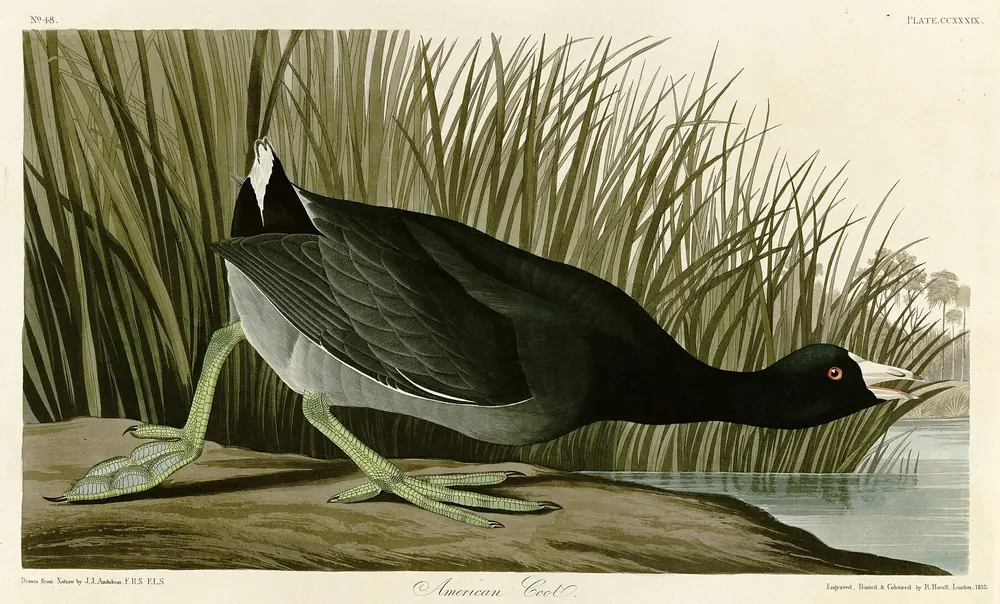
Plate 239 of The Birds of America, shown here, is titled American Coot, and the chapter Audubon wrote for it in 1835 is full of the bird's daily life. Its only call, he wrote, was a rough, guttural cruck, cruck. He never saw one dive for food, and he admitted that its main breeding places were “yet unknown to me.”
Coots were food in his day. A hunter working for him killed 80 with a single shot on Lake Barataria, and in autumn and winter the New Orleans markets sold them for gumbo; buyers skinned them like rabbits instead of plucking them. Coots caught in duck nets, he noticed, climbed out with bill and feet and dropped into the water “like so many terapins.”
The other mud hens and marsh hens
Rails and gallinules share the coot's farmyard names. Audubon titled two of his rail plates as marsh hens: the King Rail is his Fresh Water Marsh Hen and the Clapper Rail his Salt Water Marsh Hen. South Carolina's Department of Natural Resources still introduces the Clapper Rail as “also known as the marsh hen.”
Around Charleston, marsh hens were shot from canoes on the spring tides, from September to February; one marksman killed 50 with 50 shots. Audubon called the scene “a sorrowful sight.”
The Common Gallinule, the coot's cousin of the reeds, has collected more official names than nicknames: Florida Gallinule from 1886 to 1931, Common Gallinule in 1957, Common Moorhen in 1983, and Common Gallinule again since 2011, when the American birds were made a species apart from the moorhen of the Old World.
Wet ground breeds muddy names. The American Woodcock, a sandpiper of damp woods, has been a mud snipe and a bogsucker, and is best known as the timberdoodle.
Coots that count
For a bird whose name means a fool, the coot has surprised scientists. Over four years in British Columbia, a team from the University of California, Santa Cruz, tracked every egg in more than 400 coot nests, checked daily. Other females had slipped eggs into 41 percent of the nests.
The owners fought back. In 2003 the biologist Bruce Lyon reported that female coots recognize eggs that aren't theirs and count their own, and use both to decide how many eggs to lay; the egg pattern, the university's story said, “is like a fingerprint.” Its headline put it simply: “Coots can count.”
Coot chicks are odd too. They hatch with bright orange-tipped plumes, which fade after about a week, and a 2019 study from the same lab found that each parent picks a favorite chick and gives the bigger ones a shake by the back of the neck, called tousling; about half of each brood starves. No wonder the university called coots “the Rodney Dangerfields of the bird world.”
Old coot, bald as a coot
The coot gave English two put-downs. “A silly old coot” and “stupid as a coot” were common enough for Brewer's Dictionary of Phrase and Fable in 1895, and “bald as a coot” comes from the bare white patch the bill makes on the bird's forehead, the same shield you can see from across a pond.
Where the word coot came from is a mystery. It was cote or coote in Middle English and koet in Dutch, and Skeat's etymological dictionary calls its origin unknown.
Hunting mud hens
Coots are legal game birds, hunted alongside ducks. Under the federal rules for 2025–26 the daily limit was 15 coots in the Atlantic, Mississippi and Central Flyways and 25 coots and gallinules together in the Pacific Flyway, with three days' limit allowed in possession.
Few hunters bother. In Alabama coots are the most numerous waterfowl in the hunting season, yet few are taken, and Montana's wildlife magazine says the meat is often called muddy. Wilson's last volume already said Americans thought them “of no account.” A Minnesota hunters' club founded in 1979 named itself Coots Unlimited all the same, though its work was never about coots.
The oldest American Coot on record, a female banded in Alberta in 1961, was shot in Idaho in 1982, 22 years and 4 months later, the US Geological Survey's banding files show.
A coot on your list is an American Coot, whatever the old-timers called it; see your own list as a book, drawn from your eBird download.