2018 new name
Whiskey Jack, or Gray Jay, is now Canada Jay
The Gray Jay, also known as the whiskey jack, is now called the Canada Jay: the American Ornithological Society (AOS) changed its English name in June 2018, bringing back the name it had in the first official checklists. It is the same bird, so your life list doesn't change: no new species, just a new name.
Updated
What changed
Lives all year in the northern forests of Alaska and Canada, and in the northeastern US. In the West it lives in mountain forests south to New Mexico and Arizona, and near the Pacific coast south to northern California.
Surprising facts about the Canada Jay
It glues its food to trees with its own spit. The bird makes a special saliva in large glands. It molds each bite of food into a sticky blob and glues it behind flakes of bark, under lichen, among conifer needles or in the fork of a tree. It stores food this way all year round, says the National Park Service.
It nests in the dead of winter. The National Park Service says Canada Jays breed in frigid weather in February and March. The Royal Canadian Geographical Society says the bird has been recorded sitting on its eggs in snowstorms at −30°C. That is −22°F.
It lost Canada's public vote for a national bird, and was picked anyway. The Common Loon won the popular vote in 2016. The society that ran the vote chose the Gray Jay, as it was still called, instead. More on that below.
Why is it called whiskey jack?
The nickname "whiskey jack" has nothing to do with whiskey. Audubon's 2018 article on the name change says it likely comes from the Cree wisikejack or wisakedjak, a clever trickster in First Nations stories.
Its other nickname is "camp robber," and the bird earns it. The National Park Service says Canada Jays tend to be fearless of people, especially when food is involved. Audubon's field guide says they boldly enter campsites, and even cabins, to steal food.
If one comes close, enjoy the visit, but don't feed it. Mount Rainier National Park asks visitors to secure all their food and not to feed any wildlife.
Why the name changed
Canada Jay was the bird's name in the first two editions of the official checklist of North American birds, in 1886 and 1895. In 1957 the checklist switched to Gray Jay.
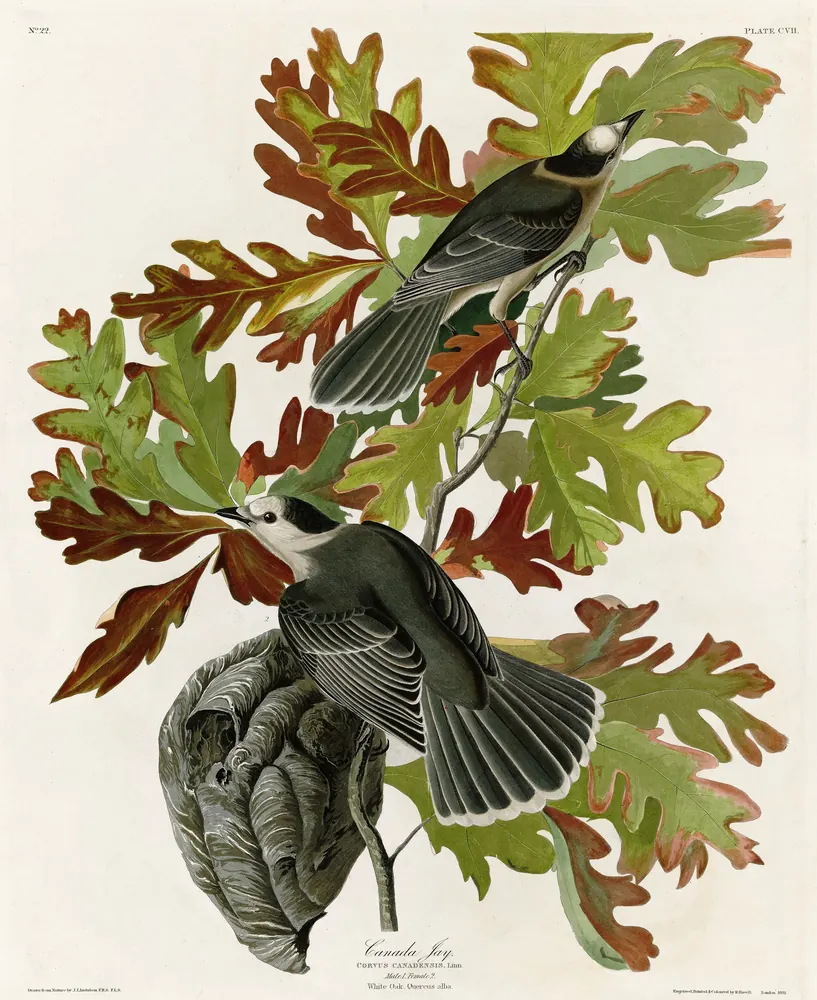
The old name is older still. John James Audubon used it in The Birds of America (1827–38): his plate 107 is titled "Canada Jay."
Dan Strickland, who had studied the bird since 1967, and six other ornithologists asked the AOS to bring the old name back. They showed that the 1957 change went against the committee's own naming rules.
A change like this needs the votes of two-thirds of the AOS's checklist committee. The Canada Jay proposal passed 9 to 1. The AOS noted that Canada Jay matches the scientific name, Perisoreus canadensis, and the bird's main home. The change also came after a campaign to make the Canada Jay the national bird of Canada.
Two years later the AOS changed another English name for a different reason: McCown's Longspur became Thick-billed Longspur in 2020, because of the man it honored.
Who decided, and when
- American Ornithological Society (AOS): the 59th Supplement to its Check-list, which restored the name Canada Jay
- eBird and the Clements Checklist: its 2018 taxonomy update
- AviList, the shared world checklist: agrees, with the same name
Is the Canada Jay Canada's national bird?
Not officially, not yet. In 2016 a Canadian society picked it as the national bird, and a bill to make that official was still waiting in Canada's Parliament in 2026.
The Royal Canadian Geographical Society, which publishes Canadian Geographic magazine, ran a National Bird Project that drew 50,000 votes. The Common Loon won the public vote. But on November 16, 2016, at the society's annual dinner in Ottawa, it named the Gray Jay as its choice.
The society gave its reasons. The bird lives in every province and territory, and almost all of its range is in Canada. It thrives in winter. And, the society said, it has the same brain-to-body ratio as dolphins and chimps.
On May 28, 2025, Senator Salma Ataullahjan introduced Bill S-221 in Canada's Senate, "to provide for the recognition of the Canada jay as the national bird of Canada." When we checked on October 7, 2026, Parliament's bill tracker showed it awaiting first reading in the House of Commons. So it is not law yet.
What does a Canada Jay look like?
Think of a large, fluffy chickadee: that is how Mount Rainier National Park describes it, with a short bill and a dark head. It is dark gray above and light gray below, with black on the back of its head like a partial hood.
It is 11 to 12¼ inches long and weighs about 2.5 ounces, according to Rocky Mountain National Park.
Young birds look different. At first they are mostly dark charcoal gray, with a paler whisker mark, says Audubon's field guide. And Pacific birds, like those at Mount Rainier, are darker than Rocky Mountain birds, with more black on the head, a white belly and a brownish tinge on the back.
What does a Canada Jay eat?
Almost anything it can find. Audubon's field guide lists insects, spiders, berries, seeds, fungi, small rodents, birds' eggs and carrion. It forages from tree to tree, and it saves extra food for later, glued in place with its sticky saliva.
Family life in the snow
Canada Jays pair for life: the National Park Service says mates stay together as long as both birds are alive. They usually live in small groups.
Nesting starts in late winter, while the breeding grounds are still under snow. The nest is 4 to 6 inches high, with a cup about 2 inches deep and 3 inches across. A clutch is 3 or 4 eggs, sometimes 2 to 5, and the eggs are incubated for about 18 to 22 days, says Audubon's field guide.
Where can you see a Canada Jay in the US?
Look in cool northern and mountain forests of spruce and fir, all year round. Audubon's field guide says it rarely lives where there are no spruce trees, and lists it in Alaska, the Great Lakes, New England, the Northwest, the Rocky Mountains, California and the Southwest, among other regions.
Two national parks describe it on their nature pages. In Rocky Mountain National Park in Colorado it lives in the subalpine forests. Mount Rainier National Park in Washington lists it as abundant all year in its forests and subalpine areas.
Often it finds you first. Audubon's field guide notes that a pair will sometimes trail a hiker through the north woods, flying quietly from tree to tree to watch.
It isn't rare. Audubon rates it of Least Concern, with a population of 27 million birds.
Which bird is it?
There is nothing new to tell apart: Gray Jay and Canada Jay are two names for the same bird.
In western mountain forests, two other birds can catch your eye. Clark's Nutcracker is also gray, but its head is pale gray with none of the Canada Jay's black. Its wings are dark with a white patch, and its tail is mostly white with black in the center.
Steller's Jay is dark blue overall, with a black head and a crest. A Canada Jay has no blue at all.
What it does to your list
A new name only: your Gray Jay now counts as Canada Jay. Your total doesn't change.
eBird has used the name Canada Jay since its August 2018 update. If an old notebook or an older list says Gray Jay, or Grey Jay in British spelling, it is the same species. If your list has both names, count the bird once.
Read more about how bird splits and lumps work, and why names change.
Want your jays and every other bird you've seen in one place? Make a book from your list and see the first pages free.
Check your own list. Drop your eBird download or type your birds: the free checker shows which of them this and other recent changes touched.
Check my list