Old bird nickname
Fish hawk: the Osprey's old name
A fish hawk is the Osprey, the big brown-and-white bird of prey that plunges feet first into water for fish. People have called it that for well over two centuries: Benjamin Franklin wrote of the “fishing hawk” in 1784, and Audubon titled his plate of it Fish Hawk. It was never the official name, but wildlife agencies still introduce the Osprey as the fish hawk.
Updated
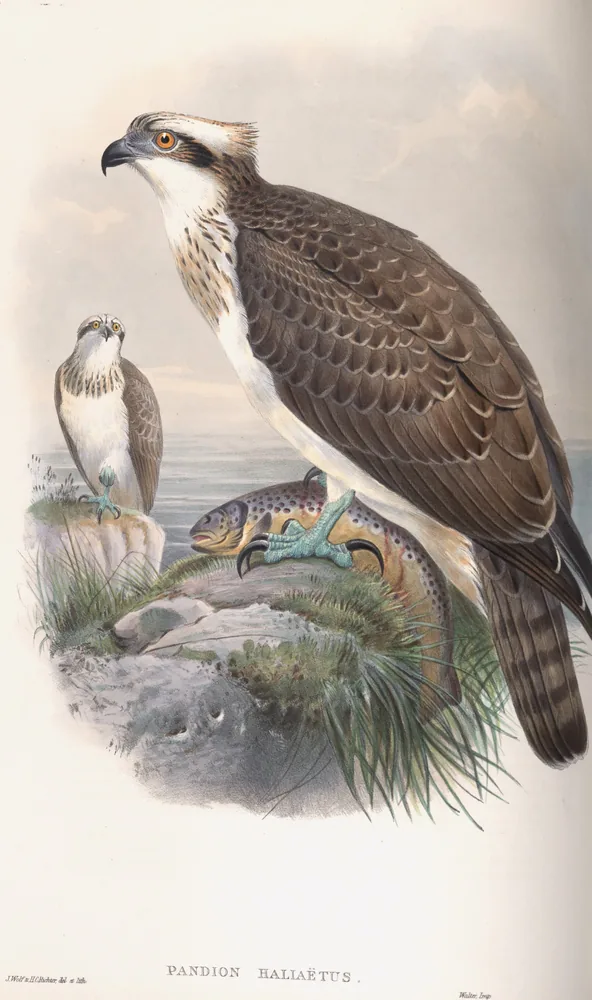
What bird is a fish hawk?
The Osprey, Pandion haliaetus. The American Heritage Dictionary gives fish hawk as another name for it, and the Chesapeake Bay Program's field guide opens the same way: “Also known as the fish hawk, the osprey is a large raptor.”
The name says what it does. An Osprey lives on live fish, and Canada's Hinterland Who's Who says that is “hence its nickname of fishing eagle or fish hawk.” It hunts over coasts, lakes and rivers on every continent except Antarctica.
It isn't quite a hawk, though. The official list gives the Osprey a family of its own, so wherever the old name was used, it meant this one bird.
What is a fish hawk called?
Its official name is Osprey, and has been since 1910. The American Ornithologists' Union, the forerunner of today's American Ornithological Society, listed the North American bird as the American Osprey in its first check-list in 1886, as bird number 364; the third edition, in 1910, shortened that to Osprey.
Fish Hawk was never the official name in any edition. It hides under the scientific one instead: the check-lists of 1931 and 1957 note that the American bird's name, carolinensis, was “based mainly on The Fishing Hawk” that Mark Catesby described from South Carolina.
The word osprey comes from the Medieval Latin avis praedae, bird of prey, the American Heritage Dictionary says. And in 2010 the American Ornithologists' Union took the Osprey out of the hawk family altogether, because of its “genetic and morphological distinctiveness.”
Franklin's fishing hawk
The best-known fish hawk in American writing is in a letter. On January 26, 1784, writing from Passy, near Paris, Benjamin Franklin answered his daughter Sarah Bache, who had sent him papers about the new Society of the Cincinnati and the bald eagle on its badge.
He didn't think much of the eagle. “He is a bird of bad moral character,” Franklin wrote, “too lazy to fish for himself”: it watches the labour of the fishing hawk, then chases it and takes the fish it was carrying to its mate and young.
Alexander Wilson, the naturalist who wrote American Ornithology, saw the same in 1812 and called the Bald Eagle the fish hawk's “common attendant, and constant plunderer.” Franklin's letter is published today by the American Revolution Institute of the Society of the Cincinnati, the very society it teased.
Audubon's Fish Hawk, plate 81
John James Audubon used the name too. Plate 81 of The Birds of America is titled Fish Hawk, and his chapter on it, in 1831, is “The Fish Hawk, or Osprey.” The plate shows a male rising with a fish, and Audubon named the fish: a Weakfish, “such as is represented in the plate.”
Weakfish were plentiful around Great Egg Harbor, New Jersey, and so were the hawks: there he saw “upwards of fifty of their nests in the course of a day's walk.” The heaviest fish he saw one lift weighed over 5 pounds, and when a gun went off, the hawk let it fall.
He found it unusually sociable for a bird of prey, migrating along the coast in flocks of eight or ten. Why he would rather have called it the Imperial Fisher is told on our Osprey painting page, with its portraits.
Why fishermen welcomed the fish hawk
To coast people in the early 1800s, the fish hawk's return meant fish. It reached the shores of New York and New Jersey about March 21, Wilson wrote in 1812, and the fishermen welcomed it as “the happy signal” that herring and shad were on their way; a man who shot one risked being insulted for it.
Farmers let it nest in the middle of their fields and along their fences. Dr. Samuel Mitchill of New York told Wilson that a nest on one's farm was thought lucky, so neither axe nor gun touched it; the pair on his own farm, in a dead chestnut tree, was killed with its young by Hessian soldiers in the Revolutionary War.
Not everyone was so respectful. Wilson's footnote tells of a man near Cape May who robbed a nest and had the innkeeper make the egg into egg-nog, which made him violently sick. Sailors on the coasting boats, meanwhile, took fish hawks circling high as a sign of a storm within hours; farmers had a weather bird of their own, the rain crow.
There were a great many of them. Wilson counted more than 20 nests within half a mile, and a Mr. Gardiner believed his small island held at least 300 nests with young.
A ship named Fish Hawk
In 1879 Congress gave $45,000 for a steamer for the US Fish Commission, planned mainly as a floating fish hatchery, and named it Fish Hawk. Commissioned in the spring of 1880, the coal-burning ship was 157 feet long, and each of its 36 hatching cones could hatch 200,000 shad eggs, NOAA Fisheries says.
It was “the first large vessel built by any nation” just for fisheries work. In 1880 it made four trips to the edge of the continental shelf, found tilefish there in numbers worth fishing, and brought back 40 new species of mollusks and 20 of fish. It served 46 years, from Maine to Florida, the Gulf of Mexico and Puerto Rico, until 1926.
The nickname is still in everyday use. New Jersey's 2024 osprey report begins “Ospreys, also known as fish hawks,” and for many years the bird flew on the back of Canada's $10 bill.
How to recognize a fish hawk today
Look for a big, long-winged bird, dark brown above and white below, with a dark stripe from the bill through the eye. It is 21 to 23 inches long with wings 5 to 6 feet across, says Audubon's field guide, and weighs 3 pounds to 4 pounds 6 ounces; females are the heavier.
In flight its long wings bend at the wrist, a crooked shape that from far off looks more like a big gull than a hawk. It hovers about 30 to 100 feet up, then dives feet first with its claws forward, and it carries its catch head first, which cuts the drag.
Its feet are made for fish. The outer toe turns backward, so it can grip with two toes in front and two behind, and the soles carry short, rigid spikes called spicules; Wilson compared them to “the teeth of a large rasp.” It eats live fish, typically 4 to 12 inches long, and on the Chesapeake that means perch, shad and menhaden.
Its nest grows every year from sticks and whatever else turns up, rope and plastic among them, and can reach 10 feet high, New York's Department of Environmental Conservation says.
The fish hawk's comeback
Ospreys nearly vanished from parts of the East, then came back. Between New York City and Boston there were an estimated 1,000 active nests in the 1940s and about 150 by 1969, New York's Department of Environmental Conservation says. DDE, from the pesticide DDT, thinned their eggshells until the eggs broke under the sitting bird.
DDT was banned in New York in 1971 and nationwide in 1972, and nest platforms helped: landowners put up poles near the water, and Ospreys took to them. By 1995 Long Island alone had 230 breeding pairs.
New Jersey's nests dwindled to about 50 by the early 1970s. Biologists moved eggs and young from cleaner nests into failing ones and put up platforms, and in 2023 they counted a record 800 occupied nests; in January 2025 the state moved the Osprey from threatened to stable.
Around the Chesapeake Bay, historically the world's largest breeding gathering of Ospreys, there are now 8,000 to 10,000 pairs, about a quarter of all the Ospreys in the lower 48 states, the Chesapeake Bay Program says.
Whatever an old notebook calls it, a fish hawk goes on a life list as an Osprey; here's how to print your life list with every bird under the name it has now.