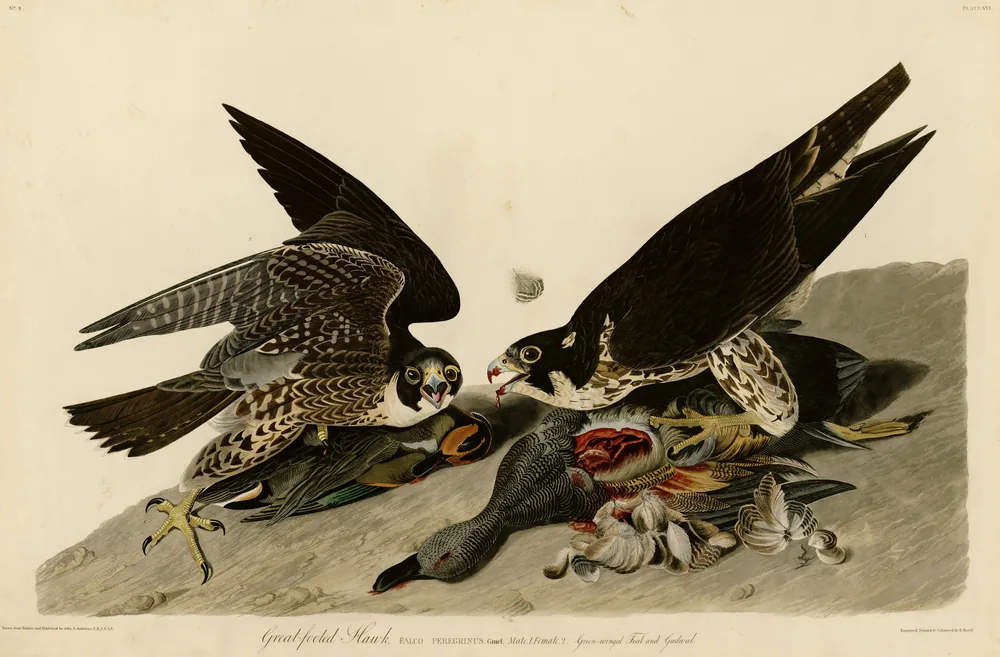
A falcon is not a hawk: falcons have a family of their own, and their DNA puts them nearer to parrots and songbirds than to the hawks they resemble. In the field, check the wing and the weapon. Falcons have long, pointed wings and kill with a notched bill; hawks have broader, rounder wings and kill with their feet. John James Audubon blurred the line himself: the two Peregrine Falcons below are plate 16 of his The Birds of America, titled "Great-footed Hawk."
Hawk vs falcon: the differences side by side
In the field, wing shape, flight and face markings tell most hawks from most falcons; how each kills, and whom each is related to, explains why they differ.
| Hawks | Falcons | |
|---|---|---|
| Family | Accipitridae, with the eagles and kites | Falconidae, with the caracaras |
| Nearest kin | Eagles, kites, Old World vultures; owls and woodpeckers further out | Parrots and songbirds, then the seriemas |
| Wings | Broad and rounded; a soaring hawk's wingtips spread like fingers | Long, pointed, swept back |
| Tail | Long in the bird-hunters, short and fanned in the soaring hawks | Long and narrow |
| Flight | Wide circles, or a few quick flaps and a glide | Fast and direct; seldom soars, though the kestrel hovers |
| Kills with | Mostly the feet: big talons on the inner and hind toes | Mostly the bill, with a bite to the neck |
| Bill | A plain hooked edge | A sharp point on each side, the "tomial tooth," with a notch below |
| Eyes | Yellow when young; dark red or dark brown in adults | Dark brown from the start |
| Face | Plain in most | A dark mustache or hood |
| Nest | Builds its own of sticks | Builds none: a ledge, a tree hole, a nest box or an old nest |
| Voice | Screams and whistles | Fast chatters, mostly near the nest |
Sources: Audubon's guide, the Pennsylvania Game Commission, The Peregrine Fund, HawkWatch International, a 2009 study of talons and the DNA studies below. The killing row is a tendency: a hawk's bill "can crush a prey's skull," the Game Commission notes, and a diving Peregrine knocks prey from the sky with closed feet before it bites (The Peregrine Fund). Audubon described the tooth back in 1831: "a sharp projecting process on each side." Eye color separates falcons only from accipiters and young hawks; a yellow eye rules out a Merlin, says HawkWatch's Jerry Liguori, so a streaky little raptor with yellow eyes is a young Sharp-shinned Hawk.
Is a falcon the same as a hawk?
No. Falcons and hawks belong to different families and different orders, and DNA shows that they evolved their hooked bills and sharp talons separately.
The surprise came from a laboratory. In 2008 Shannon Hackett and 17 co-authors compared about 32,000 letters of DNA from 19 genes in 169 bird species. Among their "most unexpected findings" (Science): parrots and songbirds are each other's closest kin, with falcons next to both, while falcons and hawks "formed distinct clades in all analyses," separate branches of the tree. Falcons got their hawk-like build "completely independently," the University of Florida said. In 2014 Erich Jarvis's team compared 48 whole genomes and again grouped falcons with seriemas, parrots and songbirds, and hawks with owls and woodpeckers.
The official list followed: in 2012 the American Ornithologists' Union moved falcons and parrots to just before the songbirds (The Auk). Falcons are "much more closely related to songbirds than to other 'hawks,'" the American Birding Association's blog explained, and its checklist (version 8.19) now puts the hawks seven families before the falcons. That doesn't make a falcon a parrot: Hackett's team found the exact placement "varied slightly among analyses." Owls are a third order, as our owl guide explains.
Why do falcons look so much like hawks?
Because they do the same work: catching live prey rewards a hooked bill, strong feet and keen eyes, so each family evolved those tools on its own. The 2014 genome study goes further. The common ancestor of the "core landbirds," the branch holding songbirds, parrots, owls, hawks and falcons, "may have been an apex predator," a way of life lost twice since. And the seriemas beside the falcons are "the sole living relatives" of the giant flightless terror birds. The sparrow at your feeder may descend from a hunter.
How to tell a hawk from a falcon in the sky
Sort the bird by shape first: hawk-watchers put most birds of prey into four groups by silhouette and wingbeat, and falcons make up one group. Pete Dunne's four, from Audubon magazine:
- Buteos (genus Buteo), the soaring hawks such as the Red-tailed: stocky, broad-winged and short-tailed, circling high.
- Accipiters (the old genus Accipiter), the Sharp-shinned and Cooper's Hawks and the goshawk: small head, long tail, short rounded wings, a burst of flaps and a glide.
- Falcons: "slender- and pointy-winged speedsters with steadier wing flaps," flying straight and rarely soaring.
- Eagles and vultures: big, dark and plank-winged.
The Northern Harrier breaks the pattern, coasting low over fields on wings held in a shallow V, and Audubon's guide calls the Gyrfalcon "very large and broad-winged," a falcon built like a hawk. Among falcons, Dunne gives the kestrel a light, bat-like flight, the Merlin wingbeats like pistons and the Peregrine shallow, supple ones. Perched, look for a falcon's dark mustache, an accipiter's long tail or a buteo's chunky body. Texas has its own field check.
Which is more powerful, a hawk or a falcon?
It depends on what you measure: for their size, hawks grip harder and falcons bite harder; falcons are faster; and a big hawk outweighs most falcons.
Diego Sustaita and Fritz Hertel measured bites and grips with force sensors: falcons bite significantly harder for their size, and accipiters grip harder, "but by a smaller margin" (meeting abstract; full study in the Journal of Experimental Biology, 2010). The talon study agrees that falcons kill "by severing the spinal cord." By weight, a Gyrfalcon reaches 4 pounds 10 ounces, more than any hawk below but the Ferruginous, at 4 pounds 14 ounces (Audubon's guide; our comparison).
Speed needs care. The Peregrine Fund says Peregrines have been timed diving "at speeds of over 200 mph," and Pennsylvania's Game Commission agrees; Audubon's guide says "well over 100 mph." A 2014 wind-tunnel study by Benjamin Ponitz and colleagues cites dives of more than 320 km/h, about 200 mph, yet its own trained falcons, diving in front of a 60-meter dam, reached about 80 km/h, or 50 mph (PLOS ONE). The famous number rests on few measurements; a falconer's skydive test is in our bird quiz. The Prairie Falcon, The Peregrine Fund thinks, is "probably just as fast."
Types of hawks in the US and Canada
By our count from the American Birding Association's checklist, 17 hawks nest or winter regularly in the US and Canada: 13 soaring hawks, 3 bird-hunting accipiters and the Northern Harrier. The checklist (version 8.19, January 2026) lists 37 hawk-family birds: these 17, 5 kites, 2 eagles and 13 rare strays. AviList's 2026 world list has 250 (our count).
| Soaring hawk | Length | Wingspan | Weight | Where and when |
|---|---|---|---|---|
| Red-tailed Hawk | 17–26 in | 45–52 in | 24–52 oz | Almost everywhere, all year |
| Red-shouldered Hawk | 16–24 in | 3 ft 4 in | 1–1.5 lb* | The East, California, Florida; mostly all year |
| Broad-winged Hawk | 13–17 in | 2 ft 8 in–3 ft 3 in | 9.3 oz–1 lb 3.8 oz | Eastern woods in summer |
| Swainson's Hawk | 18–22 in | 3 ft 10 in–4 ft 3 in | 1 lb 8 oz–2 lb 7 oz | Great Plains and the West in summer |
| Rough-legged Hawk | 18–23 in | 4 ft 4 in–4 ft 8 in | 1 lb 8 oz–3 lb 1 oz | Nests in the Arctic; winter visitor |
| Ferruginous Hawk | 22 in–2 ft 5 in | 4 ft 7 in–4 ft 11 in | 2 lb 14 oz–4 lb 14 oz | Dry plains of the West |
| Harris's Hawk | 18 in–2 ft | 3 ft 4 in–3 ft 11 in | 1 lb 8 oz–2 lb 9 oz | Southwest deserts, South Texas, all year |
| White-tailed Hawk | 17 in–2 ft | 3 ft 11 in–4 ft 7 in | 1 lb 13 oz–2 lb 13 oz | Texas coastal prairie, all year |
| Gray Hawk | 16.5–22 in | 2 ft 6 in–3 ft 1 in | 1 lb 1 oz–2 lb 2 oz | Southern Arizona, South Texas |
| Zone-tailed Hawk | 18–22 in | 3 ft 10 in–4 ft 6 in | 1 lb 10 oz–2 lb 4 oz | Southwest canyons, mostly summer |
| Common Black Hawk | 19–22 in | 3 ft 4 in–3 ft 11 in | 1 lb 9 oz–2 lb 10 oz | Southwest streams, March to October |
| Short-tailed Hawk | 15–20 in | 3 ft 3 in–3 ft 9 in | 1 lb–1 lb 9 oz | Florida |
| Hawaiian Hawk (ʻIo) | 16–18 in* | Not given | 15.6–21.3 oz* | Island of Hawaiʻi, all year |
| Bird-hunting hawk | Length | Wingspan | Weight | Where and when |
|---|---|---|---|---|
| Sharp-shinned Hawk | 10–14 in | 21 in | 3–7 oz* | Northern and western forests; feeders in winter |
| Cooper's Hawk | 15–18 in | 2 ft–2 ft 11 in | 8 oz–1 lb 8 oz | Most of the Lower 48, more and more in towns |
| American Goshawk | 20–26 in | 3 ft 6 in | 1–3.5 lb* | Northern and mountain forests |
Sizes are Audubon's guide's, starred ones The Peregrine Fund's (it puts the Red-tail at 17 to 22 inches and 1.5 to 3.25 pounds); females are larger in nearly all. The Northern Harrier, 16 to 24 inches and 12 to 18 ounces, hunts marshes and fields almost everywhere, partly by ear, as a quiz question explains.
The ʻIo lives only on the Island of Hawaiʻi, where Native Hawaiians count it among their ʻaumākua, family gods (Hawaii's wildlife division). It came off the federal endangered list in 2020 at about 3,000 birds, though The Peregrine Fund still rates it Near Threatened. Two strays, the Hen Harrier and the Oriental Honey-buzzard, joined the list in 2026 (new birds page). Three of the hawks have painting pages: Red-tailed, Red-shouldered and Cooper's.
What are the most common hawks?
The Red-tailed Hawk, "the most widespread" of North America's big soaring hawks, says Audubon magazine; then the Red-shouldered, Cooper's, Sharp-shinned and Broad-winged. Audubon's guide puts the Red-tail at 3.1 million birds and Cooper's and the Sharp-shin at 1 million each, figures of unstated origin that look like whole-range estimates (our assumption). The commonest falcon is in trouble: the guide counts 9.2 million American Kestrels, yet says their numbers "have been declining since 1966." Iowa's answer is below.
Are kites and eagles hawks?
Yes, by family: both belong to Accipitridae, which the American Birding Association's checklist heads "Hawks, Kites, Eagles, and Allies." The five regular kites:
| Kite | Length | Wingspan | Where | Eats |
|---|---|---|---|---|
| Swallow-tailed Kite | 22–24 in | 4 ft 2 in | Southeast, Florida, Texas | Insects, frogs, lizards, nestlings |
| White-tailed Kite | 14–15 in | 3 ft 3 in–3 ft 6 in | California, Texas, Florida | Voles and mice, found by hovering |
| Snail Kite | 14–16 in | 3 ft 7 in–3 ft 10 in | Florida marshes | Apple snails |
| Hook-billed Kite | 15–17 in | 33 in | Lower Rio Grande, Texas (rare) | Tree snails |
| Mississippi Kite | 12–14 in | 3 ft | Southern Plains, Southeast | Big insects caught in the air |
By length the Swallow-tailed is the biggest kite and the Mississippi the smallest (our comparison). Florida's Snail Kites are endangered, and a Mississippi Kite "might suggest Peregrine Falcon" (Audubon's guide) until you watch it fly. Eagles are below; the kites that nest in Texas have their own section of the Texas guide.
What are the biggest and smallest hawks?
The biggest is the Ferruginous Hawk, up to 29 inches long and 4 pounds 14 ounces, with a wingspan near 5 feet; the smallest is the Sharp-shinned Hawk, 10 to 14 inches and 3 to 7 ounces. The Peregrine Fund calls the Ferruginous "the largest and heaviest of the buteo hawks." Next by top weight come the American Goshawk, "North America's largest accipiter," and the Red-tail; the lightest after the Sharp-shin are the Northern Harrier and the Broad-wing (our ranking).
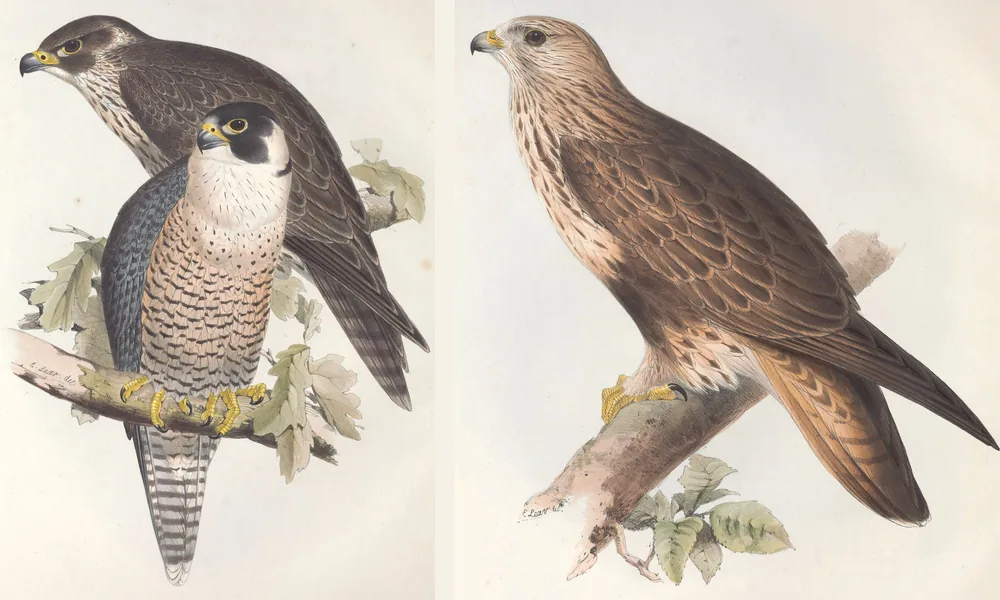
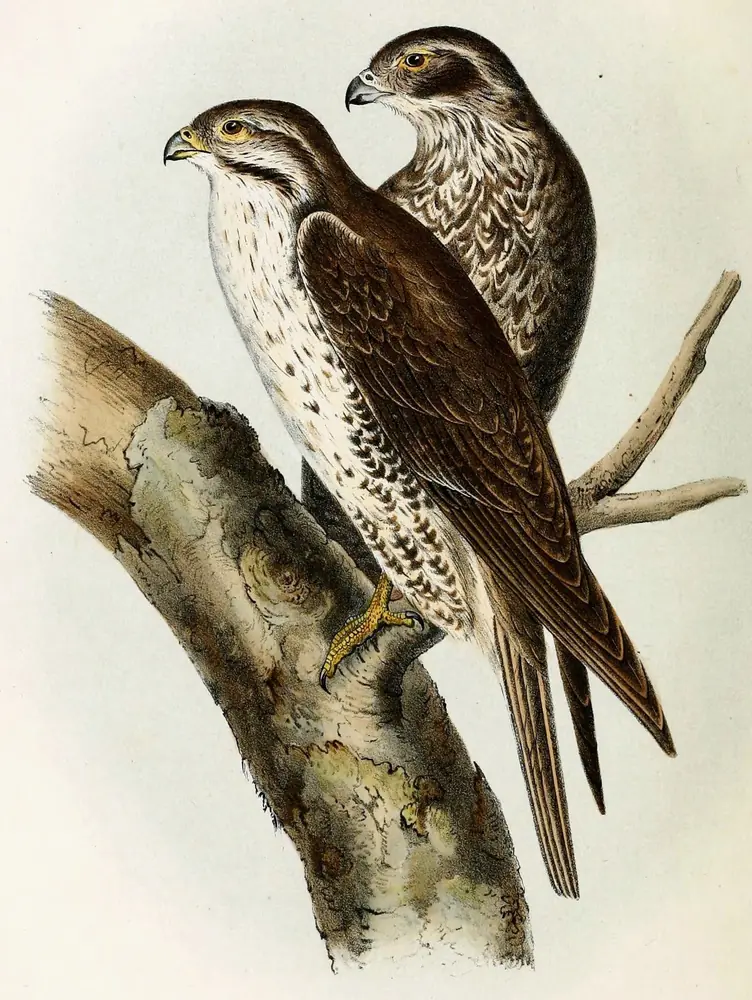
Females are larger, "in some cases, nearly twice as heavy" (Pennsylvania Game Commission), so a female Sharp-shin "can be almost as big as" a male Cooper's (Audubon's guide). The Ferruginous and the Rough-legged are North America's two "booted" hawks, legs feathered to the toes (The Peregrine Fund), like Edward Lear's Rough-leg above. Long ago, says Audubon's guide, some Ferruginous nests "were built of bison bones and lined with bison dung."
Types of falcons in North America
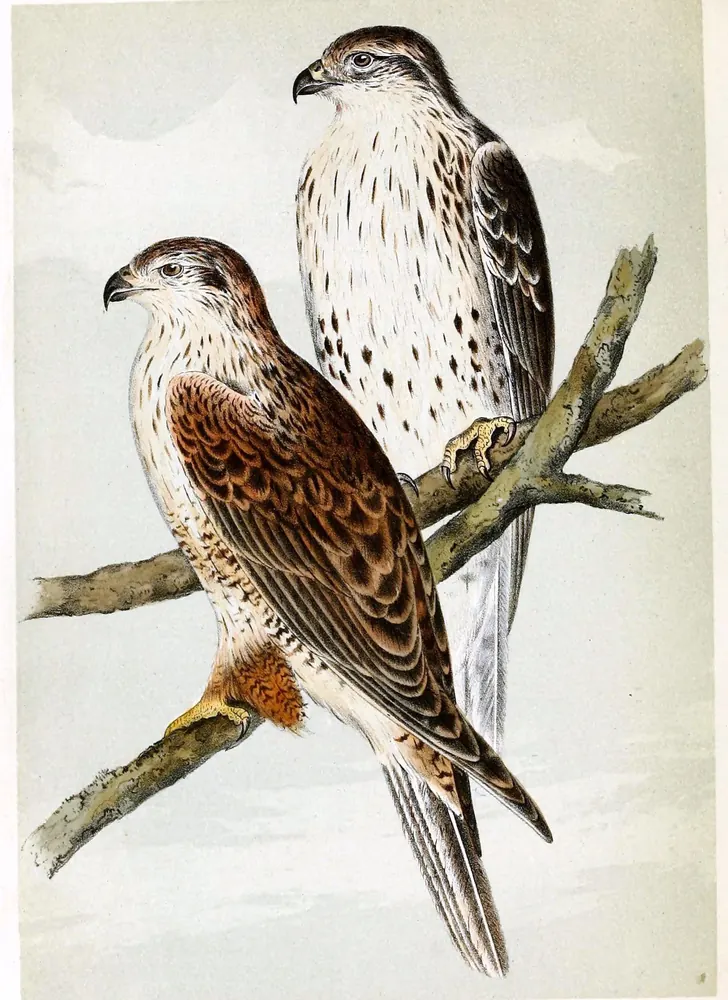
North America's nesting falcons are the American Kestrel, Merlin, Peregrine Falcon, Prairie Falcon, Gyrfalcon and the reintroduced Aplomado Falcon; the Crested Caracara shares their family but lives more like a vulture.
| Falcon | Length | Wingspan | Weight | Where |
|---|---|---|---|---|
| American Kestrel | 8.7–12.2 in | 20–24 in | 2.8–5.8 oz | Open country almost everywhere |
| Merlin | 10–14 in | 23 in | 5–8 oz* | The north and northern plains, now towns too |
| Peregrine Falcon | 14–19 in | 2 ft 7 in–3 ft 9 in | 11.6 oz–3 lb 5 oz | Cliffs, coasts and cities |
| Prairie Falcon | 14–19 in | 2 ft 11 in–3 ft 7 in | 1 lb 5 oz–2 lb 5 oz | Dry open country of the West |
| Gyrfalcon | 19.7–25 in | 4 ft–4 ft 11 in | 1 lb 12 oz–4 lb 10 oz | The Arctic; a few young birds winter south |
| Aplomado Falcon | 14–16 in | 3 ft–3 ft 4 in | 7.8–10.6 oz | Reintroduced in South Texas and New Mexico |
| Crested Caracara | 19–23 in | 4 ft | 2 lb 5 oz–2 lb 14 oz | Florida, Texas, Arizona; eats carrion |
The starred weight is The Peregrine Fund's, the rest Audubon's guide's. The last known wild US Aplomado pair was seen in New Mexico in 1952, and The Peregrine Fund calls it the last US falcon on the federal endangered list; our New Mexico page has the rule that brought it back. Vermont's first Crested Caracara, a bird nicknamed Elvis, is on our Vermont page. Six more falcon-family birds are rare strays, and AviList counts 65 worldwide (our count).
What is the smallest falcon?
In North America, the American Kestrel, at 2.8 to 5.8 ounces, which The Peregrine Fund likens to "about 34 pennies." We couldn't confirm the world's smallest; The Peregrine Fund calls Africa's Pygmy-falcon "the smallest raptor on the entire African continent."
What is the biggest falcon?
The Gyrfalcon, "the largest true falcon in the world," says The Peregrine Fund: up to 25 inches long, with a wingspan near 5 feet. A female can weigh 4 pounds 10 ounces (Audubon's guide), and in the Middle Ages, The Peregrine Fund adds, only a king could hunt with one.
What is the difference between a kestrel and a Merlin?
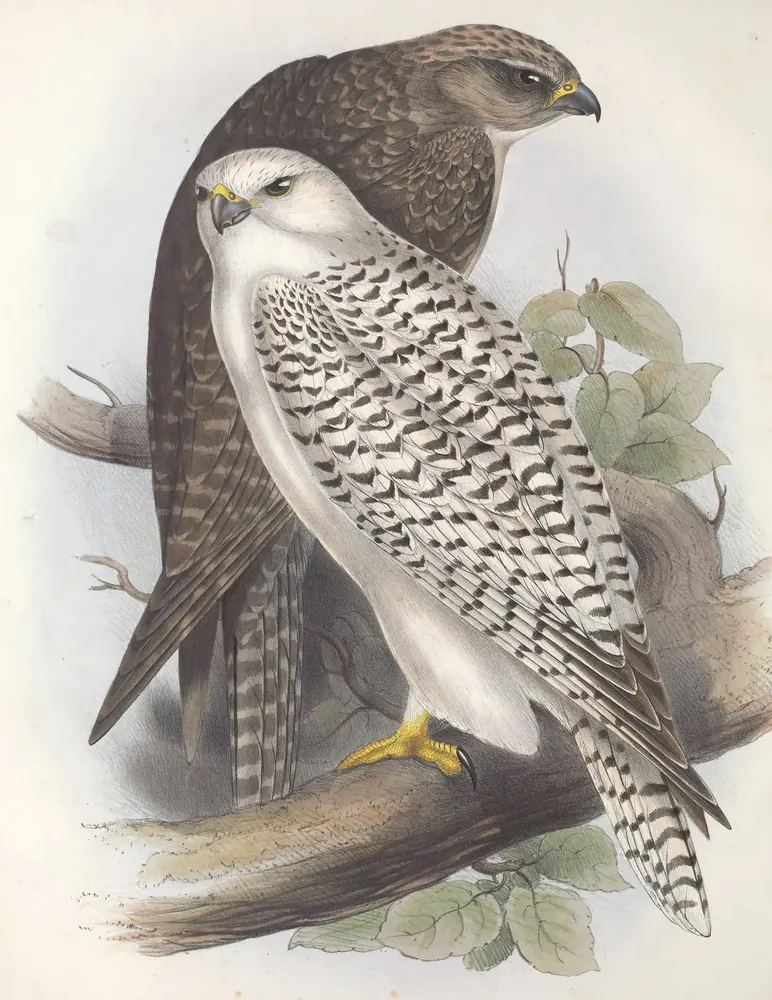
The kestrel is smaller and paler, with two dark face stripes, and it hovers; the Merlin is darker and heavier, and it flies fast and low on quick, hard wingbeats. In a glide a kestrel floats and a Merlin sinks, Dunne notes. The Merlin is "usually silent"; the kestrel calls killy-killy-killy (Audubon's guide). Only male kestrels have blue-gray wings, making the kestrel "one of only three raptor species in North America" whose sexes look different (The Peregrine Fund). A kestrel kills a mouse "by snapping its neck with the curve in its beak," an Iowa account says; Audubon's pet kestrel is on its painting page.
How do you tell a Peregrine Falcon from a Prairie Falcon?
Look at the head and the wingpits: a Peregrine is darker, with a dark hood, while a Prairie Falcon is sandy brown with a thin whisker mark and black patches where the wings meet the body. Both are 14 to 19 inches long; the Prairie hunts low and fast over open ground, the Peregrine dives from high above (Audubon's guide).
Where do Peregrine Falcons live, and what do they eat?
In North America they nest on cliffs and coasts and, more and more, on city buildings and bridges, and they eat mostly birds, pigeons above all in cities. Prey can be as small as a songbird or "as large as loons, geese, large gulls" (Audubon's guide), and some northern birds fly a yearly round trip "of more than 20,000 miles" to southern South America (The Peregrine Fund). Females are the bigger birds. Their move to the skyscrapers is below.
Why are there kestrel boxes on highway signs?
Because Iowa started it: in the early 1980s Ron Andrews of the state's Department of Natural Resources began fixing nest boxes to the backs of interstate signs, and kestrels "almost immediately made use of these." Roadsides suited the little falcons but offered few places to nest, so with a Clear Lake Boy Scout's help Andrews got permission to use the signs (Iowa Ornithologists' Union newsletter, 1991); the smooth metal posts "can't be climbed by predators" (Ames Daily Tribune, 1997). In a doctoral study of Interstate 35's kestrels, only 2 of 16 young that died were killed by traffic; most fell to mammals.
Hawk sounds: which hawk is screaming?
A long, hoarse scream from the sky is almost always a Red-tailed Hawk; a repeated kee-yeeear from the woods, a Red-shouldered Hawk or a Blue Jay copying one; a fast kak-kak-kak near a nest, an accipiter or a falcon.
Hollywood borrows the first. Films often give a Bald Eagle the Red-tail's cry in place of its own "meek, high-pitched cries," Audubon magazine has noted. Hear a real one in the National Park Service's Bald Eagle at Yellowstone.
| What you heard | Most likely | When |
|---|---|---|
| A hoarse, falling scream, keeeeer | Red-tailed Hawk | All year |
| A shrill kee-yeeear, again and again | Red-shouldered Hawk, or a Blue Jay | Loudest in spring |
| A thin, high whistle, pe-heeeeeee | Broad-winged Hawk | Spring and summer |
| A loud cack-cack-cack-cack | Cooper's Hawk | Near the nest |
| A sharp kik-kik-kik-kik | Sharp-shinned Hawk | Near the nest |
| A loud kak-kak-kak as you come close | American Goshawk | At the nest |
| A long, plaintive whistle, kreee | Swainson's Hawk | Summer, on the Plains |
| A loud, falling kree-e-ah | Ferruginous Hawk | Nesting season |
| A clear whistle, who-fleeer | Gray Hawk | Near the nest |
| A harsh, low hiss | Harris's Hawk | Around its family group |
| Kee-kee-kee | Northern Harrier | At the nest only |
| A shrill killy-killy-killy | American Kestrel | All year, when excited |
| A high cackle, klee-klee-klee | Merlin | Near the nest |
| A rasping kack-kack-kack-kack | Peregrine Falcon | At the nest |
| A loud kree-kree-kree | Prairie Falcon | Near the nest |
| A high, harsh cackle | Crested Caracara | Courting pairs |
| Squeaky chatter, thin squeals | Bald Eagle | All year |
| Loud, musical chirps | Osprey | Near the nest |
The calls and seasons are Audubon's guide's. The Park Service also has a Peregrine at Bryce Canyon, with a raven, and an Osprey at Grand Teton; the Blue Jay's hawk act is a quiz question.
What does a Red-tailed Hawk sound like?
A hoarse, falling keeeeer that "lasts for two to three seconds," says Audubon magazine; young birds give "a series of short shrieks."
What does a Cooper's Hawk sound like?
A loud cack-cack-cack-cack, mostly near the nest; the smaller Sharp-shin gives a sharp kik-kik-kik-kik (Audubon's guide).
What sound does a falcon make?
Quick chatters rather than screams: the kestrel's killy-killy-killy, the Peregrine's kack-kack-kack, the Prairie Falcon's kree-kree-kree; away from the nest most falcons are silent.
Hawk vs eagle: what's the difference?
Mostly size: eagles are hawk-family birds, but a Bald Eagle spans about 6 feet 8 inches and weighs up to 13 pounds 14 ounces, against 45 to 52 inches and at most 52 ounces for a Red-tailed Hawk.
| Red-tailed Hawk | Bald Eagle | Golden Eagle | |
|---|---|---|---|
| Length | 17–26 in | 2 ft 3 in–3 ft | 30–41 in |
| Wingspan | 45–52 in | 6 ft 8 in | 6 ft 6 in |
| Weight | 24–52 oz | 6 lb 10 oz–13 lb 14 oz | No figure in the guide |
| In flight | Circles on broad wings | Huge, flat wings, slow beats | Long, broad wings held flat |
| Voice | Hoarse scream | Weak squeaks | "Usually silent" |
The figures are Audubon's guide's. "Hawk" and "eagle" are everyday words, not scientific ranks. Bald or Golden? See the Bald Eagle page; lifespans are in how long Bald Eagles live.
Cooper's Hawk vs Sharp-shinned Hawk
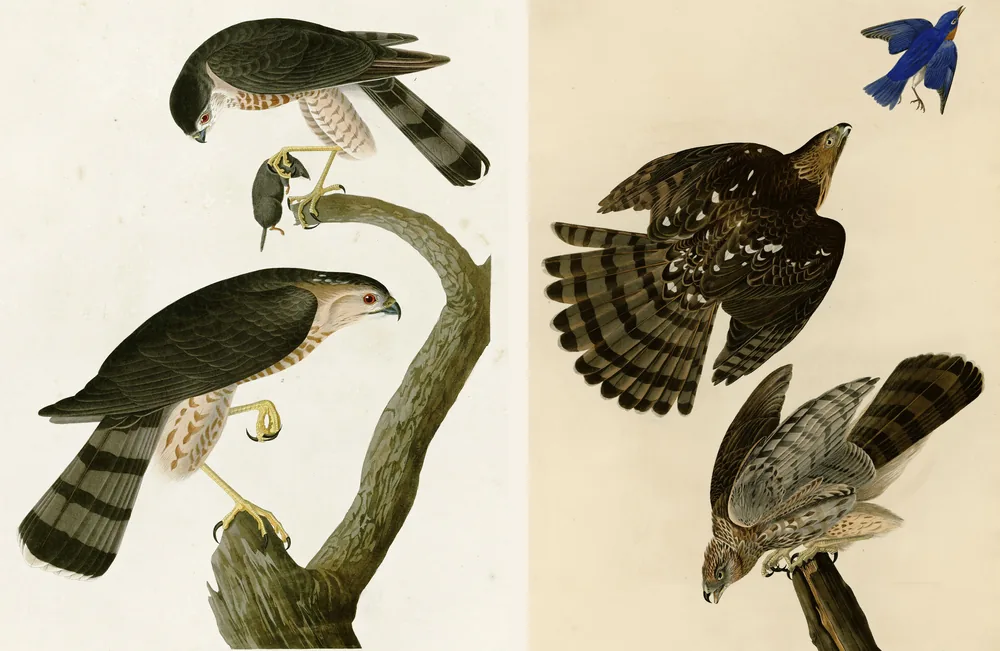
The Cooper's is the bigger bird, with a bigger head, thicker legs and a longer, rounded tail tipped with a broad white band; the Sharp-shin is smaller and small-headed, with a square tail and "pencil-thin legs."
| Clue | Sharp-shinned Hawk | Cooper's Hawk |
|---|---|---|
| Size | 10–14 in, 3–7 oz | 15–18 in, 8 oz–1 lb 8 oz |
| Head | Small, even in flight | Big; adults wear a dark cap |
| Tail tip | Square or notched | Rounded, with a wider white tip |
| Legs | Pencil-thin | Thicker |
| Young birds | Blurry streaks below | Crisp dark streaks on a white chest |
| Eyes | Yellow when young, dark red in adults | The same |
| Voice | kik-kik-kik-kik | cack-cack-cack-cack |
| Prey | Birds from sparrow to robin size | Birds the size of robins, jays and flickers; chipmunks, squirrels |
Big female Sharp-shins overlap small male Cooper's, so some birds can't be named for certain. Since 2025 they aren't even in one genus: the Cooper's is Astur, with the goshawk, the Sharp-shin still Accipiter (ABA Checklist 8.19; the goshawk split page explains). What a hawk at the feeder is after is in the Texas guide.
Red-tailed Hawk vs Red-shouldered Hawk
Check the tail and the wings: an adult Red-tail's tail is plain reddish above, while a Red-shoulder's tail and wings are crossed by narrow black-and-white bands, with reddish shoulders and chest and a pale crescent near each wingtip in flight.
| Clue | Red-tailed Hawk | Red-shouldered Hawk |
|---|---|---|
| Size | Bigger: 45–52 in across, 24–52 oz | Smaller: 3 ft 4 in across, 1–1.5 lb |
| Tail | Reddish above in adults | Narrow black-and-white bands |
| Front | White chest, dark belly band (East) | Reddish chest and shoulders |
| In flight | Dark leading edge on the inner wing | Pale "windows" near the wingtips; flaps and glides |
| Lives in | Open country, roadsides, poles | Wet woods, river bottoms, swamps; leafy suburbs |
| Voice | Hoarse keeeeer | Repeated kee-yeeear |
| Eats | Voles, rats, rabbits, ground squirrels; birds up to pheasant size; snakes | Voles, chipmunks, frogs and toads, crayfish, snakes |
The rows are Audubon's guide's, with The Peregrine Fund's weight for the Red-shoulder. In Texas, see which hawk has a red breast.
What bird is mistaken for a hawk?
Most often a vulture, a falcon, or a bird with "hawk" in its name that isn't one, such as the Common Nighthawk.
- The Turkey Vulture, which one hawk imitates to hunt (Texas guide); the Black Vulture page compares the two vultures.
- A falcon: a perched Merlin can pass for a young Sharp-shin until you see its dark eye (HawkWatch).
- The Common Nighthawk, a moth-eater of the nightjar family, which Audubon painted as the "Night Hawk," plate 147.
- The Mississippi Kite, which can suggest a Peregrine.
- A Blue Jay doing a Red-shouldered or Broad-winged Hawk call.
- The Northern Hawk Owl, an owl that hunts by day (types of owls).
What are other names for hawks?
Plenty, and many old ones belonged to falcons: chicken hawk and hen hawk, pigeon hawk, sparrow hawk, marsh hawk, fish hawk and, on the world list, buzzard.
Audubon grumbled in 1831 that farmers named these birds by size, "Hen Hawk," "Chicken Hawk," "Pigeon Hawk," and that Louisiana's French and Spanish settlers called them all Mangeurs de Poulets, chicken-eaters. Then his own plates called the Peregrine the Great-footed Hawk (16), the Merlin the Pigeon Hawk (92), the kestrel the American Sparrow Hawk (142), the harrier the Marsh Hawk (356), the Osprey the Fish Hawk (81), Swainson's Hawk the Common Buzzard (372) and the Rough-legged Hawk a Rough-legged Falcon (166, 422).
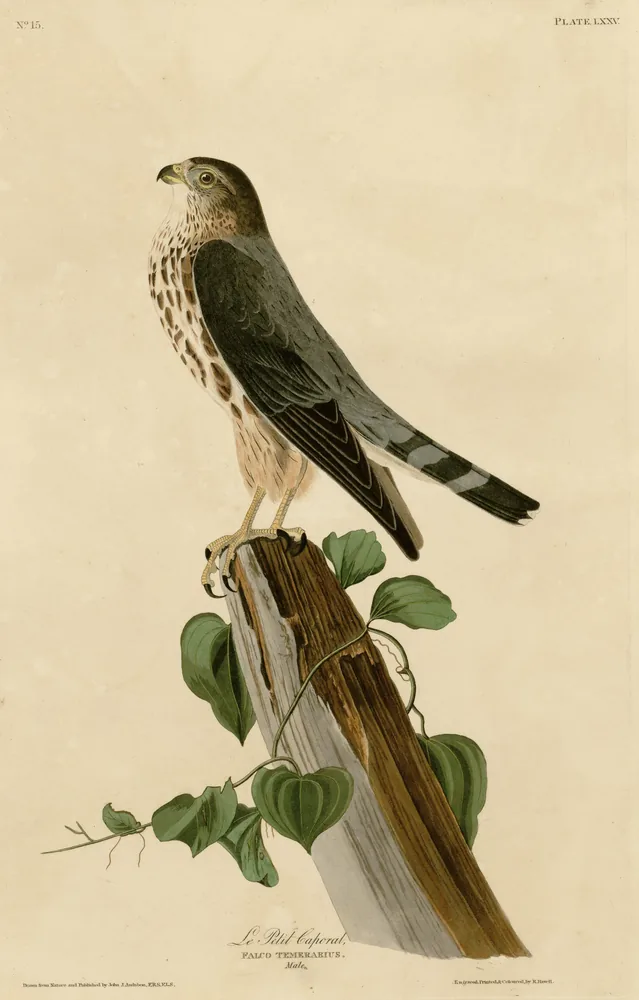
One falcon got a grander name. In April 1812, near Fatland Ford, Pennsylvania, Audubon shot a small falcon he took for a new species and named it Le Petit Caporal, after Napoleon's nickname among his soldiers; had it been "a new Eagle," he wrote in 1831, he would have used Napoleon or Bonaparte. It was a Merlin, and he later took the name back, as Audubon's birds then and now tells; his life is in our Audubon guide.
| Name | Bird |
|---|---|
| Chicken hawk, hen hawk | Any big hawk; a USDA plate of 1908 reads "Cooper Hawk (Chicken Hawk)" |
| Sparrow hawk | American Kestrel (Audubon's old names) |
| Pigeon hawk | Merlin |
| Marsh hawk | Northern Harrier |
| Fish hawk, sea hawk | Osprey |
| Buzzard | The world list's Rough-legged Buzzard; in the US, usually a vulture |
| Sharpie | Sharp-shinned Hawk |
| Jack | A male Merlin, in falconry |
The names come from Audubon, the Pennsylvania Game Commission, The Peregrine Fund, AviList and our Cooper's Hawk page. Whatever Audubon called it, a Peregrine on your life list is a falcon, and a Birdfolio prints it under that name, illustrated by a classic plate, along with all the birds you've seen: take a look at the pages.
What is hawks' biggest enemy?
People: shooting, poisoning, lost habitat and collisions have killed far more hawks and falcons than any predator; among animals, the Great Horned Owl is the one that takes hawks, mostly at night. The Peregrine Fund names those same threats for the Broad-winged Hawk.
Birds of prey were long "labeled 'chicken hawks' and shot, trapped or poisoned indiscriminately," says the Pennsylvania Game Commission; that state's bounties, and the shooting Hawk Mountain stopped in 1934, are on our Pennsylvania page. The Great Horned Owl eats hawks (Audubon's guide), yet at Pinnacles National Park in 2018 biologists found a Red-shouldered Hawk nestling being raised in a Great Horned Owl nest, probably carried in as food. The chicks preened each other until the nest tree fell on May 11, and the young hawk very likely died (National Park Service).
In the Second World War, Britain ordered its own Peregrines killed: they were eating the homing pigeons that Allied planes carried to report a downed crew's position. "Between 1940 and 1946, around 600 were shot," writes Helen Macdonald of the University of Essex. A February 1941 RAF pigeon-service article said "the destruction of peregrine falcons has been authorised" and that a survey had found 78 eyries, or nests (Legion Magazine reprint). Meanwhile the falconer Ronald Stevens flew a secret falcon squadron over the Scilly Isles and the coast from 1941 to 1943 to catch enemy pigeons; of those caught, Macdonald writes, "only two carried messages."
How did the Peregrine Falcon come back?
With human help, and by moving to town: after DDT wiped it out of the East, captive-bred young were released from 1974 on, and many pairs now nest on bridges, buildings and smokestacks. From the U.S. Fish and Wildlife Service's 1999 rule ending its federal listing:
- 1964: no active nests at 133 sites once used in the eastern US and the Canadian Maritimes; DDT had left eggshells more than 17% thinner.
- From 1974: about 6,000 captive-raised young released across North America (The Peregrine Fund counts more than 4,000 of its own).
- 1998: 1,650 pairs in the US and Canada; 87% of Midwestern pairs and 33% of eastern pairs nested on "bridges, buildings and smokestacks."
Pennsylvania had none nesting from about 1959 to 1987; the first pairs back used Philadelphia-area bridges, and the state delisted the falcon in 2021 (Game Commission). For the Bald Eagle's recovery from DDT, see its painting page.
What is the most aggressive hawk?
The American Goshawk, which Pennsylvania's Game Commission calls "one of the most aggressive raptors in the forest." Nesting adults dive at intruders, people included (Audubon's guide); our goshawk page has the rest. Size isn't everything: the Aplomado Falcon, under 11 ounces, dives on far bigger intruders and sometimes knocks them "on the back of the head," and Harris's Hawks hunt in packs of two or three (The Peregrine Fund).
Can a hawk pick up a 20 pound dog?
No: "a hawk cannot fly while carrying more than its body weight," writes Matthew L. Miller of The Nature Conservancy, and a Red-tailed Hawk, the most widespread big hawk here, tops out near 3 pounds. Smaller pets are covered in our birds of prey guide, eagles on the Bald Eagle page.
Questions people ask
When do hawks migrate, and where can you watch them?
Fall is the big season: Broad-winged Hawks pour south in flocks called kettles, bound for South America, Red-tails and goshawks move "relatively late in fall" (Audubon's guide), and Rough-legged Hawks arrive from the Arctic for the winter. The counts are on our pages for Hawk Mountain, Duluth's Hawk Ridge and Corpus Christi.
Does Hawaii have a hawk?
Just one native hawk: the ʻIo, on the Island of Hawaiʻi (above).
Is an Osprey a hawk?
Not quite: the official lists give it a family of its own, Pandionidae. See our Osprey page.
Can I keep a hawk feather?
Not without a permit: federal law covers hawks down to the feather. The fines are listed in the Texas birds of prey guide.