Old bird nickname
Bull bat: the Common Nighthawk, and why the South shot it
A bull bat, or bullbat, is the Common Nighthawk: a long-winged, dusk-flying bird of the nightjar family, cousin of the Whip-poor-will, that hunts insects in the evening sky. A century ago it was the bird's everyday name across the South, where shooting bullbats was an evening sport, and it is neither a bat nor a hawk.
Updated
What bird is called a bull bat?
The Common Nighthawk. Bull-bat was “the name by which he is commonly known in the South,” said the account in Pearson's Birds of America in 1917, and a 2018 book on the birds of the Carolinas still lists Bullbat first among its folk names, ahead of Mosquito Hawk and Moth Hunter.
The federal government used the name too. The 1916 treaty with Great Britain that protects migratory birds lists “nighthawks or bull bats” among the insect-eating birds closed to hunting all year, and Agriculture Department bulletins of 1915 and 1916 wrote of “the nighthawk, or bull-bat.”
For generations of Southerners, the Carolinas book says, the call of the bullbat was the first sign of fall. Kenn Kaufman wrote in Audubon magazine in 2026 that a century ago Americans often knew the bird by its nickname, bullbat.
Why is it called a bull bat?
Probably for the roar of its dive. The American Heritage Dictionary says the name comes from its roaring sound in flight: the boom a male makes as he pulls out of a steep dive, which Pearson's book likened to “the lowest notes obtainable on a bass-viol.”
In 1917 nobody was so sure. The same account called the name “one of the profound mysteries of popular nomenclature,” since a nighthawk looks nothing like a bat, and the dictionary gives no date or evidence for its explanation.
The bat half is older. Alexander Wilson wrote in 1812 that in Virginia and some southern districts the nighthawk “is called a bat,” and Audubon found the same in 1834: Bat in Virginia, and Crapaud volant, flying toad, among the French Creoles of Louisiana. Neither man ever wrote bull bat.
Is a bull bat a whippoorwill?
No, though many people once thought so, especially in the South. The two are cousins in the nightjar family but different birds: the Whip-poor-will stays in the woods and sings its name through the night, while the nighthawk hunts the open sky at dusk with a nasal peent.
Alexander Wilson settled it in 1812 by dissection. He compared 13 birds called night-hawks with four whip-poor-wills and found two distinct species: the whip-poor-will with long bristles around its mouth, a rounded tail and no white in the wing, the nighthawk with a forked tail and a white spot in each wing.
Forbush's field marks still work: the nighthawk's wings are longer and pointed, its tail forked rather than rounded, and the white spot shows in each dark wing “like a hole through it.”
Neither a hawk nor a bat
Everything about the name misleads. “It's not related to hawks,” Kenn Kaufman wrote of the nighthawk, and it is more active at dusk and dawn than in the dark of night.
Its feet are weak, its bill tiny and its mouth huge, built for scooping insects out of the air. Wilson thought it got the name night-hawk because on the wing it looks like a small hawk and flies in the evening; Audubon complained that the name “disagrees with the most marked characteristics of its habits,” since it often flies in broad daylight.
And a bat is a mammal. Pearson's account had some fun with it: a bat, it said, “begins to look more like a rat than any other creature.”
Its family carries an older mistake. Nightjars were called goatsuckers from an old superstition that the European species milked goats, probably because the birds flew near goats at dusk after insects; Forbush called it “a belief without foundation in fact.”
What is the old wives' tale about whippoorwills?
The oldest is that they milked goats, which gave the whole family its old name, goatsuckers; its scientific name, Caprimulgidae, means roughly milkers of goats, Kenn Kaufman explains.
In New England a whip-poor-will calling on the doorstone foretold sickness or death, Forbush wrote in 1927. In the South the nighthawk was a haunt bird, McAtee found, and along the Connecticut River its booming dive was the voice of the Shad Spirit, announcing the shad.
In the Okefenokee Swamp, hearing a Chuck-will's-widow meant the “Fontis Cat” was about.
The booming dive
In the mating season a male nighthawk climbs high, plunges almost to the ground and swerves up with a sudden boom, made by air rushing through his wing feathers at the bottom of the dive, Audubon's field guide explains. It is his courtship display.
Audubon saw it plainly in 1834: the male “may be said to court his mate entirely on the wing,” rising a hundred yards or more and dropping with half-closed wings, then turning them into the wind “like the sails of a ship suddenly thrown aback.” Several males would dive around one female until she chose.
Wilson heard a sound like “blowing strongly into the bung hole of an empty hogshead,” a big barrel, though he guessed wrong that the bird's open mouth made it. Pearson's book put another old idea to rest: the white wing patches are not holes for the air to whistle through.
Bullbat shooting in the old South
For most of the 1800s the nighthawk was a target. “Thousands are shot on their return to the south during the autumn,” Audubon wrote in 1834, and he found the fat birds “by no means unpalatable”; at New Orleans, sportsmen shot many when the rainy season began.
The Charlotte Observer reported in 1878 that it took “fifteen shots to bring down one bull bat,” and in August 1879 that boys were firing all around the city. In 1900 a North Carolina paper told of a dozen or more sportsmen gathering on a hill every evening just before dark, and some teachers let pupils out of class early to join the hunt.
Not everyone approved. The Carolina Watchman called it “the heartless and senseless amusement of killing bull-bats” in 1889, and in 1903 North Carolina's new Audubon Bill protected them; the Charlotte News grumbled that September at the loss of a tasty “mouthful of breast.”
The shooting did real harm. A 1916 Agriculture Department bulletin by W. L. McAtee blamed it for “an enormous reduction in their numbers,” made worse because the bird lays only two eggs. That year's bird treaty, and the Migratory Bird Treaty Act of July 3, 1918, made killing a bullbat against federal law.
Nesting on gravel roofs
A nighthawk builds no nest. It lays two eggs on bare ground, a plowed field or bare rock, Audubon wrote, and by 1917 on “gravel roofs in cities” as well; Forbush dated the city habit to the coming of flat tar-and-gravel roofs.
Roofs can be cruel nurseries: on one unshaded gravel roof the temperature reached 140 degrees and a chick died, Forbush reported in 1927. A sitting female defends her eggs by hissing “like a spitting cat,” charging with her mouth wide open or faking a broken wing.
Today nearly all the nighthawks nesting around Charlotte use buildings, the Carolinas book says, and as gravel roofs give way to smooth rubber ones, the birds lose those nest sites.
How rare is it to see a nighthawk?
Less common than it was, but still widespread: Partners in Flight estimates the Common Nighthawk has declined by 58 percent since 1970 and lists it among the common birds in steep decline. It is still a regular, widespread bird, by the American Birding Association's checklist.
Some regions, the Gulf Coast among them, have lost about three-quarters of their nighthawks, Partners in Flight says, and the suspected causes are pesticides that cut the insects it eats, smooth rubber roofs and collisions with cars. Connecticut lists it as endangered, and Canada as threatened.
The best time to look is a late-summer evening. Migrating nighthawks travel in loose flocks of a score to a hundred or more from late August, Forbush wrote; on September 6, 1905, in South Carolina, their dense flocks “obscured the sky,” and around Charlotte on September 11, 1946, one watcher counted more than 300 in half an hour.
Wilson noticed in Philadelphia that they were most numerous just before a northeast storm, a weather sign much like the rain crow's call.
Are there nightjars in the US?
Yes: eight kinds of nightjar are regular in the United States and Canada, by the American Birding Association's checklist, and a ninth, the Buff-collared Nightjar, is a rare visitor.
They are the Common, Lesser and Antillean Nighthawks, the Common Pauraque, the Common Poorwill, the Chuck-will's-widow, and the Eastern and Mexican Whip-poor-wills. The Lesser Nighthawk of the Southwest and the Antillean of Florida are the bull bat's look-alikes, Audubon's field guide notes.
The word nightjar comes from the family's harsh, jarring calls, the American Heritage Dictionary says.
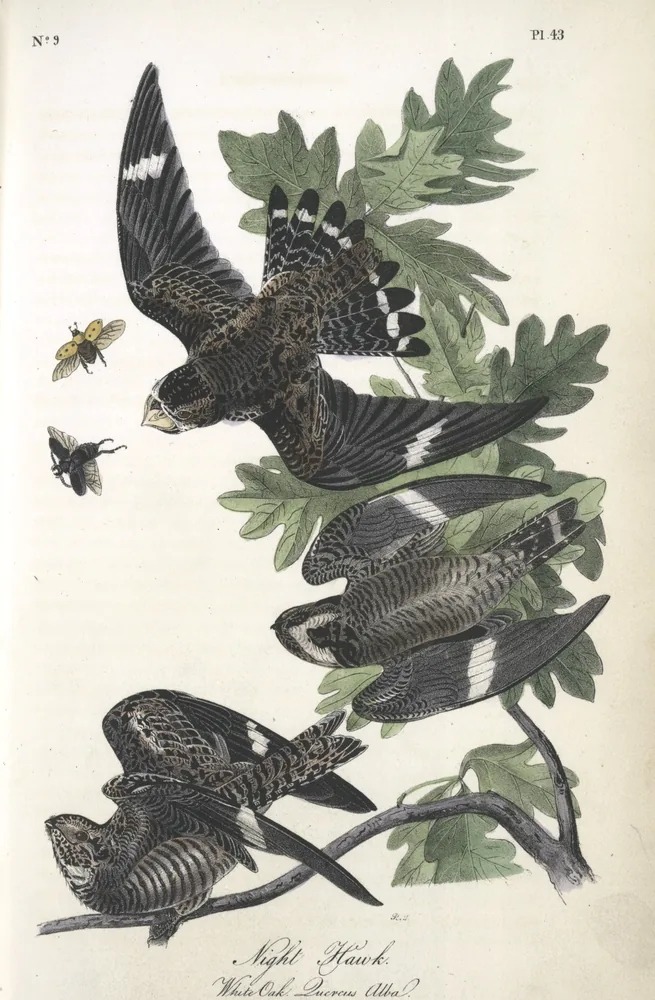
Audubon's Night Hawk, plate 147
Audubon painted the bird as the Night Hawk, plate 147 of The Birds of America, a male and a female on a branch of white oak, and in his chapter of 1834 he complains about the name. The picture on this page is from the smaller octavo edition he published in the 1840s.
He watched them leave the South from August 15 to late October, lingering for weeks over Louisiana's cotton and cane fields; none, he wrote, stayed the winter anywhere in the United States. At Indian Key, Florida, he saw a pair killed in flight by lightning, without a mark on them.
How to recognize a bull bat today
Look up at dusk. A nighthawk is about 9 inches long with wings nearly 2 feet across, long, pointed and bent at the wrist, each with a white bar across the outer part; it flies in an erratic, bounding way, “as if he were bewildered,” and calls a nasal peent.
Watch around ballfield lights on summer evenings, where it feeds on the insects the lights draw, Alabama's wildlife agency notes. At rest it lies along a branch rather than across it, and its barred, mottled gray-brown makes it hard to see.
It eats only insects: nearly a quarter of its food is ants, a 1916 government bulletin found, and one stomach held 500 mosquitoes, Forbush reported.
On an eBird list a bullbat goes down as a Common Nighthawk; here's how to download your eBird data and see every bird you've logged.