Old bird nickname
Spoonbill duck: the Northern Shoveler
A spoonbill duck is the Northern Shoveler, a dabbling duck about the size of a Mallard with a huge, spoon-shaped bill, and hunters have long known it better by that name than by its book name. It is not the pink Roseate Spoonbill, a wading bird of the ibis family and no duck at all.
Updated
What is a spoonbill duck?
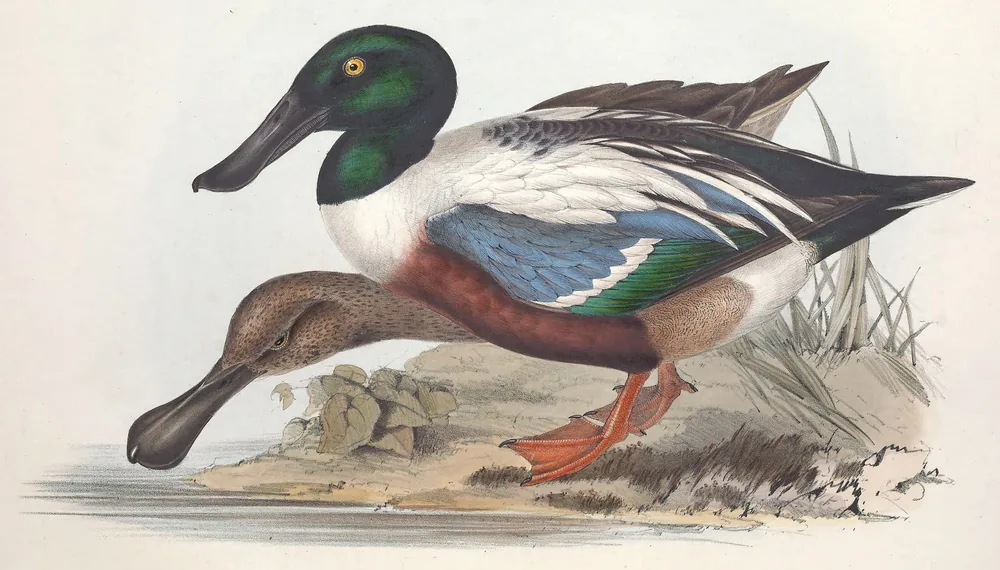
The Northern Shoveler, Spatula clypeata. Pearson's Birds of America of 1917 put Spoonbill and Spoonbill Duck first among its other names, and the account's writer, Herbert K. Job, said the bird was “better known as ‘Spoonbill’ by the average hunter and out-door person.”
Hunters still say it. Oregon's wildlife department says the bill “earned it the nickname ‘spoonbill’ among waterfowl hunters,” Alabama's lists Spoonbill, Spoonie and Smiley as its other names, and in a 1940 story from Charlotte a veterinarian called a found bird a Spoon Bill Teal.
Job thought the name fit: “Nor is this name absurd,” he wrote, and suggested mud-sucker would have suited it as well. Pearson's list ran on to Spoonbill Teal, Broady, Shovel-bill, Swaddle-bill, Butter Duck and Cow-trog, and Edward Howe Forbush added broadbill in 1925.
Duck hunters have a name for nearly every duck they shoot; see which ducks they mean by a whistler duck.
Is a spoonbill a duck?
The spoonbill duck is; the Roseate Spoonbill isn't. The Roseate Spoonbill is a big pink wading bird of the ibis and spoonbill family, in the same order as the pelicans and herons, while the shoveler belongs with the ducks, geese and swans.
They are easy to tell apart. A Roseate Spoonbill is 2 feet 4 inches to 2 feet 10 inches long, about the size of a heron, bright pink with carmine shoulders, and wades the shallows sweeping its long, flat-tipped bill from side to side; a shoveler is 17 to 21 inches long, about the size of a Mallard, and swims with its bill skimming the water.
The two do feed alike, though. Audubon watched shovelers swing their bills through the mud “in the manner of the Roseate Spoonbill,” sifting it for food. Florida hunters had their own name for the real spoonbill, Pearson wrote in 1917: the Pink Curlew.
Why hunters call it a spoonbill
For the bill, which is “twice as wide at end as at base,” as Forbush quoted the ornithologist Coues. The caption in Pearson's book said the shoveler goes about “always carrying with it a prodigious spoon.”
Inside, the bill is a sieve. Its edges carry about 400 fine, comb-like plates called lamellae, 180 on the upper half and 220 on the lower, where most dabbling ducks have 50 to 70, Ducks Unlimited says; the shoveler slurps up water and jets it out through them, keeping the tiny animals and seeds.
Alexander Wilson compared those rows to a weaver's reed in 1814, and Job noticed that captive shovelers in bitter cold got balls of ice on their bills as water froze on the bristles. Ducks Unlimited calls the bird the Jimmy Durante of ducks.
Can you eat spoonbill ducks?
Yes: the shoveler is legal game in every flyway, counted in the regular daily bag of ducks, and US hunters shot an average of 478,352 a season from 2019 to 2022, most of them in the Pacific Flyway, Ducks Unlimited says.
Whether it tastes good is an old argument. Many hunters give it “a bad rap,” as MeatEater put it in 2024, because it strains its food from the mud; Oregon's wildlife department answers that it “can be fine table fare despite a bad reputation with many hunters.”
The old books mostly liked it. Wilson called its flesh “uniformly juicy, tender, and well tasted,” Audubon said no sportsman who knew ducks “will ever pass a Shoveller to shoot a Canvass-back,” and Job found it “fat and luscious” on its winter grounds in the South. Forbush made the useful distinction: it is one of the best ducks for the table “when feeding on vegetal food.”
Its diet explains the split: in fall and winter its food is about two-thirds tiny animals and one-third seeds, Ducks Unlimited says.
How rare are spoonbills?
Not rare at all, if you mean the duck: the US Fish and Wildlife Service's 2026 breeding survey put Northern Shovelers at about 3.29 million, up 19 percent on the year before, Delta Waterfowl reported. It was the only one of the seven dabbling ducks counted to increase.
That is well above the long-term average of 2.6 million that Ducks Unlimited gives, and 1.5 to 2 million more live in Europe and Asia; the record was 4.6 million, in 2011.
The pink Roseate Spoonbill is scarcer. Plume hunters nearly wiped it out of the United States; in 1917 Pearson thought “possibly a thousand are left in Florida.” It came back, and Audubon's field guide now calls it “locally common in coastal Florida, Texas, and southwest Louisiana.”
The shoveler was once thought scarce in the East as well: Audubon called it “generally considered scarce in the United States” in 1838, and Forbush still listed it as a rare migrant in New England in 1925.
Why shovelers spin in circles
Shovelers often feed in groups that swim in a tight circle with their heads down, churning the water with their feet. Ducks Unlimited calls it whirling: the spinning stirs up insects and plankton for every bird in the ring, a kind of teamwork that is rare among other waterfowl.
Forbush watched three or four birds in a line, the leader swinging round an ellipse and each straining the water stirred up by the one ahead, “round and round they go with chattering bills.” Pairs circle the same way in courtship.
Seen from the shore, a feeding flock reminded H. H. Brimley of “a lot of muskrats wading,” every bill under water.
Audubon's Shoveller Duck
Audubon painted a male and a female as plate 327 of The Birds of America, the Shoveller Duck, with the old spelling's two l's. Louisiana's Creoles, he wrote, called it Micoine, a name whose origin he could not trace.
Early one May in Texas he found shovelers breeding in numbers around Galveston Bay, and he thought no duck in the country changed its plumage more: the drake molts into a duller coat while the female sits on the eggs. Wilson had written in 1814 that it was not known to breed anywhere in the United States; Job later watched nests on the prairies of the Northwest.
More of Audubon's story, and John and Elizabeth Gould's pair shown here, are on the Northern Shoveler's painting page.
Shoveller, Shoveler, Northern Shoveler
The bird's book name has changed more than its nickname. The American Ornithologists' Union listed it as the Shoveller in 1886, 1910 and 1931, dropped an l in 1957, and in 1983 made it the Northern Shoveler; it is one of four shovelers in the world, Ducks Unlimited says.
Its closest relatives are the Blue-winged and Cinnamon Teal. Together they are the blue-winged ducks, and both sexes of the shoveler carry that powder-blue patch on the upper wing.
How to recognize a spoonbill duck
Look at the bill first: no other North American duck has one like it. “The Shoveller stands alone,” Forbush wrote. The drake has a dark green head, a yellow eye, a white breast and chestnut sides.
The hen is mottled brownish gray, with a much bigger bill than a teal's, edged in dusky orange, and a brown eye. In flight both show the blue wing patch and a green speculum.
From below, Forbush noted, a flying drake shows five bands: dark, white, dark, white, dark. Early in the hunting season many drakes still look like hens, and both are a little under 20 inches long and weigh about a pound and a half.
It seldom dives or tips up as other dabbling ducks do; it swims with its head low and its bill swinging through the water, Audubon's field guide says.
A spoonbill duck in your notebook prints as a Northern Shoveler; see how to print your life list under the names birds go by today.