Classic bird paintings
Black Vulture painting: Audubon's plate and other classic portraits
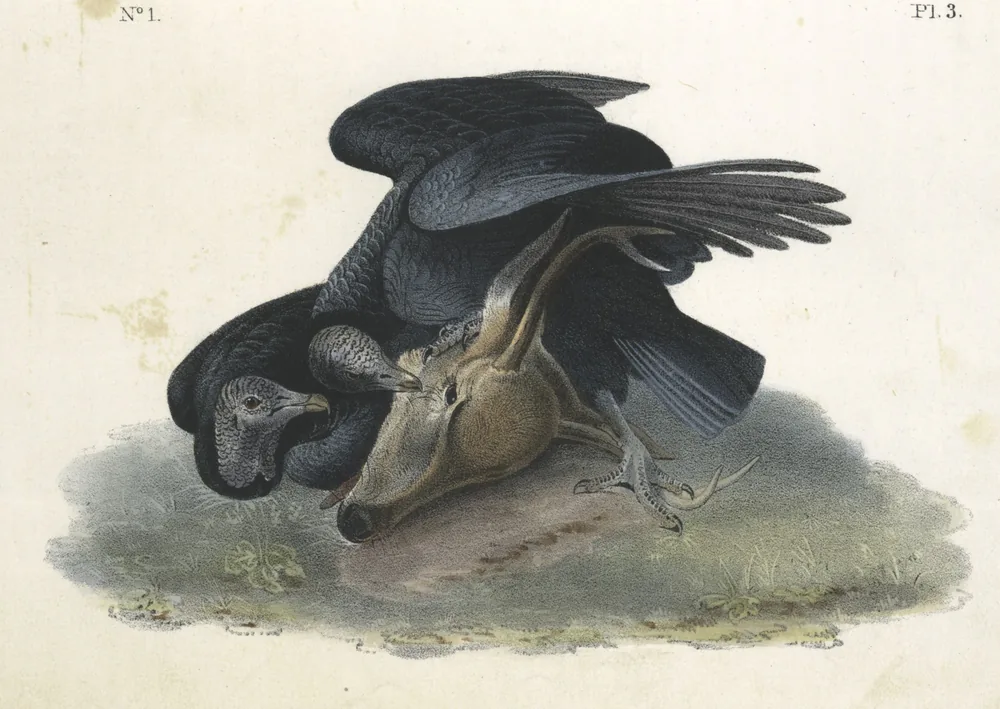
John James Audubon painted the Black Vulture as plate 106 of The Birds of America (1827–38): a pair at the head of a deer, under the name Black Vulture or Carrion Crow. A free high-resolution scan is on Audubon.org. Shown here is the same scene in his smaller octavo edition (1840–44), plate 3.
Updated
About this painting
Shown here: plate 3 of the octavo edition, Black Vulture or Carrion Crow, the big plate's scene at book size. Both birds are adults, black with bare, wrinkled gray heads; one bends low over the deer's head while the other stands on it with its wings half raised.
Audubon’s Black Vulture: plate 106, “Black Vulture or Carrion Crow”
In Charleston, in the winter of 1833–34, vultures were shown a painting. Audubon's friend the Reverend John Bachman ran experiments to settle whether they find food by smell or by sight, with the professors of the city's two medical colleges invited to watch. For one he had “a coarse painting on canvass” made, a sheep skinned and cut open, and laid it on the ground. The vultures spotted it at once, landed, walked over it and tugged at the canvas, then flew off looking disappointed. He repeated it more than fifty times; set fifteen feet from hidden, rotting offal, the painting drew them as before, and none showed a sign of smelling the meat.
Black Vultures were half tame in the Southern cities of Audubon's day. In Charleston, Savannah, New Orleans and Natchez they walked the streets in groups, waited at the markets for scraps from the butchers, leaped from bench to bench to help themselves, and on cold, wet days gathered around chimney tops for the warmth of the smoke.
With Bachman he visited their night roost in a swampy wood across the Ashley River, two miles from Charleston: about two acres of trees covered from trunk to branch tips by several thousand vultures, the ground bare and the stench horrible. Plate 106 shows a pair in full plumage at the head of a deer.
Story: Audubon, Ornithological Biography, vol. 2 (1834), pp. 44–46; vol. 2 (1834), pp. 48–51. See plate 106 free at Audubon.org.
More classic portraits, free to see
- John James Audubon, The Birds of America, octavo edition (1840–44), plate 3: “Black Vulture or Carrion Crow” (the painting shown above). Free scan (New York Public Library Digital Collections)
About the Black Vulture
- Shorter wings and tail make the Black Vulture look smaller than a Turkey Vulture, but their bodies are about the same size, and the aggressive Black Vulture often drives Turkey Vultures away from food. (Source: National Audubon Society)
- It often flies very high when foraging, watching for carrion or for what other vultures are doing, and it has spread north in the Northeast. (Source: National Audubon Society)
What is the difference between a Black Vulture and a Turkey Vulture?
Look at the head and the way it flies. An adult Black Vulture has a dark gray head, a short tail and a white patch near the end of each wing; an adult Turkey Vulture has a bright red head and a long tail that reaches well beyond its body in flight, USDA Wildlife Services says. Turkey Vultures glide with few wingbeats, while Black Vultures flap often between brief glides.
They find food differently too. Turkey Vultures have a keen sense of smell and Black Vultures much less so: they rely on their eyes and fly high to watch other scavengers, the same guide says. So Turkey Vultures often lead them to a carcass without meaning to, and the bigger, more aggressive groups of Black Vultures may then push them off it, Pennsylvania's Game Commission says. In 1834 Audubon described the black bird's flight as eight or ten flaps, then a glide of thirty to fifty yards.
Sources: USDA Wildlife Services, 2026; Pennsylvania Game Commission; Audubon, Ornithological Biography, vol. 2 (1834), p. 50.
Are Black Vultures protected?
Yes. Like other vultures they are protected by the Migratory Bird Treaty Act, so trapping or killing one takes a federal permit, USDA Wildlife Services says. Under a memo of February 6, 2026, the U.S. Fish and Wildlife Service issues one statewide permit per state to a public agency or nonprofit, which can pass permits on to livestock producers losing animals to the birds. The program grew from a 2017 pilot in Kentucky and Tennessee.
In Audubon's South it was the other way around. “No law exists for the protection of this or the other species,” he wrote in 1834, though people often spoke of one; the birds' usefulness alone kept them safe.
Sources: USDA Wildlife Services, 2026; U.S. Fish and Wildlife Service, MBPM-7-02; Audubon, Ornithological Biography, vol. 2 (1834), p. 48.
Do Black Vultures kill livestock?
Sometimes. Black Vultures kill and injure newborn, sick or weak animals that can't defend themselves, most often calves, piglets and lambs, and their mothers when helpless while giving birth, USDA Wildlife Services says. In both Florida and Indiana and Kentucky, 38% of cattle producers reported losses to them. Turkey Vultures rarely take live prey, and reports of them attacking livestock are likely mistaken identity.
South Carolinians told Audubon the same. In January 1834, seven of them signed a statement for him that the vultures, the Carrion Crow especially, attack young poultry, lambs and young hogs, and grown animals when helpless.
Sources: USDA Wildlife Services, 2026; Audubon, Ornithological Biography, vol. 2 (1834), p. 49.
How long does a Black Vulture live?
The agency guides we read say only how long a Black Vulture can live, not its typical lifespan. The oldest known wild Black Vulture was at least 25 years and 1 month old (USGS Bird Banding Laboratory): it was banded in Louisiana in 1940 and found there again in 1965.
Source: USGS Bird Banding Laboratory. A banding record is the minimum age of one bird when it was found again, not a typical lifespan. How long do wild birds live?
How can you tell if a plate 106 print is an original?
By its size: an original plate 106 is a hand-colored sheet about 26 by 38 inches; the Black Vulture’s octavo version, plate 3, is book-size, from 1840–44. Many prints sold today are reproductions: how to tell an original from a reproduction. Rather have every plate in one book? Here’s which Birds of America book to buy.
In a Birdfolio hardcover, this painting sits beside the date and place you first saw a Black Vulture. See your own list as a book, free.