Old bird nickname
Whistler duck: the whistling ducks, and the goldeneye
A whistler duck, on the Gulf Coast today, is a whistling duck: most often the Black-bellied Whistling Duck, and sometimes the Fulvous Whistling Duck, long-legged southern ducks that whistle where other ducks quack. Hunters there call them whistlers, squealers and tree ducks. To older gunners up North, though, the Whistler was the Common Goldeneye, named for the whistle of its wings.
Updated
What duck is called a whistler?
In the South today, the whistling ducks, and above all the Black-bellied Whistling Duck. In Louisiana, Delta Waterfowl says, black-bellies “go by many names: Mexican whistlers, tree ducks, and squealers,” hunting writers across the Gulf states call them whistlers, and Ducks Unlimited titled a 2018 article on them and the Wood Duck “Woodies and Whistlers.”
On the Texas coast, a writer for the Gulf Coast Bird Observatory looked up to find “a whole crowd of whistlers overhead.” Squealer may still be the commoner nickname: Ducks Unlimited, Louisiana Sportsman and Wildfowl magazine all use it, and Alabama's wildlife agency lists Mexican squealer for the Fulvous. In Mexico the black-belly is the pichichi, a name that imitates its call.
In the old bird books, though, the Whistler was a different duck, the goldeneye, as you'll see below. Hunters have a nickname for most ducks; the shoveler's is told on our page about the spoonbill duck.
The whistle, the long legs and the upright stance
Whistling ducks whistle instead of quacking. The Black-bellied gives a high, soft pe-che-che-ne, and chit-chit-chit in flight, Ducks Unlimited says; the Fulvous a hoarse ka-wheee. A flock's repeated pe-che-che gives the birds one of their local names, Alabama's wildlife agency says.
They don't look like ordinary ducks either. They stand tall on long legs, “the most erect of all ducks,” Alabama's agency says; they walk without a waddle, and in flight their feet trail behind the tail, so that one hunting writer found them more like an ibis than a duck.
Scientists consider them closer to geese and swans than to the true ducks, Ducks Unlimited says: the sexes look alike, and pairs stay together for life and share the incubation. Their scientific name, Dendrocygna, means roughly tree swan.
Do whistler ducks nest in trees?
The Black-bellied mostly does: most nests are in tree cavities or nest boxes, Ducks Unlimited says, often 4 to 20 feet up and as far as a quarter mile from water, and where holes are scarce it nests on the ground. Pairs have even nested in chimneys and barns.
A day or so after hatching, the ducklings jump from the hole to the ground or the water below. Some nests are shared dumps: Alabama's agency reports nests holding 40 to over 100 eggs. Black-bellies and Wood Ducks are the only North American waterfowl known to raise two broods in one season, and nest boxes probably helped the black-belly spread through Texas and eastern Mexico.
The Fulvous Whistling Duck doesn't: it nests on the ground or over water, often in rice fields, and seldom perches in trees. Its nest is so flimsy that the first eggs may fall through into the water, Alabama's wildlife agency says. So the old official name, tree duck, really fit only one of the two.
Are whistler ducks good to eat?
Hunters say they are among the best. Louisiana Sportsman called whistling ducks “particularly suitable for table fare,” with milder breast meat than many ducks, a Louisiana hunter told Delta Waterfowl they are “the best tasting duck out there,” and a Ducks Unlimited biologist told Shotgun Life in 2023 that “they taste great.”
Their diet explains it: more than 90 percent of what a black-belly eats is plants, from seeds to rice, sorghum and corn, and the Fulvous eats even more plant food, Ducks Unlimited says.
Few are shot. Hunters take fewer than 20,000 black-bellies a year, mostly in Texas and Louisiana, and fewer than 5,000 Fulvous, Ducks Unlimited estimates, because most whistling ducks head south before the regular seasons open.
They are legal ducks. Under the 2025–26 federal frameworks they count in the regular duck bag, with one exception: the Atlantic Flyway states, Florida among them, allowed just one Fulvous Whistling Duck a day. Louisiana has tried an early special season for black-bellies, October 3 to 11 with four a day, Delta Waterfowl reports.
Are whistling ducks rare?
No, and the Black-bellied is spreading fast: Christmas Bird Count sightings rose from 1,822 a year in the 1980s to 12,227 a year in the early 2000s, Ducks Unlimited says, and the world population is roughly 1 to 2 million.
Louisiana's midwinter counts averaged more than 140,000 whistling ducks over 2020 to 2024, likely an undercount, Delta Waterfowl reports. In 1886 the official check-list had the black-belly only on the southwestern border of the United States; by 1910 it bred from Corpus Christi, Texas, south to Panama.
Since the 2000s it has spread along the Gulf Coast: one Louisiana hunter first saw them near Paradis in 2005, and now they feed in New Orleans parks, ditches and golf courses. Its range runs from southeastern Arizona to coastal South Carolina, strays have reached Nova Scotia and North Dakota, and black-bellies even feed with pigeons on grain barges in Memphis, Wildfowl reported.
The Fulvous is steadier: about 20,000 bred in Louisiana and Texas, tied to rice farming, Ducks Unlimited said in 2006, and around 1 million live in the Americas.
Are whistling ducks found in Florida?
Yes, both kinds. The Fulvous Whistling Duck spread east along the Gulf Coast from Texas from about 1950 and has been a common nesting bird in Florida since 1960, Audubon's field guide says, mostly in the lower half of the peninsula.
The Black-bellied lives there year-round too. Florida's black-bellies go back at least to the 1960s, a state wildlife biologist told Shotgun Life in 2023, and they are spreading into the Panhandle; the Fulvous keeps mostly to the Everglades and the farm fields of south Florida.
Where the first Florida birds came from is less clear. The 1983 check-list noted that some south Florida records “may pertain to escapes from captivity,” and one magazine says Florida's black-bellies began with zoo escapees in the 1960s.
The other whistler: the goldeneye
For a century and more, the Whistler was a northern diving duck, the Common Goldeneye, named for the whistle of its wings. Pearson's Birds of America said in 1917 that the goldeneye “is commonly known as the Whistler,” for the “peculiar penetrating whistle” its wings make, often heard before the bird itself can be made out.
Audubon, on the Ohio near Louisville, found goldeneyes “generally known by the name of ‘Whistlers,’” and wrote that their wings could be heard more than half a mile away; Boston gunners, he said, decoyed them with the crudest wooden floats. Forbush wrote in 1925 that it was “well and widely known as ‘Whistler’ by the gunners of New England.”
Wilson knew the sound in 1814, “the vigorous whistling of its wings,” though he never used the name, and Audubon's field guide still says the wings earned it “the hunters' name of ‘Whistler.’” Audubon painted it as the Golden-Eye Duck, plate 342.
The goldeneye nests in tree holes too, 5 to 60 feet up, so both whistlers are tree ducks of a kind. Audubon found a nest in a tree cavity near Green Bay with nine eggs, and roasted them.
From tree duck to whistling duck
Both southern birds were officially tree ducks for nearly a century. The American Ornithologists' Union's first check-list, in 1886, called them the Black-bellied Tree-duck and the Fulvous Tree-duck, and the 1957 edition still had Black-bellied Tree Duck and Fulvous Tree Duck.
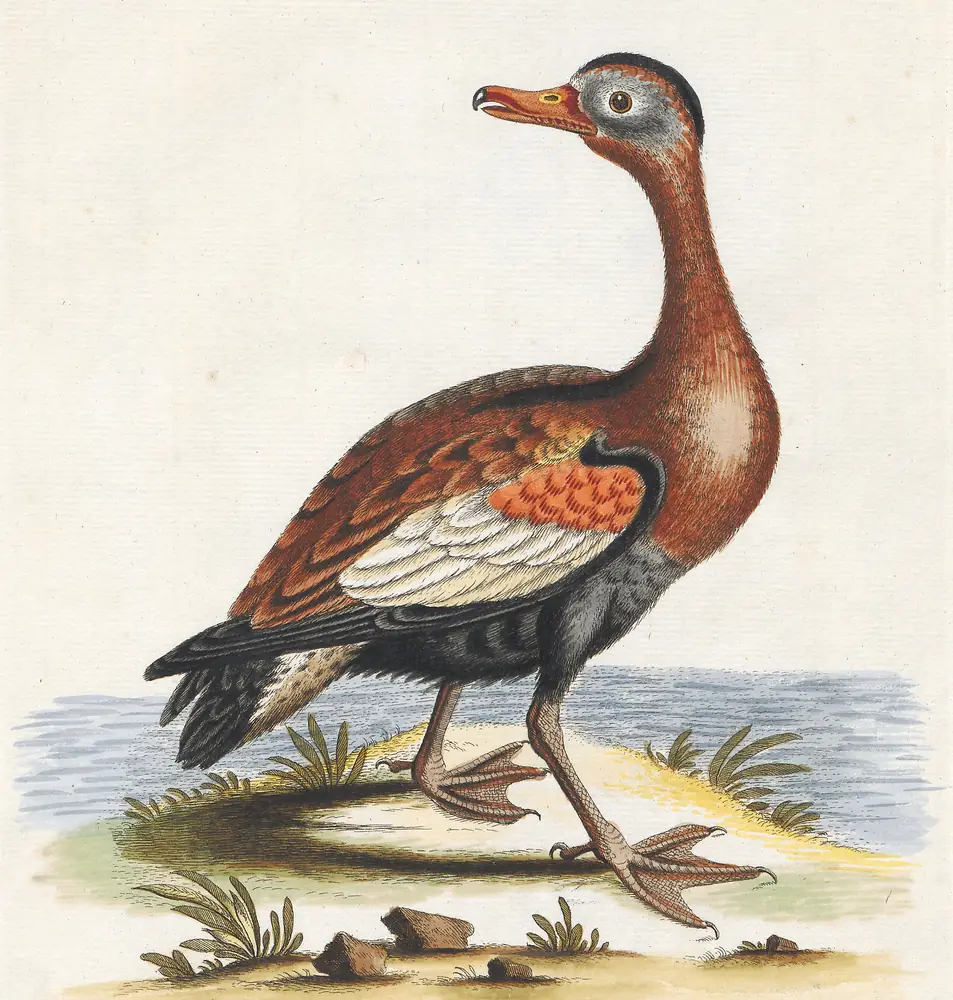
By the 1983 edition they were the Black-bellied and Fulvous Whistling-Ducks, with a note that the group name tree duck “was formerly used.” The new name was really the older one: the black-belly's scientific name rests on George Edwards's “Red-bill'd Whistling Duck,” the 1931 check-list notes, and an Edwards drawing of the same bird is the picture on this page.
The American list hyphenates the name, Whistling-Duck; AviList, the world list a Birdfolio prints its names from, writes Black-bellied Whistling Duck.
How to recognize a whistling duck
The Black-bellied is hard to mistake: a pink-orange bill, a gray face with a white eye-ring, a chestnut breast and back, a black belly and a big white patch along the wing, on a long-legged duck 18½ to 21 inches long. Ducks Unlimited says adults are unlikely to be confused with any other species.
The Fulvous is tawny all over, with a blue-gray bill and feet, a white crescent at the base of the tail and no white in the wing. In flight the Black-bellied beats its wings more slowly than most ducks, its feet trailing behind the tail, and both kinds are very vocal, Ducks Unlimited says.
More whistling ducks, with the Wood Duck and the Muscovy, are in our guide to the types of ducks.
If whistlers have flown over your marsh, they go on a life list as Black-bellied or Fulvous Whistling Ducks; turn your eBird list into a book and see them by those names.