Classic bird paintings
Cooper's Hawk painting: Audubon's plate and other classic portraits
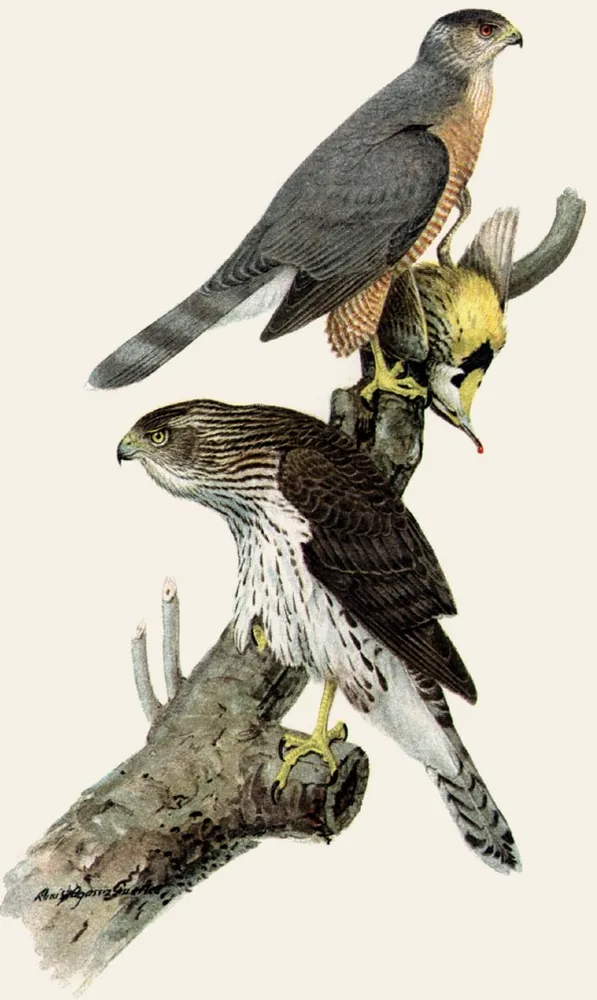
John James Audubon painted the Cooper's Hawk as plate 36 of The Birds of America (1827–38), under his own name for it, the Stanley Hawk. A free high-resolution scan is on Audubon.org. The painting shown here is by Louis Agassiz Fuertes, from a US Department of Agriculture yearbook of 1908.
Updated
The story of this painting
The adult male at the top grips a bird he has killed, a drop of blood at the tip of its bill; below him is a young female, brown and streaked. Louis Agassiz Fuertes signed the branch. The plate is number III in the US Department of Agriculture's Yearbook for 1908, published in 1909, captioned “Cooper Hawk (Chicken Hawk)” and printed at a quarter of life size.
It illustrated an article by A. K. Fisher of the Biological Survey on the economic value of predaceous birds and mammals. Most birds of prey, he argued, were the farmer's friends, living largely on rodents and big insects such as grasshoppers, crickets and May beetles, and only four or five kinds did real harm. Two of those, the Sharp-shinned and Cooper's hawks, fed almost entirely on wild birds and poultry and “need to be kept in check.” His plates I to III, a Great Horned Owl and these two hawks, were there to help readers identify them.
Fisher also blamed most raids by otherwise useful hawks and owls on a few individuals, usually young birds that lacked the skill to catch their usual prey, and wrote that many an innocent hawk had been shot for what the house cat had done. Why farmers called them chicken hawks, and what it cost the hawks, has its own page. A law printed at the front of the volume set 500,000 copies for this part of the report, the part written for farmers.
Story: USDA Yearbook 1908 (1909), plate III, facing p. 192; pp. 187–194; p. 2.
Audubon’s Cooper's Hawk: plate 36, “Stanley Hawk”
On December 5, 1809, at Louisville, Kentucky, Audubon drew an adult male of this hawk, but he kept that drawing out of his book: it was as stiff and lifeless, he wrote, as the figures in most natural histories. Plate 36 shows instead a young male, about two years old, chasing a nearly exhausted bluebird, and an adult female in the act of pouncing, a bird he shot at her nest. He named it the Stanley Hawk, for Lord Stanley, President of the Linnean Society of London.
One November morning near Bayou Sara, Louisiana, one shot past him so close he could have touched it with his gun barrel. Seconds later he heard the hens cackling and the rooster's war cry, and found hawk and rooster tumbling over and over. When the rooster was dead, he shot the hawk: a young male like the one in the plate.
By 1839 he accepted that Charles Bonaparte had already named the bird Falco Cooperii, from a specimen sent by a Mr. Cooper, though Bonaparte had seen Audubon's drawing years before. “The name which I gave it must, however, now give place,” he wrote. His plate 141 shows an adult male beside a Goshawk, so the two can be compared.
Story: Audubon, Ornithological Biography, vol. 1 (1831), pp. 186–189; vol. 2 (1834), p. 245; vol. 5 (1839), p. 376. See plate 36 free at Audubon.org. See plate 141 free at Audubon.org.
More classic portraits, free to see
- John James Audubon, The Birds of America, octavo edition (1840–44), plate 24: “Cooper's Hawk”. Free scan (New York Public Library Digital Collections)
- Louis Agassiz Fuertes, for Elon H. Eaton’s Birds of New York (1910–14): plate 44: “Cooper Hawk”, with the Sharp-shinned Hawk; plate 46: “Cooper Hawk”, with the Red-tailed Hawk. (Free scans: Internet Archive)
About the Cooper's Hawk
- A Cooper's Hawk often hunts by moving quietly from perch to perch, then speeding after its prey. (Source: National Audubon Society)
- Its eggs usually hatch after 34 to 36 days. (Source: National Audubon Society)
How long does a Cooper's Hawk live?
We could not confirm a typical lifespan for the Cooper's Hawk. Its first winter is the dangerous one: the British Columbia government's species summary cites a study in which deaths that winter approached 78%, against 34% a year for adults aged 2 to 8. The oldest known wild Cooper's Hawk was at least 20 years and 4 months old (USGS Bird Banding Laboratory): it was banded in California in 1986 and found in Washington in 2006.
Sources: British Columbia Conservation Data Centre; USGS Bird Banding Laboratory. A banding record is the minimum age of one bird when it was found again, not a typical lifespan. How long do wild birds live?
How can you tell if a plate 36 print is an original?
By its size: an original plate 36 is a hand-colored sheet about 26 by 38 inches; the Cooper's Hawk’s octavo version, plate 24, is book-size, from 1840–44. Many prints sold today are reproductions: how to tell an original from a reproduction. Modern editions print all 435 plates, from pocket size to coffee-table size: which Birds of America book to buy.
In a Birdfolio hardcover, this painting sits beside the date and place you first saw a Cooper's Hawk. See your own list as a book, free.