Classic bird paintings
Barred Owl painting: Audubon's plate and other classic portraits
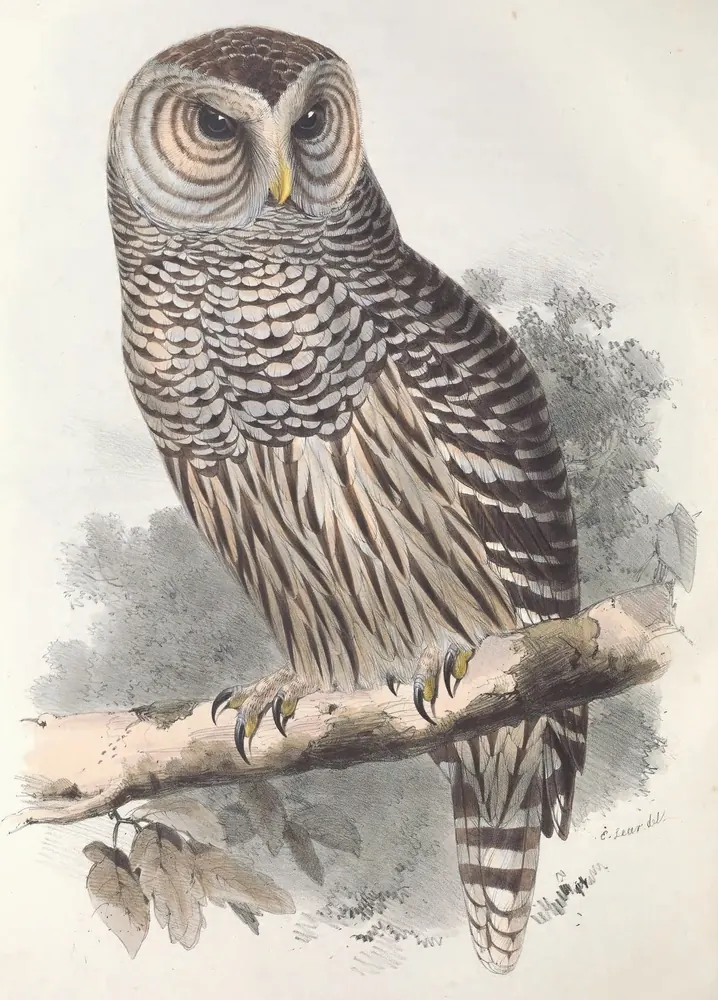
John James Audubon painted the Barred Owl as plate 46 of The Birds of America (1827–38), staring at a gray squirrel; his name for it was the same. A free high-resolution scan is on Audubon.org. The owl shown here is from John Gould's The Birds of Europe (1832–37), where it is Ulula nebulosa.
Updated
The story of this painting
Norway, Sweden and Russia: that is as far south, John Gould wrote, as the Barred Owl reaches in the Old World, and so thinly that it seemed more an accidental visitor than a native. Its true home, he thought, was the northern and temperate parts of America. So the American owl has a plate in his The Birds of Europe, number 46, under the name Ulula nebulosa.
Audubon had his doubts. In 1839 he wrote that he questioned whether his bird and the one reported from northern Europe were the same, and that in London he had seen Barred Owls imported from New York and sold as European specimens. American bird-stuffers, he added, played the same trick the other way round, passing off European birds as American.
For its habits Gould drew on Audubon, from the whah, whah, whah-aa heard at evening all through the forest to its smooth, noiseless flight, which he credited to soft plumage that lets it steal up on prey unnoticed. Edward Lear drew the plate, an adult male a little under life size, and signed it in the lower right corner; the line below reads “E. Lear del et lith.”
Story: Gould, The Birds of Europe, vol. 1 (1837), plate 46; vol. 1 (1837), text to plate 46; Audubon, Ornithological Biography, vol. 5 (1839), p. 386.
Audubon’s Barred Owl: plate 46, “Barred Owl”
Go into the forests of lower Louisiana in mid-October, Audubon told his reader, as the moon rises and the farmer comes home to supper, and you will hear the Barred Owl's whah, whah, whah, whah-aa, so ludicrous that you might compare it to the affected laughter of fashionable people. Camped in the woods, roasting venison or a squirrel, he often had one land a few yards away and stare at him in the firelight; he would gladly have invited it to join him.
He called it the “Sancho Pança of our woods.” It saw poorly by day, he thought: one landed on a cow's back and left in a hurry when the cow moved, and a gray squirrel jumping close by could frighten it, though it killed many squirrels at dusk. That is why his plate shows the owl gazing in amazement at a squirrel a few inches away.
One November afternoon on the Ohio near Cave-in-Rock, he watched crows chase a Barred Owl from its tree; it climbed like a hawk until it was out of sight, so unusual a sight that he noted it down at the time. In the New Orleans market, he added, it was often for sale, and the Creoles made gumbo of it.
Story: Audubon, Ornithological Biography, vol. 1 (1831), pp. 242–245. See plate 46 free at Audubon.org.
More classic portraits, free to see
- John James Audubon, The Birds of America, octavo edition (1840–44), plate 36: “Barred Owl”. Free scan (New York Public Library Digital Collections)
- Edward Lear, for John Gould’s The Birds of Europe (1832–37), plate 46: “Barred Owl” (Ulula nebulosa) (the painting shown above). Free scan (University of Kansas Libraries)
- Louis Agassiz Fuertes, for Elon H. Eaton’s Birds of New York (1910–14), plate 54: “Barred Owl”, with Great Gray Owl and Snowy Owl. Free scan (Internet Archive)
About the Barred Owl
- Barred Owls hunt by day or by night, and sometimes hover before dropping onto their prey. (Source: National Audubon Society)
How long does a Barred Owl live?
A wild Barred Owl can live about ten years, the University of Maryland Extension says, and one in captivity past twenty. The oldest known wild Barred Owl was at least 26 years and 7 months old (USGS Bird Banding Laboratory): it was banded in North Carolina in 1993 and found there again in 2019.
Sources: University of Maryland Extension; USGS Bird Banding Laboratory. A banding record is the minimum age of one bird when it was found again, not a typical lifespan. How long do wild birds live?
How can you tell if a plate 46 print is an original?
By its size: an original plate 46 is a hand-colored sheet about 26 by 38 inches; the Barred Owl’s octavo version, plate 36, is book-size, from 1840–44. Many prints sold today are reproductions: how to tell an original from a reproduction. Plate 46 and the other 434 also come bound in one modern book: which Birds of America book to buy.
In a Birdfolio hardcover, this painting sits beside the date and place you first saw a Barred Owl. See your own list as a book, free.