2006 split
Blue Grouse: now the Dusky Grouse and the Sooty Grouse
The Blue Grouse is now two birds: the Dusky Grouse of the Rocky Mountains and the interior, and the Sooty Grouse of the Pacific coast ranges, the Cascades and the Sierra Nevada. The American Ornithologists' Union, the forerunner of today's American Ornithological Society (AOS), split it in July 2006. Where you saw the bird is the surest way to tell which one it was.
Updated
What changed
The Rocky Mountains and the dry interior: from the Yukon and interior British Columbia through Idaho, Montana and Wyoming to Utah, Colorado, Arizona and New Mexico, west to eastern Washington and eastern Nevada. Mountain forests, near open country in summer.
The Pacific side: coastal southeastern Alaska and British Columbia, the coast ranges and the Cascades to northwestern California, and the Sierra Nevada south to the mountains of southern California and the edge of western Nevada. Coastal birds may stay in conifer forest all year.
What is a blue grouse called now?
A Dusky Grouse or a Sooty Grouse, depending on where it lives: the Dusky in the Rocky Mountains and the dry interior, the Sooty along the Pacific coast and in the Cascades and the Sierra Nevada. Until recently the two “were combined as one species, under the name Blue Grouse,” says Audubon's field guide.
Blue Grouse was the species' name on the check-lists of 1957 and 1983. The Dusky Grouse kept its scientific name, Dendragapus obscurus; the Sooty Grouse took Dendragapus fuliginosus, the name Ridgway gave it in 1873.
Surprising facts about the Blue Grouse
It goes uphill for the winter. In autumn many Dusky Grouse leave their open breeding grounds for dense conifer forest higher up, “an unusual kind of altitudinal migration,” says Audubon's field guide. The longest known trip is about 30 miles, and some birds may make it entirely on foot.
It lives on needles in winter. Its winter food is mostly the needles of pines, hemlocks, firs and Douglas-firs, often eaten up in the trees.
Audubon never saw one alive. His 1838 chapter on the “Dusky Grous” of plate 361 begins: “I have never seen this species in its native haunts.” One of the naturalists he leaned on, Nuttall, heard the male in the forests of the Columbia River and likened the sound to blowing into the bung-hole of a barrel.
Fighting males could be picked up by hand. A chief factor of the Hudson's Bay Company told the naturalist Richardson that males fought so fiercely “a man may take one of them up in his hand” before it would leave its rival.
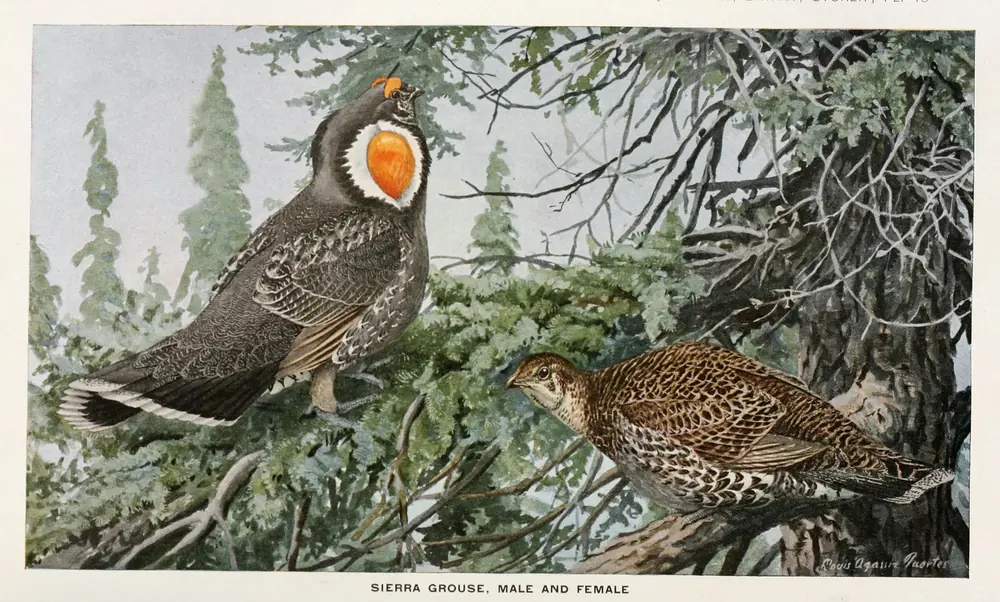
Its races once had names of their own. The 1910 check-list had a Dusky, a Sooty, a Richardson's and a Sierra Grouse; the 1931 edition added Fleming's, the Sitka and the Mount Pinos Grouse. The painting on this page by Louis Agassiz Fuertes is labeled “Sierra Grouse”: a Sooty Grouse today.
Why it changed
The genes settled an old argument. A study of mitochondrial DNA by Barrowclough and colleagues, published in 2004, supported “the previous separation” of the two, the 47th Supplement says: the union had counted them as two species in 1931, on differences in behavior, plumage and voice.
The 1931 check-list had said it plainly: the grouse “are now grouped under two species instead of one,” the Dusky and the Sooty. By the 1957 edition they were one species again, the Blue Grouse, and the 1983 edition noted that the two groups were “sometimes treated as separate species.”
In 2006 the committee named the differences: the males' hooting, their behavior and their plumage. The same genetic study found a smaller difference between northern and southern Dusky Grouse, one that doesn't follow the races named so far.
The old name lives on where people hunt them. Oregon's Department of Fish and Wildlife still lists “blue grouse,” a term, it says, that covers both the dusky and the sooty.
Who decided, and when
- American Ornithological Society (AOS): the 47th Supplement to its Check-list, printed in its journal The Auk when the society was still the American Ornithologists' Union (AOU), with the committee's decisions of 2005
When was the blue grouse split?
In July 2006, in the 47th Supplement to the Check-list of North American Birds, printed in The Auk. It sums up what the union's committee decided between January 1 and December 31, 2005. Its instruction was short: change Dendragapus obscurus “from Blue Grouse to Dusky Grouse,” and add the Sooty Grouse after it.
The same supplement moved the Willet into the genus Tringa with the yellowlegs, and five groups of terns out of Sterna.
Where are blue grouse found?
In the mountain forests of the West, from Alaska and the Yukon to Arizona and New Mexico. In the 1983 check-list's map of its two groups, the Sooty kind holds the coast, the Cascades and the Sierra Nevada, and the Dusky kind the Rockies and the mountains east of the Cascades.
Oregon has both. Its wildlife department finds blue grouse in the conifer forests of western Oregon, on the east slope of the Cascades, in the Blue Mountains of the northeast, and in the Klamath Basin and the Warner Mountains. Montana has the Dusky Grouse, which it manages as an upland game bird.
How do you identify a blue grouse?
By its size and its plain dark color: a big forest grouse, the male gray, darker and more uniform than most grouse, the female mottled brown and gray, says Audubon's field guide. Oregon's wildlife department adds that the male is solid blue-gray underneath, with bright orange-yellow combs over the eyes.
In spring a displaying male shows bare patches of skin on the sides of his neck, ringed with white feathers: reddish on a Dusky Grouse, yellow to reddish on a Sooty. Both birds are slow-moving and inconspicuous, but often surprisingly tame.
How do you tell a Dusky Grouse from a Sooty Grouse?
Mostly by where you are: the two look very much alike, and Audubon's field guide says the Sooty is “separated mainly by range.”
The males' songs help. A Sooty Grouse often hoots from high in a dense evergreen, sometimes more than 100 feet up, a low owl-like sound “like air blown across the top of a jug.” A Dusky Grouse gives a series of deep hoots that speed up and grow louder, and struts on the ground with his tail fanned. Most Dusky Grouse have a broad gray band at the tip of the tail, as every Sooty does.
What do blue grouse eat?
Leaves, flowers, buds, berries and conifer needles in summer, with many insects, which matter most to the very young; in winter, mostly the needles of conifers, says Audubon's field guide. In summer they feed mostly on the ground, in winter more in the trees.
Early naturalists noticed the berries. Richardson, quoted by Audubon, wrote that its food “consists of various berries.”
Where do blue grouse nest?
On the ground, in a shallow scrape lined with dead twigs, needles and leaves, under a shrub, a log or a rock ledge. The female mates and leaves the male, then sits alone on 5 to 10 eggs for 25 to 28 days, says Audubon's field guide.
The chicks leave the nest within a day and find their own food, make short flights at 8 or 9 days and are full grown at about 13 weeks. A hen will stand her ground to defend them; the naturalist Townsend saw one pretend to be lame, as a Ruffed Grouse does.
Can you hunt blue grouse?
Yes, in season, in the states that allow it: Oregon's hunting pages still use the name blue grouse for both kinds, and Montana manages the Dusky Grouse as an upland game bird. Oregon suggests walking ridges and timber edges in the morning or evening, since the birds often loaf high in trees at midday.
Their numbers are hard to know. Montana's wildlife agency says its forest grouse are rarely and inconsistently surveyed; it used to count Dusky Grouse by the males' hooting in spring.
Which one did you see?
Start with the place. Near the Pacific, in the Cascades or in the Sierra Nevada it was a Sooty Grouse. In the Rocky Mountains and the ranges east of the Cascades and the Sierra, a Dusky Grouse.
Where both live, listen. A Sooty hoots from high in a tall evergreen; a Dusky's deep hoots often come with a strutting display on the ground.
Look at the neck patches in spring. Reddish on a displaying Dusky, yellow to reddish on a Sooty.
Hens are hard. Both are mottled brown and gray, so the place is your best guide.
What it does to your list
One old name, two birds today. If your list has a Blue Grouse from the Cascades or California and another from the Rockies, that single line is now two species.
If you saw it on one side only, nothing changes but the name.
In a Birdfolio, a Blue Grouse that comes with a place is filed by it: seen in California, it is a Sooty Grouse; in Montana, Idaho, Wyoming, Colorado, Utah, Arizona, New Mexico or Alberta, a Dusky Grouse. In Alaska, Washington, Oregon, Nevada and British Columbia, which have both, or with no place, we ask you which one it was.
Why checklists keep changing: splits and lumps, explained.
Hunted or hiked for Blue Grouse over the years? See how to print your life list with every bird under the name it has today.
Check your own list. Drop your eBird download or type your birds: the free checker shows which of them the changes since 2018 touched.
Check my list