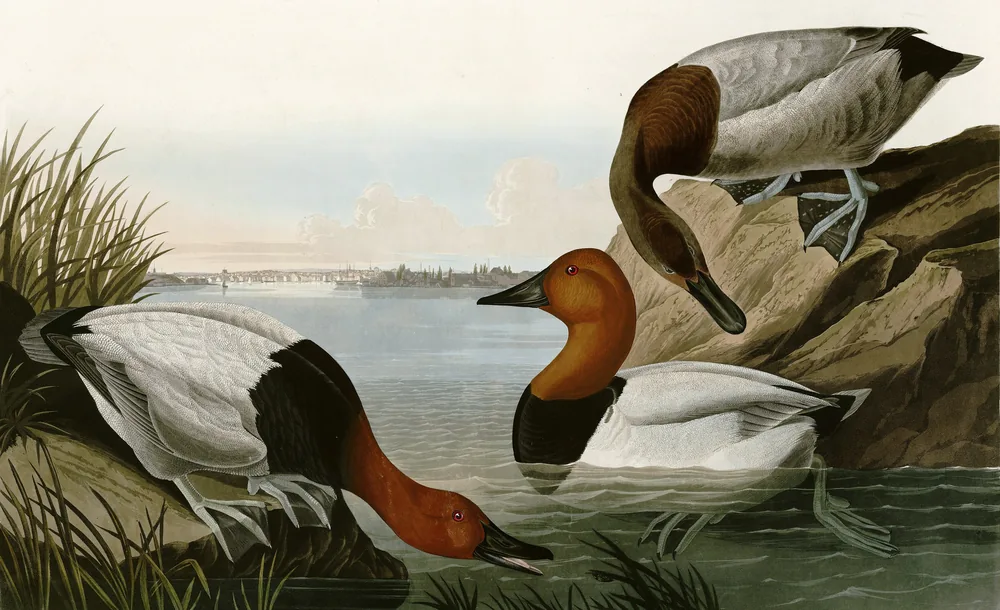
Ducks sort into types by the way they feed: dabblers tip up in the shallows, bay divers and sea ducks dive, mergansers chase fish, the Ruddy Duck dives with its stiff tail cocked, and a few perch and nest in trees. Thirty-eight kinds are regulars in the US and Canada, out of 52 ducks on the American Birding Association's checklist (our count). Some were worth real money: in 1837 John James Audubon saw Canvasbacks sell for two dollars a pair in New Orleans, and his plate of them in The Birds of America sets Baltimore on the far shore.
Six ways to be a duck
Watch what a duck does for its food and you can place it in one of six groups. Dabbling ducks, or dabblers, feed at the surface or tip forward, tail in the air; diving ducks swim down for food in deeper water (Ducks Unlimited). A dabbler's legs sit farther forward, so it walks easily, and a diver's far back (Alaska Department of Fish and Game). Perching ducks grip branches with strong claws and nest in tree holes.
| Group | How it feeds | Where you'll see it | Regulars | One you'll know |
|---|---|---|---|---|
| Dabblers (puddle ducks) | Tips up, head under and tail in the air; picks food off the surface; grazes on land | Shallow marshes, ponds, flooded fields | 13 | Mallard |
| Tree ducks (perching and whistling-ducks) | Picks food from the surface or from fields; whistling-ducks eat mostly seeds and grain | Wooded ponds and swamps; whistling-ducks on farm ponds | 4 | Wood Duck |
| Bay divers (pochards) | Dives for plant roots, seeds and clams | Big lakes, rivers, coastal bays | 5 | Canvasback |
| Sea ducks | Dives for mussels, clams and crabs | Coasts, open sea, the Great Lakes | 12 | Bufflehead |
| Mergansers (sawbills) | Chases fish underwater | Rivers, clear lakes, bays | 3 | Hooded Merganser |
| Stiff-tails | Dives, its spiky tail often cocked up | Marshy lakes, sheltered bays | 1 | Ruddy Duck |
Regulars are the checklist's codes 1 and 2 (version 8.19, 2026), Hawaii's ducks included; the groups follow Ducks Unlimited, the Alaska department and Glen Woolfenden's 1961 study of waterfowl skeletons. Worldwide, AviList's 2026 list puts 172 species of ducks, geese and swans in the family (our count). Takeoffs help too, as our duck quiz shows for dabblers and divers.
What are the 41 species of waterfowl?
"The 41" is a hunters' checklist, the North American Waterfowl Grand Slam, rather than a scientists' count: the ducks, geese and swans hunters pursue, plus one bird that isn't waterfowl at all. Outdoor Life printed it in 2025: 13 puddle ducks, 12 divers and mergansers, 7 sea ducks and 9 "Geese, Swans and Cranes." The crane is the Sandhill, and the "Blue Goose" is a dark Snow Goose, the same species (Audubon's guide), so by our reading the list holds 39 kinds of waterfowl. The checklist itself has 71 ducks, geese and swans, 50 of them regulars.
What are different duck names?
A male duck is a drake and a female a hen (on a farm, simply a "duck"), the young are ducklings, and hunters have a nickname for nearly every species. Ducks Unlimited lists "greenhead" and "susie" for drake and hen Mallards, "butterballs" for Buffleheads, "whistlers" for goldeneyes and "can" for the Canvasback; the Long-tailed Duck used to be the "Old Squaw." More are in our duck trivia and on the Bufflehead's painting page.
Duck vs goose: five tests
Ducks are the family's smaller, shorter-necked birds and geese its bigger, longer-necked ones, but the surest differences lie in how they pair, who raises the young and how many bones sit in the neck. Five tests, from the one you can make across a pond to the one that needs a skeleton:
- Size and neck. Ducks are the smallest waterfowl, with the shortest necks; geese are "generally larger than ducks and smaller than swans" (Alaska Department of Fish and Game). A Mallard grows to 2 feet 2 inches, a Canada Goose to 3 feet 10 inches (Audubon's guide).
- Drake and hen. In most ducks the drake and hen look different; Audubon's guide marks "sexes similar" for the Snow Goose, Ross's Goose, Brant and Trumpeter Swan.
- Pairing. Most ducks pair for one season, "less than 9 months," and geese and swans "form life-long pair bonds" (Ducks Unlimited). A drake leaves once incubation starts; a gander guards the nest and helps raise the goslings (Mike Brasher, Ducks Unlimited).
- Neck bones. Most ducks have 16 neck vertebrae, geese 18 to 20 and true swans 22 to 25, by Glen Woolfenden's skeleton counts.
- Grazing. The Canada Goose "forages mostly by grazing while walking on land" (Audubon's guide); ducks feed mostly in water, though American Wigeons graze too.
Is the neck-bone rule true? Nearly. A 2020 forest preserve post from Will County, Illinois, gives ducks "16 or fewer" neck bones and geese and swans 17 to 24. Woolfenden's Postcranial Osteology of the Waterfowl (1961) gives dabbling ducks 16, "except 17 to 19" in the Northern Pintail, and the Canvasback, Redhead and scaup 17. So a pintail can carry as many neck bones as a goose.
| Ducks | Geese | Swans | |
|---|---|---|---|
| Regulars in the US and Canada | 38 | 9 | 3 |
| Length | 12.2 in (Green-winged Teal) to 2 ft 6 in (Common Eider drake); the Muscovy to 34 in | 21 in (Brant, Ross's, Cackling) to 3 ft 10 in (Canada) | 3 ft 11 in (Tundra) to 5 ft 5 in (Trumpeter) |
| Neck vertebrae | Mostly 16; the pintail 17–19; Canvasback, Redhead and scaup 17 | 18–20 | 22–25 |
| Pair bond | One season | For life | For life |
| Who raises the young | The hen; whistling-duck pairs share the incubation | Both parents | Both parents |
Regulars: our ABA count. Lengths and parents: Audubon's guide. Neck bones: Woolfenden. Pair bonds: Ducks Unlimited.
What is the difference between a duck and a goose?
A goose is a bigger, longer-necked relative of the duck that usually grazes on land and keeps the same mate for life, while most ducks are smaller, pair for a single season and leave the hen to raise the ducklings. To check a bird of your own, run the five tests.
Is a goose basically a duck?
Close: ducks and geese belong to one family, Anatidae, which the American Birding Association's checklist calls "Ducks, Geese, and Swans." Within it, Woolfenden puts the geese, swans and whistling-ducks in one subfamily, Anserinae, and the other ducks in another, Anatinae.
Is a goose a female duck?
No: a female duck is a hen, or on a farm simply a "duck," while a goose is a different bird, and "goose" is also the word for a female goose, whose mate is a gander. Swans have words of their own, cob and pen (Alaska Department of Fish and Game; The Livestock Conservancy).
Is a swan a duck or goose?
Neither: swans are the family's third group, the largest and heaviest of the waterfowl, says Alaska's Department of Fish and Game. They sit nearer the geese, in the same subfamily but a tribe of their own, Cygnini (Woolfenden). Ducks Unlimited puts the Trumpeter Swan at over 35 pounds, Audubon's guide at 15 to 30. Trumpeters are back on Iowa's waters, and the introduced Mute Swan has its verse in the Twelve Days of Christmas birds.
Which "geese" are really ducks, and which ducks are goose-like?
The African Pygmy Goose, which zoos call the smallest waterfowl, is a duck, and North America's whistling-ducks are built like geese. The San Diego Zoo says the pygmy goose "is actually a type of dabbling duck," and Woolfenden files the Egyptian Goose, now settled in Florida, Texas and California (Audubon's guide), among the ducks. He puts the whistling-ducks with the geese instead, and like geese they keep "lifelong pair bonds" (Ducks Unlimited).
Dabbling ducks: the ones that tip up
The Mallard endangers other ducks by breeding with them; it has crossed with some 40 other kinds of waterfowl (Ducks Unlimited). Mallards brought to Hawaii from the late 1800s are "the primary reason" the Hawaiian Duck, or Koloa maoli, is endangered (Hawaii's Division of Forestry and Wildlife), and only about 673 pure Koloa survive, all on Kauaʻi. In Florida, pet Mallards turned loose breed with Mottled Ducks, and in the Northeast with American Black Ducks (Audubon's guide).
Dabblers feed at the surface or tip up in shallow fresh water, flooded fields and marshes. These 13 are regulars:
| Dabbler | Length | Weight | Where in the US and Canada | Winter |
|---|---|---|---|---|
| Mallard | 20 in–2 ft 2 in | 2 lb–3 lb 8 oz | Almost everywhere | North to wherever water stays open; most in the lower Mississippi Valley |
| Mexican Duck | 19.7–22.8 in | 1 lb 14 oz–3 lb | Southeast Arizona to west and south Texas | Not truly migratory |
| American Black Duck | 21–23 in | 1 lb 11 oz–3 lb 4 oz | The East | Coastal estuaries and tidal marshes; farther north than most dabblers |
| Mottled Duck | 19.7–22.8 in | 1 lb 11 oz–2 lb 14 oz | Florida, the Gulf Coast | Mostly stays put |
| Gadwall | 18.9–22.4 in | 19.4–45.9 oz | Widespread; nests mainly on prairie and western valley lakes | Most stay north of the tropics |
| American Wigeon | 16–20 in | 1 lb 6 oz–2 lb 11 oz | Widespread | Coastal estuaries and lakes; in Southern California most numerous in December and January |
| Eurasian Wigeon | 17–21 in | 1 lb 7 oz–2 lb 11 oz | Winter visitor | Pacific lowlands from British Columbia to California; a few in the Northeast |
| Northern Shoveler | 17–21 in | 1 lb 2 oz–2 lb 2 oz | Widespread | Shallow, muddy water |
| Northern Pintail | 20.1 in–2 ft 1 in | 1 lb 1 oz–3 lb | Widespread | Siberian birds cross the Bering Strait to winter here; some from Alaska fly about 2,000 miles to Hawaii |
| Green-winged Teal | 12.2–15 in | 7.8–14.1 oz | Widespread | Farther north than the other teal |
| Blue-winged Teal | 15.7–16.9 in | 9.9–17.6 oz | Open-country marshes; North Dakota's most common nesting duck | Many go to South America |
| Cinnamon Teal | 14.2–16.1 in | 9.9–17.6 oz | Mainly the West | A shorter trip than the Blue-winged's; it also nests in South America |
| Hawaiian Duck (Koloa maoli) | Not given | Not given | Hawaii; pure birds only on Kauaʻi | Stays all year |
Sizes: Audubon's guide (the Cinnamon Teal's sexes combined). Pintail and Cinnamon Teal notes: Ducks Unlimited. North Dakota: Delta Waterfowl. Shoveler or Mallard? See the shoveler's painting page.
Mallard vs American Black Duck
A black duck looks like a very dark female Mallard with a gray head, and its wing patch is dark purple without the Mallard's white borders; in flight its white underwings flash (Audubon's guide). That patch, the speculum, is "blue with white borders" on a Mallard, and the two often hybridize. The Southwest's look-alike, the Mexican Duck, has its own page.
Where are the female ducks?
They are the brown ones: a hen's drab feathers hide her on the nest, and Ducks Unlimited notes that the dark stripe through her eye even masks its shine. They are also outnumbered: drakes are 55% of Mallards and almost 70% of scaup and other divers, because hens die more often while nesting (Mike Brasher, Ducks Unlimited). In summer some drakes molt into eclipse plumage, a dull, hen-like coat; our Wood Duck page shows how to tell one from a real hen, and the Mallard, Hooded Merganser and Bufflehead pages describe each hen beside her drake's painting.
Tree ducks: whistling-ducks, the Wood Duck and the Muscovy
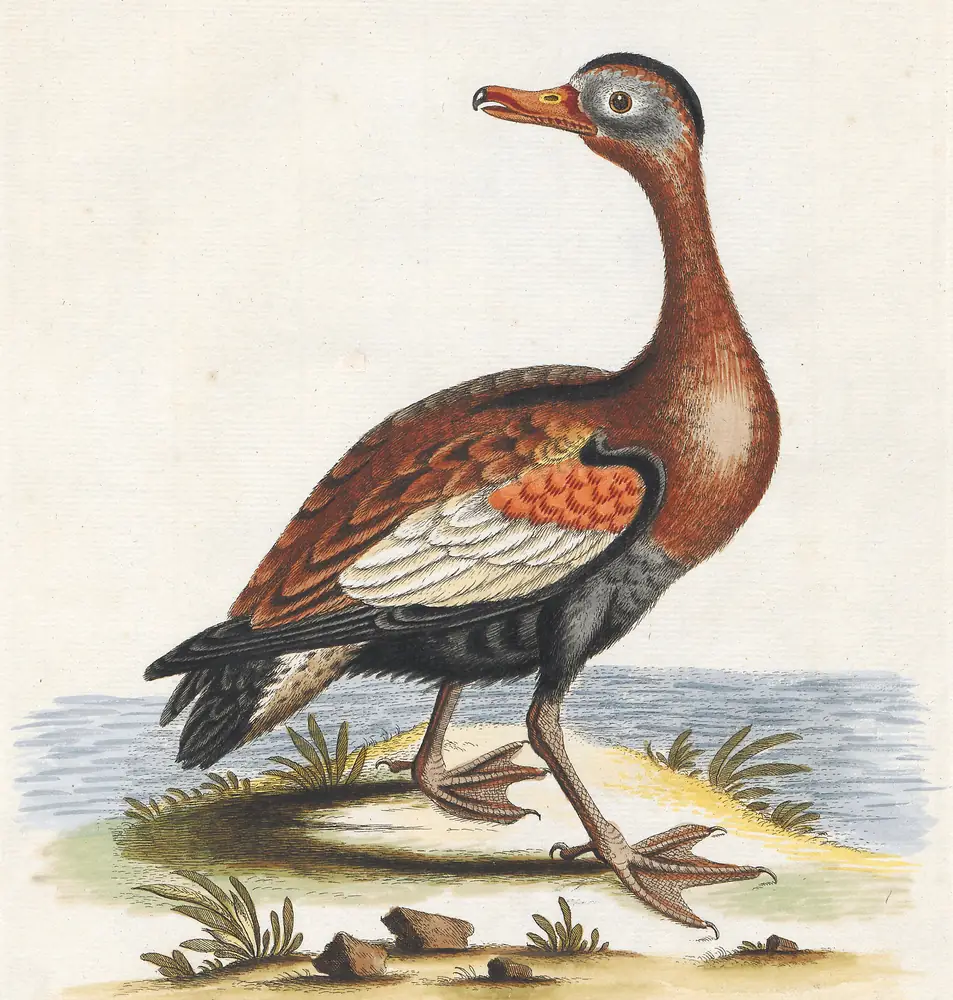
A day after hatching, Wood Duck ducklings jump from a nest hole that "can be over 65 feet above the ground," light enough to land unhurt (National Wildlife Federation), after climbing to the doorway on sharp claws, braced on their tails (Audubon's guide). Audubon's own tame ones are on the Wood Duck's painting page, and young Hooded Mergansers make the same leap, as the duck quiz tells.
Whistling-ducks whistle where other ducks quack, and the Black-bellied is spreading: Christmas Bird Count sightings rose from 1,822 a year in the 1980s to 12,227 in the early 2000s (Ducks Unlimited).
| Tree duck | Length | Weight | Where | Good to know |
|---|---|---|---|---|
| Black-bellied Whistling-Duck | 18.5–21 in | 1 lb 7 oz–2 lb 4 oz | Southeast Arizona to coastal South Carolina, and spreading | Perches high in dead trees; nests in tree holes 4 to 20 feet up, nest boxes, even chimneys and barns; most leave in winter except on the coast of South Texas |
| Fulvous Whistling-Duck | 18–21 in | 1 lb 8 oz–2 lb 5 oz | South Florida, coastal Texas and Louisiana, far southern California | "Seldom perches in trees"; often more than 95% plants in its diet; feeds in rice fields |
| Wood Duck | 17–20 in | 1–1.9 lb* | Wooded ponds, swamps and slow rivers | The only North American waterfowl known to raise two broods regularly; southern hens may stay the winter |
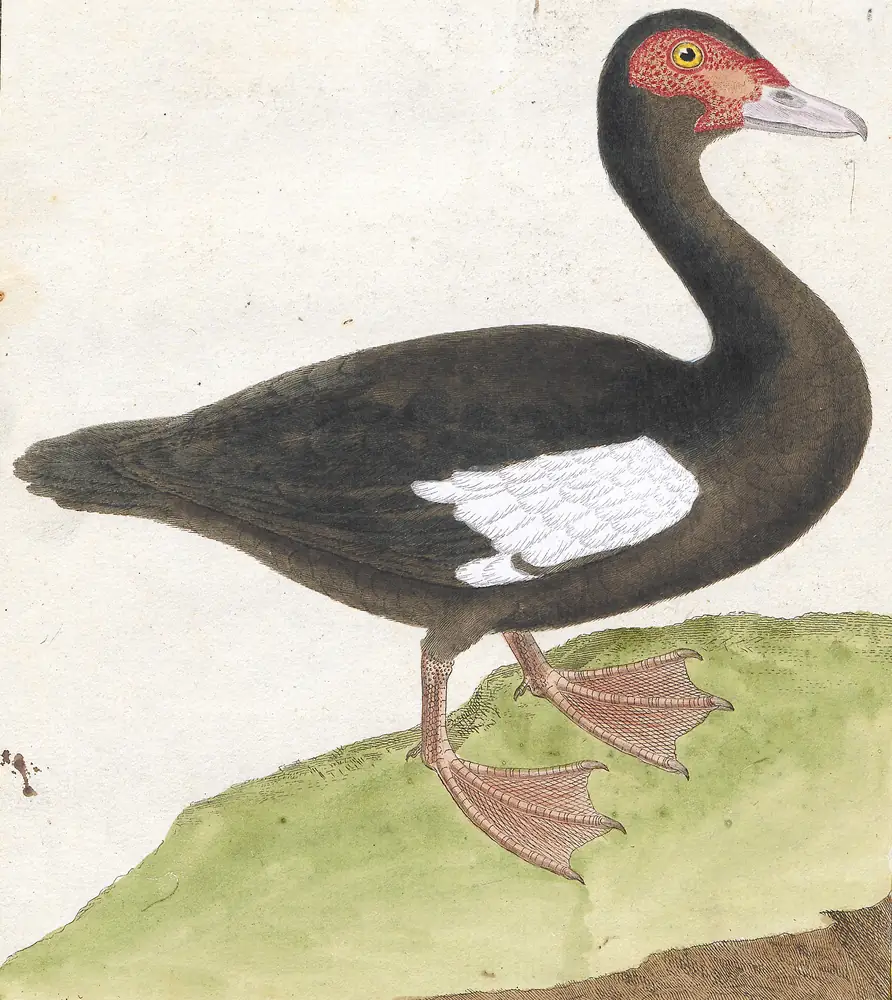
| Muscovy Duck | 25–34 in | Not given | A few wild birds on the Rio Grande in South Texas | "Most Muscovies seen in North America are of the barnyard variety" |
Sizes, nests and quotes: Audubon's guide. Starred weight, ranges, diets and broods: Ducks Unlimited.
Wood Duck vs Mandarin Duck
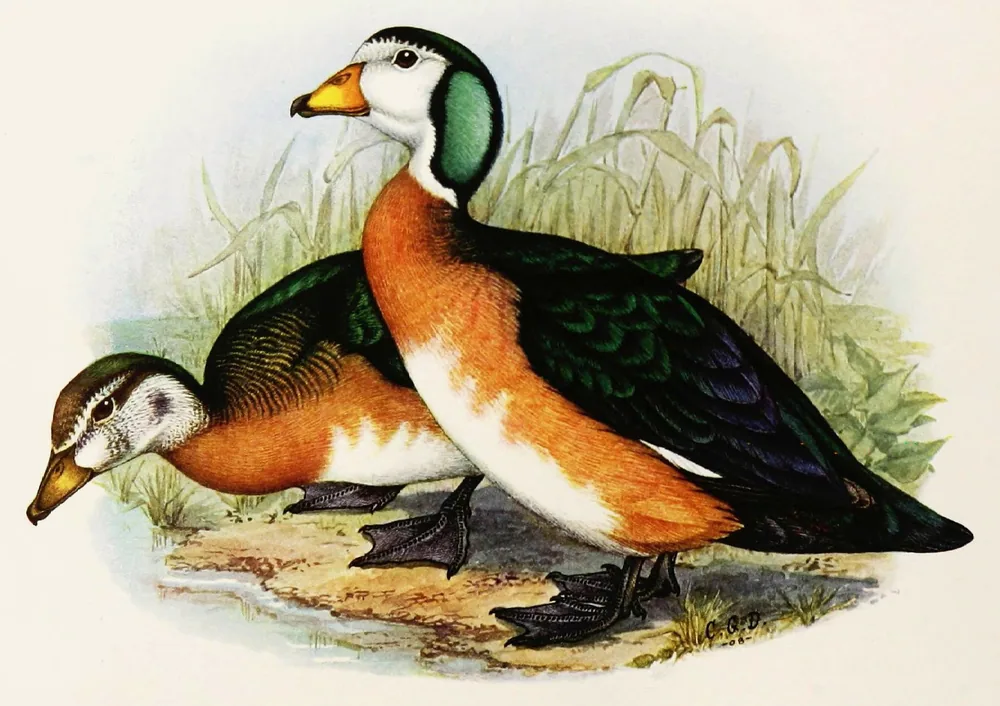
They are the only two ducks in their genus, Aix: the Wood Duck is American, the Mandarin comes from eastern Asia. The Wood Duck "has no close relatives, except for the Mandarin Duck of eastern Asia" (Audubon's guide), and escaped Mandarins are on the American Birding Association's Provisional List A, of exotics "that may be becoming established." The Wood Duck is also Mississippi's state waterfowl, and its comeback is in the duck quiz.
Diving ducks of lakes and bays: the canvasback's price
The two-dollar Canvasbacks Audubon saw at New Orleans, where they were the Canard Cheval, had climbed "from a very low price" in about fifteen years, he wrote, thanks to epicures who praised them above every other duck. Markets cheated: Redheads, nearly as good to his taste and 75 cents a pair in Baltimore, were "very frequently promiscuously sold in the markets as Canvass-backs."
Plate 301, at the top of this page, puts Baltimore across the water: Audubon's thanks to the people who made good his loss when a mob destroyed a quantity of his plates "during an outburst of political feeling." Later in the century a "prime" pair could fetch the equivalent of $100 today (Ducks Unlimited; The Nature Conservancy). The flavor was credited to wild celery, Vallisneria, source of the scientific name Aythya valisineria.
The bay divers, or pochards, dive for roots, seeds and shellfish on big lakes, rivers and bays, and patter across the water to take off.
| Bay diver | Length | Weight | Winter |
|---|---|---|---|
| Canvasback | 18.9–22.8 in | 1 lb 14 oz–3 lb 8 oz | Coastal bays and estuaries, inland lakes; "the largest of its genus" |
| Redhead | 17.3–20.9 in | 24.7–45.9 oz | Coastal bays and lagoons, inland lakes |
| Ring-necked Duck | 15–18 in | 1 lb 1 oz–2 lb | Ponds, lakes and slow rivers, "generally not on saltwater bays" |
| Greater Scaup | 16–21 in | 1 lb 10 oz–3 lb | Coastal bays and the Great Lakes; a bird from Alaska may winter on opposite coasts in different years |
| Lesser Scaup | 15.7–18.1 in | 1 lb 1 oz–2 lb 3 oz | Lakes, reservoirs and sheltered bays, more on fresh water than the Greater |
Figures: Audubon's guide; the Great Lakes, Ducks Unlimited. Redheads lay eggs in other ducks' nests, up to 87 in one "dump nest" (the guide); how many end up in Canvasback nests is in the duck quiz, and the "Canvas backed Duck" is among Audubon's changed names.
Sea ducks: eiders, scoters, the Long-tailed and the Harlequin
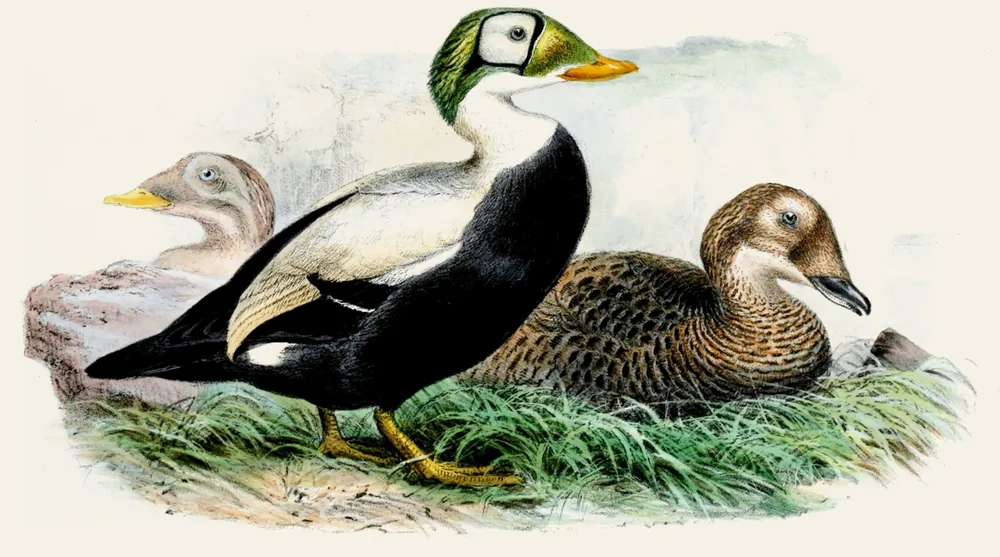
A whole species' winter home was found by satellite. The Spectacled Eider was listed as threatened in 1993 after declines of "as much as 94–98 percent" in western Alaska, and Audubon's guide, from 1996 text, still calls its winter range "very poorly known." In the mid-1990s researchers followed eiders carrying satellite transmitters to the Bering Sea and found huge flocks in openings in the pack ice southwest of St. Lawrence Island, over water up to 250 feet deep (Ducks Unlimited, which dates it both to 1995 and to the early 1990s); a 2004 USGS study mapped the area "from satellite telemetry."
The next Federal Duck Stamp is a sea duck: Robert Hautman's pair of Long-tailed Ducks, picked from 331 entries in September 2026 for 2027–28 and on sale from late June 2027 (Popular Science). Until July 2000 the duck's official name was Oldsquaw; that page has the reasons for the change.
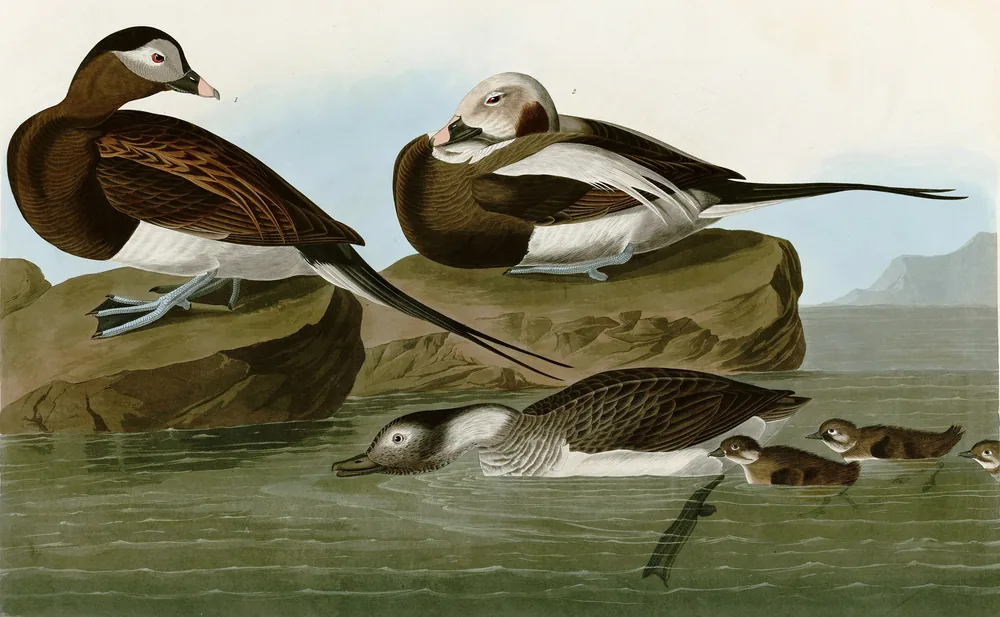
Sea ducks dive for mussels, clams and crabs on rocky coasts and in the open sea, many wintering far north, out to the ice.
| Sea duck | Length | Weight | Winter |
|---|---|---|---|
| Steller's Eider | 17–18.5 in | 1.4–2.2 lb* | Southern Bering Sea and Aleutian lagoons; the smallest eider |
| Spectacled Eider | 19 in–2 ft | 2 lb 5 oz–4 lb 14 oz | Bering Sea pack ice, southwest of St. Lawrence Island |
| King Eider | 17 in–2 ft 4 in | 3 lb 5 oz–6 lb 11 oz | The far north, to the edge of the sea ice; strays reach Florida, Louisiana, Kansas and Southern California |
| Common Eider | 23 in–2 ft 6 in | 3 lb 5 oz–6 lb 11 oz | Near northern coasts all year; Hudson Bay birds stay in open leads in the ice |
| Harlequin Duck | 15–17 in | 1 lb 3 oz–1 lb 10 oz | Rocky coasts with surf; summers on mountain streams |
| Surf Scoter | 19–22 in | 2 lb 2 oz–4 lb 6 oz | Pacific from the Aleutians to San Francisco Bay; Atlantic from Newfoundland to Virginia |
| White-winged Scoter | 19–23 in | 2 lb 10 oz–4 lb 13 oz | Both coasts, south to Georgia on the Atlantic; the Great Lakes |
| Black Scoter | 19–23 in | 2 lb 2 oz–3 lb 8 oz | Both coasts |
| Long-tailed Duck | 15.7–21.7 in | 15.9 oz–2 lb | Bering Sea, Hudson Bay, the Great Lakes; coasts south to Oregon and Virginia |
| Bufflehead | 13–15 in | 9.6 oz–1 lb 6.4 oz | Both coasts and the Gulf; the Great Lakes |
| Common Goldeneye | 18–23 in | 1 lb 8 oz–3 lb 5 oz | Both coasts, inland rivers and lakes; males winter farther north |
| Barrow's Goldeneye | 18–22 in | 1 lb 10 oz–3 lb 3 oz | Pacific coast from Kodiak to Washington; the St. Lawrence estuary |
Sizes: Audubon's guide, sexes together. Starred weight, Steller's and the St. Lawrence: Ducks Unlimited. "Studies show that many Harlequin Duck adults have had broken bones," the guide adds. The scoters are sorted out on our White-winged Scoter page, and the Bufflehead's size on its own page.
Mergansers: the fish-catchers with saw-edged bills
On big inland lakes in winter, Hooded Mergansers sometimes chase schools of shad in large flocks (Ducks Unlimited). All three mergansers hunt fish underwater, the Hooded by sight.
| Merganser | Length | Weight | Winter |
|---|---|---|---|
| Hooded Merganser | 16–19 in | Males 1.5 lb, females 1.2 lb* | Wooded ponds, swamps and estuaries; a short-distance migrant |
| Common Merganser | 22 in–2 ft 3 in | 31.7 oz–4 lb 12 oz | Big lakes and rivers; adult males winter farther north |
| Red-breasted Merganser | 20.1 in–2 ft 2 in | 1 lb 5 oz–3 lb | Salt bays and estuaries, the Gulf of Mexico |
Starred weights: Ducks Unlimited. A merganser's speed record and a Minnesota hen's enormous brood are in our duck quiz, and Audubon's moonlit Hooded Mergansers on their painting page.
The stiff-tail: Ruddy Duck
A courting Ruddy Duck drake "produces ticking and clapping sounds by pressing its bill against its breast," says Audubon's guide. The Ruddy is "the main North American representative" of the stiff-tails, ducks whose spiky tails are often cocked up; it is 13.4 to 16.5 inches long and winters on sheltered bays and lakes. A rare cousin, the Masked Duck, is known for "periodically invading southern Texas and Florida," and Maryland's one record, shot in 1905, is on our Maryland page.
Where do ducks go in winter?
South to open water: the great winter gatherings are in the lower Mississippi Valley, California's Central Valley and along the Gulf and Atlantic coasts, while many sea ducks winter in northern seas at the edge of the ice. Many hatch on the prairies, where the Prairie Pothole Region "produces more than half of North America's breeding ducks each year" (Ducks Unlimited).
| Where | What was counted |
|---|---|
| Arkansas Delta, January 5–13, 2026 | 544,705 ducks, 334,110 of them Mallards, 640,394 below the 2010–25 average in a drought year; about 1.41 million Snow and Ross's Geese and 466,550 White-fronted Geese. A late-January count found 694,286 ducks |
| Mississippi Delta, January 5–20, 2026 | 603,165 ducks, 8% under the long-term early-January average; Mallards 33% below theirs; other dabblers, led by Gadwalls, Northern Shovelers and Green-winged Teal, "nearly 70%"; diving ducks mostly on aquaculture complexes, the fish-farm ponds |
| California's Central Valley (2006) | "More than 60 percent of the Pacific Flyway's ducks and geese" at peak times: 5 to 7 million wintering waterfowl, about a million of them pintails, down from 10 to 12 million in the 1970s; 9% of 4 million acres of wetlands left |
Counts: Arkansas Game and Fish Commission; Mississippi Department of Wildlife, Fisheries, and Parks; Ducks Unlimited. Why Stuttgart is called the Duck Capital of the World is on our Arkansas page, and Missouri's winter geese and swans on its page.
Rare ducks, the commonest duck, and one that's gone
Audubon painted the Labrador Duck from a pair that "the Honourable Daniel Webster of Boston" shot on the Vineyard Islands and sent him, believing no one had pictured the female before. The last specimen anyone trusts, a young male now in the Smithsonian, was taken on Long Island in the fall of 1875 (William Dutcher, The Auk, 1894). A report of one shot and eaten in Elmira, New York, in 1878 is unproven (Diane Janowski, Elmira's city historian), and the American Birding Association dates the extinction to 1858. Why the duck vanished is unknown: Ducks Unlimited says hunting "is not believed" to be the cause, while Alfred Newton, quoted by Dutcher, blamed the shooting of nesting birds on the Labrador coast. More lost birds are in Audubon's birds, then and now.
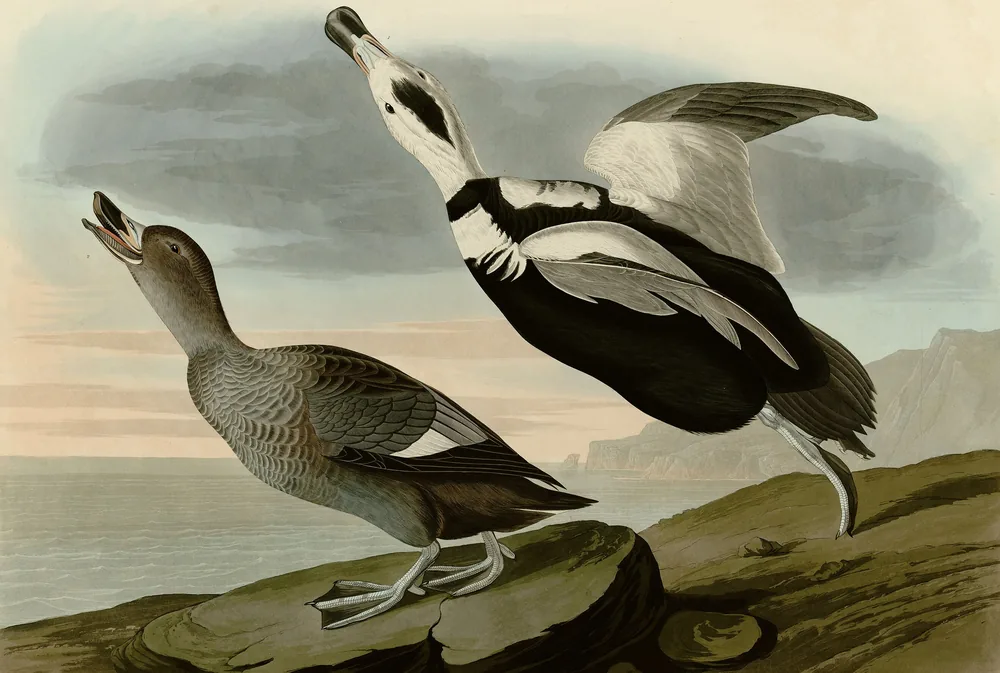
The rarest ducks in the US today are Hawaii's: the Hawaiian Duck, at about 673 pure birds, and the endangered Laysan Duck, which has "one of the smallest geographic ranges of any duck" and runs through swarms of brine flies at night, snapping them up. Rabbits stripped its island around 1900 and the ducks crashed, recovering once the rabbits were removed in the 1920s; counts found about 339 on Laysan in 2012 and, after moves to new islands, 231 to 330 on Midway (2012) and 90 on Kure (2024) (Hawaii's 2025 State Wildlife Action Plan).
The Spectacled Eider (1993) and the Alaska-breeding Steller's Eider (1997) are federally threatened. By the American Birding Association's codes, the Laysan Duck, Common Pochard, Tufted Duck, Stejneger's Scoter, Smew and Masked Duck are Code 3, "in very low numbers, but annually"; the Common Shelduck, Baikal Teal, Garganey, Falcated Duck, Eastern Spot-billed Duck and White-cheeked Pintail Code 4, "not recorded annually"; and the Common Scoter Code 5. Rare geese and swans include the bean-geese, the Pink-footed and Barnacle Geese and the Whooper Swan.
What is the most common duck?
The Mallard: about 5.9 million were counted on the spring 2026 breeding survey, more than any other duck, though it was the lowest Mallard count since 1993. Canvasbacks ran 32% and Redheads 26% above their long-term averages, pintails 48% below (Ducks Unlimited). The full table is on our duck quiz page.
Duck sounds: who quacks, who whistles, who squeals
The classic quack is the hen's. In Audubon's guide the Mallard drake makes soft, reedy notes and the hen quacks, and of the Runner, a farm breed, the University of Kentucky writes: "Only the females quack. All drakes are limited to a hoarse whisper."
| You heard | Probably |
|---|---|
| A loud, familiar quack | A Mallard hen; Black Duck, Mottled Duck and Mexican Duck hens sound alike |
| Soft, reedy notes, a thin rreeb | A Mallard or Mexican Duck drake |
| A loud, rising squeal, wooo-eeek! | A Wood Duck hen (the drake gives a softer jeee?) |
| A whistled whew-whee-whew | American Wigeon |
| A clear, repeated whistle, prip-prip | A Green-winged Teal drake |
| A two-tone whistle | A Northern Pintail drake (the hens quack) |
| Soft lisping or peeping | A Blue-winged Teal drake |
| Mellow whistles, pe-che-che-ne; chit-chit-chit in flight | Black-bellied Whistling-Duck, "very vocal" |
| A hoarse whistle, ka-wheee | Fulvous Whistling-Duck |
| A cat's meow | Redhead |
| A musical ow-owdle-ow, carrying far | Long-tailed Duck, "far more vocal than most ducks" |
| A hollow moan and cooing | A Common Eider drake |
| A mouse-like squeak | Harlequin Duck |
| A whistled cour-loo in spring | Black Scoter |
| Hoarse grunts and chatters | Hooded Merganser |
| Ticking and clapping | A courting Ruddy Duck, bill against breast |
| Whistling wings, heard half a mile off on still days | Goldeneyes, the hunters' "whistlers" |
| Hisses and grunts, few quacks | Muscovy Duck |
| Rich, musical honking | Canada Goose |
| A high, barking bow-wow! | Snow Goose |
| A bugling ko-hoh, or a mellow hoo-ho-hoo | Trumpeter Swan, or Tundra Swan |
Calls: Audubon's guide; goldeneye wings and the Black-bellied's flight call, Ducks Unlimited; the Muscovy, two university pages as well.
What is the sound of ducks?
Mostly a quack from the hens; many drakes whistle, coo or grunt instead, and the whistling-ducks whistle. The table above matches each sound to its duck.
What do different duck sounds mean?
Nobody has a full dictionary of duck talk, but hunters name the hen Mallard's calls by their use: a falling "greeting," a quick "comeback," a rolling "feed" chuckle, a loud "hail" and a drawn-out "lonesome hen." The names are Ducks Unlimited's, and a live hen calls to passing ducks "after they have flown over the pond," usually once, says the caller Rod Haydel. Treat the names as hunters' shorthand, not a scientific code.
What are duck noises called?
Quacks, mostly: Audubon's guide files the Mallard's call under "Croak/Quack," and the hunters' names for a hen's calls, from "greeting" to "hail," are just above. The whistling-ducks' calls are whistles.
What noises do ducks make when happy?
No study measures a duck's happiness, but contented feeding Mallards make a soft, broken chuckle, the sound the hunters' "feed call" copies (Ducks Unlimited). Audubon heard Hooded Mergansers "grunt softly with pleasure" (their painting page), and whether a quack echoes is a trivia question.
What are the biggest and smallest ducks?
In the US and Canada, the smallest regular duck is the Green-winged Teal, under a pound; the heaviest are the Common and King Eiders, up to 6 pounds 11 ounces; the longest is the Muscovy, up to 34 inches. Audubon's guide calls the teal "North America's smallest dabbling duck," and Ducks Unlimited says a female can weigh as little as six ounces and calls the Common Eider "the largest duck in the northern hemisphere." The smallest diver is the Bufflehead. Among all waterfowl the Trumpeter Swan is the biggest; the Canada is the biggest goose, at up to 19 pounds 13 ounces (Audubon's guide), and a race of the Cackling Goose, as light as 3 pounds, the smallest (Ducks Unlimited).
What is the smallest species of duck?
Zoos name the African Pygmy Goose, a duck despite its name: about 12 inches long and 10 ounces, says the San Diego Zoo, and the Calgary Zoo calls it "the smallest waterfowl in the world." In North America, it's the Green-winged Teal, and a six-ounce female teal can weigh less than an average pygmy goose: no source we read ranks every duck by weight.
What kind of duck stays small?
Among farm ducks, the Call: hens weigh 1.12 to 1.25 pounds and drakes 1.38 to 1.62 in the University of Kentucky's table of American Poultry Association breeds, lighter than the bantam Mallard and East Indie. Among wild ducks, the teal and Bufflehead stay small.
Are there miniature ducks available?
Yes, as breeds: the American Poultry Association's bantam class holds the Call, the East Indie and the bantam Mallard, the University of Kentucky's guide explains. A wild duckling is another matter, as the questions at the end explain.
What is the friendliest duck to have as a pet?
No study ranks duck breeds by friendliness, and the University of Kentucky's guide only warns that the egg breeds, the Runner and the Campbell, "tend to be nervous and flighty." A breeder crossed Campbells with others for "calmness," the guide adds.
Farm ducks: where the breeds come from
Almost every farm duck is a Mallard underneath, and the proof is a feather: the drakes carry the Mallard's curled tail feathers, and "No other wild duck has these sex-feathers" (University of Kentucky). The exception is the Muscovy, a separate species from Central and South America, tamed there "before Columbus' arrival" (University of Wisconsin–Madison Extension); crossed with a Mallard-type duck, it gives a sterile "mule."
The Pekin is about 90% of US duck meat, and its arrival on Long Island is a trivia question. The Cayuga, named for Cayuga Lake in New York, is "the only duck breed developed in America," now on The Livestock Conservancy's Watch list. Adele Campbell's Campbell, bred in the late 1800s, can lay "an egg a day for ten months," and Runners "stand upright like penguins."
What are 10 common breeds of duck?
Pekin, Rouen, Khaki Campbell, Indian Runner, Cayuga, Muscovy, Swedish, Buff, Aylesbury and Call are ten that university extension guides describe; the choice of ten is ours.
What are the names of some common duck breeds?
The University of Kentucky's table of American Poultry Association breeds names the Aylesbury, Buff, Call, Campbell, Cayuga, Crested, East Indie, Magpie, Mallard, Muscovy, Pekin, Rouen, Runner and Swedish. Rarer heritage breeds on The Livestock Conservancy's 2026 list include the Ancona, Australian Spotted, Dutch Hookbill, Saxony, Shetland, Silver Appleyard and Welsh Harlequin. Kentucky's figures for eight:
| Breed | Hen | Drake | Eggs a year |
|---|---|---|---|
| Call | 1.12–1.25 lb | 1.38–1.62 lb | 20–50 |
| East Indie | 1.38–1.50 lb | 1.62–1.88 lb | 20–50 |
| Mallard (bantam) | 1.88–2.25 lb | 2.25–2.50 lb | 20–50 |
| Campbell | 3.5–4.0 lb | 4.0–4.5 lb | 200–300 |
| Runner | 3.5–4.0 lb | 4.0–4.5 lb | 100–150 |
| Pekin | 8–9 lb | 9–10 lb | 100–180 |
| Rouen | 8–9 lb | 9–10 lb | 40–60 |
| Muscovy | 6–7 lb | 10–12 lb | 60–120 |
The farm goose's wild ancestor, the Graylag, is among the Twelve Days of Christmas birds.
Market guns, a treaty and a stamp: how ducks were saved
"Nobody alive in America today has legally sold a wild duck," Ducks Unlimited's Mark Petrie wrote in 2014. Market hunters' biggest punt guns fired two pounds of shot, about 25 12-gauge shells' worth, and 40 to 50 birds made a good shot; between 1910 and 1918 Atley Lankford of Elliot Island, Maryland, killed 35,000 ducks with a Remington Model 11. Railroads and refrigeration carried the ducks to city restaurants, and Mark Twain, The Nature Conservancy notes, listed canvasback among the American foods he missed in Europe.
The law caught up step by step, from the Lacey Act of 1900 to the Migratory Bird Treaty Act of 1918, which made it a crime to "sell" a migratory bird (Audubon magazine). Missouri sued to stop a federal game warden, Ray P. Holland, from enforcing it, and in Missouri v. Holland (1920) the Supreme Court upheld the act 7 to 2, Justice Holmes writing that "Wild birds are not in the possession of anyone." It remains "the principal Supreme Court decision" on treaty power and federalism (Federalism in America).
Then hunters paid for wetlands. Franklin D. Roosevelt signed the Federal Duck Stamp into law on March 16, 1934; it cost $1, and 635,000 hunters bought one. At $25 since 2014, it sends 98% of its price to the Migratory Bird Conservation Fund by law: more than $1.3 billion raised and 6 million acres conserved so far (Ducks Unlimited).
Its art comes from "the only federally sponsored wildlife art competition in the United States" (American Hunter), which one family keeps winning: Jim Hautman's three Buffleheads are on the 2026–27 stamp, his seventh win, and in 2015 the brothers Joe, Bob and Jim finished first, second and third (Friends of the Migratory Bird/Duck Stamp). The first stamp's sketch is a trivia question, the stamp a gift idea, and the contest a film, The Million Dollar Duck.
If Buffleheads and Canvasbacks are on your life list, a Birdfolio prints them, with every other bird you've seen, beside classic paintings like these in a hardcover book: flip through one.
How to identify ducks: a five-question field check
Ask how it feeds, what its bill is like, what color its wing patch is, how it holds its tail and body, and where and when you're watching.
- Tipping up or diving? Dabbler or diver.
- What bill? A spoon is a Northern Shoveler, a narrow saw-edged bill a merganser, a stubby one a Bufflehead, a long sloping one a Canvasback.
- What wing patch? Blue with white borders on a Mallard, dark purple on a black duck.
- What tail and stance? A Ruddy Duck cocks its tail; whistling-ducks stand tall on long legs.
- Where and when? Sea ducks crowd winter coasts; whistling-ducks live in the far South.
Some hens can't be named at all: a "Eurasian" female Green-winged Teal "is not safely identified" (Audubon's guide). Practice on our duck quiz.
Coot vs duck
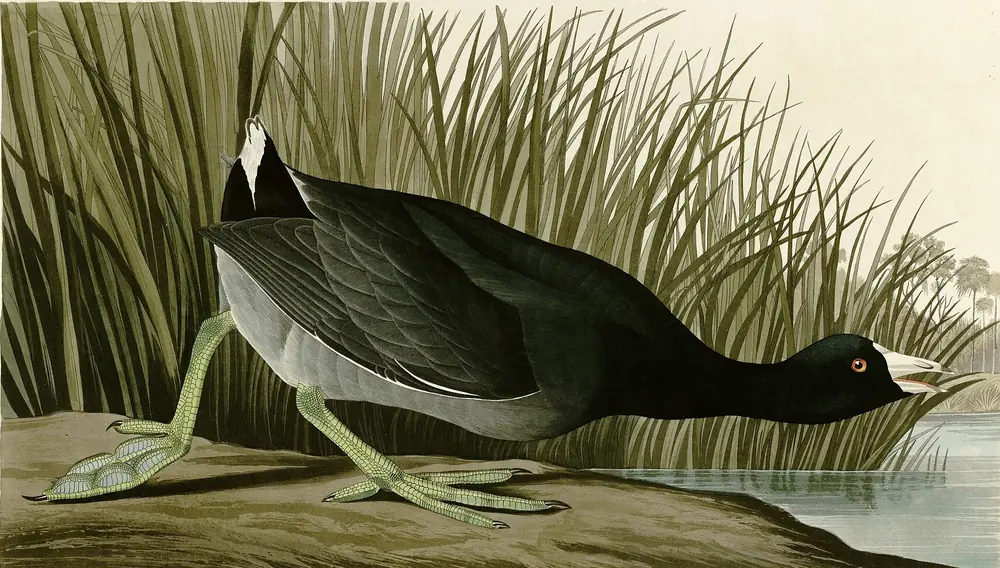
A coot isn't a duck: it is a rail relative with a thick white bill, a shield on the forehead and lobed, not webbed, toes, and it nods its head as it swims (Audubon's guide). Coots also patter along the water to take off.
Questions people ask
Do ducks mate for life?
No: most pair for one season (Ducks Unlimited). Geese and swans pair for life, and so do whistling-ducks.
Does Hawaii have native ducks?
Yes, two, both endangered: the Hawaiian Duck and the Laysan Duck, beside feral Mallards (Hawaii's Division of Forestry and Wildlife). The Nēnē is Hawaii's goose.
Can I keep a wild duck or its eggs?
No: "It is illegal to remove Mallard ducks or their eggs from the wild," says the University of Kentucky's guide, under the Migratory Bird Treaty Act of 1918.
How long do ducks live?
The oldest duck known to have been taken by a hunter was a 29-year-old Canvasback (Ducks Unlimited). See how long Mallards live and the Wood Duck, Bufflehead, Hooded Merganser and Canada Goose painting pages.
How fast and how high do ducks fly?
Brant fly nonstop from Alaska to Baja California, about 3,000 miles in 60 to 72 hours (Ducks Unlimited); the highest flight and the fastest merganser are in our duck quiz.