Old bird nickname
Timberdoodle: the American Woodcock's nickname
A timberdoodle is an American Woodcock, a plump, long-billed sandpiper that lives in young woods and wet thickets instead of on the shore. Wildlife agencies from Pennsylvania to Virginia use the nickname, along with a string of others: bogsucker, mudsnipe, night partridge, big-eye, Labrador twister and hokumpoke.
Updated
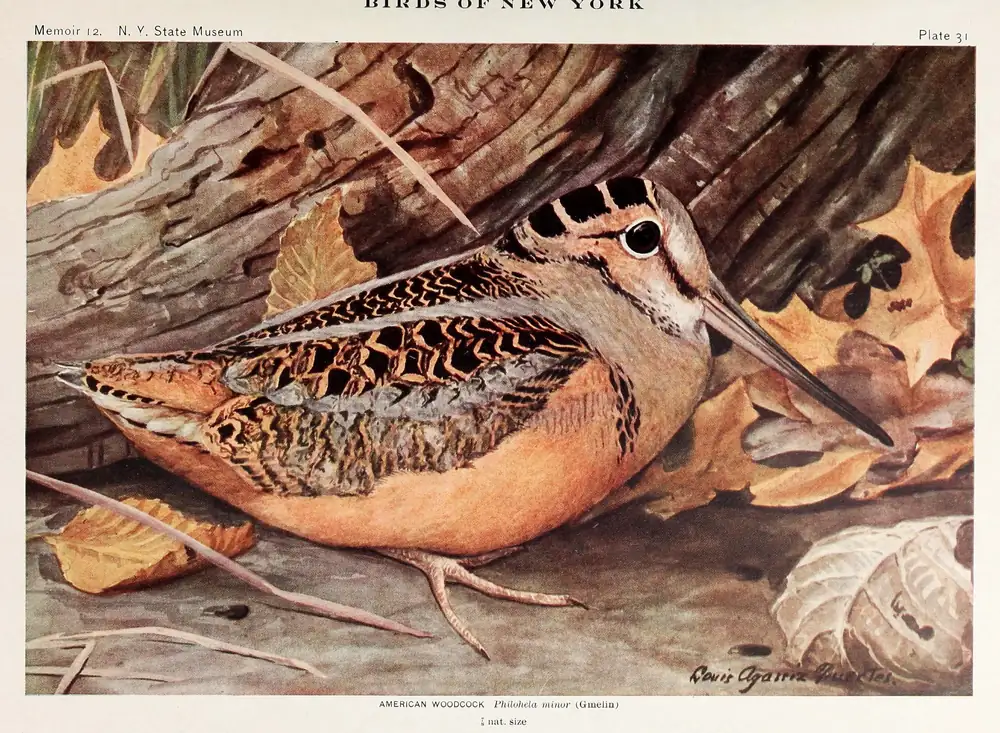
Is a timberdoodle a woodcock?
Yes: timberdoodle is a nickname for the American Woodcock, Scolopax minor. Pennsylvania's Game Commission lists it with night partridge, big-eye, bogsucker and mudsnipe; New York's Department of Environmental Conservation adds mud bat and Labrador twister; the National Park Service adds hokumpoke and calls timberdoodle “supremely satisfying.”
It is a shorebird that left the shore. Woodcocks belong to the sandpiper family, but they live in young forest and shrubland and probe the soil for earthworms. Audubon, in 1835, heard it called the Bog-sucker in New Brunswick.
It is a small bird with a long bill: 10 to 12 inches long with wings 16 to 19 inches across, but only about 5 inches tall as it stands, Pennsylvania's Game Commission says, and the female is a little heavier than the male.
Its official name has hardly moved. The American Ornithologists' Union's first check-list, in 1886, listed it as the American Woodcock, Philohela minor; the 1910 edition called it plain Woodcock, and American Woodcock came back in 1931. By 1983 the bird had moved into Scolopax, the same genus as the Eurasian Woodcock.
What does timberdoodle mean?
Nobody has pinned it down. The wildlife agencies that use the word don't explain it, and we found no date or origin for it in the dictionaries we could read, including four old dictionaries of American words from 1859 to 1902. The timber is easy to see in a bird of the woods; the doodle is anyone's guess, so treat any confident story about it with care.
The other names explain themselves better. Night partridge and big-eye fit a bird with very large eyes whose travels, Audubon wrote, are “altogether performed under night.” Bogsucker and mudsnipe fit a bird that feeds with its bill buried in soft ground. (The mud hen is a different bird altogether: the American Coot.)
What is the slowest bird in the world?
The American Woodcock, by Guinness World Records' reckoning, together with its cousin the Eurasian Woodcock: both have been timed in their courtship flights at 5 miles an hour (8 km/h) without stalling. Flushed from danger, a woodcock can reach 30 miles an hour, New York's wildlife agency says.
Alexander Wilson had noticed in 1812: “The flight of the Woodcock is slow.” Flushed in the woods, he wrote, it rises just over the bushes and drops down again.
The sky dance
The slow flight is part of a show. On spring evenings, in the half hour after sunset and again before sunrise, a male on the ground calls a buzzy peent that carries several hundred yards; a soft tuko before it can be heard only within about 15 feet, Pennsylvania's Game Commission says. In Virginia the show starts in late February or early March.
Then he spirals up, 200 to 300 feet by Pennsylvania's count and a little lower by New York's, his wings twittering as air rushes through three narrow outer flight feathers. At the top he chirps, then tumbles back down and lands near where he started, often on the very spot.
Aldo Leopold named it “The Sky Dance” in A Sand County Almanac. “The show begins on the first warm evening in April at exactly 6:50 p.m.,” he wrote, and he warned watchers not to be late. Oxford University Press accepted the book on April 14, 1948; a week later Leopold died fighting a grass fire, and the book came out in 1949.
Audubon wrote the ground call down as kwauk, Wilson as “a sudden quack.”
Big eyes, an upside-down brain and a bill that opens underground
A woodcock's eyes sit far back and high on its head, which gives it nearly 360-degree vision, New York's wildlife agency says, so it can watch for danger while its bill is buried in the mud. Audubon tested this his own way: woodcocks probing a tub of worms spotted a cat even below the rim of the tub, and fled.
Its ears sit ahead of its eyes, and its brain is, in effect, upside down, with the cerebellum below the rest, Pennsylvania's Game Commission says; the usual explanation, still a theory, is that the eyes moved back as the bill grew long.
The bill is a tool of its own. Nerve endings in its lower third find worms underground, the tip of the upper bill opens while it is still buried, and a rough tongue holds the worm. Earthworms make up more than 60 percent of its food, and an adult may eat half its body weight or more in a day. As it stands, a woodcock often rocks its body, possibly to make the worms move, Audubon's field guide suggests.
Its droppings, white splashes the size of a silver dollar called chalk, show where it has been feeding.
Audubon's woodcocks
Plate 268 of The Birds of America shows a male, a female and their young. In his 1835 chapter Audubon told of a mother woodcock that lay down in the middle of a road as if she were dead, to draw a pack of boys away from her five chicks, until he stepped in.
He also recorded what people did to woodcocks. Market hunters shot them in “almost incredible numbers” from July into winter, the best of them more than a hundred a day with relays of dogs, and in lower Louisiana dazzled birds were knocked down at night by men carrying torches. Wilson, too, wrote of hunters keeping two sets of dogs because one set tired. Near Charleston, John Bachman knew of 30 unfledged young killed in a single day.
Audubon wrote the chapter in Edinburgh, and admitted he missed the bird at table: he longed for a woodcock dinner with Newark cider.
Can you legally own an American woodcock?
No. Woodcocks are migratory birds, which puts them under the US Fish and Wildlife Service, Pennsylvania's Game Commission explains, and the Migratory Bird Treaty Act makes it unlawful to take, possess, sell or transport one, or its nest or eggs, except as federal rules allow.
The exception the rules make is for hunting. Under the federal frameworks for 2025–26, states in the Eastern and Central regions could open woodcock seasons of up to 45 days, with a limit of 3 birds a day. Of the whole sandpiper family, only woodcock and snipe have hunting seasons in the US.
How the timberdoodle is doing
Not as well as it used to. The yearly Singing-ground Survey, begun in 1968, found the woodcock declining by 1.05 percent a year in the Eastern region and 0.56 percent a year in the Central region from 1968 to 2017, the US Fish and Wildlife Service's biologists reported. New York's agency puts the eastern loss at over 55 percent in 40 years.
The main cause is habitat: woodcocks need young forest and shrubland, which is lost to development and to woods growing old. New York's Young Forest Initiative, begun in 2015, cuts patches of 5 to 10 acres in rotation to keep woods of mixed ages, and the same young woods help other birds, such as the Golden-winged Warbler.
Woodcocks migrate at night and low, about 50 feet up, which puts them at risk from towers and windows. Once grown, a woodcock can expect to live about two years, Pennsylvania's Game Commission says, though one female banded in Wisconsin in 1971 was shot there 11 years and 4 months later.
Heard a peent at dusk? Every bird on your list, the woodcock included, gets its own page in a Birdfolio; look inside one.