Classic bird paintings
Northern Flicker painting: Audubon's plate and other classic portraits
John James Audubon painted the Northern Flicker as plate 37 of The Birds of America (1827–38), five birds around a dead trunk, under the name Golden-winged Woodpecker. That plate, dated 1828 on its engraver's line, is the painting shown here, and a free high-resolution scan is on Audubon.org.
Updated
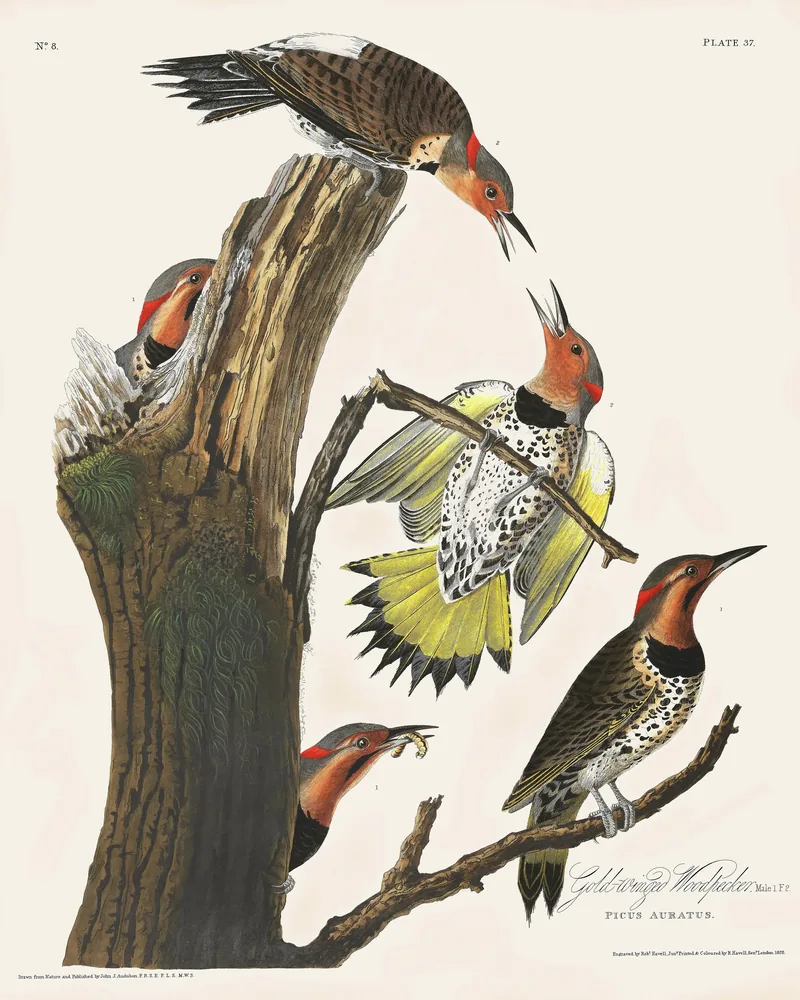
Audubon’s plate: plate 37, “Golden-winged Woodpecker”
Plate 37 shows three males and two females. Audubon noted that people seldom used the name Golden-winged Woodpecker: he heard High-holder, Yucker and Flicker, and among the French settlers of Louisiana, Pique-bois jaune.
In spring, he wrote, its call from the tops of tall dead trees sounds like a long, jolly laugh: “Their note at this period is merriment itself.” Several males follow one female from tree to tree, bowing and fanning their tails, and he saw no fighting until she chose one. A red-shafted flicker of the West appears on his later plate 416.
Story: Audubon’s Ornithological Biography, vol. 1 (1831). See plate 37 free at Audubon.org. See plate 416 free at Audubon.org.
More classic portraits, free to see
- John James Audubon, The Birds of America, octavo edition (1840–44), plate 273: “Golden-winged Woodpecker”. Free scan (New York Public Library Digital Collections)
- John James Audubon, The Birds of America, octavo edition (1840–44), plate 274: “Red-shafted Woodpecker”. Free scan (New York Public Library Digital Collections)
- John James Audubon, The Birds of America, octavo edition (1840–44), plate 494: “Missouri Red-moustached Woodpecker”. Free scan (New York Public Library Digital Collections)
- Louis Agassiz Fuertes, for Elon H. Eaton’s Birds of New York (1910–14), plate 64: “Northern Flicker”, with the Red-bellied Woodpecker. Free scan (Internet Archive)
About the Northern Flicker
- Northern Flickers look for food both on the ground and in trees. (Source: National Audubon Society)
- The yellow-shafted flickers of the East and the red-shafted flickers of the West were once counted as separate species. (Source: National Audubon Society)
The oldest known wild Northern Flicker lived at least 9 years and 2 months: it was banded in Florida in 1965 and found there again in 1973. That is a record from bird banding, not a typical lifespan. (Source: USGS Bird Banding Laboratory, 2025 longevity table.) How long do wild birds live?
Buying a print?
An original plate 37 is a hand-colored sheet about 26 by 38 inches, printed in Britain in 1827–38; many prints sold today are reproductions or small 1840s octavo prints. How to tell an original from a reproduction.
In a Birdfolio, the hardcover book of your own life list, this painting sits beside the Northern Flicker with the date and place you first saw one. See your own list as a book, free.