Classic bird paintings
Blue Jay painting: Audubon's plate and other classic portraits
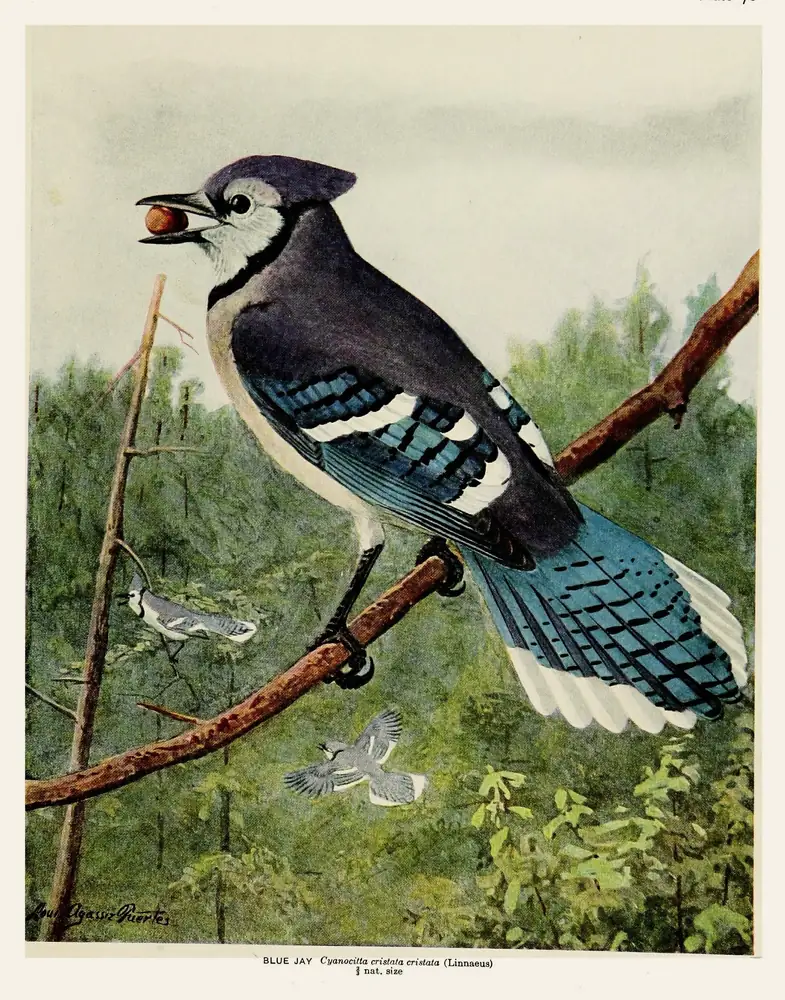
John James Audubon painted the Blue Jay as plate 102 of The Birds of America (1827–38): three jays eating stolen eggs, under the same name. A free high-resolution scan is on Audubon.org. The jay shown here was painted by Louis Agassiz Fuertes for Elon H. Eaton's Birds of New York (1910–14), plate 70.
Updated
About this painting
Louis Agassiz Fuertes signed this jay in the lower corner. It is plate 70 of Elon H. Eaton's Birds of New York (1910–14), published by the New York State Museum, and the caption gives its size as two-thirds of life. Two more jays fly low through the trees behind it. More about the painter in our guide to Louis Agassiz Fuertes.
Audubon’s Blue Jay: plate 102, “Blue Jay”
Audubon's plate shows three jays, each with an egg taken from another bird's nest. He called them “rogues though they be, and thieves,” and wrote that a jay can copy the cry of the Sparrow Hawk, today's American Kestrel, so well that small birds hurry into cover.
In the winter of 1830, at Louisville, Kentucky, he bought twenty-five jays at 6¼ cents each, hoping to set them free in the English woods. In their cage they cracked corn side by side “like so many blacksmiths paid by the piece.” Most reached Liverpool in good health, but insects that covered their bodies killed them one after another, and only one bird reached London.
Story: Audubon’s Ornithological Biography, vol. 2 (1834). See plate 102 free at Audubon.org.
More classic portraits, free to see
About the Blue Jay
- Blue Jays store acorns by burying them in holes in the ground. (Source: National Audubon Society)
The oldest known wild Blue Jay lived at least 26 years and 11 months: it was banded in Newfoundland and Labrador and St. Pierre et Miquelon in 1989 and found there again in 2016. That is a record from bird banding, not a typical lifespan. (Source: USGS Bird Banding Laboratory, 2025 longevity table.) How long do wild birds live?
Buying a print?
An original plate 102 is a hand-colored sheet about 26 by 38 inches, printed in Britain in 1827–38; many prints sold today are reproductions or small 1840s octavo prints. How to tell an original from a reproduction.
In a Birdfolio, the hardcover book of your own life list, this painting sits beside the Blue Jay with the date and place you first saw one. See your own list as a book, free.