Classic bird paintings
Green Heron painting: Audubon's plate and other classic portraits
John James Audubon painted the Green Heron as plate 333 of The Birds of America (1827–38), under the same name: an adult male and a young bird in September, the young one stretching up toward a luna moth. That plate is the painting shown here, and a free high-resolution scan is on Audubon.org.
Updated
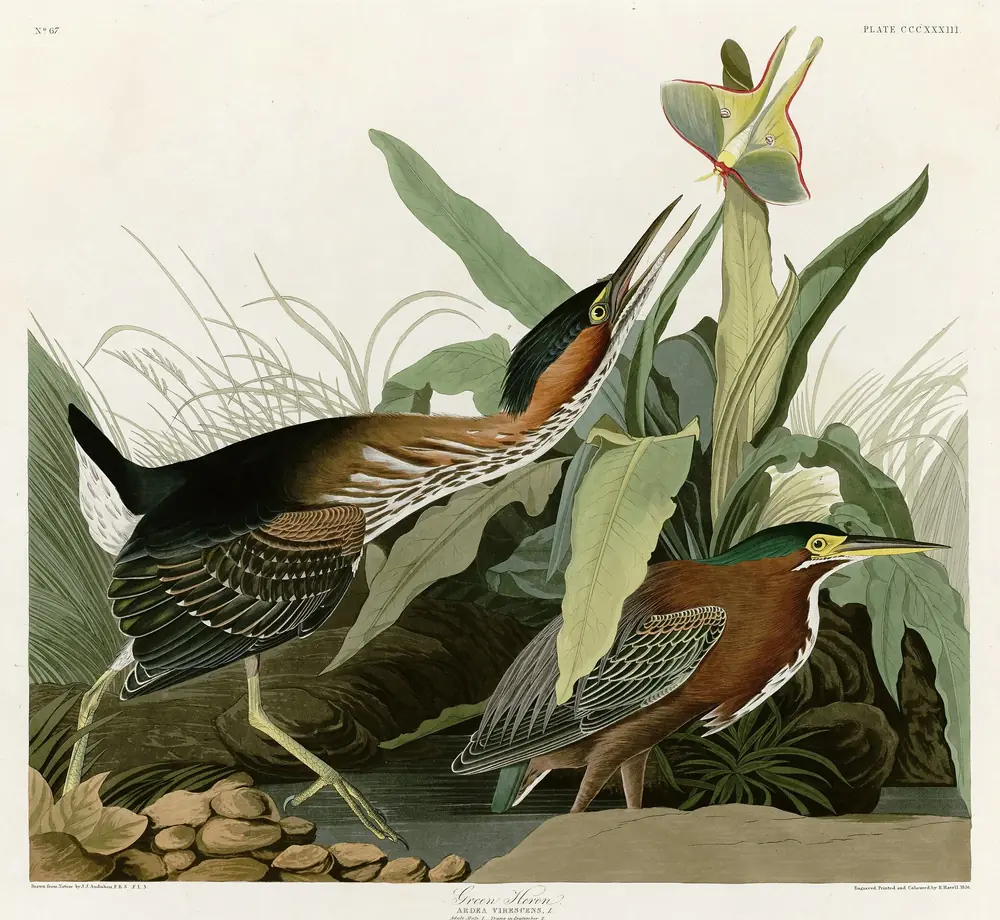
Audubon’s plate: plate 333, “Green Heron”
Flocks of twenty to fifty Green Herons came back each spring, Audubon wrote, zigzagging down out of their line of flight to land in swamp trees about an hour after sunrise. They spent the day resting, preening and feeding, then at sunset rose, formed their lines again and flew on, he was sure, all night. In autumn, oddly, they went south alone or in very small groups. Some pairs nested alone, others by the dozen on a tangle of vines in a pond, two or three feet above the water, or high in tall cypresses, and the three or four eggs were a delicate sea-green.
He found the bird gentle, or, as many would say, stupid: it let people come within a few paces and looked at them as calmly as a house sparrow on a London street. It ate frogs, fish, snails, tadpoles, crabs and small mammals, and in courtship the male strutted before the female with his neck feathers raised, calling a rough qua, qua. Green Herons were often sold for food in Southern markets, especially in New Orleans.
On plate 333 he set an adult in full plumage beside an immature bird. The young birds' changes had misled authors who knew the species only from skins, he wrote, and the pair shows “how carefully Nature ought to be studied.”
Story: Audubon, Ornithological Biography, vol. 4 (1838), pp. 274–276. See plate 333 free at Audubon.org.
When was Audubon's Green Heron painted?
In Louisiana, probably in 1821 or 1822, says a 1966 book of his original watercolors, and he showed the picture at Edinburgh in 1826.
He worked in watercolor, pencil and pastel, and the adult at right was cut out and pasted in beneath the leaves of a plant drawn too loosely to identify, the same book says.
In Charleston he found several nests in a single live oak in the grounds of Joel Poinsett. An amateur botanist, Poinsett had sent poinsettias from Mexico to his Charleston greenhouse around 1828, while serving as the first US minister there; the plant is named for him, says the University of Florida's extension service.
Sources: Maryland State Law Library; Audubon, Ornithological Biography, vol. 4 (1838), p. 275; University of Florida extension.
What is the moth in Audubon's Green Heron painting?
A luna moth: the young heron at left is reaching for it, says the 1966 book of Audubon's original watercolors.
It suits a Louisiana picture. In Louisiana and Florida, adult luna moths can be found in every month of the year, says the University of Florida's profile of the moth. The adults have only vestigial mouthparts and never feed, so they live short lives, and in flight their long, twisted tails are believed to confuse the sonar of hunting bats. In 1987 the moth appeared on a US first-class postage stamp.
Sources: Maryland State Law Library, Audubon Collection; University of Florida, Featured Creatures.
More classic portraits, free to see
- John James Audubon, The Birds of America, octavo edition (1840–44), plate 367: “Green Heron”. Free scan (New York Public Library Digital Collections)
- Louis Agassiz Fuertes, for Elon H. Eaton’s Birds of New York (1910–14), plate 23: “Green Heron”, with American Bittern and Least Bittern. Free scan (Internet Archive)
About the Green Heron
- It sometimes fishes with bait: it breaks twigs into pieces small enough to make convincing lures, drops them on the water and waits for a fish to come close; sometimes it uses a feather or even a live insect instead. (Source: National Audubon Society)
- Its plain looks helped save it: plume hunters nearly wiped out showier marsh birds such as the Snowy Egret, and in the DDT years it suffered less than eagles and falcons, since the tiny fish it eats were unlikely to carry much of the insecticide. (Source: National Audubon Society)
- Breeding Bird Survey data suggest that Green Heron numbers fell by 55% across the country between 1966 and 2013. (Source: National Audubon Society)
- In one season at Audubon's Rainey sanctuary in Louisiana, researchers found 244 Green Heron nests and banded 142 chicks, one of the largest batches of the species ever banded. (Source: National Audubon Society)
- The young start climbing about near the nest at 16 to 17 days old and are reportedly able to swim well. (Source: National Audubon Society)
- The green on its back is iridescent and often looks dull bluish or simply dark. (Source: National Audubon Society)
How long does a Green Heron live?
The wildlife-agency guides we read give the Green Heron no typical lifespan, only how long one can live. The oldest known wild Green Heron was at least 11 years and 1 month old (USGS Bird Banding Laboratory): it was banded in Texas in 2013 and found there again in 2023.
Source: USGS Bird Banding Laboratory. A banding record is the minimum age of one bird when it was found again, not a typical lifespan. How long do wild birds live?
How can you tell if a plate 333 print is an original?
By its size: an original plate 333 is a hand-colored sheet about 26 by 38 inches, dated 1836; the Green Heron’s octavo version, plate 367, is book-size, from 1840–44. Many prints sold today are reproductions: how to tell an original from a reproduction. For all 435 plates at a fraction of an original’s price, see which edition of The Birds of America to buy.
In a Birdfolio hardcover, this painting sits beside the date and place you first saw a Green Heron. See your own list as a book, free.