Old bird nickname
Chicken hawk: which hawks got the name, and what they really eat
A chicken hawk is, most often, a Cooper's Hawk or its smaller cousin the Sharp-shinned Hawk: chicken hawk is the farmers' name for any hawk blamed for taking chickens. The bigger Red-tailed and Red-shouldered Hawks were usually called hen hawks. It was never an official name, and it got a great many hawks shot.
Updated
What is considered a chicken hawk?
Any hawk that “preys or is believed to prey on chickens,” in Merriam-Webster's words, a name it dates to about 1775. Most writers pinned it on the Cooper's Hawk. A. K. Fisher of the US Department of Agriculture called it “the true ‘Chicken Hawk,’” along with its smaller relative the Sharp-shinned Hawk, in 1893, and Alabama's wildlife agency still lists chicken hawk, blue darter and quail hawk as the Cooper's Hawk's other names.
Hen hawk was the bigger birds' name. Merriam-Webster gives it to several large hawks of the buteo kind that sometimes attack poultry, such as the Red-tailed and Red-shouldered Hawks, and Fisher wrote of “the Red-tail, or ‘Hen Hawk,’ as it is commonly termed.”
Neither was ever an official name: the American Ornithologists' Union's check-lists give these birds only their standard names.
Why do they call them chicken hawks?
Because some of them do take chickens, and farmers named hawks by what they took. Audubon complained in 1831 that farmers called hawks, by size, “Hen Hawk,” “Chicken Hawk” and “Pigeon Hawk,” and that Louisiana's French and Spanish settlers called every one of them Mangeurs de Poulets, chicken-eaters. Had tame ducks been as common as wild ones, he joked, the hawks would have been Mangeurs de Canards.
He knew the raids were real. Among American farmers, he wrote, the Red-tailed Hawk's common name was the Hen-hawk; once the kingbirds had raised their young, it came to farmyards for chickens, ducklings and young turkeys, and he caught several by baiting a steel trap with a live chicken. Alexander Wilson's model for his Red-tail, in 1812, was caught in a trap baited with the hen it had just killed: “fair and just retribution,” in the farmer's eye.
The small hawks could be worse. Thomas Nuttall told Audubon of a Sharp-shinned Hawk that came to a farm in thinly settled Georgia and Alabama every day until it had carried off 20 to 30 chickens. Our guide to hawks and their other names has the rest, from pigeon hawk to the Osprey's old name, fish hawk.
What 2,700 stomachs showed
In 1893 the government counted. Fisher's bulletin for the Department of Agriculture rested on the contents of about 2,700 hawk and owl stomachs, and his chief, C. Hart Merriam, summed it up: only six of the 73 kinds of hawks and owls in the United States did real harm, and of those only the Sharp-shinned and Cooper's Hawks mattered much.
Fisher's verdict on the two hen hawks: they were “striking examples of the effects of having a bad name.” Under 2 percent of the Red-shouldered Hawk's food, he worked out, was the kind that earned it the nickname. The Rough-legged Hawk, shot in the East as a hen hawk, had “never destroyed a hen or chicken in its life.”
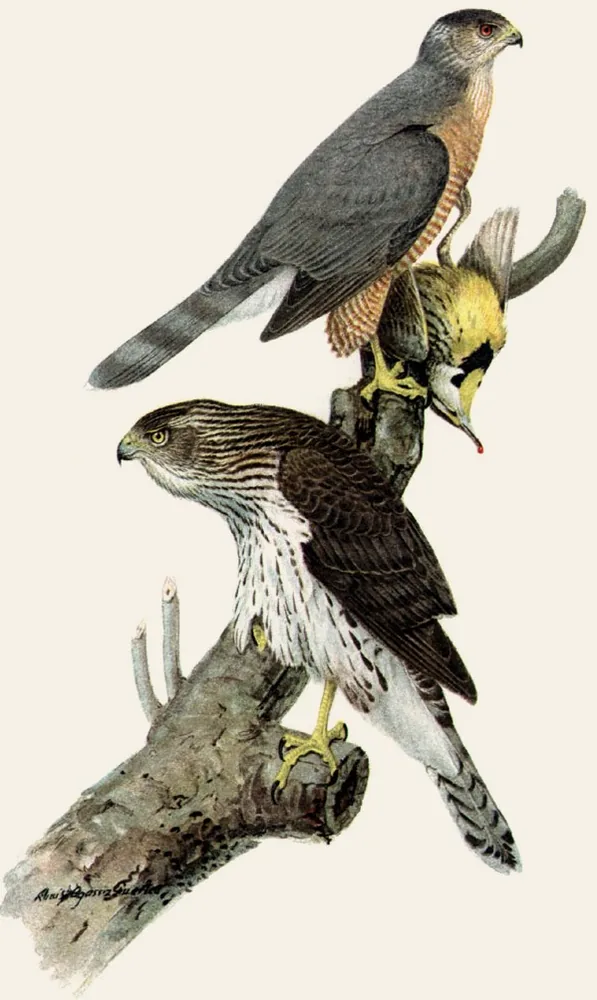
The Cooper's Hawk was another matter: 34 of its 133 stomachs held poultry or game birds, and Fisher called it “preëminently a ‘Chicken Hawk.’” A hawk that found an easy farm, he warned, would come back day after day. Fifteen years later the department's 1908 yearbook printed the painting of Cooper's Hawks shown here, by Louis Agassiz Fuertes, captioned “Cooper Hawk (Chicken Hawk)”; its story is on our Cooper's Hawk painting page.
| Hawk | Stomachs | Poultry or game birds | Other birds | Mice and other mammals |
|---|---|---|---|---|
| Red-tailed Hawk | 562 | 54 | 51 | 409 |
| Red-shouldered Hawk | 220 | 3 (poultry) | 12 | 142 |
| Cooper's Hawk | 133 | 34 | 52 | 11 |
| Sharp-shinned Hawk | 159 | 6 | 99 | 6 |
| Rough-legged Hawk | 49 | 0 | 0 | 45 |
The $90,000 chickens
Pennsylvania learned the cost the hard way. Its “Scalp Act” of June 23, 1885, paid a bounty of 50 cents for every hawk, most owls, and every weasel and mink, and a magistrate had to cut off each bird's head in front of the claimant and burn it. In the 18 months that followed, Merriam reported, about $90,000 was paid out and at least 128,571 animals were killed, most of them hawks and owls.
Then he did the sums. If the birds had taken 5,000 chickens a year at 25 cents each, the state had spent $90,000 to save its farmers $1,875. Counting the mice the dead hawks and owls would have eaten, a thousand each a year by his estimate, he put the farmers' loss near $4 million and wrote that the state had “thrown away $2,105 for every dollar saved!”
The bounty drew cheats. Ruffed Grouse heads were cashed in as “hawk heads,” and heads of nighthawks, chickens, cuckoos and even shrikes, the butcher birds, were paid for as hawks; some county officials paid on Nighthawks simply because the name says hawk, B. H. Warren wrote in 1890.
Ornithologists across the country sent letters against the law, and by 1890 it had been repealed. Warren reckoned the counties had paid at least $75,000 for hawks and owls alone. The rest of the state's story is on our page about Pennsylvania's birds.
How Hawk Mountain stopped the shooting
On a Pennsylvania ridge the shooting went on into the 1930s. Gunners on Hawk Mountain shot hundreds of passing hawks for sport, and in 1929 the state even put a $5 bounty on the goshawk. Richard Pough gathered and photographed the dead birds, and his photographs reached the conservationist Rosalie Edge.
On June 3, 1934, her son drove her to Berks County to see the mountain. She leased about two square miles for a year for $500, with an option to buy it all for $3,500, about $2.50 an acre, and put a warden, Maurice Broun, on the ridge. The shooting stopped at once.
The gunners left something behind: a local junk dealer made regular trips up the mountain to collect their brass shell casings. Broun's daily tally became the first systematic count of birds of prey anywhere, and the sanctuary now covers 2,600 acres.
Chicken hawks and the law
Every hawk is protected now. Hawks and falcons came under the Migratory Bird Treaty Act in 1972, when the 1936 treaty with Mexico was amended to cover them, the US Fish and Wildlife Service says.
Killing or capturing one is a federal crime, Connecticut's environmental agency explains: a misdemeanor with a fine of up to $15,000 and up to a year in prison. And no permit is issued through the Department of Agriculture to kill hawks that take a homeowner's chickens; protecting the flock is the answer.
How to keep hawks away from chickens
Cover the run. Wire or mesh over the chicken pen keeps hawks out, Connecticut's agency says; keep the coop away from trees and other perches, give free-ranging birds low cover to dash under, such as evergreen shrubs or old Christmas trees, and when a hawk keeps coming back, keep the flock in the covered run for a while.
Even a thin wire or fishing line strung over the run makes it hard for a hawk to fly in, the University of Maryland Extension says. Hawks hunt by day and usually eat a big bird where they kill it, or carry a small one into a nearby tree; a chicken gone in the night was more likely taken by a Great Horned Owl.
Owls have raided henhouses for a long time. In 1812 Wilson told of a farm where hens vanished one by one for more than a week, until the farmer's wife found an escaped pet Great Horned Owl eating one under the house.
Will a chicken hawk pick up a small dog?
Almost certainly not. A hawk can't fly carrying more than its own body weight, The Nature Conservancy's Matthew L. Miller writes, and the hawks called chicken hawks are light: a Cooper's Hawk weighs 8 to 20 ounces and a Sharp-shinned Hawk 3 to 8, says the Pennsylvania Game Commission. Even a Red-tailed Hawk, the biggest of the common hen hawks, weighs only about 2 to 3 pounds.
A miniature poodle weighs 12 to 15 pounds, Miller notes, and even a small Chihuahua would be a great feat of strength. A large hawk could still hurt a small pet, and stories of hawks taking a cat or a Chihuahua are “exceedingly rare.” If a bird does take a pet, a Great Horned Owl is the likeliest culprit; more in our birds of prey guide.
Audubon once watched a Sharp-shinned Hawk near Charleston seize a Brown Thrasher, a bird it found too heavy to carry far.
How to tell the chicken hawks apart
Cooper's and Sharp-shinned Hawks are accipiters: small heads, long tails, short rounded wings and a flap-flap-glide flight. Adults of both have red eyes, a blue-gray back and a rusty breast. The Cooper's is bigger, with a rounded tail tip and a slight crest; the Sharp-shin is round-headed, with pencil-thin legs and a square-tipped tail, though a female Sharp-shin can be nearly as big as a male Cooper's, Audubon's field guide warns.
The hen hawks are buteos: stocky, broad-winged, with short, fanned tails. An adult Red-tail has a rusty-red tail and, in the East, a white chest with a dark belly band of streaks; its rasping keer-r-r-r is the scream “often used in mass media.” A Red-shouldered Hawk shows chestnut-red shoulders, a black-and-white barred tail and a pale window near each wingtip, and Blue Jays imitate its kee-yer.
Merriam told Pennsylvania's farmers the same in 1886: the three harmful hawks “have long tails and short wings.” The oldest Sharp-shinned Hawk on record was banded in New Mexico in 2002 and caught alive in Mexico in 2015, 12 years and 9 months later.
What does it mean when someone calls you a chicken hawk?
In politics it's an insult. Merriam-Webster's second sense, marked as disparaging, is a person who strongly supports or promotes a war but has never served in the military. It has nothing to do with the birds beyond the borrowed name.
Whatever your grandparents called them, a Cooper's Hawk and a Red-tail are two different birds on a life list; here's how to get your list out of eBird and keep it on paper.