1982 new name
Marsh Hawk: the hawk now called the Northern Harrier
Marsh Hawk is the old name of the Northern Harrier, the one harrier that lives in North America. The American Ornithologists' Union, the forerunner of today's American Ornithological Society (AOS), changed it in July 1982, in a preview of its 1983 check-list, to match the name harriers carry around the world. It is the same bird, so nothing on your list changes but the name.
Updated
What changed
Marshes, prairies and open fields. It nests from northern Alaska and Canada south to California, Mexico and parts of the southern US, though not the Southeast, and winters from southern Canada to northern South America, says New York's Department of Environmental Conservation.
What is a marsh hawk called now?
The Northern Harrier, Circus hudsonius: a slim, long-tailed hawk with a white patch on the rump that hunts low over marshes and fields. New York's Department of Environmental Conservation still introduces it as “formerly known as the marsh hawk.”
Marsh Hawk was its official name for close to a century. The AOU's first check-list, in 1886, listed it as bird number 331, found in “North America in general, south to Panama.” The 1983 edition printed NORTHERN HARRIER under the same number.
Surprising facts about the Marsh Hawk
It hunts by ear, like an owl. The month the new name came out, The Auk opened with a study by William Rice of Oregon State University: the Marsh Hawk could place a sound about as precisely as owls that hunt in total darkness, and on an Oregon refuge wild harriers struck at vole squeaks from hidden loudspeakers, with nothing to see or smell.
Audubon was sure it was the European bird. After comparing seven American skins with seven from Europe, he wrote in 1838 that “the Marsh Hawk of America is the Hen-Harrier of Europe.”
It once flew off with a whole nest. On April 2, 1837, at the Southwest Pass of the Mississippi, Audubon watched a Marsh Hawk seize a small bird sitting on its nest, perhaps a Marsh Wren, and “carry it off in its talons with the nest!”
One wild harrier lived past 15. A female banded in New Jersey in her first fall, in 1986, was caught and released in Québec in October 2001: the species' age record in the US Geological Survey's banding files.
The same list renamed a whole flock. The Turkey became the Wild Turkey and the Whistling Swan the Tundra Swan. In The Chat, the Carolina Bird Club's journal, Eloise Potter called the swan “my own least appreciated change in the entire list.”
Why the name changed
It was a matter of family names. For its sixth check-list the AOU set a rule for birds that range far beyond North America: use English names “generally accepted on a world-wide basis.” So it “adopted ‘harrier’ as the group name for hawks of the genus Circus.” The same rule turned the Common Gallinule into the Common Moorhen.
The Marsh Hawk qualified. Since 1957 the AOU had counted it as the American race of Circus cyaneus, a species that also nests across northern Europe and Asia. Another rule put a word in front of any group name that several species share, and the bird came out as the Northern Harrier.
The rule could cut the other way. Of the sea duck it called Oldsquaw, the committee wrote, “we have retained the American name”; that duck became the Long-tailed Duck only in 2000.
Who decided, and when
- American Ornithological Society (AOS): the 34th Supplement to its Check-list, printed as a supplement to the July 1982 issue of its journal The Auk and using the names of the sixth edition of 1983, when the society was still the American Ornithologists' Union (AOU)
- American Ornithological Society (AOS): the 58th Supplement to its Check-list made the Northern Harrier of the Americas a species of its own, Circus hudsonius, apart from the Hen Harrier of Europe and Asia
When did the marsh hawk become the Northern Harrier?
In July 1982. The AOU's 34th Supplement to its Check-list, printed as a supplement to that month's Auk, already used the English names of the sixth edition, which followed in 1983. The Chat listed the Northern Harrier among the new names that summer, “formerly Marsh Hawk.”
The sixth edition's notes offered American Harrier or Marsh Hawk as names in case the American bird were ever treated as a species of its own. When that happened, in 2017, the committee kept Northern Harrier.
Is a marsh hawk the same as a hen harrier?
Not anymore. From the 1957 check-list until 2017, the AOU counted the American Marsh Hawk and the Hen Harrier of Europe and Asia as one species, Circus cyaneus. On July 5, 2017, its 58th Supplement made the American bird a species again, Circus hudsonius, citing “differences in morphology, plumage, and breeding habitat.”
It was a return more than a discovery: the check-lists of 1886 and 1931 had listed the Marsh Hawk as Circus hudsonius. The committee had turned the split down in 2015, and AviList, the shared world list, keeps the two apart as well.
They still look much alike. Our page on new birds on the US list in 2026 tells how a single Hen Harrier wing from Alaska's Attu Island was finally identified.
Is a marsh hawk the same as a marsh harrier?
No. The Marsh Harrier, which AviList calls the Western Marsh Harrier (Circus aeruginosus), is a different bird that nests in Europe and Asia “from England to western Mongolia,” the AOU wrote in 2005, when new records put it on its list.
North America has only one harrier, Audubon's field guide says, so a marsh hawk in an American notebook is the Northern Harrier.
What is another name for a marsh hawk?
Northern Harrier is its name today, and older books offer several more. Its scientific name, hudsonius, rests on Edwards's “Ring-tail'd Hawk” from Hudson Bay; Audubon's 1838 account lists “Hen-Harrier, or Marsh Hawk” from Nuttall's Manual; and the 1983 check-list proposed American Harrier.
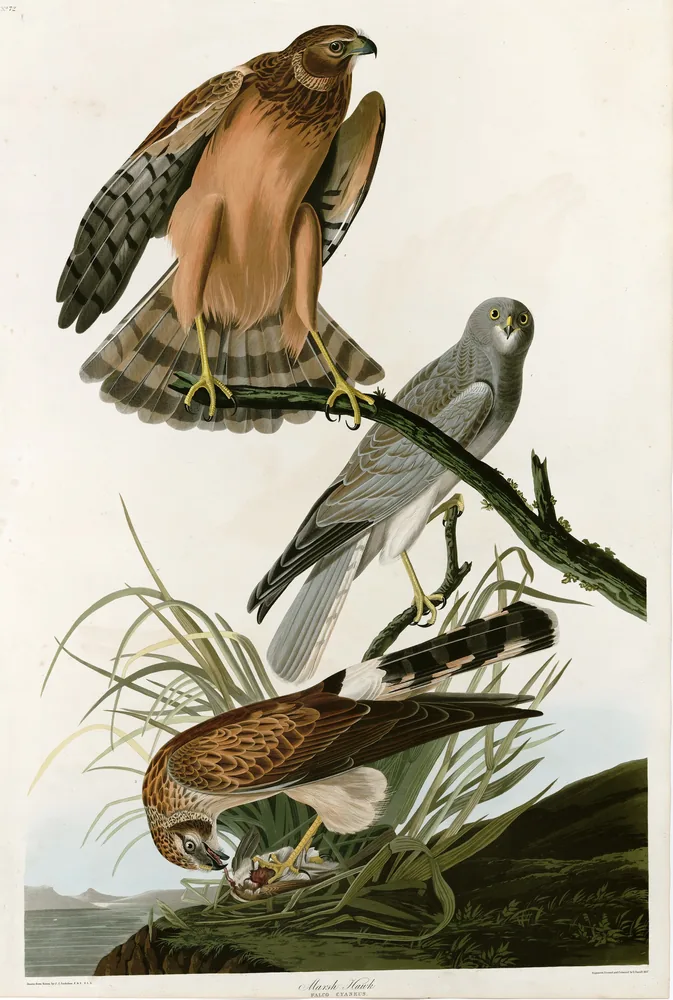
Audubon painted it under the old name: plate 356 of The Birds of America, shown on this page, is titled Marsh Hawk. By his numbering the gray bird is the adult male, the brown one above it the female and the streaked one below a young bird.
What does a marsh hawk look like?
A slim hawk 16 to 24 inches long, with wings about 3½ feet across and a white rump patch that stands out, says Audubon's field guide. Adult males are gray with black wingtips. Females and young birds are brown; a young bird is rusty orange below, a female whiter with more streaks. The female is the bigger of the pair, Audubon noted in 1838.
Up close, its face looks like an owl's, ringed by what New York's wildlife agency calls “distinct facial disks.” It flies low and slow, with its wings held up in a shallow V.
How does a marsh hawk hunt?
Low and slow over open ground, listening as much as looking. It quarters back and forth just above the grass and may hover over prey hidden in dense cover or try to drive it into the open, says Audubon's field guide; males tend to fly lower and faster than females.
Voles and other rodents are its staple, with birds up to the size of doves and small ducks, snakes, frogs and grasshoppers. A harrier may cover up to 100 miles a day, New York's wildlife agency says, and Audubon thought its diligence would “remind you of the search of a well-trained pointer.”
Where does a marsh hawk nest?
On the ground, in a dense field or marsh, sometimes low over shallow water, says Audubon's field guide. The female does most of the building, from a grass-lined hollow to a platform of sticks and weeds, and sits on 4 to 6 pale bluish-white eggs for 30 to 32 days; the young fly at about 30 to 35 days.
Harriers often nest in loose colonies, and one male may have two or more mates; he brings food and hands it to the female, who feeds the young. At the nest they call a sharp kee-kee-kee-kee, though they are mostly silent.
Is the Northern Harrier endangered?
Not nationally: it is not on the federal list, and the IUCN rates it Least Concern, as Audubon's field guide shows. But it has vanished from many places where it used to nest, especially in the south of its range, and surveys suggest it is still declining in parts of North America, the guide adds.
New York lists it as threatened. The state's wildlife agency traces the losses to the 1950s, when nesting grounds disappeared and pesticides took their toll, and notes that harriers raise more young in years when voles are plentiful.
Which bird is it?
Nothing to sort out: a Marsh Hawk in an old book and a Northern Harrier in a new one are the same bird.
Look for the white rump and the low flight on wings raised in a shallow V. A gray one with black wingtips is an adult male; a brown one is a female or a young bird.
Seen in Europe or Asia? There it was a Hen Harrier, a species of its own since 2017.
What it does to your list
Only the name is different: a Marsh Hawk on your list is a Northern Harrier, and your total stays as it was.
In a Birdfolio, a hawk entered as Marsh Hawk is filed as Northern Harrier when it was seen in the Americas or when no place is given; one seen in Europe or Asia is filed as Hen Harrier.
How names change, and why: our guide to bird splits and lumps.
An old list with a Marsh Hawk on it is easy to bring up to date: here's how to print your life list with every bird under today's name.
Check your own list. Drop your eBird download or type your birds: the free checker shows which of them the changes since 2018 touched.
Check my list