Classic bird paintings
Northern Shoveler painting: Audubon's plate and other classic portraits
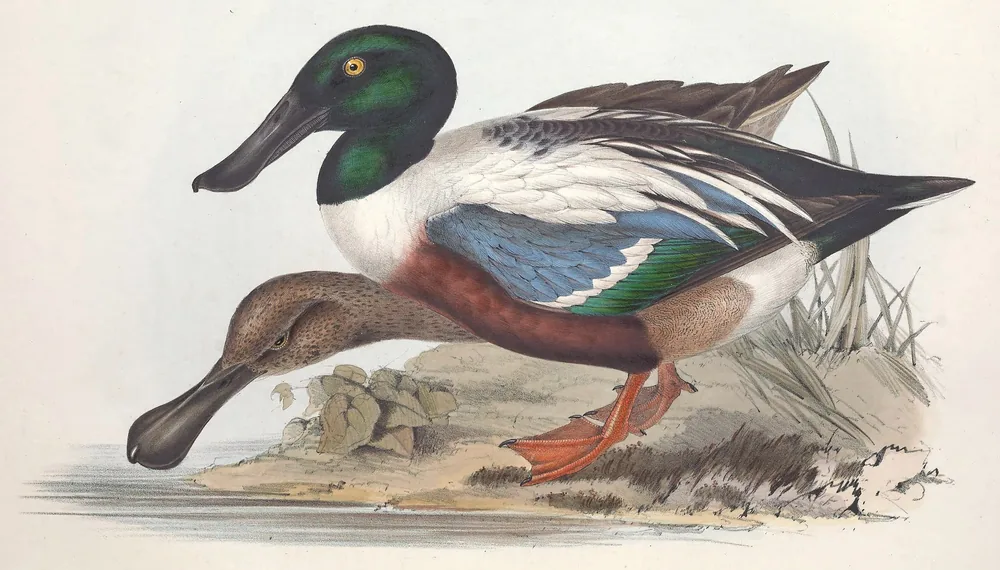
John James Audubon painted the Northern Shoveler as plate 327 of The Birds of America (1827–38), a male and a female, under the name Shoveller Duck. You can see a free high-resolution scan on Audubon.org. The pair shown here is by John and Elizabeth Gould, plate 360 of John Gould's The Birds of Europe (1832–37).
Updated
The story of this painting
John Gould began with the bill. A spoon-shaped bill edged with fine plates set this duck and a few relatives apart, he wrote, and naturalists disagreed over what to call the group: Dr. Leach chose Rhynchaspis, Dr. Fleming Spathulea, while Mr. Swainson kept the bird in Anas. Gould sided with Leach. Decades later his The Birds of Great Britain (1862–73) titled its shoveler plate Spatula clypeata, the name the bird goes by today.
What puzzled him more was the drake's summer change. Mr. Selby had a male killed in July that was already turning to look like the female. Gould had seen the same change in other ducks that breed among reeds, and he asked whether it might protect the drake while the young were raised, since his bright breeding plumage would stand out against the somber reeds.
Its food, he wrote, was insect larvae and freshwater plants such as grasses and chickweed, which made its flesh tender and prized at the table. The pair on plate 360, in the fifth volume, is a little under life size, and its lettering reads “Drawn from Nature & on Stone by J. & E. Gould.”
Story: Gould, The Birds of Europe, vol. 5 (1837), plate 360; vol. 5 (1837), text to plate 360; Gould, The Birds of Great Britain, vol. 5 (1873), plate 14.
Audubon’s Northern Shoveler: plate 327, “Shoveller Duck”
Louisiana's Creoles called the shoveler Micoine, a name whose origin Audubon could not trace. It arrived there at the start of autumn with the Blue-winged Teal and stayed the winter. He watched it wade the muddy edges of ponds with its head under water, swinging its bill from side to side like a Roseate Spoonbill, sifting the mud and throwing out what it could not eat. In spring it even pulled up the bulbs of a small wild onion. Some might find that strange, he admitted, but he had long resolved to “learn from Nature, and believe what is.”
No duck in the country changed its plumage more, he thought. While the female sat on her eggs, the drake molted into a mottled coat, as if putting on his partner's dress, and from July to late November few bright males were to be seen.
Early one May in Texas he found shovelers breeding in numbers around Galveston Bay, though his party never found a nest. As food he ranked it with the Blue-winged Teal: “No sportsman who is a judge will ever pass a Shoveller to shoot a Canvass-back.” Plate 327 shows a male and a female.
Story: Audubon, Ornithological Biography, vol. 4 (1838), pp. 241–243. See plate 327 free at Audubon.org.
More classic portraits, free to see
- John James Audubon, The Birds of America, octavo edition (1840–44), plate 394: “Shoveller Duck”. Free scan (New York Public Library Digital Collections)
- John and Elizabeth Gould, The Birds of Europe (1832–37), plate 360: “Shoveller Duck” (Anas clypeata) (the painting shown above). Free scan (University of Kansas Libraries)
- John Gould’s The Birds of Great Britain (1862–73), vol. 5, plate 14: “Shoveller Duck” (Spatula clypeata). Free scan (University of Kansas Libraries)
- Louis Agassiz Fuertes, for Elon H. Eaton’s Birds of New York (1910–14), plate 14: “Shoveler”, with Wood Duck and Blue-winged Teal. Free scan (Internet Archive)
About the Northern Shoveler
- Its big spatulate bill takes straining food to the extreme: flocks often swim with their bills barely under the surface, straining food from shallow, muddy water. (Source: National Audubon Society)
- Several males may court one female, and the male stays with his mate longer than in most ducks, often through part of the incubation. (Source: National Audubon Society)
Why is it called a shoveler?
For its bill. The Northern Shoveler has a distinctive shovel- or spoon-shaped bill, which also earns it the nickname spoonbill, the Chesapeake Bay Program says. The bill can be more than two inches long and carries a row of bristles that filter food from the water as the duck swims along with its head low, pushing water and mud through it.
Source: Chesapeake Bay Program.
How can you tell a Northern Shoveler from a Mallard?
By the bill. The two are sometimes confused, since both drakes have a glossy green head and both females are mottled buff and brown, but the shoveler's long bill makes it easy to tell apart, the Chesapeake Bay Program says. The National Audubon Society's guide adds that the male shoveler has a white chest and rusty sides, the female a big gray and orange bill, and that a blue patch on the wing shows clearly in flight.
Sources: Chesapeake Bay Program; National Audubon Society.
How long does a Northern Shoveler live?
The wildlife agency pages we read give no typical lifespan for the Northern Shoveler that we could confirm. The oldest known wild Northern Shoveler was at least 16 years and 7 months old (USGS Bird Banding Laboratory): it was banded in Nevada in 1952 and found in California in 1969.
Source: USGS Bird Banding Laboratory. A banding record is the minimum age of one bird when it was found again, not a typical lifespan. How long do wild birds live?
How can you tell if a plate 327 print is an original?
By its size: an original plate 327 is a hand-colored sheet about 26 by 38 inches; the Northern Shoveler’s octavo version, plate 394, is book-size, from 1840–44. Many prints sold today are reproductions: how to tell an original from a reproduction. For all 435 plates at a fraction of an original’s price, see which edition of The Birds of America to buy.
In a Birdfolio hardcover, this painting sits beside the date and place you first saw a Northern Shoveler. See your own list as a book, free.