Old bird nickname
Gooney bird: the albatrosses of Midway
A gooney bird is an albatross: most often the Laysan Albatross or the Black-footed Albatross, the two big seabirds that nest by the hundreds of thousands on Midway Atoll in the North Pacific. Sailors used the name long before World War II, from an old English country word for a fool, and the Navy men who later shared Midway with the birds made it famous.
Updated
What kind of bird is a gooney bird?
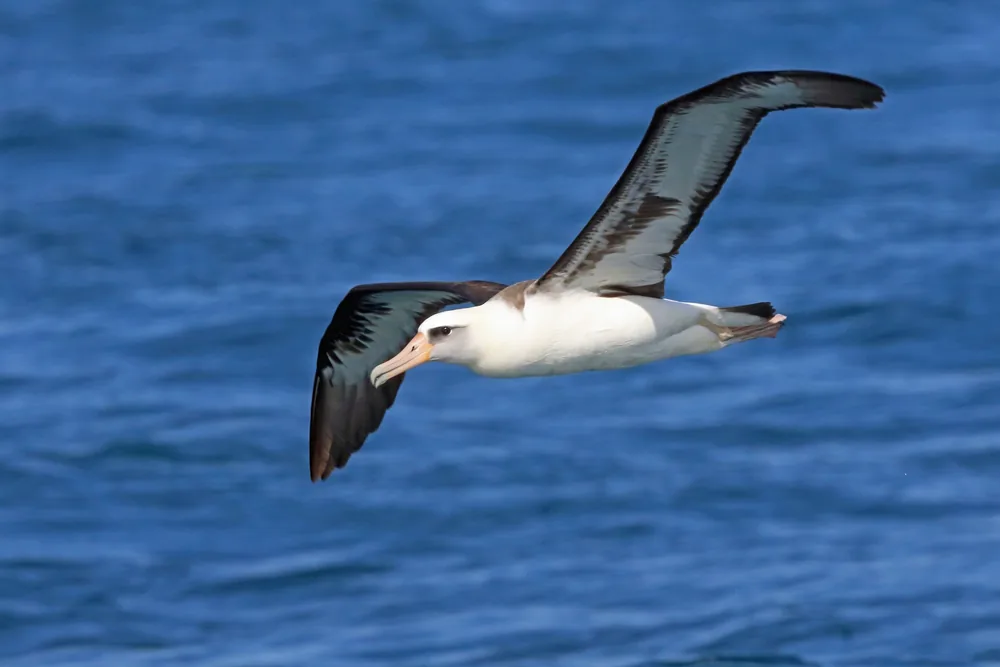
An albatross. The American Heritage Dictionary defines a gooney as “an albatross, especially one in the Northern Hemisphere,” and on Midway Atoll the name belongs to the two that nest there: the Laysan Albatross, white with a dark back and wings, and the all-brown Black-footed Albatross.
In Hawaiian the Laysan is the mōlī and the Black-footed the kaʻupu, Hawaii's Division of Forestry and Wildlife says. Smithsonian magazine, the Associated Press and the conservation group Island Conservation all call Midway's albatrosses gooney birds.
Sailors once stretched the name further. The Century Dictionary of 1895 gave gony as a North Pacific sailors' name for the Black-footed Albatross and for the young of the Short-tailed Albatross, a much rarer, endangered bird; two pairs of Short-tailed Albatrosses raised chicks on Midway in the 2010s, American Bird Conservancy reported in 2019.
Why is an albatross called a gooney bird?
Because sailors thought it a fool. Gooney was an English country word for “a stupid or awkward person,” Alfred Newton's Dictionary of Birds noted in 1896, and the bird-name collector W. L. McAtee wrote in 1956 that gooney means much the same as booby.
Booby was the sailors' name for seabirds that landed on ships and let themselves be caught by hand, and albatrosses on their nesting islands seemed just as simple. They stand their ground: on Midway, Smithsonian magazine reported in 2001, “gooneys won't budge for a bus.”
Their landings didn't help. Their huge wings make takeoffs and landings hard, Island Conservation explains, and a bird coming in without a wind to brake against may tumble when it lands; National Wildlife magazine said in 2000 that those tumbling landings earned the birds their nickname.
Who said it first, nobody knows. The American Heritage Dictionary calls the word's origin unknown, and an Associated Press reporter on Midway in 2002 found that “no one seems to know exactly who came up with the name.”
What does the word “gooney” mean?
Silly or clumsy. As a word for people it meant a simpleton: the Century Dictionary of 1895 gives gony as “a stupid person; a goose,” used in country England and in the United States, and its second meaning is the albatross.
The same word probably gave English its goons: the American Heritage Dictionary traces goon to gooney in the sense of simpleton.
As a sailors' word for the birds it is old. When the Navy ship Saginaw was wrecked at Ocean Island, today's Kure Atoll, in 1870, the stranded crew lived partly on “some of the brown albatross or ‘goonies,’ as they call them,” and a diary kept that November lists the day's food as “goonies and turtle.”
Where are gooney birds found?
On the islands northwest of Hawaii, above all Midway Atoll, and at sea across the whole North Pacific. More than 70 percent of the world's Laysan Albatrosses nest on Midway, the Friends of Midway Atoll say, and the island chain of Papahānaumokuākea, a marine national monument since 2006, holds the world's largest colonies of both species, NOAA Fisheries says.
Midway itself is tiny: about 1,200 miles northwest of the main Hawaiian Islands, a third of the way from Honolulu to Tokyo, the Associated Press noted, with three small islands, Sand, Eastern and Spit. The albatrosses nest there from November to July.
Away from the islands, the Black-footed Albatross is the one Americans see: it is the only albatross seen commonly off the North American coast, most of all from June through August, Audubon's field guide says, and it follows ships. Laysans range off Alaska in summer and off California in winter, usually farther from shore.
A few Laysans nest on Kauai and Oahu as well, and since the 1980s on islands off western Mexico.
Counting the gooneys
Every winter, staff and volunteers count each nest on Midway with a bird sitting on it. In December 2025 they found 589,623 Laysan Albatross nests and 28,246 Black-footed nests, 617,869 in all, the Friends of Midway Atoll reported.
It wasn't always so. Only a few thousand pairs lived on Midway when a cable company arrived in 1903, Smithsonian says, and Time reported about 9,000 albatrosses counted in 1922 and 214,000 in 1946.
That same year, 1903, Theodore Roosevelt put the atoll under the Navy by executive order and sent 21 Marines there, largely to protect the albatrosses from Japanese poachers, Smithsonian says. Elsewhere in the chain the feather hunters had their way: 300,000 birds were killed on Laysan Island in 1909.
The Navy and the gooneys
World War II made Midway famous, and the gooney bird with it. A naval air station opened on the atoll in 1941, and the Battle of Midway, June 4 to 6, 1942, when American planes sank four Japanese carriers, turned the war in the Pacific, the Friends of Midway Atoll's history says.
After the war the birds and the planes had to share the runways. Time reported in 1954 that ten planes had been wrecked that year by “goony-bird action,” and by 1959 the damage ran to about $300,000 a year as birds flew into propellers and struck radar domes.
The Navy tried nearly everything. Sailors burned old tires and fired flares, rifles, bazookas and mortars; marked birds were flown to Guam, Kwajalein, northern Japan and even Puget Sound, and flew home again. Runways cut on Kure Atoll to lure them away drew not one bird, Time said.
In the end the Navy killed them. About 54,000 albatrosses were killed between 1954 and 1964 as control measures, the Friends of Midway Atoll say, and radio antennas on Eastern Island killed more than 3,000 adults in collisions in 1964 and 1965, before the antennas came down in 1967. The banding done in those years, to learn how to keep birds and aircraft apart, is how one albatross became famous.
When the Navy left Midway
The gooneys outlasted the base. The Navy made Midway an overlay national wildlife refuge in 1988 and began closing its facilities in 1993; a presidential order of October 31, 1996, handed the atoll to the Interior Department to be run as Midway Atoll National Wildlife Refuge, and the Navy officially left on June 30, 1997.
Its cleanup cost about $90 million. A 20-foot statue of an albatross stands on Sand Island, more prominent than any battle monument, the Associated Press noted in 2002, and a visiting admiral said he was glad to see “the gooney birds are still in charge here.”
Navy families had made their peace with them long before. In the 1960s one chief petty officer's lawn held about 25 pairs, and the pair by the front door, Gertrude and Heathcliffe, were the family pets, Smithsonian reported.
The gooney dance
Young albatrosses court with a dance. Laysans bow, preen each other, swing their heads and point their bills straight up while calling, Audubon's field guide says; Black-footed Albatrosses dance the same way, with bill-clapping, quacks and whistles.
The dance belongs to birds still choosing a mate. Up to 25 different moves have been counted, and young birds watch older ones to learn them, National Wildlife reported. Once paired, albatrosses stay together for years, often for life, and come back to within about three feet of last year's nest.
Each pair lays one egg, and if it is lost there is no second that year. Both parents take turns sitting on it for about 65 days, and a Laysan chick takes about 165 days from hatching to leaving the island, fed on squid oil and food its parents bring up. One parent tracked in 2001 flew 4,000 miles without stopping to find it.
Wisdom, the oldest gooney
The world's oldest known wild bird is a gooney. Chandler Robbins banded a Laysan Albatross on Midway on December 10, 1956, as she sat on her nest; she was already an adult, so she was at least five then. He found her again in 2002, and in 2006 a refuge biologist gave her a red band and the name Wisdom, the Friends of Midway Atoll say.
In November 2024, at about 74, she laid her first egg in four years, possibly her 60th, though the chick that hatched in January 2025 did not fledge. She came back in November 2025, at least 75, and a new mate, banded EX25, joined her on November 26. By June 2026 she had not been sighted for a while.
Over her life she has raised as many as 30 chicks. One of them, a male hatched in 2011 when she was at least 59, survived that year's tsunami and in 2026 raised a chick of his own: Wisdom's grandchick. Her record stands among the oldest wild birds on record.
What threatens the gooney birds?
Plastic, first: adults pick up floating plastic and feed it to their chicks, and an estimated five tons of plastic are fed to albatross chicks at Midway each year, NOAA's sanctuaries office says. Thousands of cigarette lighters mistaken for squid have turned up there.
Old buildings poisoned chicks with lead paint chips. Sick birds couldn't fold their wings, a condition called droop-wing, a 1987 study found, and the lead cleanup was finished in 2018, American Bird Conservancy says.
Since the winter of 2015, house mice, which came with the military in the 1940s, have been biting nesting adults, which stay on their eggs while the mice chew. In the first year the mice injured 480 birds and killed at least 52. A poison drop in July 2023 failed to wipe them out.
The 2011 tsunami that followed Japan's great earthquake killed an estimated 110,000 chicks and 2,000 adults, and rising seas threaten the low islands where they nest. In 2011 the US Fish and Wildlife Service found that the Black-footed Albatross didn't need listing under the Endangered Species Act.
Why is the C-47 called Gooney Bird?
For the albatross, though nobody wrote down exactly why. The Douglas DC-3, first flown on December 17, 1935, went to war as the C-47, the Navy's R4D, and its crews called it the Gooney Bird; Time mentioned the Air Force's “Goony Bird,” the DC-3, in 1954.
Two explanations are told. Carroll V. Glines, a C-47 pilot who wrote books about the DC-3, said in Air Force Magazine in 1985 that it was named after the albatross, “a seabird known for its endurance”; the Museum of Flight says its large, lumbering look mirrored the albatrosses of Midway. Neither gives evidence.
It had plenty of other nicknames: Old Methuselah, the Placid Plodder and the Dowager Duchess among them, Glines wrote.
How to tell a Laysan from a Black-footed Albatross
Look at the color first. The Laysan is white on the head and body, with a dark brown back and upper wings, a pink bill with a gray hooked tip, and pink feet. The Black-footed is dusky brown all over, with white around the base of its dark bill, and its feet are black.
They are much the same size. Laysans are 2 feet 7 inches to 2 feet 10 inches long, with wings 6 feet 5 inches to 6 feet 8 inches across; Black-footed Albatrosses are a little shorter but on average heavier, with wings up to 7 feet 2 inches, Audubon's field guide says.
Laysans first breed at 7 to 9 years old, Audubon's guide says, and the young come back to the island in their third year to dance and look around, Hawaii's wildlife division says.
However the old sailors named them, an albatross you've seen goes in a Birdfolio under its real name; see what the finished book looks like.