Classic bird paintings
Bufflehead painting: Audubon's plate and other classic portraits
John James Audubon painted the Bufflehead as plate 325 of The Birds of America (1827–38), a male and a female, under the name Buffel-headed Duck. That plate is the painting shown here; its engraver's line is dated 1836. A free high-resolution scan is on Audubon.org.
Updated
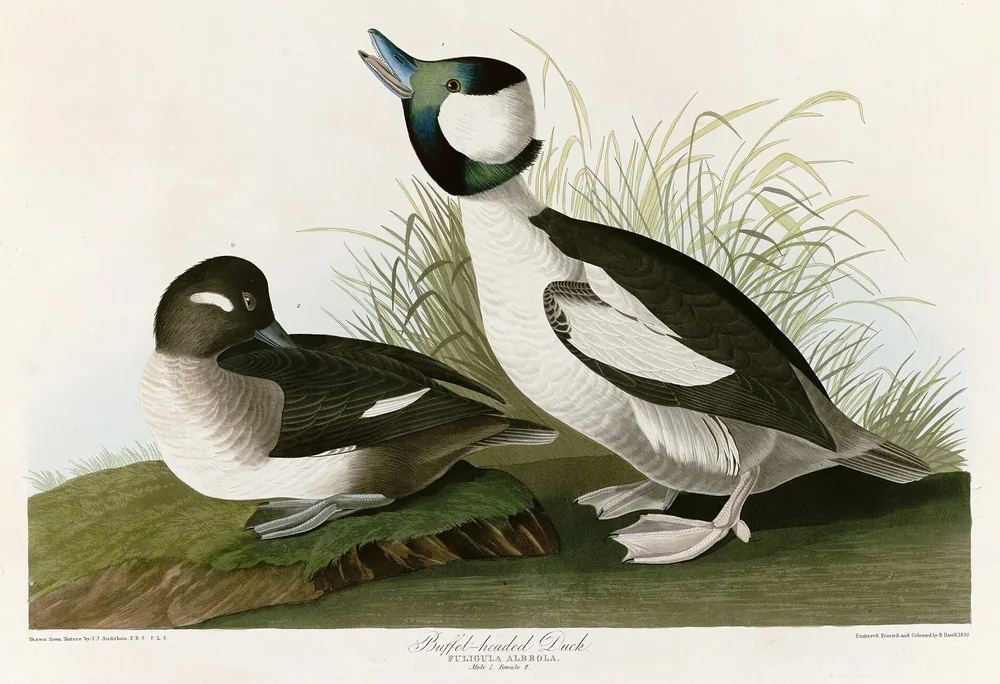
Audubon’s plate: plate 325, “Buffel-headed Duck”
Audubon met this little diver in fall and winter on every kind of water in the country, from the miller's dam to the bayous of Lower Louisiana, and under as many names: Spirit Duck, Butter-box, Marrionette, Dipper and Die-dipper. Marrionette he thought a pretty one. He called it “a beautiful miniature of the Golden-eye Duck,” and a hardy one: on the Ohio it kept diving among thick floating ice, and when the river froze over it moved to the eddies of rapid streams.
So sure of its speed underwater, it let people come quite close, then vanished at the snap of a gun and came up a few yards off, as if to see what the alarm was about. He was amused to watch some vagrant boys snap a miserable flintlock at a flock again and again: the birds dived at every snap, and when the boys gave up and threw stones, the ducks seemed quite pleased.
In spring the males swelled their throats and raised the feathers of the head, moving over the water with great pomposity, and sometimes charged at one another, though he never saw a real fight. He never found a nest, and believed none bred within the United States. Plate 325 shows a male and a female.
Story: Audubon, Ornithological Biography, vol. 4 (1838), pp. 217–218. See plate 325 free at Audubon.org.
Why is it called a Bufflehead?
For the male's head. The name comes from “buffalo-head,” for the drake's oddly puffy head, the National Audubon Society's guide says; Audubon's plate spells it Buffel-headed Duck. His own description explains the look: the long, narrow feathers on the top and back of the head and on the upper neck, when raised, give the head an “extremely tumid appearance,” that is, swollen, all the more because the neck feathers just below are short.
Sources: National Audubon Society; Audubon, Ornithological Biography, vol. 4 (1838), p. 219.
More classic portraits, free to see
- John James Audubon, The Birds of America, octavo edition (1840–44), plate 408: “Buffel-headed Duck”. Free scan (New York Public Library Digital Collections)
- Louis Agassiz Fuertes, for Elon H. Eaton’s Birds of New York (1910–14), plate 10: “Buffle-headed Duck”, with Red-breasted Merganser, Ruddy Duck and Common Merganser. Free scan (Internet Archive)
About the Bufflehead
- One of North America's smallest ducks, the Bufflehead is small enough to nest in old Northern Flicker holes as they are, which other cavity-nesting ducks can't use without enlarging. (Source: National Audubon Society)
- It feeds mostly underwater, and all the birds in a small flock may dive at the same time. (Source: National Audubon Society)
Is the Bufflehead the smallest duck?
It is one of the smallest: Canada's smallest diving duck, says Hinterland Who's Who, and one of North America's smallest ducks of any kind, says the National Audubon Society's guide. Drakes average about 450 grams, about a pound, and females about 340 grams, Hinterland Who's Who adds. Audubon weighed his male at 1 pound and his female at 8 ounces.
Sources: Hinterland Who's Who; National Audubon Society; Audubon, Ornithological Biography, vol. 4 (1838), p. 220.
How long does a Bufflehead live?
Buffleheads live 2.5 years on average in the wild, the Chesapeake Bay Program says. Only about half of the ducklings live to fly, at seven to eight weeks old, Hinterland Who's Who says; cold, wet weather in their first two weeks and pike take many. The oldest known wild Bufflehead was at least 18 years and 8 months old (USGS Bird Banding Laboratory): it was banded in New York in 1975 and found there again in 1993.
Sources: Chesapeake Bay Program; Hinterland Who's Who; USGS Bird Banding Laboratory. A banding record is the minimum age of one bird when it was found again, not a typical lifespan. How long do wild birds live?
How can you tell if a plate 325 print is an original?
By its size: an original plate 325 is a hand-colored sheet about 26 by 38 inches, dated 1836; the Bufflehead’s octavo version, plate 408, is book-size, from 1840–44. Many prints sold today are reproductions: how to tell an original from a reproduction. Modern editions print all 435 plates, from pocket size to coffee-table size: which Birds of America book to buy.
In a Birdfolio hardcover, this painting sits beside the date and place you first saw a Bufflehead. See your own list as a book, free.