Old bird nickname
Rain crow: the cuckoos that call before a storm
A rain crow is a cuckoo: most often the Yellow-billed Cuckoo, and sometimes its cousin the Black-billed Cuckoo. Farmers believed its guttural call meant rain was coming, and Alexander Wilson wrote in 1811 that in Virginia it was called the Rain Crow because it was noisiest just before rain. No one has shown that it can forecast the weather, but the name has lasted more than two centuries.
Updated
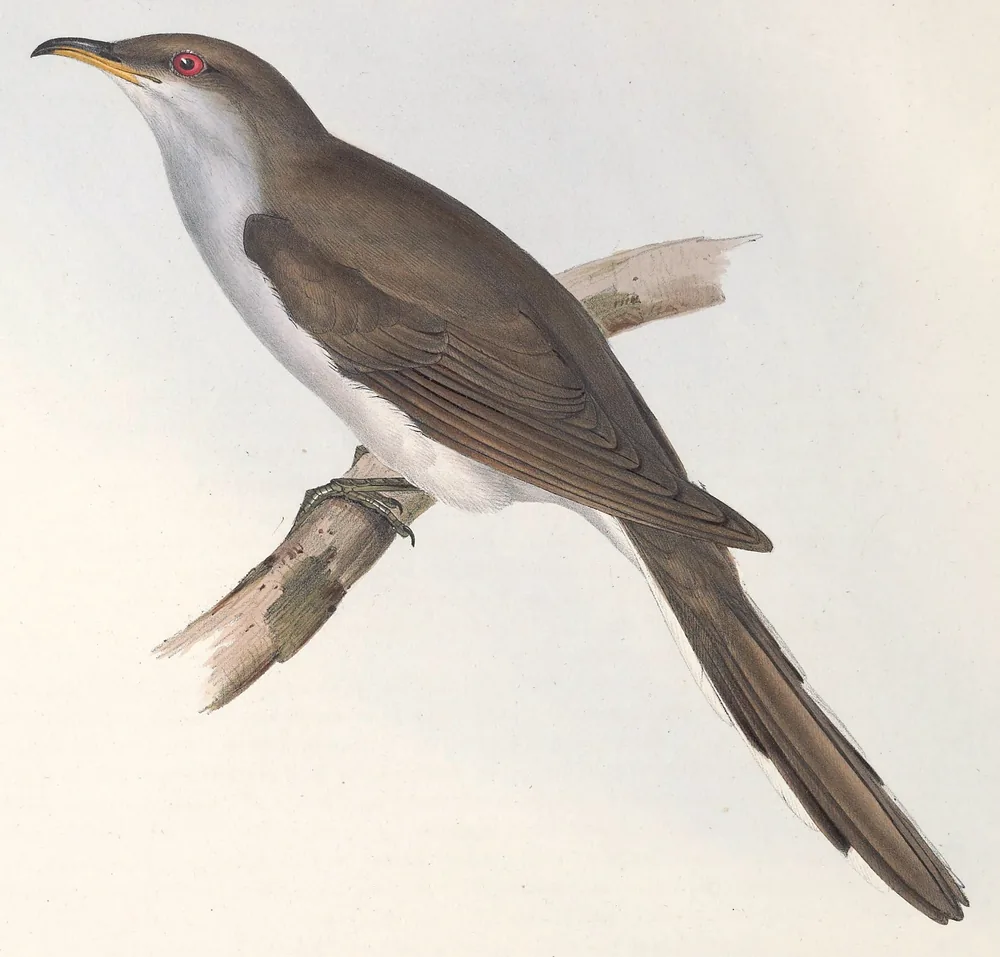
What bird is known as a rain crow?
The Yellow-billed Cuckoo, and in many places the Black-billed Cuckoo as well. Pearson's Birds of America of 1917 lists Rain Crow first among the other names of both, and Alabama's wildlife agency still says the two are “commonly called rain crows.”
Neither is a crow. They are slender, long-tailed birds of the cuckoo family, grayish-brown above and white below, and the account in Pearson's book found the word crow “one of the queerest freaks of popular terminology.”
The name turns up all over the country: in Virginia in 1811, among the Dutch farmers of Pennsylvania in 1831, in the Carolinas, where people have called the cuckoo raincrow for more than a century, in the Midwest, and in southern Arizona, where it arrives with the summer monsoon. Pearson's list adds rain dove, storm crow and kow-kow.
Does a rain crow's call really mean rain?
No one has shown that it does, though people have believed it for more than 200 years. Wilson reported in 1811 that Virginians found the bird “most clamorous immediately before rain,” and Edward Howe Forbush wrote in Birds of Massachusetts in 1927 that “probably there is some foundation for the belief.”
Cuckoos may simply call more in the heavy, humid air before a storm. W. L. McAtee, who collected American bird names, put the names down to “their increased croaking before storms,” and Audubon's field guide notes the calls are “often heard on hot, humid afternoons.”
The belief ran deep. In Maine, where stormy weather was said to sour milk, the Yellow-billed Cuckoo got the blame and the name milk-sourer, McAtee found. In 1897 a Carolina man trusted the rain crow over the government's Signal Service, the forerunner of the National Weather Service, and in dry spells people in Charlotte asked, “Who killed the rain-crow?”
Forbush had a simpler idea: cuckoos dislike getting wet. He told of one seen drying its wings on a fence after a thunderstorm. The nighthawk, the old bull bat, had a weather story of its own.
What noise does a rain crow make?
A long, wooden run of clucks that slows down at the end: ka-ka-ka-ka-ka-ka-kow-kow-kowp, kowp, kowp, kowp, as Audubon's field guide writes the Yellow-billed Cuckoo's song.
Audubon himself likened its dull notes to a young bullfrog's and wrote that it repeats cow eight to ten times, faster and faster. That call gave it the name it went by nearly everywhere in his day, the Cow Bird, which isn't the cowbird of today's field guides. Pearson's book called the call “most unbird-like and wholly unmusical,” and nothing like a cuckoo clock.
The Black-billed Cuckoo's song is softer: cu-cu-cu-cu in groups of two to five, all on one pitch. Both cuckoos call at night as well as by day, and in July 1909 a rain crow calling between 9 and 10 at night made the Charlotte Observer.
What does a rain crow look like?
A slim, long-tailed bird about 12 inches long, plain grayish-brown above and white below, about the size of a robin or a Mourning Dove. It sits still in leafy trees and is heard far more often than it is seen, which in Kentucky earned it the names spirit bird and phantom bird.
To tell the two apart, look for four marks. The Yellow-billed has a yellow lower half to its bill, rusty-red flight feathers that flash in flight, and big white spots under a black tail; the Black-billed has an all-black bill, no rust in the wing, small white tail spots and, as an adult, a red ring around the eye.
Wilson thought that ring the Black-billed's best mark: bare, wrinkled skin “of a deep red color” around the eye.
Audubon's rain crows
The second plate of Audubon's The Birds of America is the Yellow billed Cuckoo, a male and a female in a papaw tree, and plate 32 is the Black-billed Cuckoo, on a magnolia in bloom.
In his chapter of 1831 Audubon gave three names: Cow Bird nearly everywhere, Rain Crow among the Dutch farmers of Pennsylvania, and Coucou among the French settlers of Louisiana. Early in March, he wrote, they cross into the southern states one by one, and only the Creoles of Louisiana shot them to eat, when they were fat in autumn.
He was hard on the bird in one way, accusing it of sucking other birds' eggs “on all occasions,” though Forbush later found no direct evidence of that against the Yellow-billed. Wilson, a generation earlier, had the cuckoo reaching Pennsylvania about April 22 and nesting in apple trees, and saw a sitting female drop to the ground and feign lameness to draw him away, as a woodcock does.
Why do cuckoos throw eggs out of nests?
That is the Old World's Common Cuckoo, and it is the chick that does it. Edward Jenner reported in 1788 that he had watched a newly hatched cuckoo in a hedge sparrow's nest in Gloucestershire get the young sparrow onto its back, climb up the side of the nest and throw it out “with a jerk.”
Our cuckoos are different. The American cuckoo “builds its own nest, hatches its own eggs, and rears its own young,” Wilson wrote, unlike the European bird that “drops its eggs in those of other birds.”
Now and then they cheat a little. Each of our two cuckoos sometimes lays an egg in the other's nest: one nest held three Black-billed and four Yellow-billed eggs, Forbush reported, and Alabama's wildlife agency says the Yellow-billed has laid in the nests of at least 11 other species, most often robins, catbirds and Wood Thrushes. Pearson's book put it gently: “Sometimes Mrs. Yellow-billed Cuckoo employs Mrs. Black-billed to bring up her children.”
Even so, Forbush judged that “our cuckoos as a rule are very faithful parents.”
The caterpillar eater
A rain crow eats the hairy caterpillars most birds leave alone, and it eats them fast. One Yellow-billed Cuckoo ate 41 gypsy-moth caterpillars in 15 minutes and another 47 forest tent caterpillars in 6 minutes, Forbush reported, and 121 cuckoo stomachs held 2,771 caterpillars, more than 21 apiece.
So many caterpillar hairs collect in its stomach that the bird can shed the whole lining and grow a new one, Alabama's wildlife agency says. Wilson found the gizzard lined with fine hair and guessed that it shielded the bird from the caterpillars' bristles.
Cicadas, katydids, grasshoppers and beetles are on the menu too, and cuckoo numbers rise and fall with caterpillar outbreaks.
Seventeen days from egg to fledgling
Cuckoos raise their young at a sprint. From the first egg to the young leaving the nest takes only 17 days, Alabama's wildlife agency says: eggs can hatch in as little as 9 to 10 days, and the young climb out about a week later, though they can't fly for about three weeks.
The nest is a flimsy platform of twigs, so shallow, Pearson's book said, that “it is remarkable the eggs do not roll out oftener.” The young look like little porcupines in their black feather sheaths, which burst open within a few hours on the day they leave the nest, Forbush wrote.
When the rain crows come and go
Rain crows come north late in spring and leave early in fall, Audubon's field guide says. The Yellow-billed winters in South America east of the Andes, as far as Argentina, and the Black-billed in South America too, traveling by night.
In the Carolinas most arrive in early to mid-April; Forbush gave May 9 to September 26 for Massachusetts; and western birds reach their breeding grounds four to eight weeks later than eastern ones, mostly in June. One bird carrying a tracking device left New Mexico on August 28, 2009, and was back on June 14, 2010.
The western rain crow, a threatened bird
West of the Rockies the Yellow-billed Cuckoo has nearly vanished. The US Fish and Wildlife Service listed the western population as threatened under the Endangered Species Act in a rule effective November 3, 2014, and in 2021 set aside about 298,845 acres of critical habitat in seven states.
It no longer breeds in western Canada, Washington, Oregon or Montana, the listing says, and the Service's 2013 estimate was 680 to 1,025 breeding pairs in all, about half of them in Mexico. The losses came with dams and changed river flows, overgrazing, farming and nonnative tamarisk.
Eastern birds are still common enough to be heard on a summer afternoon, but a 2018 book on the birds of the Carolinas warned that the Yellow-billed's numbers are in steep decline nationwide. Both cuckoos have been protected by law since the bird treaty of 1916.
If a rain crow ever called from your yard, it counts as a Yellow-billed or Black-billed Cuckoo; Merlin users can see how a Merlin list becomes a printed book.