Classic bird paintings
Northern Mockingbird painting: Audubon's plate and other classic portraits
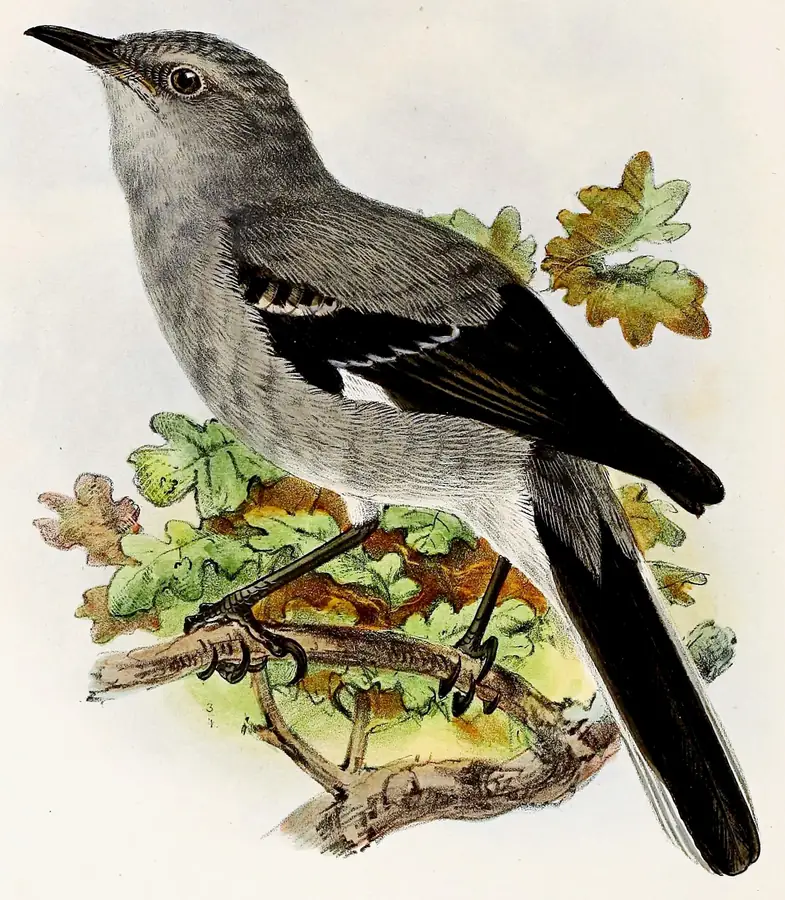
John James Audubon painted the Northern Mockingbird as plate 21 of The Birds of America (1827–38), under the name The Mocking Bird. A free high-resolution scan is on Audubon.org. The mockingbird shown here is by John Gerrard Keulemans, from his Dutch book Onze Vogels in Huis en Tuin (1869–76).
Updated
The story of this painting
John Gerrard Keulemans drew this mockingbird from life, the lettering says, for his own Dutch book on birds kept at home, Onze Vogels in Huis en Tuin (Our Birds in House and Garden). The plate is titled De spotlijster, the mocking thrush. It carries no printed number; the mockingbird is the 14th bird in the second volume's list of contents.
He had little good to say about it as a cage bird. Mockingbirds brought over from America, he wrote, lost their gifts as soon as they were sold. One could sell for a hundred dollars or more in America and two to four pounds in Liverpool, yet of thirty bought by a London dealer a few months before, only one sang, and it was priced at ten pounds against five for the rest.
He had kept two himself. The first gave such a loud, harsh screech that within days it spoiled his other singers: the nightingale and the robin fell silent, the siskin grew shriller, and the old starling screeched back at it. Conversation became impossible, and the bird had to go; so did the second. In the American woods, he granted, its song might be wonderful, but the forest is not a room, and a wild bird is not a caged one.
Story: Keulemans, Onze Vogels in Huis en Tuin, vol. 2 (1873), plate of the 14th bird (unnumbered); vol. 2 (1873), text on the 14th bird.
Audubon’s Northern Mockingbird: plate 21, “The Mocking Bird”
In Louisiana, Audubon wrote, you should listen to the mockingbird's love song: the male circles his mate with his tail spread, rises, lands, bows with his wings lifted, then bounces up and pours out his song, and afterward imitates every other singer of the woods. He called it “this king of song, who has derived all from Nature’s self.”
He had no patience with Europeans who ranked the Nightingale with it. At best, he wrote, the Nightingale was like a singer of some taste who might improve with lessons from Mozart. Yet he never heard a caged mockingbird sing anything close to its natural song, though a hand-raised bird at Natchez would fly out of the house to sing and come back when it saw its keeper.
Plate 21 shows two males and two females in a Florida, or Carolina, jessamine. When a snake climbs to a nest, he wrote, the owners and many neighboring mockingbirds fly at it and sometimes kill it. Throughout Louisiana people would not willingly let one be shot.
Story: Audubon, Ornithological Biography, vol. 1 (1831), pp. 108–114. See plate 21 free at Audubon.org.
More classic portraits, free to see
- John James Audubon, The Birds of America, octavo edition (1840–44), plate 138: “Common Mocking Bird”. Free scan (New York Public Library Digital Collections)
- Louis Agassiz Fuertes, for Elon H. Eaton’s Birds of New York (1910–14), plate 101: “Mocking Bird”, with Gray Catbird and Brown Thrasher. Free scan (Internet Archive)
About the Northern Mockingbird
- Northern Mockingbirds often catch insects while walking or running on the ground. (Source: National Audubon Society)
How long does a Northern Mockingbird live?
The Northern Mockingbird's typical lifespan is not something we could confirm. The oldest known wild Northern Mockingbird was at least 14 years and 10 months old (USGS Bird Banding Laboratory): it was banded in Texas in 1986 and found there again in 2000.
Source: USGS Bird Banding Laboratory. A banding record is the minimum age of one bird when it was found again, not a typical lifespan. How long do wild birds live?
How can you tell if a plate 21 print is an original?
By its size: an original plate 21 is a hand-colored sheet about 26 by 38 inches; the Northern Mockingbird’s octavo version, plate 138, is book-size, from 1840–44. Many prints sold today are reproductions: how to tell an original from a reproduction. For all 435 plates at a fraction of an original’s price, see which edition of The Birds of America to buy.
In a Birdfolio hardcover, this painting sits beside the date and place you first saw a Northern Mockingbird. See your own list as a book, free.