The US and Canada have 22 woodpeckers that live here regularly, from the 5- to 7-inch Downy to the crow-sized Pileated. Two rare strays from Asia and the Ivory-billed Woodpecker, whose last widely accepted sighting was in 1944, bring the American Birding Association's official list to 25. Five of the most common, says the U.S. Fish and Wildlife Service, are the Downy, Hairy, Red-bellied, Northern Flicker and Pileated.
Woodpeckers of North America at a glance
Lengths and weights are all from National Audubon's Guide to North American Birds, so they compare like with like; the ranges also draw on Audubon magazine, the Fish and Wildlife Service and state wildlife agencies.
| Woodpecker | Length | Weight | Where |
|---|---|---|---|
| Downy Woodpecker | 5–7 in | 0.7–1.0 oz | Most of the US and Canada; every state but Hawaii |
| Hairy Woodpecker | 7.1–10.2 in | 1.4–3.4 oz | Nearly every state; all but one Canadian province |
| Red-bellied Woodpecker | 9.4 in | 2–3.2 oz | Eastern and central US |
| Northern Flicker | 11–12 in | 4–6 oz | Most of the US all year; Alaska and Canada in summer |
| Pileated Woodpecker | 16–19 in | 8.8–12.3 oz | The East, much of Canada, the Pacific Northwest |
| Red-headed Woodpecker | About 10 in | About 2.5 oz | East of the Rockies |
| Yellow-bellied Sapsucker | 7.1–8.7 in | 1.5–1.9 oz | Nests North and East; winters south to Central America |
| Red-naped Sapsucker | 8–9 in | 1.6–2.3 oz | Rockies and Great Basin |
| Red-breasted Sapsucker | 7.9–8.7 in | 1.9–2.6 oz | Pacific Coast forests |
| Williamson's Sapsucker | 8–9 in | 1.6–2.5 oz | High western conifer forests |
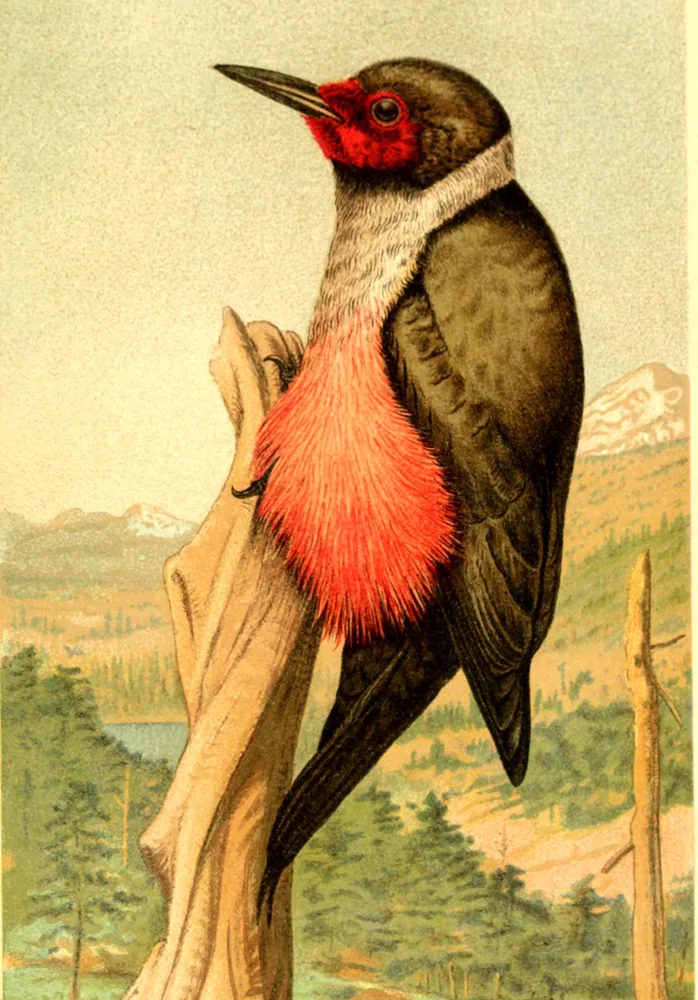
| Lewis's Woodpecker | 10–11 in | 3.1–4.6 oz | Open pine woods and burns of the West |
| Acorn Woodpecker | 8.3–9.1 in | 2.3–3.2 oz | Western oak woods |
| Gila Woodpecker | 8–10 in | 2.1–2.8 oz | Deserts of Arizona, southern California, New Mexico |
| Golden-fronted Woodpecker | 8–9 in | 2.5–3.5 oz | Central and South Texas, southwestern Oklahoma |
| Gilded Flicker | 11–12 in | 3.9–5.3 oz | Sonoran Desert saguaro country |
| Nuttall's Woodpecker | 6.3–7.1 in | 1.1–1.4 oz | California oak woodlands |
| Ladder-backed Woodpecker | 6–7 in | 0.9–1.4 oz | Dry Southwest and Texas brush |
| White-headed Woodpecker | 9–10 in | 2.1–3.2 oz | Mountain pines of the far West |
| Red-cockaded Woodpecker | 7.1–8.7 in | 1.4–1.8 oz | Old pine forests of the Southeast |
| American Three-toed Woodpecker | 8–9 in | 1.6–2.5 oz | Western mountains and the far North |
| Black-backed Woodpecker | 9–10 in | 2.1–3.2 oz | Northern forests and western burns |
| Arizona Woodpecker | 7–8 in | 1.1–1.6 oz | Oak canyons of southeastern Arizona and southwestern New Mexico |
The Red-headed's weight is from the University of Michigan's Animal Diversity Web; Audubon's guide gives none. The two strays and the Ivory-billed are under rare woodpeckers.
What are the different species of woodpeckers?
The 22 in the table: 16 named woodpeckers, four sapsuckers and two flickers, one family on the American Birding Association's list.
What is a type of American woodpecker?
Any of the 22. The Downy, Hairy, Red-bellied, Northern Flicker and Pileated are among the most common, and one carries the continent's name: the American Three-toed Woodpecker.
How many different woodpeckers are there in North America?
Twenty-five are on the American Birding Association's checklist for the US and Canada (version 8.19, January 2026), and 22 of them live here regularly. The list's codes put 17 at Code 1, widespread, and five at Code 2, local or thinly spread: the American Three-toed, Black-backed, Red-cockaded and Arizona Woodpeckers and the Gilded Flicker. The Great Spotted Woodpecker is casual (Code 4), the Eurasian Wryneck accidental (Code 5), and the Ivory-billed is marked "(extinct, 1944)" (Code 6).
The ABA's North America is the 49 continental states, Hawaii, Canada, St. Pierre et Miquelon and the waters out to 200 miles; the American Ornithological Society's list adds Middle America and counts far more. Worldwide, AviList's 2026 list has 237 woodpecker species, three extinct or possibly extinct: the Ivory-billed, Mexico's Imperial Woodpecker and the Bermuda Flicker. Woodpeckers live on every continent but Australia and Antarctica, the Fish and Wildlife Service notes. The ABA list's 1,161 species are counted in how many bird species the US and Canada have.
What is the most common type of woodpecker?
By numbers, the Red-bellied Woodpecker, about 16 million birds in National Audubon's guide; by reach, the Downy, found in every state but Hawaii, the Fish and Wildlife Service says. Next come the Yellow-bellied Sapsucker (14 million), the Downy (13 million) and the Northern Flicker (12 million). The guide names no source for these figures; they look like whole-range estimates (our assumption), so the flicker's would include birds in Mexico. Mass Audubon calls the Downy "the most common woodpecker in North America," fair if you count birds at suet feeders.
What is the biggest woodpecker in North America?
The Pileated Woodpecker: 16 to 19 inches long, with a wingspan of about 2 feet 2 inches to 2 feet 5 inches and a weight of 8.8 to 12.3 ounces, says National Audubon's guide. The Fish and Wildlife Service calls it "North America's largest and possibly loudest woodpecker"; the Pennsylvania Game Commission, "crow-size but with a long, slender neck." By weight, from the guide:
| Rank | Woodpecker | Weight |
|---|---|---|
| 1 | Pileated Woodpecker | 8.8–12.3 oz |
| 2 | Northern Flicker | 4–6 oz |
| 3 | Gilded Flicker | 3.9–5.3 oz |
| 4 | Lewis's Woodpecker | 3.1–4.6 oz |
| 5 | Golden-fronted Woodpecker | 2.5–3.5 oz |
| 6 (tie) | Red-bellied, Acorn, White-headed and Black-backed | Up to 3.2 oz |
The Hairy, at 1.4 to 3.4 ounces, varies too much to rank.
What is a great big woodpecker called?
Almost always a Pileated Woodpecker: black, crow-sized, with a red crest and a white stripe down its neck. Its painting page has the names Audubon heard for it.
What is the biggest woodpecker in the United States?
The Pileated, among those known to be alive. The Ivory-billed Woodpecker was bigger: 19 to 20 inches long, with a 30- to 31-inch wingspan and 16 to 20 ounces "according to historical sources," the Fish and Wildlife Service says; the Encyclopedia of Arkansas calls it "at one time the third-largest woodpecker in the world." It is still officially endangered; whether it is extinct is a question of its own.
The biggest ever was Mexico's "raven-sized" Imperial Woodpecker, last filmed in 1956 by a Pennsylvania dentist, William L. Rhein, from the back of a mule, and lost to logging and, to a lesser extent, hunting, Audubon reported. The biggest alive, Wikipedia says, citing the Handbook of the Birds of the World, is Asia's Great Slaty Woodpecker, 18 to 20 inches long by the Bird Society of Singapore's measure.
Why is it called pileated?
From the Latin pileus, a cap, for its red crest, says the Pennsylvania Game Commission. The word "refers to the red cap of feathers found from the bill to the nape," the back of the neck, the Fish and Wildlife Service adds.
What is the biggest red-headed woodpecker?
If you mean a big woodpecker with red on its head, the Pileated, 16 to 19 inches. The Red-headed Woodpecker itself is about 10 inches in Audubon's guide, 7 to 10 by New York's Department of Environmental Conservation (DEC) and 8 to 9 by the Pennsylvania Game Commission.
What is the smallest woodpecker?
In North America, the Downy Woodpecker: 5 to 7 inches and 0.7 to 1 ounce, "the smallest woodpecker in North America," says National Audubon's guide. The Ladder-backed (6 to 7 inches) and Nuttall's (6.3 to 7.1 inches) come close but weigh more. Worldwide the tiniest are piculets; Wikipedia gives South America's Bar-breasted Piculet as about 3 inches and 8.9 grams, about a third of an ounce.
What kind of bird is a tiny black and white woodpecker?
Almost always a Downy Woodpecker, with a white back, a striped face and a "very short, stubby bill" (Audubon's guide). In the dry Southwest or California's oaks, a small barred-backed one is a Ladder-backed or Nuttall's. One that climbs down headfirst is a nuthatch, not a woodpecker.
Downy or Hairy Woodpecker? How to tell them apart
Look at the bill: a Downy's is shorter than its head is deep, a Hairy's about as long as the head or longer, and the Hairy is the bigger bird, say the Pennsylvania Game Commission and the Fish and Wildlife Service.
| Clue | Downy Woodpecker | Hairy Woodpecker |
|---|---|---|
| Bill | Short and "chisel-like" | As long as the head, "much heavier" |
| Outer tail feathers | White with black bars | Clean white |
| Size | 5–7 in, 0.7–1.0 oz | 7.1–10.2 in, 1.4–3.4 oz |
| Call | Quiet pik; a falling rattle | Sharp peek; a rattle on one pitch |
| Drum | 12–17 beats in under a second | About 26 beats in a second, "an angry buzz" |
| Where | Edges, suburbs, even weed stalks | Bigger trees, less often in suburbs |
Sizes, calls and places are from Audubon's guide, drums from Kenn Kaufman in Audubon magazine. A Hairy is "about 50% again as big," writes John Lloyd of the Vermont Center for Ecostudies.
Why do Downy and Hairy Woodpeckers look so alike?
Nobody knows for sure, and they aren't close relatives, Lloyd explains: the Downy is nearer kin to Nuttall's and the Ladder-backed, the Hairy to the Arizona Woodpecker. Yale's Richard Prum suggests the Downy gains by looking like the bigger, more aggressive Hairy; a 2018 study led by Gavin Leighton suggests Downys use the likeness against other rivals, such as House Sparrows, Audubon reported. Both are hypotheses.
Male or female? Which woodpeckers wear red where
In most woodpeckers the male has more red on his head than the female; in a few, the two look alike.
How can you tell the difference between a male and female Pileated Woodpecker?
The male's forehead and "mustache" stripe are red, the female's black, says National Audubon's guide, and the female "has less red in the crest," the Pennsylvania Game Commission adds.
| Woodpecker | Male | Female |
|---|---|---|
| Downy, Hairy | Small red patch on the back of the head | No red |
| Red-bellied | Red from the bill to the nape | Red on the nape and above the bill only |
| Northern Flicker | "Mustache," black in the East, red in the West | No mustache |
| Pileated | Red forehead and mustache | Black forehead and mustache |
| Red-headed, Red-breasted Sapsucker | Red head | The same |
| Yellow-bellied Sapsucker | Red throat | White throat |
| Williamson's Sapsucker | Black, white wing patch, yellow belly | Brown and barred, brown head |
| Acorn | Red cap touching the white forehead | Black bar between cap and forehead |
| Gila, White-headed, Arizona | Red cap, head patch or nape spot | No red |
| American Three-toed, Black-backed | Yellow crown patch | No yellow |
Sources: Audubon's guide and magazine, the Fish and Wildlife Service, the Pennsylvania Game Commission, New York's DEC and National Geographic. A female Red-headed has the male's all-red head ("Sexes are similar," says the DEC), while male and female Williamson's Sapsuckers differ so much that they were first described as two species, says Audubon's guide.
What do young woodpeckers look like?
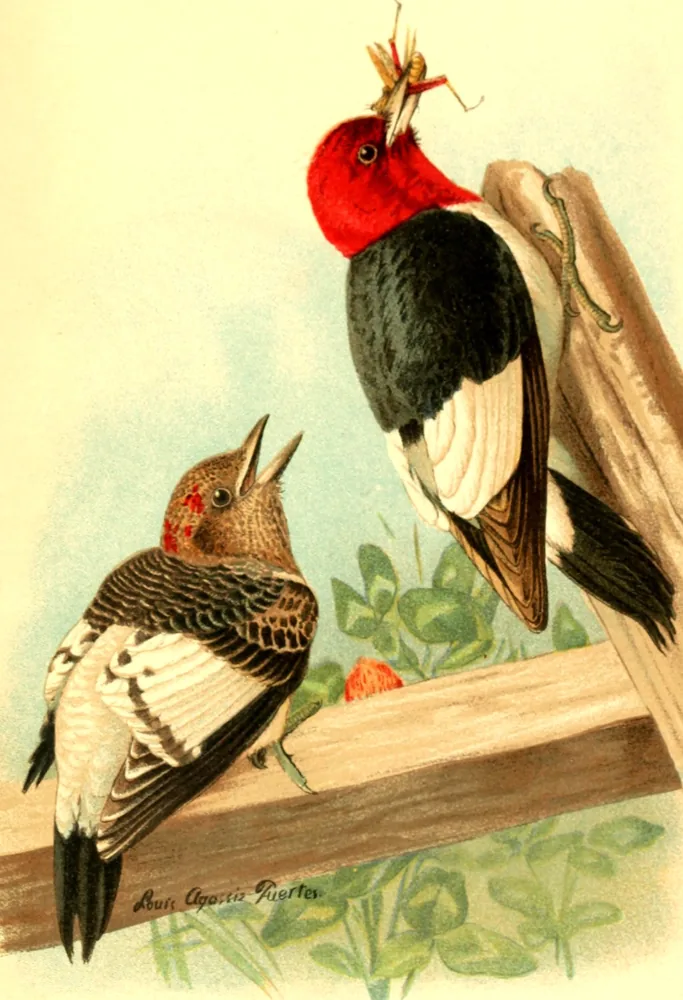
Duller, and often without the red. A young Red-headed has a brown head; the "brown is replaced by red gradually during first winter," says Audubon's guide. A young Red-bellied lacks red above the bill and on the nape (National Geographic), and a young Hairy "may also have yellow on crown," like a three-toed woodpecker (Audubon's guide).
What kind of woodpeckers have red heads?
Two have all-red heads: the Red-headed Woodpecker, east of the Rockies, and the Pacific Coast's Red-breasted Sapsucker. Red caps, crests or patches mark the Pileated, Red-bellied and Acorn Woodpeckers, male Gila, Downy and Hairy Woodpeckers, and the other sapsuckers.
Red-headed or Red-bellied? The names that trip people up
A red cap over a zebra-striped back means a Red-bellied Woodpecker; an all-red head over a black back and big white wing patches means a Red-headed. Red on the head "doesn't mean you can call them red-headed woodpeckers," the Fish and Wildlife Service points out, and both are about 9 to 10 inches. Why the Red-bellied has its name, and how to tell it from Texas's Golden-fronted Woodpecker, is on its painting page. A Pileated is nearly twice a Red-headed's length, with red only in the crest and, on a male, the forehead and mustache.
Is it rare to see a red-headed woodpecker?
In much of its range, yes. Once very common in the East, it is "now uncommon and local in many regions," says National Audubon's guide. Surveys show a 2.4% yearly decline from 1966 to 2015, and Pennsylvania lists it as a Species of Greatest Conservation Need, its Game Commission says. Starlings take its nest holes, cars hit birds hunting insects along roads (New York's DEC), and dead trees get cut down (Audubon's guide).
What attracts a red-headed woodpecker?
Dead trees, nut trees and open ground. It needs "dead trees for nest sites, snags for roosting, and open ground for foraging," says the DEC (a snag is a standing dead tree), and it stores acorns, beechnuts and even live grasshoppers in cracks, covered with bark, says the Pennsylvania Game Commission.
What does it mean when you see a red-headed woodpecker?
In nature's terms, that dead trees and nut-bearing oaks or beeches are probably close by.
Are flickers and sapsuckers woodpeckers?
Yes. "Make no mistake – northern flickers are indeed woodpeckers," says the Fish and Wildlife Service, and sapsuckers are woodpeckers that drill rows of small holes for sap.
In 1995, Northern Flickers grounded a space shuttle. Flickers at Launch Pad 39B "poked about 200 holes in foam insulation of Discovery's external tank," NASA says; repairs on the pad failed, Discovery rolled back to the Vehicle Assembly Building on June 8, and its mission, STS-70, waited until July 13.
The flicker is a brown woodpecker of 11 to 12 inches and 4 to 6 ounces that feeds on the ground and "probably eats ants more frequently than any other North American bird" (Audubon's guide). It even lets ants crawl over it, using "the formic acid ants secrete to help control parasites" (Fish and Wildlife Service). Because it isn't black and white, many people don't know it's a woodpecker, says the Pennsylvania Game Commission, and its numbers have fallen since the 1960s. It's Alabama's state bird, the yellowhammer, and its plate and old names are on its painting page.
Hummingbirds follow sapsuckers. A sapsucker drills neat rows of holes in live trees, "up to 30 holes per day," and returns for the sap and the insects it draws, says the Pennsylvania Game Commission; these are sapsucker wells. Ruby-throated Hummingbirds reach the Northeast in April and May, when few flowers are open, and feed at the wells, "closely tailing sapsuckers" from tree to tree, says the National Park Service, which puts the sap at up to 20 to 30% sugar. The Yellow-bellied Sapsucker, 7.1 to 8.7 inches and 1.5 to 1.9 ounces, is "one of the most migratory of woodpeckers" (Audubon's guide).
What bird looks like a woodpecker but is not?
Nuthatches, the Brown Creeper and the Black-and-white Warbler all climb tree trunks the way woodpeckers do, but none of them is one.
- Nuthatches "can easily go up and down," Bob Sundstrom writes for BirdNote; woodpeckers climb up but usually fly to come down. See our White-breasted Nuthatch painting.
- The Brown Creeper, 4.7 to 5.5 inches, looks "like a piece of bark come to life" and climbs with its tail braced (National Audubon's guide).
- The Black-and-white Warbler was "once known as the 'Black-and-white Creeper'" (the guide).
Are brown creepers woodpeckers?
No. The Brown Creeper is a small songbird that braces on its stiff tail as a woodpecker does, but AviList files it with the treecreepers.
What birds are woodpeckers related to?
Toucans, barbets, honeyguides, jacamars and puffbirds. They share the order Piciformes, nine families and 440 species in AviList's 2026 list by our count, with the woodpeckers, at 237, the largest family.
Woodpecker sounds: what drumming is, and who drums how
Drumming is a woodpecker's song: a fast drumroll on a loud surface, to claim a territory and call a mate rather than to find food, Kenn Kaufman explains in Audubon magazine. It happens "most commonly in spring," says Mass Audubon; drilling is for food or a nest. Kaufman's drums, with the calls from Audubon's guide:
| Woodpecker | Drum | Call |
|---|---|---|
| Downy | 12–17 beats in under a second | Pik; a falling rattle |
| Hairy | About 26 beats in a second | Peek; a rattle on one pitch |
| Pileated | Slow and loud, speeding up, then fading | Cuk-cuk-cuk, rising then falling |
| Northern Flicker | Nearly two seconds, up to 30 beats | Wicka-wicka-wicka; kleeer |
| Red-bellied | Slow, 13–17 beats, often between loud calls | Chuck-chuck-chuck; a rolling churrrr |
| Sapsuckers | A fast roll, then irregular single or double knocks | Mews |
The Red-headed calls churr-churr and yarrow-yarrow-yarrow, the Acorn ja-cob, ja-cob, the Red-cockaded a nuthatch-like yank-yank (Audubon's guide). One sound may be gone for good: the Ivory-billed called a nasal kent, like a toy trumpet, and rapped a "double knock," says the Fish and Wildlife Service. To listen, try the National Park Service's Northern Flicker from Yosemite, or a Hairy Woodpecker and sapsucker drumming in Montana State University's Acoustic Atlas, both courtesy of the Park Service.
Why is there a woodpecker pecking my house?
Usually for one of four reasons: insects in the siding, a place to dig a nest or roost hole, a loud spot to drum on in spring, or a place to store food, says the U.S. Fish and Wildlife Service.
Killing it can cost you. In 2015 the owner of a Wisconsin pest control company paid $4,185 in fines and restitution for illegally killing 108 woodpeckers for about 30 customers, the Service reports. Like almost all native birds, woodpeckers are protected by the Migratory Bird Treaty Act, "in place since 1918," which bars killing or possessing one, or its nest or eggs, without a permit (16 U.S.C. § 703). A depredation permit to kill one is a "last resort," after non-lethal methods fail.
So first "inspect your siding for insect damage," the Service advises. Most drilling on houses happens from September to November, often on dark or natural cedar or redwood siding, says Mass Audubon, and the driller may be a young bird short of food. What helps:
- Bird netting from the eaves, kept taut: "probably the most effective control method," says the Service.
- Filling and painting holes at once, as soon as drumming starts.
- Burlap around a tree a sapsucker is working.
- Plastic sheeting or mylar streamers, and dead trees left standing as an alternative (Mass Audubon).
- Waiting out an active nest, usually until about midsummer.
Scare devices "have inconsistent success," and sticky gels can impair a bird's flight and its ability to keep warm. This is a summary, not legal advice; the law's penalties are in our birds of prey guide.
How do woodpeckers peck without brain damage?
They may not need much protection: a 2022 study of three species found the skull works "as a stiff hammer," not "a shock-absorbing system," and the small brain stays "below the threshold of concussions known for primate brains." That turned around an old idea behind football helmets and shock-absorbing materials modeled on the woodpecker (Sam Van Wassenbergh and colleagues, Current Biology).
There is a catch. In 2018, Boston University researchers found deposits in 8 of 10 woodpecker brains under a silver stain, and tau, a protein linked to brain injury, in 2 of 3 tested, but none in 5 Red-winged Blackbirds; "further research is needed," they wrote. And in 2025, Brown University researchers found that Downy Woodpeckers breathe out with every strike, "similar to how professional tennis players grunt." Where a woodpecker keeps its tongue is one of our bird trivia questions.
Rare woodpeckers in the US
The rarest regular woodpecker is the Red-cockaded, federally threatened and found only in old pine forests of the Southeast; rarer still are two strays from Asia and the Ivory-billed Woodpecker. Other small populations in National Audubon's guide are Lewis's Woodpecker (82,000; it "has disappeared from many former nesting areas"), the Arizona (200,000), the White-headed (240,000) and Williamson's Sapsucker (300,000).
The Red-cockaded Woodpecker
This woodpecker guards its nest with pine resin. It chips small "resin wells" around the nest hole so sticky resin coats the trunk, and climbing tests with rat snakes found this "resinous barrier … is highly effective" at keeping them out, a US Forest Service study reported in 1990. The trunk can take on a "candle-like appearance," says North Carolina's Wildlife Resources Commission.
It is the only North American woodpecker that nests and roosts in holes it digs in living pines, the Fish and Wildlife Service says, often longleaf pines averaging 80 to 120 years old; one hole can take one to six years (Outdoor Alabama). Fewer than 10,000 were left when it was listed as endangered in 1970. Today's 7,800 active clusters, the groups of cavity trees a family uses, are "almost double the number of clusters that existed in 1995," and since November 25, 2024 it has been listed as threatened instead. Its rule even covers artificial cavities drilled into the pines: people now make homes for it.
How rare is a Great Spotted Woodpecker in North America?
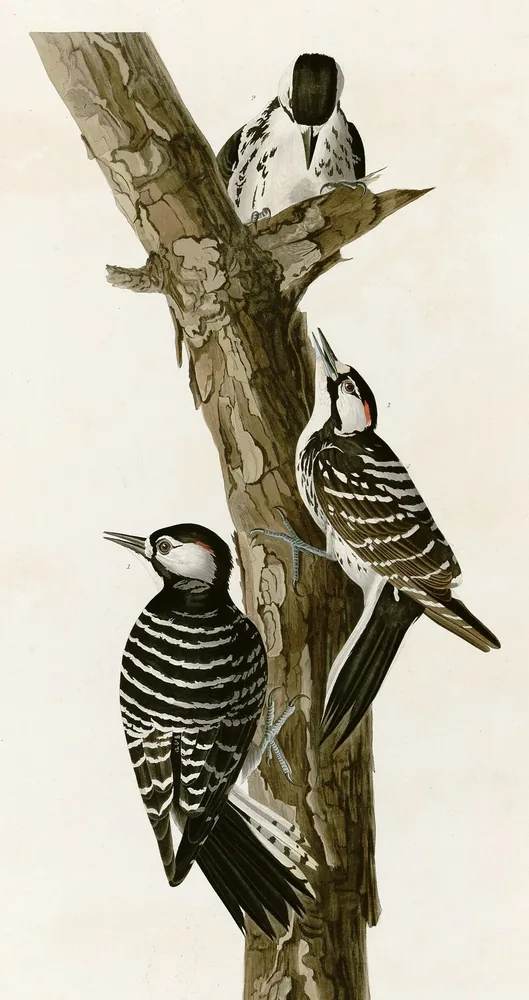
Very rare. The American Birding Association rates it Code 4, casual: "not recorded annually," but with at least six records, three or more in the past 30 years. The Eurasian Wryneck is Code 5, accidental, though the University of Alaska Museum's 2020 checklist kept it "Casual, not Accidental" for Alaska, a different area.
What happened to the Ivory-billed Woodpecker?
No one has shown for certain that it survives. The "last commonly agreed upon sighting" was in April 1944, on the Singer Tract along Louisiana's Tensas River, says the Fish and Wildlife Service, which listed the bird as endangered in 1967.
That forest went to war. During World War II, the company logging it had German prisoners of war cutting its trees for "boxes in which to ship tea to British soldiers," Frank Graham Jr. wrote in Audubon magazine. Observers "blurted 'Lord God!' on seeing it," hence its old name, the Lord God bird. Our Arkansas and Louisiana pages follow the later searches, and Audubon's plate 66 of the bird is among his famous plates.
Which woodpeckers stay for winter?
Most stay all year; the Yellow-bellied Sapsucker leaves, and northern flickers move south. By National Audubon's guide and the Pennsylvania Game Commission:
- All year: the Downy, Hairy, Pileated and Red-bellied, though northern Red-bellieds may move in harsh winters.
- Partly: the Northern Flicker, whose northern birds are "strongly migratory," and the Red-headed, which moves short distances.
- All the way: the Yellow-bellied Sapsucker, with "essentially no overlap between its summer and winter ranges."
- Wanderers: Lewis's (in some winters, "large numbers invade lowlands of southwest") and the Acorn, when the acorn crop fails.
At feeders, Downy, Hairy and Red-bellied Woodpeckers take suet (Audubon's guide), and a UConn Home & Garden Education Office column has flickers and Downies gobbling unsalted peanuts. Of Pileateds, "some will even frequent suet feeders," says Travis Audubon, and the Gila drinks from hummingbird feeders.
The Acorn Woodpecker's pantry
Acorn Woodpeckers live in groups of 2 to 15 and store acorns in a granary tree that "may be riddled with up to 50,000 holes," says National Audubon's guide. Granaries also turn up in utility poles, fence posts, eaves and under clay roof tiles, a US Forest Service review notes, and The Nature Conservancy reports "485 pounds of acorns found in an Arizona water tank." BirdNote says Woody Woodpecker was probably inspired by an Acorn Woodpecker; the story is among our bird trivia questions.
Audubon's woodpeckers
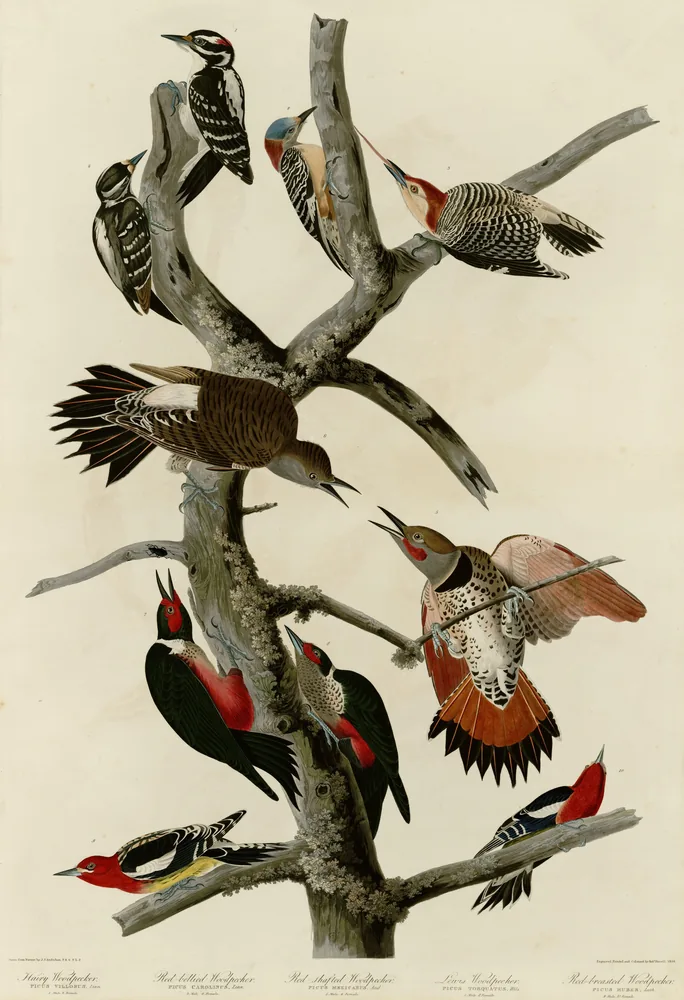
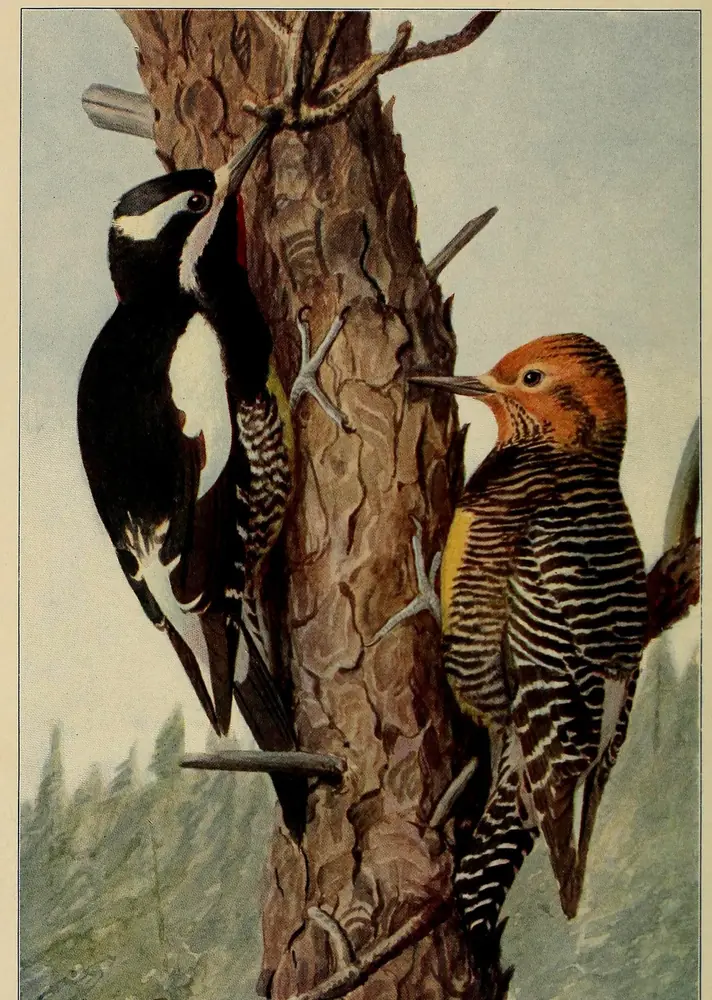
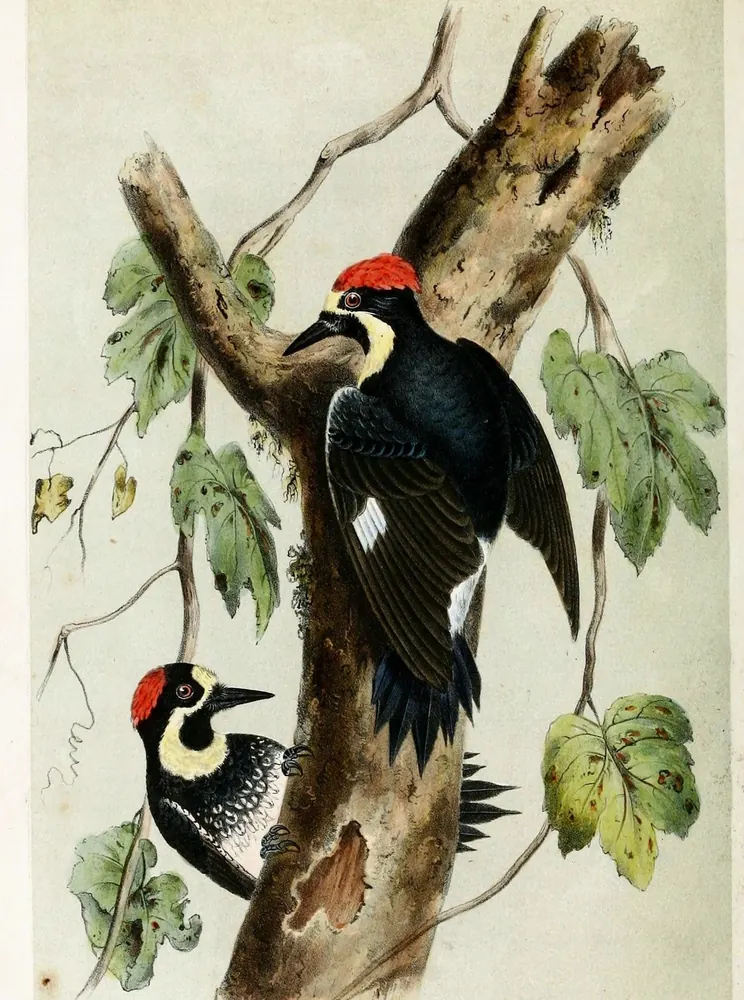
The plate at the top is number 416 of John James Audubon's The Birds of America: ten birds of five kinds, the Hairy, Red-bellied, Red-shafted (now part of the Northern Flicker), Lewis's and Red-breasted (now the Red-breasted Sapsucker), engraved, printed and colored by Robert Havell and dated 1838. Our Red-bellied Woodpecker page explains who's who. Louis Agassiz Fuertes painted and signed the Red-headed and Lewis's Woodpeckers for a 1911 government study and the Williamson's Sapsuckers for Birds of the Rockies (1902); George G. White drew the Acorn Woodpeckers for John Cassin in the 1850s. More about Fuertes and Audubon.
Can you tell a Downy from a Red-bellied by its painting alone? Try the backyard birds level of our bird quiz.
Heard a Pileated drumming but never saw it? Many birders count a bird they have only heard, and a Birdfolio prints every bird on yours beside a classic painting of it: look inside a Birdfolio.
Five states have woodpecker guides of their own so far, each built from that state's official list: Texas, Florida, Michigan, Ohio and California.
Our state pages give each state's official bird count and its 25 most common summer birds: Arizona, California, Colorado, Florida, Georgia, Illinois, Indiana, Maine, Maryland, Michigan, Minnesota, Missouri, New Jersey, Ohio, Oregon, Tennessee, Texas, Virginia, Wisconsin and every other state.
Questions people ask
Is the Pileated Woodpecker rare?
No. National Audubon's guide puts it at about 2.6 million birds, and it has made a gradual comeback since about 1900.
Is the Northern Flicker rare?
No: about 12 million birds by Audubon's figures, though declining over much of its range since the 1960s.
How long do woodpeckers live?
The record in the USGS Bird Banding Laboratory's table is an Acorn Woodpecker that lived at least 17 years and 3 months (banded in California in 1992); a Hairy reached 15 years and 11 months. Every species' record is in our table of the oldest wild birds.