Classic bird paintings
White-breasted Nuthatch painting: Audubon's plate and other classic portraits
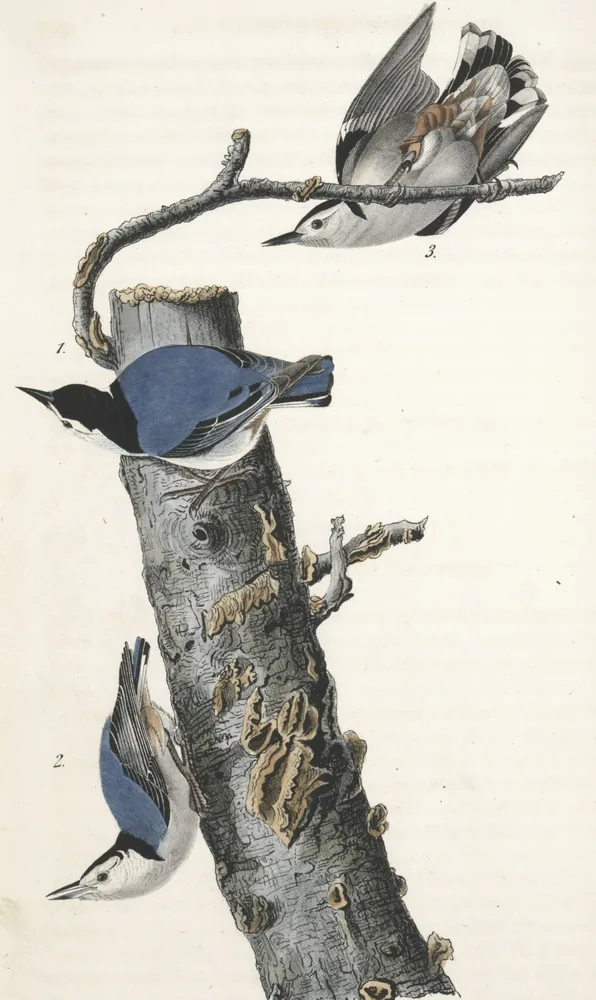
John James Audubon painted the White-breasted Nuthatch as plate 152 of The Birds of America (1827–38), under the name White-breasted Black-capped Nuthatch. A free high-resolution scan is on Audubon.org. Shown here is plate 247 of his smaller octavo edition (1840–44): a male and two females on a dead stump.
Updated
About this painting
This is plate 247 of the octavo edition, the book-size reprint of 1840 to 1844, where the bird goes by its short name, White-breasted Nuthatch. The faint lines behind the birds are type from the facing page, showing through the paper of the scan. One bird hangs head down from a twig, a habit Audubon describes in his text.
Audubon’s White-breasted Nuthatch: plate 152, “White-breasted Black-capped Nuthatch”
Remembering the hours he had spent watching young White-breasted Nuthatches leave the nest, Audubon wrote that “those summer days of hope and joy are fled.” A pair digs the nest hole together in rotten wood: the female chisels, while the male carries off the chips, peeps into the hole and chirps. While she sits on the eggs, he feeds her. When the young creep out around the entrance, the parents teach them to fly, to climb the trunk and at last to find their own food.
In winter, he found, the bird comes to the very doors of farmhouses, tapping at the eaves, slipping into barns and searching for food among the poultry. It wedges acorns and chestnuts into cracks in the bark or a fence rail and hammers them open, after the grubs inside more than the nut, he thought. Its call is nasal, like hank, hank. Many farmers shot it, mistaking it for the little woodpecker they called the Sap-sucker.
Of the three nuthatches then known in the United States, this was the least common, and he predicted two more: a bigger one in the woods near the Pacific, and one about this size near the Mexican border. Plate 152 shows a male and two females, which differ, he wrote, only in being slightly smaller and less deeply colored. By 1839 he had found it plentiful in Texas.
Story: Audubon, Ornithological Biography, vol. 2 (1834), pp. 299–302; vol. 5 (1839), p. 473. See plate 152 free at Audubon.org.
More classic portraits, free to see
- John James Audubon, The Birds of America, octavo edition (1840–44), plate 247: “White-breasted Nuthatch” (the painting shown above). Free scan (New York Public Library Digital Collections)
- Louis Agassiz Fuertes, for Elon H. Eaton’s Birds of New York (1910–14), plate 103: “White-breasted Nuthatch”, with 4 other birds. Free scan (Internet Archive)
About the White-breasted Nuthatch
- White-breasted Nuthatches hide food in cracks in the bark during fall and winter. (Source: National Audubon Society)
A nuthatch comes and goes all day, often flying off with a seed to hide, so Project FeederWatch asks you to report the most you see at one time, not every visit. The 2026–27 season runs from November 1 to April 30: how FeederWatch counts work.
How long does a White-breasted Nuthatch live?
The White-breasted Nuthatch has no typical lifespan in the agency guides we read. The oldest known wild White-breasted Nuthatch was at least 9 years and 9 months old (USGS Bird Banding Laboratory): it was banded in Colorado in 1962 and found there again in 1971.
Source: USGS Bird Banding Laboratory. A banding record is the minimum age of one bird when it was found again, not a typical lifespan. How long do wild birds live?
How can you tell if a plate 152 print is an original?
By its size: an original plate 152 is a hand-colored sheet about 26 by 38 inches; the White-breasted Nuthatch’s octavo version, plate 247, is book-size, from 1840–44. Many prints sold today are reproductions: how to tell an original from a reproduction. Modern editions print all 435 plates, from pocket size to coffee-table size: which Birds of America book to buy.
In a Birdfolio hardcover, this painting sits beside the date and place you first saw a White-breasted Nuthatch. See your own list as a book, free.