The Ohio Ornithological Society's official checklist has 11 woodpeckers: seven you can find every year, three rarities its records committee reviews, and the Ivory-billed, no longer found in Ohio. Here a woodpecker is mostly a yard bird, a Downy at the feeder or a flicker on the lawn; the Red-headeds of Killdeer Plains perch on telephone poles.
Which woodpeckers live in Ohio?
Seven are found every year: the Downy, Hairy, Red-bellied, Red-headed and Pileated Woodpeckers, the Northern Flicker and the Yellow-bellied Sapsucker.
Birders up north agree: the Toledo Naturalists' Association counts "7 species occurring regularly" in northwest Ohio. Their seasons and haunts come from Common Birds of Ohio, the 2013 field guide of the Ohio Department of Natural Resources (ODNR), and the sapsucker's from Ohio State University Extension:
| Woodpecker | Where in Ohio | When | In the sources' words |
|---|---|---|---|
| Downy | Statewide: small woodlots, towns with big trees | All year | "Common statewide" |
| Red-bellied | Statewide, out into the fields | All year | "The most versatile of our woodpeckers" |
| Hairy | Statewide, but mostly in larger, older woods | All year | "Outnumbered by downys by ten to one" |
| Northern Flicker | Statewide, in open country | All year; most in migration, especially spring | "Easily found" |
| Pileated | Statewide; least common in the west and northwest | All year | "By far our largest woodpecker" |
| Red-headed | Mainly the glaciated north and west | Mostly summer | "Somewhat scattered and local" |
| Yellow-bellied Sapsucker | Passes through | Spring and fall | Here "on their way to their nesting grounds" (Ohio State) |
The other four on the list are three rare strays and one lost bird, covered below. The whole state list, 456 species as of July 2026, is on our Ohio bird list page.
What is Ohio's most common woodpecker?
The Downy Woodpecker: Ohio's Division of Wildlife calls it "the most common Ohio woodpecker and also the smallest," at home "in all manner of habitats," feeders included.
Next in its order comes "possibly" the Northern Flicker, then the Red-bellied. The Downy's look-alike, the Hairy, trails far behind. Downys outnumber Hairys ten to one, ODNR says, and the Hairy keeps to larger, older woods, being "much less tolerant of forest fragmentation," the breaking up of woods into small patches. Telling the two apart is easier with our Downy or Hairy clues, and Audubon's Downy is on its painting page.
Glaciated or hill country: where Ohio's woodpeckers live
Ohio's Division of Wildlife divides its birding map in two: the glaciated north and west, which Ice Age glaciers once covered, and the unglaciated hill country of the southeast. The woodpeckers follow the line. Red-headeds are "primarily in glaciated northern and western Ohio." The Pileated does best in the big forests of the unglaciated southeast and is "least common in western and northwestern Ohio," though it is "slowly expanding northward."
| Where you are | Woodpeckers to expect |
|---|---|
| Toledo, the northwest and the Lake Erie shore | Downy, Red-bellied, Hairy, Red-headed; big flicker flights at Magee Marsh in April and May; few Pileateds |
| Columbus and central Ohio | Downy, Red-bellied at the Blendon Woods Metro Park feeders, Hairy in larger woods, flickers; Red-headeds locally, Killdeer Plains to the north |
| Cleveland and Akron | Downy and Red-bellied; Hairy and Pileated in Cuyahoga Valley National Park |
| Cincinnati and the southwest | Downy and Red-bellied; Hairy at Hueston Woods State Park; sapsuckers in migration |
| The unglaciated southeast | The Pileated at its best, with Hairy, Downy and Red-bellied |
The rows are our summary of ODNR's guide.
Red-headed Woodpeckers on the Killdeer Plains poles
Ask Ohio's wildlife division where to see a Red-headed Woodpecker and it doesn't send you into a forest. Its first pick is "Killdeer Plains WA, on roadside telephone poles," WA standing for Wildlife Area. Next come the Goll Woods and Lawrence Woods state nature preserves and the Killbuck and Funk Bottoms wildlife areas.
The bird keeps mostly to the glaciated north and west, and it "can be common in larger woodlots of western Ohio," in open woods with oaks and hickories. The trees matter: Red-headeds "eat plenty of mast in winter," mast being the nuts and acorns that trees drop. How the species has fared across its range, and what draws one in, are in the woodpecker guide.
What attracts woodpeckers to your yard?
Food and big trees: ODNR says the Red-bellied is "easily lured to backyard feeders" and the Downy is "a frequent visitor to yards and feeders."
Ohio's woodpeckers each have their own lure:
- Red-bellied: goldenrod. Red-bellieds "often venture into fields, where they bore into goldenrod galls," the knobby swellings on the stems. Leaving a patch standing through fall may help; that's our suggestion, not ODNR's.
- Red-headed: oaks and hickories, for the mast.
- Northern Flicker: a lawn with ants, "a huge part of their diet."
- Pileated: big woods close by.
What to put in the feeder is in the hub's winter feeding notes. To watch Red-bellieds before you set one up, ODNR points to county parks with feeders, "such as Blendon Woods MP in Columbus."
Do woodpeckers come back to the same spot every year?
Most of Ohio's never leave: the Downy, Hairy, Red-bellied and Pileated live here all year, and a Pileated pair needs about 100 acres of woods. The travelers are the Yellow-bellied Sapsuckers, which pass through each spring and fall, and many flickers, "more common in migration, particularly in spring," ODNR says.
And the sapsuckers' trees? Ohio State University Extension's Joe Boggs was asked whether sapsuckers come back to the same trees year after year. He looked for the research and wrote, in May 2026: "I've yet to find any research supporting this A.I. (Artificial Incompetence?) conjecture." What studies do show is that sapsuckers pick trees mainly by the sugar in their sap, drill more than 250 kinds of trees, shrubs and vines, and favor stressed trees. So a sweet tree can keep drawing them without any bird remembering it. Boggs also reminds readers that sapsuckers are protected under the Migratory Bird Treaty Act, as all of Ohio's native woodpeckers are.
Black, white or brown: which Ohio woodpecker did I see?
| What you saw | Probably | The clue |
|---|---|---|
| A brown woodpecker on the ground | Northern Flicker | It's eating ants |
| A big black woodpecker with a red crest | Pileated | "Crow-sized," says ODNR, and "surprisingly secretive" |
| A small black-and-white one at the feeder | Downy | The common one, everywhere |
| The same, but bigger, with a longer bill | Hairy | About one for every ten Downys |
| An all-red head and square white wing patches | Red-headed | Open oak and hickory woods, mostly in the west |
| A red cap over a zebra-striped back | Red-bellied | Feeders, and goldenrod fields |
A brown woodpecker surprises a lot of people, but the flicker is a woodpecker all the same, as the hub explains.
Ohio's rare and lost woodpeckers
Three woodpeckers reach Ohio so rarely that the Ohio Bird Records Committee reviews every report: the Red-naped Sapsucker of the Rockies, the Black-backed Woodpecker of the northern forests and the Red-cockaded Woodpecker of Southern pines. Next door in Michigan the Black-backed is a regular (woodpeckers in Michigan).
The Ivory-billed is gone. The society's printable checklist leaves it off, with the other species extirpated from Ohio, and in 2013 ODNR counted it among the birds that "once occurred in Ohio."
One more woodpecker is a bird Ohio is still waiting for. In 2015 ODNR's field checklist printed a "Wishful Thinking?" list of 20 species seen in neighboring states but never in Ohio. By July 2026, 12 of the 20 had made the state list. Lewis's Woodpecker, a bird of the West, still hadn't, by our check against the official checklist.
Magee Marsh, Blendon Woods and the hill forests: where to go in Ohio
| Place | Woodpeckers | When or why |
|---|---|---|
| Killdeer Plains Wildlife Area | Red-headed | Watch the roadside telephone poles |
| Goll Woods and Lawrence Woods state nature preserves; Killbuck and Funk Bottoms wildlife areas | Red-headed | ODNR's other picks for it |
| Magee Marsh Wildlife Area, on Lake Erie | Northern Flicker | "Big migrations" in April and May |
| Blendon Woods Metro Park, Columbus | Red-bellied | At the feeders |
| Cuyahoga Valley National Park | Pileated, Hairy | Big woods between Cleveland and Akron |
| Shawnee and Hocking state forests; Lake Katharine State Nature Preserve | Pileated | Ohio has 20 state forests; the big ones of the southeast suit it best |
| Hueston Woods State Park; Davey Woods State Nature Preserve | Hairy | ODNR's picks for it |
| Oak Openings, near Toledo | Winter woodpeckers | The Toledo Naturalists' Association led a woodpecker field trip there in February 2025 |
One Hairy for every ten Downys: Audubon's pair
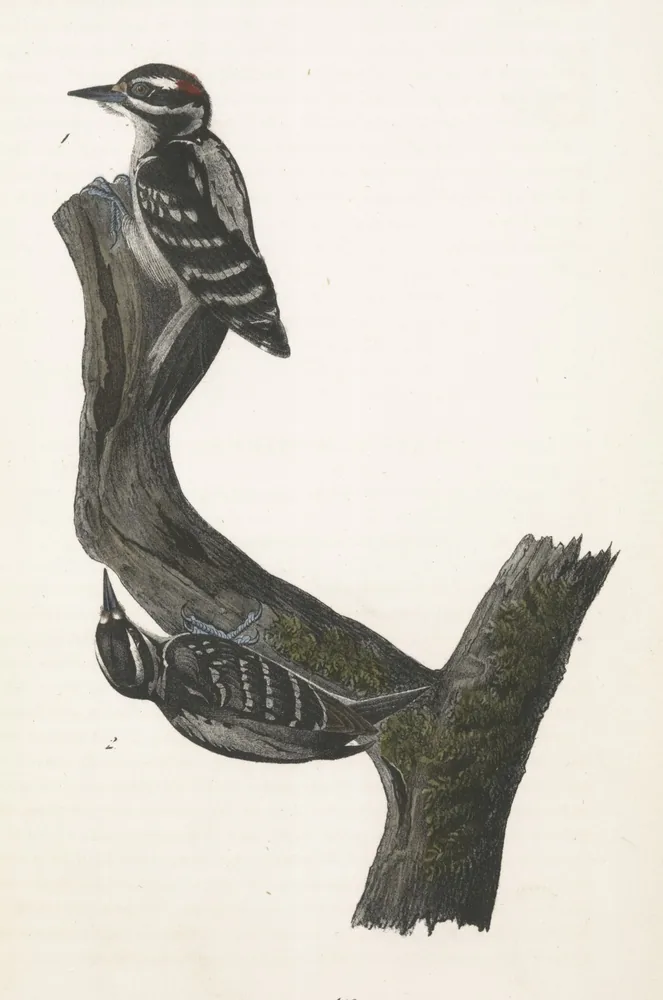
John James Audubon brought out The Birds of America a second time in the 1840s, as a smaller, book-size octavo edition, and the pair at the top comes from it: a male Hairy Woodpecker, with the red patch on the back of his head, perched above a female on a bent, mossy trunk. In Ohio you'd meet about one Hairy for every ten Downys, so a Hairy at the suet is worth a second look.
Find all seven and you have the start of a life list. A Birdfolio turns a list into a hardcover, every bird paired with a classic painting the way these two Hairys are: a printed book of your own sightings.
Questions people ask
What does it mean if you see a woodpecker in your yard?
Usually that it has found food. A brown one on the lawn is a Northern Flicker hunting ants; a Downy or Red-bellied is after your feeder or the insects in your trees, ODNR's guide suggests.
Why is a woodpecker drumming on my downspout?
Most likely it's a male Northern Flicker making noise on purpose: Ohio's wildlife division says males "sometimes use metal downspouts of homes to create a barrage of sound." Metroparks Toledo adds houses and trash cans to the list of things woodpeckers drum on. The hub explains what drumming is for and what to do about a house.