Reference
How many bird species are in California?
California has 696 bird species on its official list (California Bird Records Committee, October 27, 2026), the most of any US state. The list counts every species accepted for the state, including 19 introduced species now established in the wild, the Sharp-tailed Grouse, no longer found in California, and the California Condor, still being reintroduced.
California’s state bird is the California Quail: our California state bird page tells how it was chosen.
Updated
What are the most common birds in California?
In summer, the 25 most common birds in California are led by the Cliff Swallow, at about 279 birds per survey route, then the House Finch and the Acorn Woodpecker, by the USGS Breeding Bird Survey’s counts for 2021–2025. Together these 25 made up 59% of all the birds counted on California’s 124 survey routes.
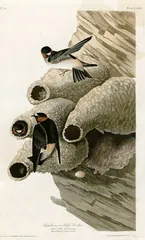
John James Audubon, The Birds of America (1827–38) 1 Cliff Swallowabout 279 per routeon 64% of routesno clear trend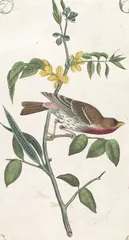
John James Audubon, The Birds of America (1840–44) about 44 per routeon 85% of routesno clear trend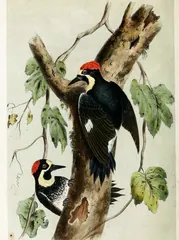
George G. White (on stone by William E. Hitchcock), John Cassin’s Illustrations of the Birds of California, Texas, Oregon, British and Russian America (1853–56) 3 Acorn Woodpeckerabout 38 per routeon 56% of routesrising since 2015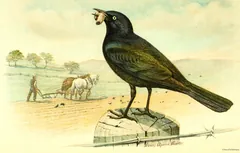
Louis Agassiz Fuertes, Bulletin, Biological Survey (1908) 4 Brewer's Blackbirdabout 32 per routeon 74% of routesfalling since 2015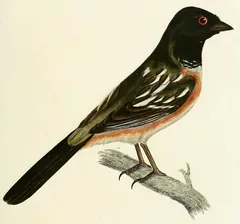
Artist unrecorded, Illustrations of Ornithology (1826) 5 Spotted Towheeabout 23 per routeon 74% of routesno clear trend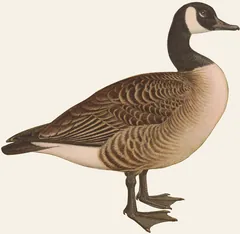
Marinus Adrianus Koekkoek, E. D. van Oort's Ornithologia Neerlandica (1922) about 22 per routeon 37% of routesno clear trend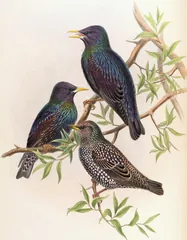
John Gould and Henry Constantine Richter, The Birds of Asia, vol. 5 (1850–83) 7 European Starlingabout 21 per routeon 69% of routesno clear trendintroduced species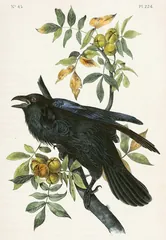
John James Audubon, The Birds of America (1840–44) 8 Common Ravenabout 20 per routeon 96% of routesrising since 2015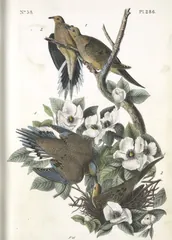
John James Audubon, The Birds of America (1840–44) about 19 per routeon 99% of routesno clear trend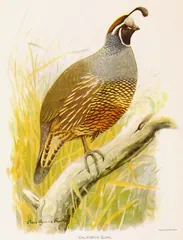
Louis Agassiz Fuertes, Birds of California in Relation to the Fruit Industry (1910) about 18 per routeon 74% of routesno clear trend
Show all 25
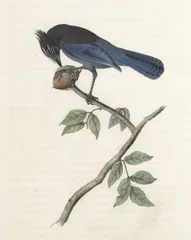
John James Audubon, The Birds of America (1840–44) about 16 per routeon 50% of routesfalling since 2015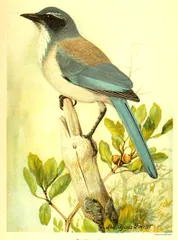
Louis Agassiz Fuertes, Bulletin, Biological Survey (1908) 12 California Scrub-Jayabout 15 per routeon 65% of routesno clear trend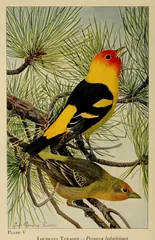
Louis Agassiz Fuertes, Birds of the Rockies (1902) 13 Western Tanagerabout 15 per routeon 58% of routesno clear trend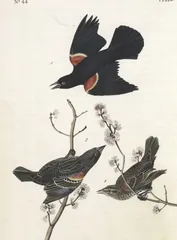
John James Audubon, The Birds of America (1840–44) about 15 per routeon 69% of routesno clear trend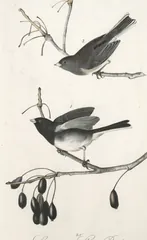
John James Audubon, The Birds of America (1840–44) 15 Dark-eyed Juncoabout 14 per routeon 55% of routesno clear trend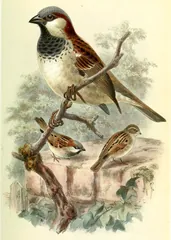
John Gerrard Keulemans, Lord Lilford’s Coloured Figures of the Birds of the British Islands (1885–97) 16 House Sparrowabout 13 per routeon 63% of routesno clear trendintroduced species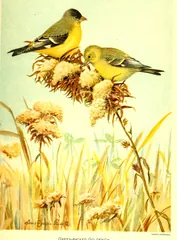
Louis Agassiz Fuertes, Bulletin, Biological Survey (1908) 17 Lesser Goldfinchabout 13 per routeon 73% of routesno clear trend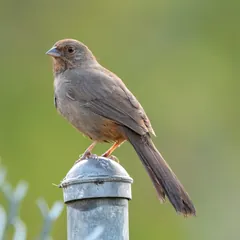
Photo: an iNaturalist contributor, CC0 1.0 18 California Towheeabout 10 per routeon 51% of routesno clear trend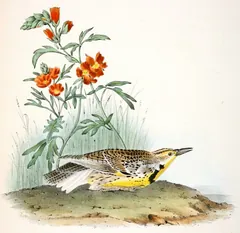
John James Audubon, The Birds of America (1840–44) 19 Western Meadowlarkabout 9.5 per routeon 60% of routesno clear trend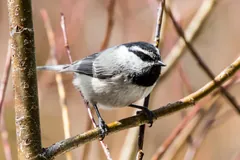
Photo: Ron Knight, CC BY 4.0 20 Mountain Chickadeeabout 9.4 per routeon 35% of routesfalling since 2015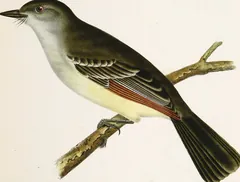
Artist unrecorded, Reports of Explorations and Surveys for a Railroad from the Mississippi River to the Pacific Ocean, vol. 10 (1859) 21 Ash-throated Flycatcherabout 9.4 per routeon 70% of routesno clear trend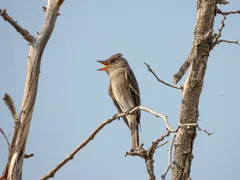
Photo: Jason Alexander, CC BY 4.0 22 Western Wood-Peweeabout 8.8 per routeon 66% of routesno clear trend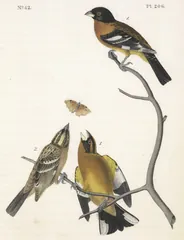
John James Audubon, The Birds of America (1840–44) 23 Black-headed Grosbeakabout 8.7 per routeon 70% of routesno clear trend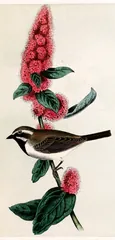
William E. Hitchcock, John Cassin’s Illustrations of the Birds of California, Texas, Oregon, British and Russian America (1853–56) 24 Black-throated Sparrowabout 8.6 per routeon 22% of routesno clear trend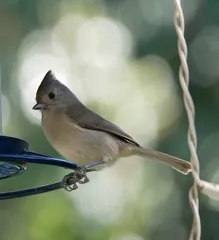
Photo: Barbara Coll, CC BY 4.0 25 Oak Titmouseabout 8.6 per routeon 44% of routesno clear trend
In the mountains, a few turn up almost everywhere: the National Park Service names the Steller's Jay, American Robin and Dark-eyed Junco as examples of Yosemite's most common birds, and a 2015 survey at Lassen Volcanic National Park found the junco at every streamside point. Audubon California calls the Yellow-rumped Warbler a very common winter bird in much of the state, and the California Scrub-Jay a common year-round resident of oak woodland, dry shrubland, parks and neighborhoods.
Sources: Birds, Yosemite National Park (National Park Service); Birds, Lassen Volcanic National Park (National Park Service); Top 10 Birds in California (Audubon California), read October 10, 2026.
A field guide to North America covers the House Finch, the Acorn Woodpecker and most of the 696 species on California’s list; we compared the best bird books of 2026 to find the one that suits a beginner.
What is the most common bird in California?
The Cliff Swallow leads California’s summer survey: about 279 a route on average in 2021–2025, more than twice the House Finch’s 44, seen on 64% of the 124 routes. USGS finds no clear rise or fall in its California numbers since 2015.
How was this list made?
Each of California’s 124 routes is a roadside count, 50 stops along about 25 miles, run once a year in early summer by a volunteer. We took USGS’s yearly estimate for each species in California, the number of birds a typical route records, averaged it over the five latest survey years (there was no survey in 2020) and ranked the birds by it. To keep the list to birds you’re likely to meet across California, we left out species recorded on fewer than one in five of its routes, and those USGS can only estimate very roughly, which usually means big flocks or colonies on a few routes.
For California that left out the Tricolored Blackbird, the White-faced Ibis, the Western Gull and 1 more.
The share of routes is our own count from USGS’s route data for California, using only counts that met the survey’s standards; “rising” and “falling” are USGS’s trends for the state since 2015, named only where it finds a clear change. Roadside counts on early-summer mornings miss most of California’s owls and waterbirds, and its winter visitors aren’t here at all.
California’s counts come from two USGS data releases, the North American Breeding Bird Survey Analysis Results 1966–2025 (Hostetler et al., 2026) and its Dataset 1966–2025 (Ziolkowski et al., 2026), gathered by volunteer observers and free for anyone to use; Birdfolio isn’t connected with the USGS.
How many bird species are in California?
| Official count | 696 species |
|---|---|
| List’s date | October 27, 2026 |
| Kept by | California Bird Records Committee (Western Field Ornithologists) |
| Introduced species | 19, established in the wild |
| Gone or returning | 1 gone from the state (Sharp-tailed Grouse), 1 being reintroduced (California Condor) |
| Review species | 190, whose sightings the committee reviews |
| Not counted | 6 species of uncertain wild origin, on a supplemental list |
| Among US states | The highest of the 49 states with a verified count |
| Official list | Official California Checklist |
What does California’s count include?
- Every species accepted for California: to add a new one, the committee must review and accept at least one record of it.
- 19 introduced species now established in the wild.
- The Sharp-tailed Grouse, gone from California in historical times, and the California Condor, being reintroduced but not yet established.
- 190 Review Species, whose sightings the committee reviews.
- 138 species with no museum specimen from California, accepted on photos, video, sound recordings or tracking data instead.
- Not counted: 6 species on a supplemental list, where the committee couldn't tell a wild stray from an escaped cage bird.
Why do other sources give a different number?
California’s count is every species ever accepted on its official list, so a figure from another year, or one that counts something else, won’t match:
- More than 660. From the California Department of Fish and Wildlife's Atlas of the Biodiversity of California (second edition), which counted native species only and used the committee's 2020 list. Source: Atlas of the Biodiversity of California, second edition (California Department of Fish and Wildlife), Birds.
- More than 600. A rounded figure on Audubon California's website, which also says about 450 species are commonly seen in the state. Source: Birds (Audubon California).
- 691 and 693. From the committee's 50th annual report (Western Birds, 2026): 691 species once the report's six first state records were added, and 693 with the Waved Albatross and Dark-sided Flycatcher, accepted after it. The online checklist has been updated since. Source: The 50th Annual Report of the California Bird Records Committee: 2024 Records (Western Birds 57:166-195, 2026).
California’s list follows its own committee’s rules, and so does every other state’s: see why the counts differ from state to state.
California records, from a banded sparrow in 1970 to an eagle over San Francisco
- The committee was announced in 1970, in the first issue of California Birds, the journal that became Western Birds. Of the records it received that year, its first report accepted one: an immature Clay-colored Sparrow banded at San Pedro, Los Angeles County, on September 26, 1970. In its first three years it found fewer than 20 percent of the records sent in unacceptable. Sources: The California Field Ornithologists Records Committee Report 1970-1972 (Western Birds 4:101-106, 1973); Founding of the CBRC (California Bird Records Committee), read October 6, 2026.
- A Stejneger's Scoter photographed on Monterey Bay from Watsonville on January 15, 2014, was turned down at first. Looked at again with better identification criteria and help from European experts, it was accepted in the 50th report as California's first, the second for the lower 48 states and the first winter record for North America. Source: The 50th Annual Report of the California Bird Records Committee: 2024 Records (Western Birds 57:166-195, 2026), read October 6, 2026.
- An adult White-tailed Eagle flew north past Battery Godfrey in San Francisco in March 2024, California's first. Adults of the species mostly stay put, the committee noted, while young birds are the ones that wander south in winter. Source: The 50th Annual Report of the California Bird Records Committee: 2024 Records (Western Birds 57:166-195, 2026), read October 6, 2026.
- Two species rest on the slimmest evidence the list allows: Ainley's Storm-Petrel is supported only by tracking or remote-sensing data, and the White-collared Swift only by sight records with convincing written descriptions. Source: Official California Checklist, updated October 20, 2026 (California Bird Records Committee, Western Field Ornithologists), read October 21, 2026.
- The six species on the Supplemental List are the Demoiselle Crane, Blue Mockingbird, Gray Thrasher, Gray Silky-flycatcher, Black-backed Oriole and Yellow Grosbeak. Texas's committee has put three of them, the Blue Mockingbird, Gray Silky-flycatcher and Yellow Grosbeak, on its main list. Sources: Official California Checklist, updated October 20, 2026 (California Bird Records Committee, Western Field Ornithologists); Texas State List, last updated June 7, 2026 (Texas Bird Records Committee, Texas Ornithological Society), read October 6, 2026.
- Review status follows the numbers. At its January 2026 meeting the committee took the Short-tailed Albatross off the Review List after 65 accepted records, noting that its breeding population is growing and more birds are turning up off the coast. The Emperor Goose stays on despite 105 accepted records, because it has averaged only one a year over the past 25 years. Sources: CBRC Annual Meeting Minutes, January 10, 2026 (California Bird Records Committee); The 50th Annual Report of the California Bird Records Committee: 2024 Records (Western Birds 57:166-195, 2026), read October 6, 2026.
Our guide to rare bird alerts shows where California's rare birds are reported, county by county, and how to report a sighting to the committee.
Questions people ask about California’s birds
Which US state has the most bird species?
California, with 696 species on its official checklist, last updated October 27, 2026. Texas is next with 682, and no other state with a verified count reaches 600 (our table).
Sources: Official California Checklist, 696 species, updated 27 October 2026 (California Bird Records Committee, Western Field Ornithologists); Texas State List, 682 species, last updated October 24, 2026 (Texas Bird Records Committee, Texas Ornithological Society), read November 19, 2026.
What big birds live in California?
The biggest is the California Condor, North America's largest land bird, with a wingspan of 9.5 feet and a weight of around 20 pounds, the National Park Service says. In the northeast lives the Greater Sage-Grouse, the continent's largest native grouse; among fowl-like birds, only the turkey is larger. Golden Eagles, about 40 inches long with a wingspan of 88 inches, nest more densely in the hills of the East Bay than anywhere else in the world, the regional park district says.
Sources: About California Condors (National Park Service); Sage Grouse Hunting (California Department of Fish and Wildlife); Common Raptors in the East Bay Regional Park District (East Bay Regional Park District, 2021), read October 10, 2026.
What is the most common bird of prey in California?
No statewide survey names one, but at Hawk Hill above the Golden Gate, whose fall counts are the only statewide index of how raptor numbers rise and fall, the most common are Turkey Vultures, Red-tailed Hawks, Cooper's Hawks and Sharp-shinned Hawks, the National Park Service says. Audubon California calls the Cooper's Hawk the most common in the state of the three bird-hunting hawks of its group, the accipiters, and the Department of Fish and Wildlife counts more than 30 kinds of raptors in California, owls and vultures included.
Sources: Raptors at Hawk Hill, Golden Gate National Recreation Area (National Park Service); Top 10 Birds in California (Audubon California); Raptors of California (California Department of Fish and Wildlife), read October 10, 2026.
What is the rarest bird in California?
Among birds that live here, the California Condor is one of the rarest: after falling to 22 birds in the 1980s, when all the wild ones were caught for captive breeding, it numbered 607 worldwide at the end of 2025, 216 of them flying free in California. The official list still marks it as a reintroduction in progress, not yet established, and the Sharp-tailed Grouse as gone from the state.
Among strays, the rarest have a single accepted record, such as the Slate-throated Redstart, a bird of mountain forests from northern Mexico to Bolivia, that stayed seven weeks at Pine Lake Park in San Francisco in 2024. The Xantus's Hummingbird, found otherwise only in the southern half of Baja California, has reached the state twice.
Sources: California Condor Facts, Pinnacles National Park (National Park Service); 2025 California Condor Population Status (US Fish and Wildlife Service), the Internet Archive's copy of October 5, 2026; Official California Checklist, updated 8 September 2026 (California Bird Records Committee); The 50th Annual Report of the California Bird Records Committee: 2024 Records (Western Birds, 2026), read October 10, 2026.
What are some common small birds in California?
Anna's Hummingbirds, House Finches, Lesser Goldfinches, Bushtits and Black Phoebes, all of which the state Department of Fish and Wildlife's species accounts call common residents. Anna's Hummingbird, about 4 inches long, lives throughout coastal California and much of the interior, the House Finch flourishes in towns and farmland, and the Lesser Goldfinch, as short as 3.5 inches, is common across most of the state.
The Bushtit, weighing 5 to 9 grams, is common in many habitats through most of California, oak and other hardwood woodland above all, and the Black Phoebe lives beside streams all year on the Pacific side of the mountains. In the humid conifer forests of the coast, Audubon California calls the Chestnut-backed Chickadee common, and at Point Reyes and the Golden Gate the National Park Service found the Song Sparrow the most abundant of the nesting birds that stay all year or move only short distances.
Sources: Anna's Hummingbird, life history account (California Wildlife Habitat Relationships System, California Department of Fish and Wildlife); House Finch, life history account (California Wildlife Habitat Relationships System, California Department of Fish and Wildlife); Lesser Goldfinch, life history account (California Wildlife Habitat Relationships System, California Department of Fish and Wildlife); Bushtit, life history account (California Wildlife Habitat Relationships System, California Department of Fish and Wildlife); Black Phoebe, life history account (California Wildlife Habitat Relationships System, California Department of Fish and Wildlife); Anna's Hummingbird, Audubon Guide to North American Birds (National Audubon Society); Lesser Goldfinch, Audubon Guide to North American Birds (National Audubon Society); Bushtit, Audubon Guide to North American Birds (National Audubon Society); Top 10 Birds in California (Audubon California, April 6, 2020); Landbird Inventory for Point Reyes National Seashore and Golden Gate National Recreation Area (National Park Service), read October 11, 2026.
Which birds live in California?
Seabirds on the coast, waterfowl in the Central Valley, mountain birds in the Sierra Nevada, desert birds in the southeast, and oak-woodland and chaparral birds in between. Its specialties include the Tricolored Blackbird, nearly all of which live in California, and the Yellow-billed Magpie, which lives nowhere else.
Coast: tens of thousands of Common Murres nest on the cliffs and sea stacks of Redwood National and State Parks, and Alcatraz holds San Francisco Bay's only colonies of Brandt's and Pelagic Cormorants and Pigeon Guillemots. Point Reyes National Seashore has recorded nearly 490 species, more than half of North America's.
Central Valley: one of the most important wintering grounds for waterfowl in the world, where ducks, geese and swans fill the remaining wetlands and flooded rice fields, along with Greater and Lesser Sandhill Cranes. The magpie lives there all year with the Oak Titmouse and Nuttall's Woodpecker, the Central Valley Bird Club says.
Sierra Nevada: 262 species in Yosemite, which rises from 2,000 feet to more than 13,000, among them a genetically distinct population of Great Gray Owls; at high elevation in Sequoia and Kings Canyon, Clark's Nutcrackers harvest seeds from pine cones.
Deserts: the Greater Roadrunner, Gambel's Quail and Cactus Wren in Joshua Tree National Park and Mojave National Preserve, with LeConte's Thrasher an uncommon resident.
Oaks and chaparral: Oak Titmice and California Quail, the state bird since 1931, in the pine and oak woodland of Pinnacles National Park, and California Thrashers, Spotted Towhees and Bushtits in its chaparral; in the coastal sage scrub of southern California, the threatened Coastal California Gnatcatcher.
Sources: Survey says: California's blackbird in sharp decline (University of California, Davis); Birds, Redwood National and State Parks (National Park Service); Birds, Golden Gate National Recreation Area (National Park Service); Birds, Point Reyes National Seashore (National Park Service); The Central Valley (Central Valley Bird Club); Birds, Yosemite National Park (National Park Service); Birds, Sequoia and Kings Canyon National Parks (National Park Service); Birds, Joshua Tree National Park (National Park Service); Birds, Mojave National Preserve (National Park Service); Birds, Pinnacles National Park (National Park Service); State Emblems, Insignia, Song, and Poet Laureate, Appendix Q of the legislative handbook (California State Assembly); Rare coastal sage scrub habitat provides a home for threatened gnatcatcher and many other species (Audubon California), read October 10, 2026.
Why does California have more bird species than any other state?
Size and variety, in the state wildlife agency's words. The California Department of Fish and Wildlife's Atlas of the Biodiversity of California says the state has higher bird diversity than any other, and credits its large size, varied topography, mild climate and habitat diversity. Birds use every habitat it has, from the Pacific Ocean to the deserts, and live everywhere from the top of Mount Whitney to the bottom of Death Valley.
The atlas sorts the native birds into rough groups: about a quarter live in California all year, a third to a half are regular migrants that come to breed, to winter or to pass through, and about a third are vagrants whose usual ranges and routes lie outside the state. Winter matters most for waterfowl: California provides vital winter habitat for about 60 percent of the Pacific Flyway's waterfowl, with the largest concentrations in the Great Valley.
Source: Atlas of the Biodiversity of California, second edition (California Department of Fish and Wildlife), Birds, read October 6, 2026.
Which birds are found only in California?
Two species live nowhere else in the world, according to the state's biodiversity atlas: the Island Scrub-Jay and the Yellow-billed Magpie. Seven more are nearly confined to the state: the Ashy Storm-Petrel, Nuttall's Woodpecker, Oak Titmouse, Wrentit, California Thrasher, Lawrence's Goldfinch and Tricolored Blackbird. Many subspecies are found only in California as well.
The California Condor belonged with them until releases near Arizona's Grand Canyon and in Baja California took it beyond the state; the official checklist still marks it as a reintroduction in progress, not yet established. Both endemics are on that checklist as regular species, without the asterisk of a review species.
California's 17 woodpeckers, and how to tell a Nuttall's from a Downy
Sources: Atlas of the Biodiversity of California, second edition (California Department of Fish and Wildlife), Birds; Official California Checklist, updated October 20, 2026 (California Bird Records Committee, Western Field Ornithologists), read October 21, 2026.
Why do so many rare birds turn up on the Farallon Islands?
Point Blue Conservation Science, whose biologists have lived and worked on the islands with the US Fish and Wildlife Service since 1968, explains it this way. Young birds that migrate without their parents sometimes set off on a mirror image of their species' route, and eastern warblers heading southwest pass the Pacific shoreline at night, find themselves over the ocean at dawn and have to stop on the nearest land. When the weather allows, its fall crew may find several vagrants a day, many of them wood-warblers from the eastern United States.
Two of California's newest species were found there in 2024. An adult male Blue Rock-Thrush of the East Asian subspecies stayed on Southeast Farallon Island from April 25 to 28, the first for California and the second for North America; it may have been the same bird photographed on a beach at Hug Point, Oregon, 800 km (about 500 miles) north, four days earlier. In November a Song Thrush, a species of Europe and northern Asia, was caught and banded there on its first migration, one of the state's most extreme examples of long-distance vagrancy, the committee wrote.
Sources: Keystone Datasets: Farallon Islands, est. 1968 (Point Blue Conservation Science); Where wood warblers wander (Point Blue Conservation Science, Farallones blog, November 14, 2018); The 50th Annual Report of the California Bird Records Committee: 2024 Records (Western Birds 57:166-195, 2026), read October 6, 2026.
Where is the official California bird list, and how often is it updated?
On the committee's website, californiabirds.org: the Official California Checklist, updated October 27, 2026, with a plain-text version for spreadsheets, a Review List of 190 species, and a Watch List, updated May 2026, of introduced birds breeding in the state that could be added later. Every species on the checklist is annotated with the strongest evidence behind it, from a specimen to a photo, video, audio, tracking data or sight records. Documentation for every record the committee reviews, apart from specimens, is archived at the Western Foundation of Vertebrate Zoology in Camarillo, open to researchers.
The committee belongs to Western Field Ornithologists but runs under its own bylaws. At least nine voting members serve staggered three-year terms, three elected at each annual meeting (the 2026 meeting was held online on January 10), and may serve only one full term before sitting out until the next meeting. A record is accepted if no more than one member votes against it on identification, or two on whether the bird arrived naturally; five votes against reject it, and anything in between circulates again, up to three rounds, before a final vote at the meeting. In general, review species are those found in California 50 or fewer times or averaging under two a year over the past ten years. Decisions appear in an annual report in Western Birds; the 50th, on 2024 records, came out in 2026.
Sources: Official California Checklist, 696 species, updated 27 October 2026 (California Bird Records Committee, Western Field Ornithologists); CBRC Review List, 190 species, updated 27 October 2026 (California Bird Records Committee); CBRC Watch List of introduced birds, updated May 2026 (California Bird Records Committee); Founding of the CBRC (California Bird Records Committee); Bylaws of the California Bird Records Committee, revised January 10, 2026; CBRC Annual Meeting Minutes, January 10, 2026 (California Bird Records Committee); The 50th Annual Report of the California Bird Records Committee: 2024 Records (Western Birds 57:166-195, 2026), read October 6, 2026.
How do you count your own California list?
Your California list is every species you’ve seen in California. eBird can filter your life list to California, and your eBird data download gives the state of every sighting. On paper, count the species you’ve seen in California; what is a life list? explains how birders keep their lists.
To print your whole list, California birds and all, see how to print your bird life list, or let Birdfolio make it a hardcover book.
California’s state bird
California’s state bird is the California Quail, the state bird since 1931. Its story, the state flower and animal, and a free picture card for a report are on our California state bird page.
Birding festivals in California
Our birding festivals calendar lists 11 in California, with dates from each festival’s own website:
- Central Valley Birding Symposium, Stockton: November 19–22, 2026
- Morro Bay Bird Festival, Morro Bay: January 14–18, 2027
- Snow Goose Festival of the Pacific Flyway, Chico: January 28–31, 2027
- San Francisco Bay Flyway Festival, Vallejo: February 12–15, 2027
- San Diego Bird Festival, San Diego: February 17–21, 2027
- Godwit Days Spring Migration Bird Festival, Arcata: April 15–18, 2027
- Lake Almanor Grebe Festival, Lake Almanor (Prattville): August 7–8, 2027
- Monterey Bay Festival of Birds, Monterey Bay region: October 8–10, 2027
- Berkeley Bird Festival, Berkeley: dates not announced yet; expected in October 2027 (2026 festival: October 18, 2026)
- California Swan Festival, Yuba-Sutter region: dates not announced yet; expected in November 2027 (2026 festival: November 12–15, 2026)
- Lodi Sandhill Crane Festival, Lodi: dates not announced yet; expected in November 2027 (2026 festival: November 6–8, 2026)
Christmas Bird Count in California
California had 143 Christmas Bird Count circles on Audubon’s map last winter, each counted on a single day between December 14 and January 5. Our guide shows where to find California’s counts and lists 35 California count dates already announced for this winter; it’s free, and beginners are welcome.
More about bird counts
- How many bird species are in each state: California beside all 50 states, DC and Canada.
- How many bird species are in Texas?
- How many bird species are in Florida?
- How many bird species are in the US and Canada
- Bird splits and lumps
If you’re shopping for a birder in California, our gift guide for birders and our pick of coffee table bird books are good places to start.