The official checklist for the US and Canada has 24 hummingbirds: 14 breed here, and 10 are rarities from Mexico, the Caribbean and Baja California. East of the Great Plains only the Ruby-throated nests; the rest belong to the West and the Mexican border. Which one you see depends on the month: Anna's may nest in December, male Rufous head south by late June, and a January hummingbird around Charlotte, North Carolina, is very likely a Rufous.
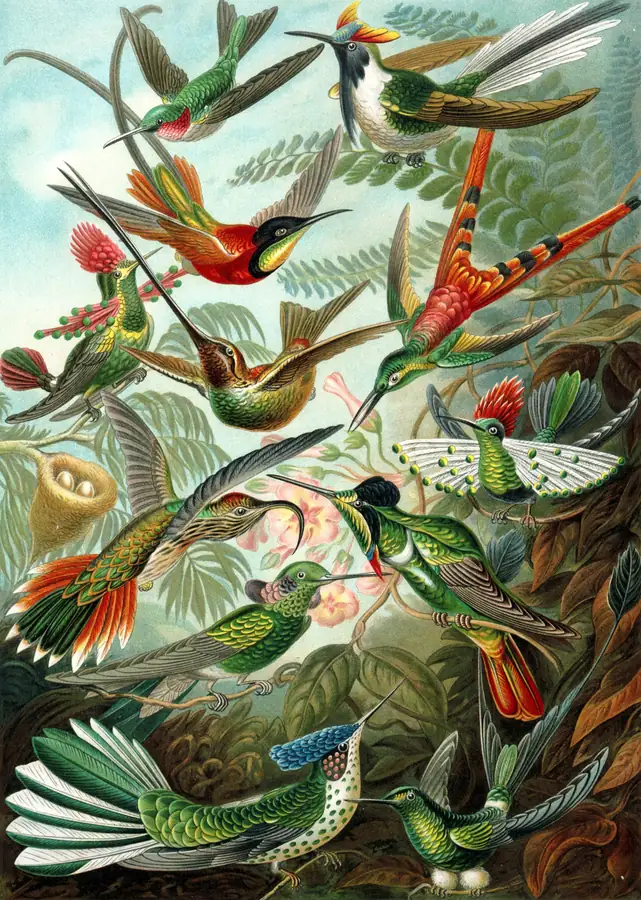
All 24 types of hummingbirds in the US, and when to see them
Eight widespread regulars first, then six of the Mexican border. Weights are in grams, about 28 to the ounce.
| Hummingbird | Where | When here | Length | Weight | The male's giveaway |
|---|---|---|---|---|---|
| Ruby-throated | The East, into Canada | South from about Mar 1, Canada by May; leaves Aug–Oct | 2.8–3.5 in | 2–6 g | Ruby throat, black in most light |
| Black-chinned | Western lowlands | Texas mid-Mar to mid-Oct; Arizona Apr–Sep | 3.5–4.3 in | 2–5 g | Black chin, thin purple band |
| Anna's | Pacific Coast, east to Arizona | All year; may nest from Dec | 4 in | 3–6 g | Rose-red crown and throat |
| Costa's | California and Arizona deserts | Nests late winter to spring; some all year | 3.1–3.5 in | 2–4 g | Purple throat flaring into points |
| Calliope | Northwest and northern Rockies | North in early spring, south from July | 3.1–3.5 in | 2–3 g | Magenta streaks on white |
| Rufous | Nests Northwest to Alaska | North in early spring, south from late June; Southeast feeders Nov–Mar | 2.8–3.5 in | 2–5 g | "Glowing like a new copper penny" |
| Allen's | Coastal California, southern Oregon | North in late winter; one island race stays | 3.3–3.5 in | 2–4 g | A green-backed Rufous |
| Broad-tailed | Rocky Mountain West | North in early Mar, south in early Aug | 3.5–3.9 in | 3–5 g | Rose throat, trilling wings |
| Rivoli's | Mountains of Arizona, New Mexico, west Texas | Summer; a few winter | 4.7–5.5 in | 6–9 g | Looks all dark |
| Blue-throated Mountain-gem | Border canyons | Texas mid-Apr to Sep | 4–5 in | 6–9 g | Big white tail corners |
| Lucifer | Big Bend, west Texas | Texas records Mar 7 to Nov 10 | 3–4 in | 3–6 g | Curved bill, purple throat |
| Broad-billed | Southern Arizona | Mostly Mar–Sep | 3–4 in | 3–6 g | Red bill, blue-green body |
| Violet-crowned | Southeast Arizona, southwest New Mexico | Summer; a few winter | 4–5 in | 5–8 g | Snow-white below |
| Buff-bellied | South Texas | All year | About 4½ in | Not given | Buff belly, red bill |
Lengths and weights all come from the National Audubon Society's online guide; the months, from the Texas Breeding Bird Atlas, Arizona State Parks, the Pennsylvania Game Commission and a University of Mississippi page.
The 10 rare visitors
Ten more have wandered in from the south: some show up most years, others only a handful of times ever.
| Hummingbird | ABA code | Where it has turned up |
|---|---|---|
| Mexican Violetear | 3 | Texas many times; strays reach Canada |
| White-eared | 3 | Southeast Arizona; has nested |
| Berylline | 3 | Southeast Arizona; first seen in 1964, now almost every summer |
| Green-breasted Mango | 4 | Texas; north to Wisconsin, east to North Carolina |
| Plain-capped Starthroat | 4 | Arizona, mostly in summer |
| Amethyst-throated Mountain-gem | 5 | Davis Mountains, Texas, 2016 |
| Bahama Woodstar | 5 | Lantana, Florida, 1971 |
| Bumblebee | 5 | Arizona, an old specimen |
| Xantus's | 5 | California and British Columbia |
| Cinnamon | 5 | Arizona |
The codes are the American Birding Association's. Code 3 means very low numbers but every year; Code 4, not every year, with six or more records and at least three in the last 30 years; Code 5, no more than five records, or under three in 30 years.
How do you identify hummingbirds?
Start with the place and the month, then the male's throat and tail. In the West the gorget, a male's patch of glittering throat feathers, names most of them; females and young are the hard part.
How many types of hummingbirds are there?
AviList's 2026 world list counts 362 hummingbird species, all native to the Americas; 24 have been recorded in the US and Canada.
Yet the oldest fossils of modern-type hummingbirds come from Germany: two skeletons about 4 centimeters long and over 30 million years old, found near Frauenweiler. Gerald Mayr of Senckenberg named them Eurotrochilus inexpectatus, an "unexpected European version of Trochilus" (Science, 2004). Their shoulder bones suggest they could hover; the next-oldest modern-type fossils were about a million years old, from South America.
With 362 species, hummingbirds are the third-largest bird family, not the second as some pages say: only the tyrant flycatchers (447) and the tanagers (393) are bigger. In 2026 AviList split the Giant Hummingbird and folded two racket-tails into one, so 363 became 362. Other totals, like the 366 that some sites take from the IOC list, come from other lists or older counts. The 24 are part of the 1,161 species of the US and Canada, and the year's changes are on our splits and lumps page.
When do hummingbirds come back in spring?
In the West, Allen's head up the Pacific Coast in late winter and Rufous in early spring, while Anna's never left; in the East, Ruby-throats reach the southern states around March 1 and Canada by May.
The first Ruby-throats in the Northeast lean on a woodpecker. Arriving in April and May, before most nectar flowers open, they drink at the wells Yellow-bellied Sapsuckers drill in tree bark, sap the National Park Service puts at up to 20 to 30 percent sugar, against 2 to 3 percent in a maple-syrup tap. Hummingbirds have even been seen trailing a sapsucker from tree to tree; how the wells are made is in our woodpecker guide.
On the Pacific side, Rufous and Calliope come north through the lowlands; Ruby-throats fill the middle states in late March and early April. Males lead: in Pennsylvania male Ruby-throats arrive a week or two before females, and male Calliope, Rufous and Broad-tailed travel ahead of females and young "in both spring and fall" (Audubon guide).
Ruby-throated hummingbird migration: do they cross the Gulf?
Some do, nonstop; others follow the Gulf Coast around it, says the Texas Breeding Bird Atlas.
Radio tags show how common the long way is. Of young Ruby-throats tagged on the Alabama coast in fall, 77 percent set off along the shore rather than over open water, "indicative of a circum-Gulf path" (Theodore Zenzal and colleagues, Animal Behaviour, 2018). The same team's banding there found that older birds arrive earlier, carry more fuel and stop over for less time than young ones.
The crossing is about 500 miles and 18 to 20 hours, by the National Park Service's arithmetic some 3,860,000 wingbeats without a rest, and a Ruby-throat almost doubles its weight beforehand, from about 3.25 grams to 6.
In fall, males leave Pennsylvania from early August, females and young from late August; Texas sees them pass until mid-November, and most winter from southern Mexico to Costa Rica or Panama. At Rockport, on the Texas coast, you may see "tens of thousands of hummingbirds if you hit it right," Sheri Williamson told Audubon magazine; its festival is on our calendar.
Why don't we see baby hummingbirds?
Because the young stay hidden in a nest about 2 inches wide until they can fly, at about three weeks old, and by then they look like their mothers.
The nest, says the Pennsylvania Game Commission, is a soft, flexible cup camouflaged with bud scales and lichens, and it "stretches as young grow," adds the Audubon guide. The female lays two eggs about half an inch long and raises the brood alone. The young fly at 18 to 22 days, she feeds them 4 to 7 days more, and their plumage "matches the females'," so a fledgling at a feeder passes for an adult female. The largest US hummingbird nests differently.
How can you tell female hummingbirds apart?
By where and when you see them, then by size and the tail, and some can't be told apart in the field at all. Females and young of Allen's and Rufous are "almost impossible to separate," says the Audubon guide; the Tucson Bird Alliance says it takes a bird in the hand or a photo of its tail feathers.
| Female | What to look for |
|---|---|
| Rufous | Green back, spotted throat, orange-buff sides and tail base |
| Allen's | Nearly identical to a female Rufous |
| Broad-tailed | Like a Rufous with a bigger tail; "nearly indistinguishable in the field," says Oregon's wildlife department |
| Calliope | Smaller and shorter-billed than a Rufous; a short, rounded tail with "very little rusty at base" |
| Black-chinned | "Almost identical" to a Ruby-throated; in the West, a long bill and a tail she flips and spreads while hovering |
| Costa's | Smaller and shorter-billed than an Anna's or Black-chinned, paler below |
| Anna's | "Dingy gray below, often with red spots on throat" (its page) |
Young birds of most species look like the females, so a juvenile Rufous or Broad-tailed is the same puzzle. The female Ruby-throated is on its own page.
What is the bird that looks like a hummingbird but is smaller?
Usually not a bird at all but a hummingbird moth, a day-flying sphinx moth such as the hummingbird clearwing, with wings 1½ to 2¼ inches across.
It hovers at flowers by day like a hummingbird, but its body is "furry" and its proboscis "coils up like a party noisemaker," says the University of Wisconsin–Madison Extension; the bigger white-lined sphinx flies more at dusk. In Cuba the answer might be a real bird: the Bee Hummingbird is "often mistaken for bees."
| Hummingbird clearwing (moth) | Ruby-throated Hummingbird | |
|---|---|---|
| Size | Body 3/4–1 in; wings 1½–2¼ in across | 2.8–3.5 in long; wings 3–4.3 in across |
| Wings | Clear, with a dark border | Feathered |
| Body | Furry | Feathered |
| Feeds with | A proboscis that coils up | A bill with a tongue inside |
| Seen | By day, May to July in Minnesota | Spring to early fall |
When do hummingbirds leave?
Earlier than most people expect: in the West male Rufous leave the Northwest by the end of June, and in the East male Ruby-throats start south in early August.
The Rufous Hummingbird flies a loop: north along the Pacific Coast in spring, south through the mountains in summer, "8,000 miles in a clockwise loop," says The Nature Conservancy. Counted in body lengths it is one of the longest migrations of any bird. The shortest one-way route, about 2,700 miles from Alaska to Mexico, comes to about 49 million body lengths by a University of Mississippi page's figure, or 48.6 million by the Arizona-Sonora Desert Museum's, which cites the physiologist William Calder. No other hummingbird nests as far north: up to south-central Alaska, says the Audubon guide.
Females and young follow the males in July and August, "when Broad-tailed and Allen's Hummingbirds are also on the move," says Audubon magazine, and Black-chinned are "largely southbound by August." Arizona's big Rufous passage runs from July to October.
Should I take my feeder down so hummingbirds migrate?
No: "nothing short of captivity can keep a healthy migratory bird from going south," says the University of Mississippi page, which suggests taking it down a week after your last hummingbird. The Nature Conservancy calls the worry a myth.
Do hummingbirds ride on the backs of geese?
No: geese and hummingbirds "don't migrate at the same time or to the same places," the University of Mississippi page notes, and hunters don't find hummingbirds in the feathers of the geese they shoot. The Ruby-throats that cross the Gulf do it on their own wings.
Which hummingbirds stay for the winter?
Anna's Hummingbird, which lives all year on the Pacific Coast, and a growing number of western hummingbirds, mostly Rufous, that winter at feeders from the Carolinas to Florida and Texas.
In January 2010 a bander caught a female Rufous at a feeder in Tallahassee, Florida. Five months later a bander on Alaska's Prince William Sound caught "the exact same bird more than 3,500 miles to the northwest," the longest distance between banding and recapture then known for any hummingbird (National Wildlife, 2010).
Winter hummingbirds in the Southeast are new. Before 1980 the Rufous had "a few sporadic eastern records"; sightings neared 50 in the late 1980s and 800 in 1995, says Birds of the Central Carolinas (2018). Around Charlotte most arrive after Thanksgiving and leave by Valentine's Day, and banders have caught Black-chinned, Rufous and Buff-bellied coming back "to the same home for seven consecutive years" (National Wildlife).
Out West, Anna's is "the only hummingbird regularly found in Oregon in winter," says the state's wildlife department, and National Wildlife found it living year-round as far north as Vancouver. The Buff-bellied, unusually, moves north and east after nesting, wintering as far as Gainesville, Florida. Even Kentucky had one: its first Anna's spent the winter of 2021–22 at heated feeders.
How do hummingbirds survive cold nights?
They go into torpor, a nightly "mini-hibernation" in which body temperature can fall from 107°F to 48°F, National Geographic reports. A Blue-throated Mountain-gem's heart slows from about 1,260 beats a minute to 50 to 180, Oregon State's Adam Hadley told the magazine, which also describes an Anna's at a feeder on a 28°F day. The metabolic rate drops "to 1/15 of its normal rate," says the University of Wisconsin–Madison Extension.
What is the most common type of hummingbird?
The Ruby-throated: the Audubon guide puts it at 36 million birds, the most of any US hummingbird, and it is the only one that nests across the East.
Next in the guide come the Rufous (22 million), Broad-tailed (9.8 million), Anna's (9.6 million) and Black-chinned (8.8 million); the Lucifer has 200,000. We read these as totals for each bird's whole range (our assumption).
Locally the answer shifts. UC Berkeley called Anna's "the West Coast's most common hummer" in 2008, Oregon's wildlife department calls the Rufous its most common and widespread, and in some Colorado mountain towns "you could have, like, 100 Broad-tailed Hummingbirds coming to a feeder station," David Griffin told Audubon magazine. The Ruby-throated has "steadily increased since 1966"; the Rufous, rated Near Threatened by the IUCN, "faces continuing declines."
What is the smallest hummingbird?
In the US and Canada, the Calliope Hummingbird, "the smallest bird in North America" in the Audubon guide's words, about 3 inches long; in the world, Cuba's Bee Hummingbird, 2¼ inches long and under 2 grams.
The Calliope is also "the smallest long-distance avian migrant in the world," says Oregon's wildlife department. It can cover about 5,000 miles a year, southern Mexico to British Columbia and back (Audubon magazine), at about the weight of a ping pong ball, and it nests high in the northern Rockies, getting through cold summer nights "despite its tiny size" (Audubon guide).
The Bee Hummingbird weighs "less than a dime," BirdNote says on Audubon's site; its nest is "barely an inch across," its eggs "about the size of a coffee bean." The IUCN rates it Near Threatened.
What is the second smallest hummingbird?
In the world, the Vervain Hummingbird of Jamaica and Hispaniola, about 5 centimeters long and just over 2 grams, "the second smallest bird in the world," says BirdsCaribbean. Jamaicans call it the Little Doctorbird. In the US there's no clear runner-up: by the Audubon guide's weights, Costa's and Allen's (2 to 4 grams) come after the Calliope (2 to 3), our comparison. For one state's smallest bird, see our Wisconsin page.
What is the biggest hummingbird?
In the US, the Blue-throated Mountain-gem of the Southwest's mountain canyons, at 6 to 9 grams; in the world, the Giant Hummingbird of the Andes, which became two species in 2026.
The world's biggest was hiding a second species. Since Charles Darwin watched them on the Beagle voyage, no one knew where the giant hummingbirds that nest on Chile's Pacific coast went after breeding. A University of New Mexico team fitted birds with miniature backpack trackers and found them climbing over 13,000 feet into the Andes, as far as Peru, a round trip of more than 5,200 miles, pausing for days on the way up, "the same acclimatization strategy used by human mountaineers." Genomes from museum specimens, one 154 years old, showed the migrants and the year-round Andean birds had been evolving apart for about three million years, and the residents are the bigger ones (PNAS, 2024).
AviList's 2026 list calls the Andean bird the Northern Giant Hummingbird, Patagona peruviana (the paper had proposed Patagona chaski), and the migrant the Southern Giant Hummingbird. Giant hummingbirds are "about eight times the size of a Black-chinned hummingbird," the university says.
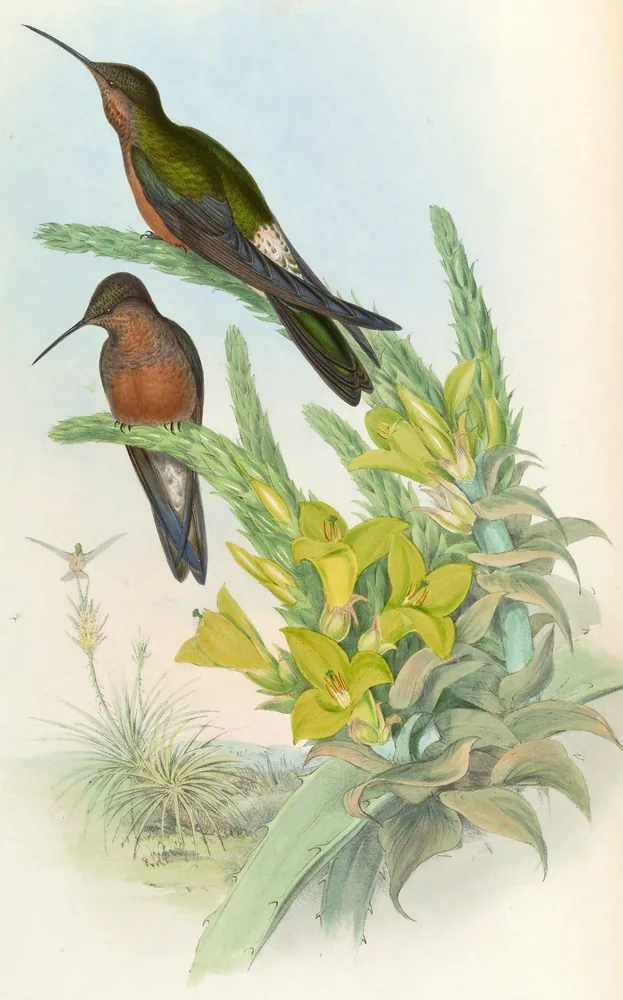
The Blue-throated has its own page. Rivoli's is "almost as large," says the Audubon guide, with wingbeats "almost slow enough for the human eye to see"; oddly, the guide gives it the longer body, 4.7 to 5.5 inches against 4 to 5.
What is the rarest kind of hummingbird?
In the US and Canada, the five "accidentals" on the ABA list: the Amethyst-throated Mountain-gem and the Bahama Woodstar, Bumblebee, Xantus's and Cinnamon Hummingbirds. Worldwide, six are Critically Endangered.
In 2022 a local birdwatcher, leaving a field site in Colombia's Sierra Nevada de Santa Marta, raised his binoculars and found a Santa Marta Sabrewing, a bird documented only once since it was first collected in 1946; the first photos dated from 2010. This one "perched on a branch, giving me time to take photos and video," he told the American Bird Conservancy, which notes that only about 15 percent of those mountains' forest remains. AviList's other Critically Endangered hummingbirds are the Gorgeted Puffleg, Juan Fernandez Firecrown, Short-crested Coquette, Blue-throated Hillstar and Chilean Woodstar.
Of the US accidentals, a female Xantus's once built a nest at Ventura, California, and laid eggs that never hatched (Audubon guide). An Amethyst-throated Mountain-gem visited a feeder in the Davis Mountains of Texas on October 14, 2016, first filmed by a live hummingbird webcam there (Texas Ornithological Society, 2021). A Bahama Woodstar stayed at Lantana, Florida, from August to October 1971 (The Auk, 1974). Every Arizona report of a Bumblebee or Cinnamon still goes to the state's records committee (our Arizona page). Less rare visitors draw crowds too: a Mexican Violetear brought hundreds of people to Terra Alta, West Virginia, in 2003.
What is the most beautiful hummingbird?
No one ranks them officially, but the dazzle has a cause you can measure: a male's throat color comes from the structure of his feathers, not from pigment. The Ruby-throat's red gorget "actually contains no pigmentation," the National Park Service explains; it is iridescence, shifting with the light and the angle.
In 2022 a Yale team measured 1,600 feather patches on 114 hummingbird species, as a bird would see them, and found the family's colors exceed "the color diversity of all other bird species in total," adding 56 percent to the known range of plumage colors. The most varied sit on the crowns and throats males flash in display. Richard Prum called hummingbirds "the most colorful bird family of all."
Beauty nearly cost them. Queen Victoria saw John Gould's hummingbirds in London on June 10, 1851, and wrote in her journal that it was "impossible to imagine anything so lovely as these little Humming Birds" (the 1851 display). Sixty years on, London's feather auctions sold them by the tens of thousands: at three sales in 1911, two firms sold 41,090 hummingbirds while the trade insisted "Hummingbirds Not Wanted," and a dealer's list priced some skins at 1/32 of a cent. William T. Hornaday, director of the New York Zoological Park, printed a photo of "1600 hummingbird skins at 2 cents each" in Our Vanishing Wild Life (1913). Today every US hummingbird is protected by the Migratory Bird Treaty Act of 1918, "considered by many to be the most powerful and important bird-protection law ever passed," the Park Service says.
For candidates, look at the gorgets in the table: rose-red on Anna's, purple on Costa's, magenta on the Calliope, copper on the Rufous.
Hummingbird sounds: hums, chirps, trills and songs
Most hummingbird sounds don't come from the throat: the hum and the Broad-tailed's metallic trill come from the wings, and the loud chirp at the bottom of an Anna's courtship dive comes from its tail.
Two UC Berkeley students worked that out in 2008. Filming male Anna's diving at 500 frames a second, they saw the chirp line up with a 60-millisecond spread of the tail; in a wind tunnel the outer tail feathers "vibrate like a reed in a clarinet," near the top note of a piano, and males with those feathers trimmed dove in silence. One of the two, Teresa Feo, "plays clarinet in the Cal Band," the university added. The dives, from 100 feet or more, come in a breeding season that runs from November to May.
For its size, the bird outflies a fighter jet. At its fastest a diving male covers 385 of its own body lengths a second, National Geographic's Ed Yong wrote of a 2009 study by Christopher Clark; by Yong's comparison a stooping Peregrine Falcon manages about 200, "a jet fighter with afterburners ablaze" 150, and the Space Shuttle coming back into the atmosphere 207. Pulling out, the hummingbird takes nearly 10 g, about ten times the pull of gravity.
The hum is the wings at work. An Eindhoven and Stanford team filmed hovering Anna's with 12 high-speed cameras and 2,176 microphones and traced the sound to the lift the wings make twice in every beat. "Mosquitoes whine, bees buzz, hummingbirds hum, and larger birds 'woosh,'" said David Lentink (eLife, 2021).
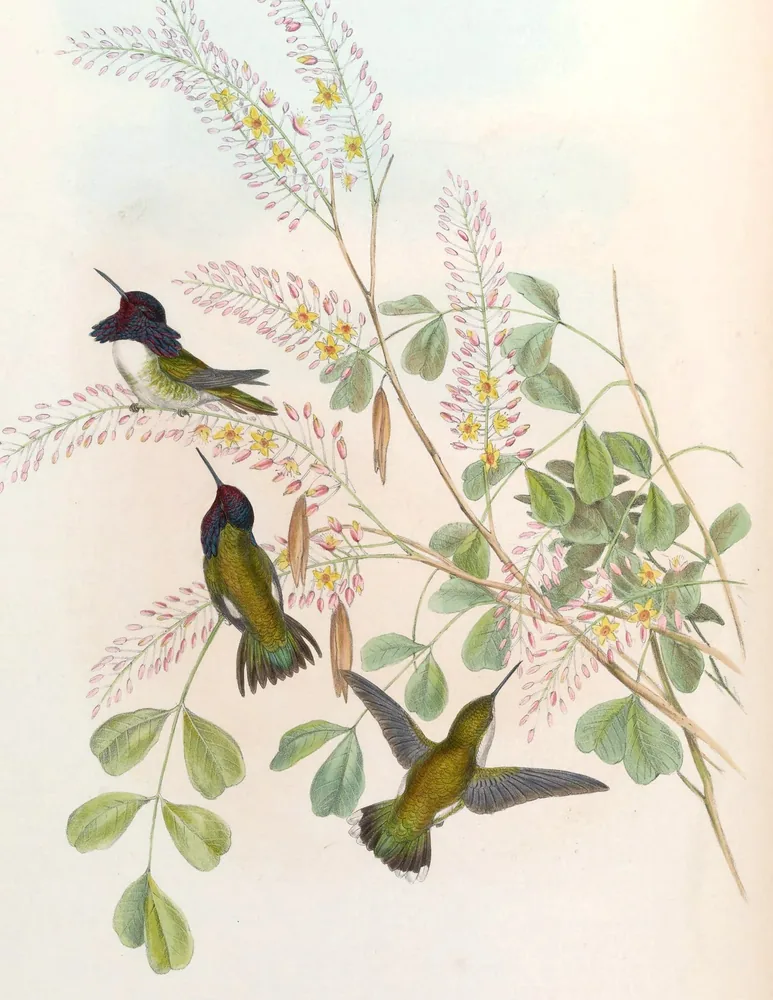
| Sound | Who | Where and when |
|---|---|---|
| A buzzy, scratchy song from a perch | Anna's, male | Pacific Coast, all year |
| A loud chirp at the bottom of a high dive | Anna's, male, with its tail | November to May |
| A thin, high whistle, shriller in the dive | Costa's | Deserts, early spring |
| A metallic trill as an unseen bird zings past | Broad-tailed, male, with its wings | Mountain West, summer |
| A slightly lower wing trill; whining and popping in a U-shaped dive | Rufous, male | Migration |
| Zeeee chuppity-chup; a metallic whine in a J-shaped dive | Allen's | Coastal California |
| Popping and "zinging" at the bottom of a dive | Calliope | Mountain meadows |
| Mouse-like squeaks; whirring on each swing of a pendulum display | Ruby-throated | The East, summer |
| A chattering chi-dit, like a kinglet | Broad-billed | Southern Arizona |
| A loud seep, over and over | Blue-throated Mountain-gem | Border canyons |
| A long, monotonous tink-tink-tink | White-eared, breeding male | Southeast Arizona |
| A soft three-note call "like a tiny trumpet" | Berylline | Southeast Arizona |
The words are the Audubon guide's, with the Tucson Bird Alliance's for the Rufous's trill. The Blue-throated's duets are on its page.
What is a hummingbird's worst enemy?
No single predator: predation "probably does not account for much hummingbird mortality," says the Pennsylvania Game Commission, and more die "crashing into windows, cars, and telecommunications towers."
The commission's list of hunters runs from free-roaming cats to small hawks and owls, and "even frogs and bass"; Blue Jays have eaten nestlings, and some hummingbirds get caught in spider webs. The strangest is the praying mantis, and a review of 147 cases is on our Blue-throated Mountain-gem page.
Hummingbird facts, checked
Some of the most repeated hummingbird facts hold up, and some don't.
| You may have read | What the sources say |
|---|---|
| They ride south on the backs of geese | No, as above |
| A feeder left up keeps them from migrating | No, as above |
| Hummingbirds are the second-largest bird family | Third, as above |
| Their tongues sip nectar like a straw | No: the tongue is "a tiny pump." In hundreds of filmed licks, straw-like filling showed up once, and 50 years of nectar models "will have to be reconsidered" (University of Connecticut, 2015) |
| Their wings beat 200 times a second | About 53 for a hovering Ruby-throated, up to 80 in forward flight (Pennsylvania Game Commission), 40 for a hovering Anna's, 23 for the big Blue-throated; BirdNote's 200 is for Bee Hummingbird courtship flights |
| Their hearts beat about 1,200 times a minute | True when they're active (National Park Service; BirdNote); in torpor a Blue-throated's slows to 50 to 180 |
| They eat eight times their weight a day | An adult Ruby-throat "can eat twice its body weight each day," says the National Park Service; the eight times is from a store's blog |
| They're the only birds that can fly backward | National Geographic says so, quoting Oregon State's Adam Hadley; the Park Service adds upside down |
Hummingbirds in classic paintings: Audubon, Gould and Haeckel
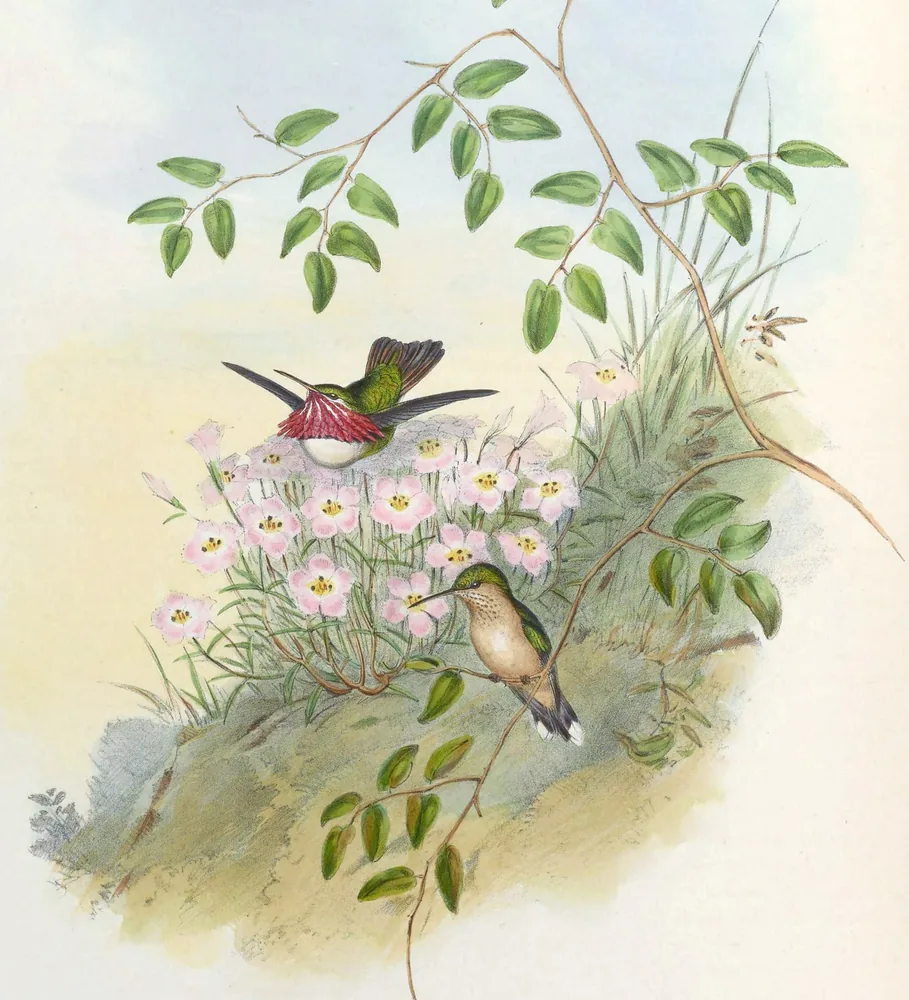
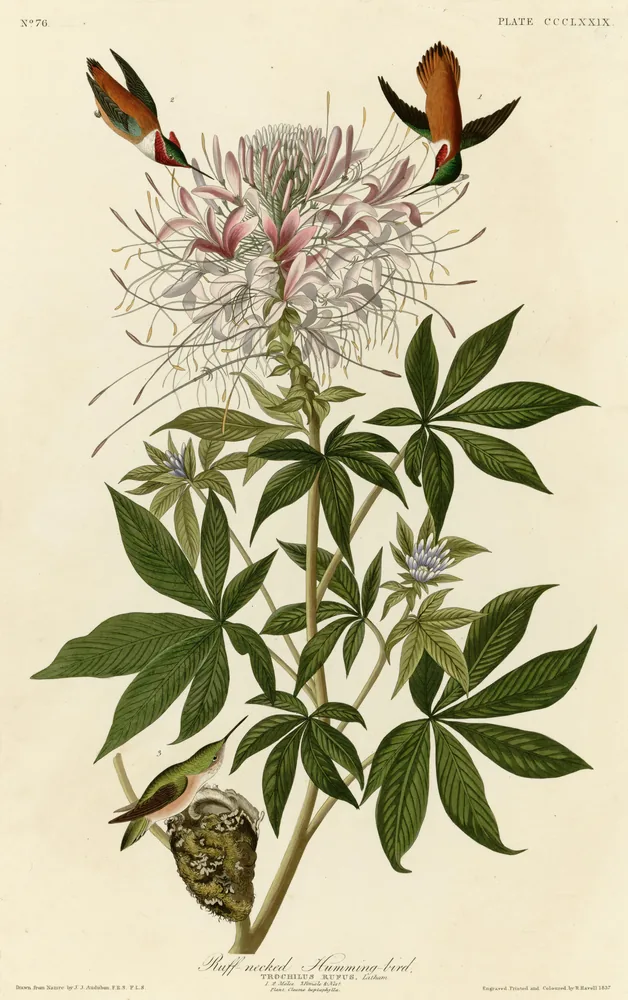
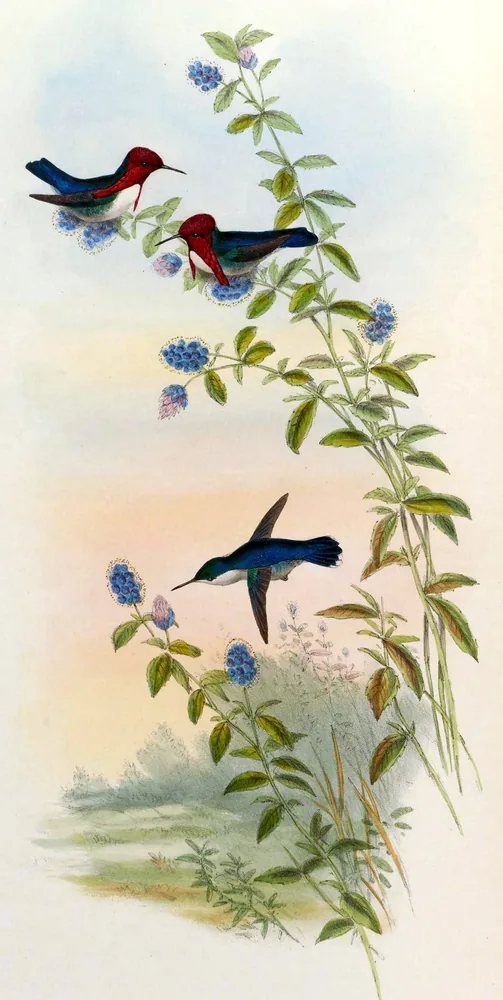
John James Audubon put only four hummingbird plates in The Birds of America, John Gould gave the family a monograph in five volumes (1849–61), and Ernst Haeckel crowded twelve onto one plate of Kunstformen der Natur in 1904.
Audubon's second hummingbird came from Key West. In 1834 he quoted his friend John Bachman, who wrote that it had been supposed "only one species of Humming Bird … ever visits the United States." Bachman's new one, a mango caught at Key West, was "apparently wearied after its long flight across the Gulf of Mexico." Audubon painted it as plate 184, the Mangrove Humming Bird; our list of his plates makes it today's Black-throated Mango, which isn't on the US list at all. The mango that is, a Code 4 stray, is the Green-breasted. More of his changed names are in Audubon's birds, then and now.
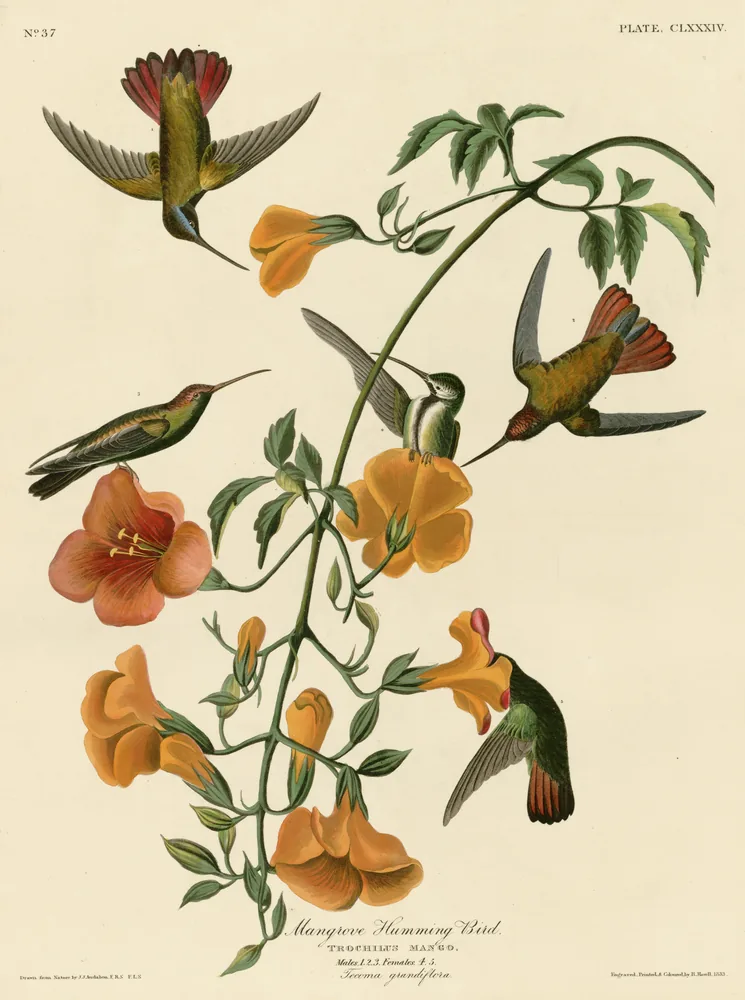
His Rufous, plate 379, is the Ruff-necked Humming Bird, which he wrote "was discovered by the great navigator, Captain Cook, who found it abundant at Nootka Sound"; to Thomas Nuttall the male was "a breathing gem, or magic carbuncle of glowing fire." Plate 47, the Ruby-throated, and plate 425, Anna's, have pages of their own, and he tucked a hummingbird nest into his American Crow.
Gould's plates, gold leaf and all, are in our guide to him, and one modern book collects them. Haeckel's own key to the plate that opens this page names all twelve birds, among them a Sword-billed Hummingbird, two coquettes and a sicklebill. Its Juan Fernandez Firecrown is now Critically Endangered, and its Booted Racket-tail took in two other racket-tails when AviList merged them in 2026.
In a Birdfolio, each hummingbird on your own list gets a page, most of them with one of Gould's plates: turn the pages of one.
Hummingbird species by state
It depends mostly on how far west and south you live: the East has one nesting hummingbird, while Arizona's official checklist has 18 and the Texas list had 19 in 2021.
In Arizona 11 of the 18 have nested, and our Arizona page names them. A study of West Texas from 2007 to 2019 found 18 of the 19 on the Texas list (Texas Ornithological Society, 2021), and Oregon counts seven. North Dakota has one nesting species, Utah's records include a hummingbird seen in 1972, and Virginia's record hummingbird changed its name.
Questions people ask
How long do hummingbirds live?
A few reach their teens: the oldest in the USGS Bird Banding Laboratory's longevity records is a Broad-tailed from Colorado, banded in 1976 and at least 12 years and 2 months old when last caught. A Black-chinned in Idaho reached 12 years and 1 month, and a Ruby-throated in Illinois 11 years and 1 month. Most live far shorter lives; our lifespan guide has the typical figures, and the oldest wild birds lists every species' record.
Is the hummingbird a state bird?
No: no state has chosen a hummingbird, as our list of all 50 state birds shows.
Is there a National Hummingbird Day?
Yes, in early September; our National Bird Day guide gives the rule and the 2027 date.