Reference
How many bird species are in New Jersey?
New Jersey has 509 bird species on its official list (New Jersey Bird Records Committee, September 2026), the 12th highest count of the 49 states with a verified count. It counts species of natural origin, extinct ones such as the Labrador Duck included; species of uncertain origin are listed separately.
New Jersey’s state bird is the American Goldfinch: our New Jersey state bird page tells how it was chosen.
Updated
What are the most common birds in New Jersey?
In summer, the 25 most common birds in New Jersey are led by the Canada Goose, at about 130 birds per survey route, then the European Starling and the American Robin, by the USGS Breeding Bird Survey’s counts for 2021–2025. Together these 25 made up 70% of all the birds counted on New Jersey’s 27 survey routes.
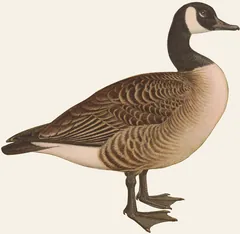
Marinus Adrianus Koekkoek, E. D. van Oort's Ornithologia Neerlandica (1922) about 130 per routeon 81% of routesno clear trend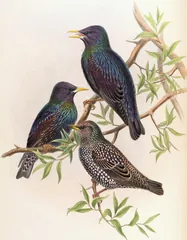
John Gould and Henry Constantine Richter, The Birds of Asia, vol. 5 (1850–83) 2 European Starlingabout 92 per routeon 93% of routesno clear trendintroduced species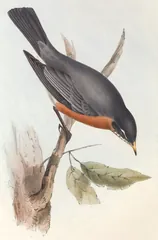
John and Elizabeth Gould, The Birds of Europe (1832–37) about 61 per routeon 100% of routesfalling since 2015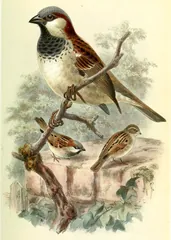
John Gerrard Keulemans, Lord Lilford’s Coloured Figures of the Birds of the British Islands (1885–97) 4 House Sparrowabout 47 per routeon 89% of routesno clear trendintroduced species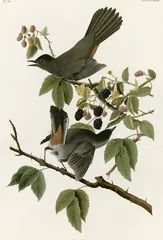
John James Audubon, The Birds of America (1827–38) 5 Gray Catbirdabout 35 per routeon 100% of routesno clear trend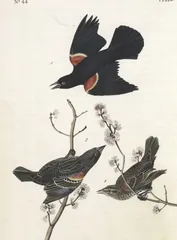
John James Audubon, The Birds of America (1840–44) about 34 per routeon 100% of routesno clear trend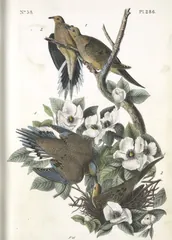
John James Audubon, The Birds of America (1840–44) about 33 per routeon 100% of routesno clear trend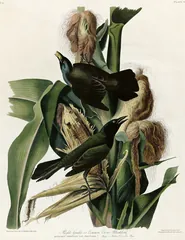
John James Audubon, The Birds of America (1827–38) 8 Common Grackleabout 32 per routeon 100% of routesfalling since 2015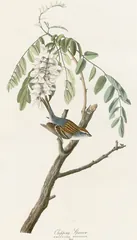
John James Audubon, The Birds of America (1827–38) 9 Chipping Sparrowabout 28 per routeon 96% of routesfalling since 2015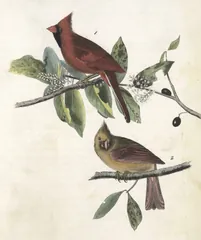
John James Audubon, The Birds of America (1840–44) about 25 per routeon 100% of routesno clear trend
Show all 25
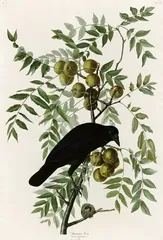
John James Audubon, The Birds of America (1827–38) about 21 per routeon 96% of routesfalling since 2015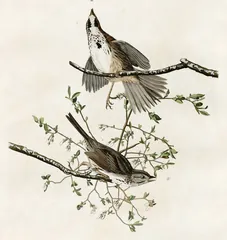
John James Audubon, The Birds of America (1827–38) 12 Song Sparrowabout 20 per routeon 93% of routesno clear trend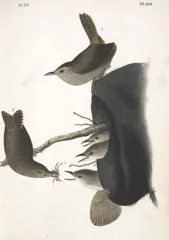
John James Audubon, The Birds of America (1840–44) 13 Northern House Wrenabout 19 per routeon 100% of routesno clear trend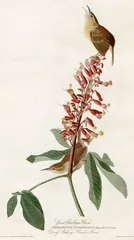
John James Audubon, The Birds of America (1827–38) about 15 per routeon 100% of routesrising since 2015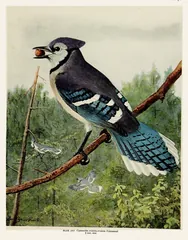
Louis Agassiz Fuertes, Elon H. Eaton's Birds of New York (1910–14) 15 Blue Jayabout 15 per routeon 96% of routesno clear trend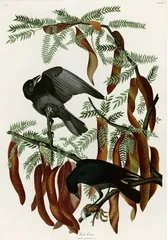
John James Audubon, The Birds of America (1827–38) 16 Fish Crowabout 13 per routeon 96% of routesno clear trend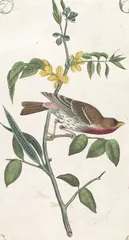
John James Audubon, The Birds of America (1840–44) 17 House Finchabout 13 per routeon 96% of routesrising since 2015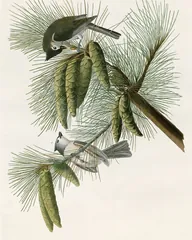
John James Audubon, The Birds of America (1827–38) about 13 per routeon 96% of routesno clear trend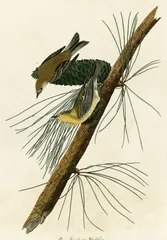
John James Audubon, The Birds of America (1827–38) 19 Pine Warblerabout 12 per routeon 44% of routesno clear trend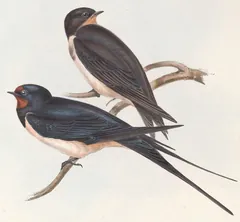
John and Elizabeth Gould, The Birds of Europe (1832–37) 20 Barn Swallowabout 12 per routeon 93% of routesno clear trend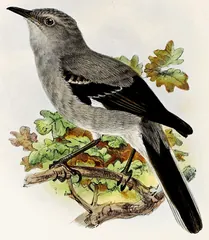
John Gerrard Keulemans, Onze Vogels in Huis en Tuin (1869–76) about 12 per routeon 96% of routesno clear trend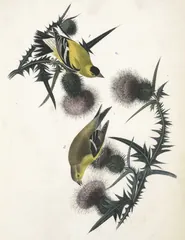
John James Audubon, The Birds of America (1840–44) about 10 per routeon 100% of routesno clear trend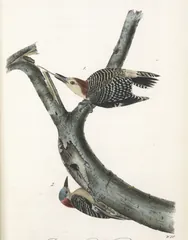
John James Audubon, The Birds of America (1840–44) about 9.8 per routeon 96% of routesno clear trend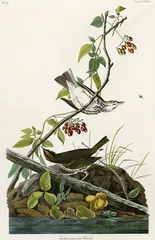
John James Audubon, The Birds of America (1827–38) 24 Ovenbirdabout 9.5 per routeon 89% of routesfalling since 2015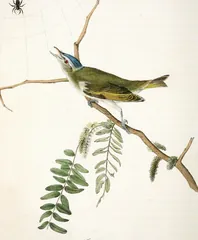
John James Audubon, The Birds of America (1840–44) 25 Red-eyed Vireoabout 9.1 per routeon 89% of routesno clear trend
From the Canada Goose to the Red-eyed Vireo, these are New Jersey’s common summer birds; for the rest of its 509 species, our guide to the best bird books of 2026 compares the five big North American guides, Sibley’s and Peterson’s among them.
What is the most common bird in New Jersey?
The Canada Goose leads New Jersey’s summer survey: about 130 a route on average in 2021–2025, ahead of the European Starling at about 92, seen on 81% of the 27 routes. USGS finds no clear rise or fall in its New Jersey numbers since 2015.
In winter, National Audubon's summaries of the state's Christmas Bird Counts name no overall leader. They do single out a few: in 2022-23 the Red-bellied Woodpecker, with 2,218, again outnumbered the Downy Woodpecker, with 1,986, as the commonest woodpecker. The Common Raven, missed completely on the counts as recently as 1995, turned up on every count but the Pinelands in 2024-25, 360 birds after a record 437 the winter before.
Sources: The 123rd Christmas Bird Count in New Jersey and Pennsylvania (National Audubon Society, January 18, 2024); The 125th Christmas Bird Count in New Jersey (National Audubon Society, November 10, 2025), read October 10, 2026.
How was this list made?
Each of New Jersey’s 27 routes is a roadside count, 50 stops along about 25 miles, run once a year in early summer by a volunteer. We took USGS’s yearly estimate for each species in New Jersey, the number of birds a typical route records, averaged it over the five latest survey years (there was no survey in 2020) and ranked the birds by it. To keep the list to birds you’re likely to meet across New Jersey, we left out species recorded on fewer than one in five of its routes, and those USGS can only estimate very roughly, which usually means big flocks or colonies on a few routes.
For New Jersey that left out the Laughing Gull.
The share of routes is our own count from USGS’s route data for New Jersey, using only counts that met the survey’s standards; “rising” and “falling” are USGS’s trends for the state since 2015, named only where it finds a clear change. Roadside counts on early-summer mornings miss most of New Jersey’s owls and waterbirds, and its winter visitors aren’t here at all.
New Jersey’s counts come from two USGS data releases, the North American Breeding Bird Survey Analysis Results 1966–2025 (Hostetler et al., 2026) and its Dataset 1966–2025 (Ziolkowski et al., 2026), gathered by volunteer observers and free for anyone to use; Birdfolio isn’t connected with the USGS.
How many bird species are in New Jersey?
| Official count | 509 species |
|---|---|
| List’s date | September 2026 |
| Kept by | New Jersey Bird Records Committee |
| Extinct | 5 species, such as the Labrador Duck |
| Review list | 180 species and forms, October 12, 2026 |
| Annual reports online | 1990 to 2026 |
| Among US states | 12th highest of the 49 states with a verified count |
| Official list | New Jersey State List (7 September 2026) |
What does New Jersey’s count include?
- Species of natural origin recorded in New Jersey, as of September 2026.
- 5 extinct species: the Labrador Duck, Greater Prairie-Chicken, Passenger Pigeon, Eskimo Curlew and Carolina Parakeet.
- Rare species on the committee's review list are marked; they're part of the 509, not extra.
- Not counted: species whose wild origin is uncertain, listed at the end.
Why do other sources give a different number?
New Jersey's committee states a grand total near the start of each annual report, so every year's report gives a different one:
- 508. The total through 2025, from the committee's 2026 report, which counts five additions, two of them by splits. The September 2026 list is one higher. Source: New Jersey Bird Records Committee Annual Report 2026, on 2025 records.
- 503. Through 2024, after four additions and one deletion that year; Scopoli's Shearwater, split from Cory's Shearwater, was among the additions. Source: New Jersey Bird Records Committee Annual Report 2025, on 2024 records.
- 494. Through 2022, a year that added seven species to the state list. Source: New Jersey Bird Records Committee Annual Report 2023, on 2022 records.
- 416. The species the committee first approved, at its meeting of December 9, 1990, toward an updated state list; 32 more reported species were held back for lack of information. Source: N.J. Bird Records Committee Yearly Report, 1990 (Records of New Jersey Birds).
- 6, 7 or 8. Species of uncertain origin, none counted in the 509. The committee's lists page says six, the list's own heading says seven, and the list prints eight at its end (our count): Harris's Hawk, White-tailed Hawk, Black-billed Magpie, Hooded Crow, Common Chaffinch, European Goldfinch, European Greenfinch and Eurasian Siskin. Source: Lists and Annual Reports (New Jersey Bird Records Committee).
New Jersey’s list follows its own committee’s rules, and so does every other state’s: see why the counts differ from state to state.
New Jersey firsts, from a shearwater seen off the Cape May ferry to a swift that came back
- On May 11, 2025, three observers aboard the Cape May-Lewes Ferry, still in New Jersey waters, photographed a shearwater whose thin bill and underwing pattern didn't fit the expected Cory's or Scopoli's. Experts agreed it was a Streaked Shearwater: the first for New Jersey and, the committee says, the first for the Atlantic Ocean. Source: New Jersey Bird Records Committee Annual Report 2026, on 2025 records, read October 5, 2026.
- New Jersey's first Common Swift spent May 17, 2024, feeding with Chimney Swifts over the South Cape May Meadows; the committee counted only three vagrant records for all of North America. A Common Swift over Cape May on May 19, 2025, was most likely the same bird, and the committee has since accepted another from June 24, 2026. Sources: New Jersey Bird Records Committee Annual Report 2025, on 2024 records; New Jersey Bird Records Committee Annual Report 2026, on 2025 records; Summary of Results of Items Accepted by the NJBRC as of September 5, 2026 (New Jersey Bird Records Committee), read October 5, 2026.
- A Bermuda Petrel seen from a pelagic trip off Atlantic County on August 27, 2022, was the state's first. The committee took it as a sign that the conservation work begun in Bermuda after the species was rediscovered in 1951 is succeeding; the "Cahow" numbers around 400 birds. Source: New Jersey Bird Records Committee Annual Report 2023, on 2022 records, read October 5, 2026.
- Two Cape Verde or Desertas Petrels, New Jersey's first of that pair, were photographed about two hours apart in deep water off Ocean County on June 3, 2024. The two species, both split from Fea's Petrel, apparently can't be told apart at sea away from their breeding grounds. Source: New Jersey Bird Records Committee Annual Report 2025, on 2024 records, read October 5, 2026.
- 2022 stood out on the committee's own account: seven new species reached the state list, among them the first accepted Common Gull in January, two Kirtland's Warblers on September 29 and a Hammond's Flycatcher at Sandy Hook on October 28. Sources: New Jersey Bird Records Committee, home page; New Jersey Bird Records Committee Annual Report 2023, on 2022 records, read October 5, 2026.
Our guide to rare bird alerts shows where New Jersey's rare birds are reported today, and how to report a sighting to the committee.
Questions people ask about New Jersey’s birds
What is the rarest bird in New Jersey?
The rarest are the birds the state's records committee has accepted just once, such as a Red-cockaded Woodpecker specimen taken at Hoboken before 1866 and kept at the American Museum of Natural History, a Large-billed Tern at Kearny Marsh on May 30, 1988, and a Red-flanked Bluetail that stayed at Whiting, in Ocean County, from December 5, 2023, to March 31, 2024.
Among nesting birds, the Piping Plover remains one of New Jersey's most endangered species, listed in the state in 1984.
Sources: List of Accepted Records of Rare Birds in New Jersey through December 2025, revised July 2026 (New Jersey Bird Records Committee); Piping Plover, New Jersey Endangered and Threatened Species Field Guide (Conserve Wildlife Foundation of New Jersey), read October 10, 2026.
What are common birds in New Jersey?
In winter, Dark-eyed Juncos, one of the most common songbirds to migrate into New Jersey for the season, often with White-throated and White-crowned Sparrows at feeders and the calls of wintering Red-breasted Nuthatches nearby. On the coast, the Christmas Bird Counts of 2024-25 found a near-record 633 American Oystercatchers and a record 137 Sandhill Cranes.
Sources: Winter Bird Watching in New Jersey (Conserve Wildlife Foundation of New Jersey, January 31, 2023); The 125th Christmas Bird Count in New Jersey (National Audubon Society, November 10, 2025), read October 10, 2026.
What US state has the most bird species?
California, with 696 species on its official checklist (October 27, 2026), ahead of Texas with 682, while New Jersey's committee counts 509 species of natural origin, behind only Massachusetts and New York among the northeastern states.
Sources: Official California Checklist, 696 species, updated 27 October 2026 (California Bird Records Committee, Western Field Ornithologists); Texas State List, 682 species, last updated October 24, 2026 (Texas Bird Records Committee, Texas Ornithological Society); Lists and Annual Reports (New Jersey Bird Records Committee), read October 10, 2026.
What is the official state bird of New Jersey?
The Eastern Goldfinch, made the state bird when Governor Harold G. Hoffman signed the bill on June 27, 1935. It didn't go smoothly, the New Jersey State Library recounts: when the bill was first read, senators whistled over its sponsor's speech and it failed by four votes, and one skeptic suggested the crow, buzzard, sparrow or pigeon instead, but in May it passed unanimously.
These 5-inch birds live in New Jersey all year, usually perched high in the trees unless a feeder draws them down, and they molt twice a year.
How the goldfinch became New Jersey's state bird, and whether it stays all winter
Source: New Jersey State Bird: Eastern Goldfinch (New Jersey State Library, updated May 28, 2026), read October 11, 2026.
What are some common big birds found in New Jersey?
Bald Eagles, Ospreys, Wild Turkeys, Great Blue Herons and swans. The state counted 251 active eagle nests in 2025, down from 264 the year before, the first drop since its eagle project began, most likely because of bird flu that winter. Volunteers followed 689 Osprey nests in 2025, a hard season in which 57 percent of the active nests they tracked raised no young, nearly three times the usual failure rate.
Wild Turkeys, gone from New Jersey by the mid-1800s, came back from 22 birds released in 1977 to an estimated 20,000 to 23,000. The state's older bird checklist marks the Mute Swan as introduced, the Tundra Swan and Snow Goose as increasing, and the Great Blue Heron, which nests, migrates and winters here, as a species of special concern.
Sources: 2025 New Jersey Bald Eagle Report (Conserve Wildlife Foundation of New Jersey, March 31, 2026); New Jersey Bald Eagle Project, 2025 (New Jersey Division of Fish and Wildlife), the Internet Archive's copy of March 26, 2026; New Jersey Osprey Project (Conserve Wildlife Foundation of New Jersey); Wild Turkey (New Jersey Division of Fish and Wildlife), the Internet Archive's copy of May 27, 2025; Birds of New Jersey, a checklist (New Jersey Division of Fish and Wildlife), the Internet Archive's copy of September 26, 2026, read October 11, 2026.
Is there a large black bird in New Jersey?
Several. The Common Raven is increasing in New Jersey, the state's bird checklist says, alongside the stable American and Fish Crows, and both Black and Turkey Vultures, which roost, feed and soar in groups, are increasing too. Black Vultures build no nest, laying their eggs in tree hollows, logs, caves or on the floors of abandoned buildings; in August 2022 bird flu killed more than 100 of them along the Sussex Branch Trail in Lafayette.
Sources: Birds of New Jersey, a checklist (New Jersey Division of Fish and Wildlife), the Internet Archive's copy of September 26, 2026; Three Vultures get a second chance (Conserve Wildlife Foundation of New Jersey, August 24, 2020); Avian Influenza (Bird Flu) in Vultures (New Jersey Division of Fish and Wildlife, August 25, 2022), the Internet Archive's copy of February 25, 2025, read October 11, 2026.
What birds are out at night in NJ?
Owls and night-herons, among others. On still spring evenings the “hooting and eerie caterwauling” of Barred Owls, threatened in New Jersey, carries through the state's remote swampy woods, the Conserve Wildlife Foundation says; they call all year, most from late February to early April, by day as well as at night. Black-crowned Night-Herons, endangered in the state and nesting mostly along the Atlantic coast, are largely nocturnal.
Sources: Barred Owl, New Jersey Endangered and Threatened Species Field Guide (Conserve Wildlife Foundation of New Jersey); Black-crowned Night-heron, New Jersey Endangered and Threatened Species Field Guide (Conserve Wildlife Foundation of New Jersey), read October 11, 2026.
Which birds live in New Jersey?
Birds of the Atlantic beaches and Delaware Bay, the Pine Barrens, the Meadowlands marshes and the forested ridges of the northwest, with migrants passing through all of them. The best-known sight is the Red Knot's spring stop on Delaware Bay; the specialties include the Piping Plover, Least Tern and Black Skimmer, all endangered in New Jersey, and the Golden-winged Warbler of the northwestern hills.
Delaware Bay: Red Knots arrive in May with little or no fat left and feed on the eggs of the largest spawning concentration of horseshoe crabs on the East Coast; most double their weight, from about 110 grams to 185-220 grams, before flying on to the Arctic. New Jersey listed the knot as endangered in 2012. Bald Eagles gather most along the bay in Salem and Cumberland counties, and the state's eagles have grown from one active nest in 1982 to 251 in 2025.
Atlantic beaches: Piping Plovers nest on the beaches from Sandy Hook to Cape May, and the Edwin B. Forsythe National Wildlife Refuge has hosted nearly half of the state's Piping Plovers in recent years. Horseshoe Island, a new island offshore, holds New Jersey's largest Black Skimmer colony.
Pine Barrens and Meadowlands: the Pinelands Commission counts 299 bird species in the Pinelands. More than 285 have been found in the Meadowlands, many on the state's threatened, endangered and special concern lists, and DeKorte Park, once meant to be a landfill, draws birders all year for egrets, Ospreys, hawks and falcons.
Northwest ridges: in the Delaware Water Gap, shared with Pennsylvania, the Kittatinny Ridge is an important fall corridor for migrating birds of prey, hemlock ravines hold nesting Blackburnian and Black-throated Green Warblers, Acadian Flycatchers and Hermit Thrushes, and a large population of Bald Eagles winters in the river valley. The Golden-winged Warbler has been found nesting only in the northwest of the state, and New Jersey listed it as endangered in 2012.
Sources: Red Knot, New Jersey Endangered and Threatened Species Field Guide (Conserve Wildlife Foundation of New Jersey); Bald Eagle, New Jersey Endangered and Threatened Species Field Guide (Conserve Wildlife Foundation of New Jersey); New Jersey Bald Eagle Project (Conserve Wildlife Foundation of New Jersey); Piping Plover, New Jersey Endangered and Threatened Species Field Guide (Conserve Wildlife Foundation of New Jersey); Beach Nesting Bird Project (Conserve Wildlife Foundation of New Jersey); Wildlife of the New Jersey Pinelands (New Jersey Pinelands Commission); Parks and Trails (New Jersey Sports and Exposition Authority, Meadowlands District); Birds, Delaware Water Gap National Recreation Area (National Park Service); Golden-winged Warbler, New Jersey Endangered and Threatened Species Field Guide (Conserve Wildlife Foundation of New Jersey), read October 10, 2026.
Why do so many hawks pass Cape May Point?
The land funnels them there. In a 1936 paper in The Auk, Robert P. Allen and Roger T. Peterson likened southern New Jersey to a giant funnel whose mouth is the Cape May peninsula, a finger of land between Delaware Bay and the Atlantic; from the Point, open water fills three quarters of the compass for 13 miles. From late August to mid-November, they wrote, a series of migratory flights passes the Point. In 1935 the Audubon Association's warden there recorded 188 species and estimated 124,000 birds, about 13,500 of them hawks and other raptors of 13 species.
Guns explain the warden: the Audubon Association sent its people there mainly to help enforce the law during the flights. Local gunners used to line the road through the woods at the Point to wait for the hawks, shooting from New Jersey's highways had been legal until shortly before, and the toll on Sharp-shinned Hawks, then unprotected, was heavy. The Audubon Association's Witmer Stone Wildlife Sanctuary largely ended the shooting from the sand hills in those woods.
The hawks still come. In 2018, the 43rd season of New Jersey Audubon's Cape May Hawkwatch, counters tallied 53,495 raptors of 15 species between September 1 and November 30, the most since 1999, including 5,406 American Kestrels on October 12 alone, the largest kestrel count in the watch's history.
Sources: The Hawk Migrations at Cape May Point, New Jersey, by Robert P. Allen and Roger T. Peterson (The Auk 53:4, October 1936), the Internet Archive's copy of June 7, 2024; 2018 Cape May Hawkwatch: 53,495 Raptors and More (New Jersey Audubon), the Internet Archive's copy of February 10, 2026, read October 5, 2026.
What happened to the Eurasian Marsh-Harrier in New Jersey?
It was found at Troy Meadows in Morris County and seen, elusively, there and in Newark between November 8 and 19, 2022. The committee thought it the same bird found in Knox County, Maine, in late August, and its home page calls it the first accepted record for North America. The only earlier North American report, the committee noted, was a sight record from Accomack County, Virginia, in December 1994, which Virginia accepted but the American Birding Association's checklist committee never evaluated.
Its stay ended badly: on November 19, 2022, the harrier was struck by a plane at Newark Liberty International Airport. Out of its usual range, the committee added, the species has also appeared in the Azores, Iceland, Bermuda and the Caribbean.
Sources: New Jersey Bird Records Committee Annual Report 2023, on 2022 records; New Jersey Bird Records Committee, home page, read October 5, 2026.
What does the New Jersey Bird Records Committee do?
It keeps the official state list and the evidence behind it. Its goals, set out in March 1996, are to collect and archive the data on rare birds reported in the state, set standards for observing and reporting them, review reports of species on its review list, publish its decisions, and draw up and maintain the state list. The chair at the time wanted to "dispel the myth that our major purpose is to vet your rare bird reports": most records fail because the documentation can't support the identification, not because the bird was necessarily misidentified, and a record not accepted can be looked at again later.
Where a bird came from matters as much as what it was. Three Barnacle Geese at Weamaconk Lake in Monmouth County from December 24, 2025, to January 24, 2026, raised concern because a known breeder was a few miles away; they behaved like wild birds and were accepted. Species whose wild origin stays in doubt are listed at the end of the state list and not counted. The committee also asks anyone who posts a review species online to send it a description, since a sighting without supporting details can't enter the historical record.
Sources: Purpose and Goals of the New Jersey Bird Records Committee, March 1996 (New Jersey Bird Records Committee); New Jersey Bird Records Committee Annual Report 2026, on 2025 records, read October 5, 2026.
Where is the official New Jersey bird list, and how often is it updated?
On the committee's website, njbrc.com, under Lists & Annual Reports: the New Jersey State List, a PDF dated September 7, 2026, with review species marked R or R*, extinct ones EX and the provenance-uncertain species at the end; the New Jersey Review List, dated October 12, 2026, with 180 numbered species and forms, for which every sighting should be documented; a List of Accepted Records of Rare Birds, updated March 2026; and every annual report from 1990 to 2026. Partway through the year the committee also posts its results so far, most recently for reports received through June 2026.
The committee votes by email during the year and then meets in person to finish the year's reports: it met on March 15, 2026, for those of 2025, and considered 143 reports in all. Each annual report lists the accepted records first, then those not accepted, and gives the new state total. Its bylaws were last revised in 2005.
Sources: Lists and Annual Reports (New Jersey Bird Records Committee); New Jersey Review List, October 12, 2026 (New Jersey Bird Records Committee); Summary of Results of Items Accepted by the NJBRC as of September 5, 2026 (New Jersey Bird Records Committee); New Jersey Bird Records Committee Annual Report 2026, on 2025 records; Purpose and Goals of the New Jersey Bird Records Committee, March 1996 (New Jersey Bird Records Committee), read October 5, 2026.
How do you count your own New Jersey list?
Your New Jersey list is every species you’ve seen in New Jersey. eBird can filter your life list to New Jersey, and your eBird data download gives the state of every sighting. On paper, count the species you’ve seen in New Jersey; what is a life list? explains how birders keep their lists.
To print your whole list, New Jersey birds and all, see how to print your bird life list, or let Birdfolio make it a hardcover book.
New Jersey’s state bird
New Jersey’s state bird is the American Goldfinch (officially, the “eastern goldfinch”), the state bird since 1935. Its story, the state flower and animal, and a free picture card for a report are on our New Jersey state bird page.
Birding festivals in New Jersey
Our birding festivals calendar lists 2 in New Jersey, with dates from each festival’s own website:
- Cape May Spring Festival, Cape May: May 13–16, 2027
- Cape May Fall Festival, Cape May: October 14–17, 2027
Christmas Bird Count in New Jersey
New Jersey had 31 Christmas Bird Count circles on Audubon’s map last winter, each counted on a single day between December 14 and January 5. Our guide shows where to find New Jersey’s counts and lists 3 New Jersey count dates already announced for this winter; it’s free, and beginners are welcome.
More about bird counts
- How many bird species are in each state: New Jersey beside all 50 states, DC and Canada.
- Bird lists of nearby states: New York and Pennsylvania.
- State birds of all 50 states, New Jersey’s American Goldfinch among them
- How many bird species are in the US and Canada
- Bird splits and lumps
If you’re shopping for a birder in New Jersey, our gift guide for birders and our pick of coffee table bird books are good places to start.