The Michigan Bird Records Committee counts 12 woodpeckers: 8 that turn up every year and 4 rarities, one of them a Red-cockaded that landed on a Muskegon golf course in 2022. Here the North meets the South: Black-backeds follow fires in the Upper Peninsula's pines, while the Red-bellied, common in the south, thins out northward.
How many different woodpeckers are there in Michigan?
Twelve: the committee's checklist of 466 species, updated July 7, 2025, has 8 regular woodpeckers, 1 casual and 3 accidental.
Count them online and you'll find 6, 8 or 10. The committee keeps the official tally, and its labels mean something exact:
| Label | The committee's rule | Woodpeckers |
|---|---|---|
| Regular (8) | Recorded in at least 9 of the last 10 years, or more than 30 times in 10 years | Red-headed, Red-bellied, Yellow-bellied Sapsucker, Black-backed, Downy, Hairy, Northern Flicker, Pileated |
| Casual (1) | "Recorded more than three times, but 30 or fewer times, in the last 10 years" | American Three-toed |
| Accidental (3) | Recorded "three or fewer times in the last 10 years" | Lewis's, Golden-fronted, Red-cockaded |
All four rarities are on the committee's review list, updated June 5, 2025, so every sighting must be documented. None of Michigan's woodpeckers is marked extinct or extirpated. The rest of the state's 466 species are on our page on Michigan's birds.
What is the most common woodpecker in Michigan?
It's the Downy Woodpecker, found in every part of the state in every season: the University of Michigan's checklist calls it a "common permanent resident throughout the state."
The Huron-Clinton Metroparks, around Detroit, say it in fewer words: the Downy is "seen all over Michigan in every season." The Hairy is statewide too, but "less abundant" than the Downy in the south. We found no count that ranks them, so take this as the naturalists' verdict rather than a census. If you can't decide which of the two is at your suet, use our Downy or Hairy check; the Downy also has a painting page of its own.
Upper Peninsula or Lower: which woodpeckers live where?
Most of Michigan's woodpeckers live on both peninsulas; the Black-backed and the American Three-toed belong to the Upper Peninsula, and the Red-bellied to the south.
The fullest statewide account we could read is the University of Michigan Museum of Zoology's distributional checklist by Robert B. Payne, revised online in 2001. Its ranges are 25 years old, and the Red-bellied's northern edge in particular may have moved since.
| Woodpecker | Where in Michigan, in 2001 | When | How common then |
|---|---|---|---|
| Downy | Statewide, in woods; at feeders in winter | All year | Common |
| Hairy | Statewide | All year | Common; fewer than Downys in the south |
| Red-bellied | Common in the south; had nested north to Muskegon, Oceana, Lake, Roscommon and Saginaw counties | All year | "Uncommon and local" in the Upper Peninsula |
| Red-headed | Most numerous in Lower Peninsula oak woodlands; has nested in Iron, Marquette and Keweenaw counties | Summer resident and migrant | Common |
| Yellow-bellied Sapsucker | Most numerous in the north | Summer; a few winter in the south and visit feeders | Fairly common |
| Northern Flicker | Statewide | Spring to fall; uncommon in southern winters, generally gone from the north | Common |
| Pileated | Upper Peninsula pine forests; several northern and southwestern Lower Peninsula counties | All year | Uncommon |
| Black-backed | Several Upper Peninsula counties and Isle Royale; now and then the northern Lower Peninsula | Local in summer; an uncommon winter visitor | Uncommon |
| American Three-toed | The Upper Peninsula only | A rare resident and occasional winter visitor | Casual |
| If you live in | Woodpeckers to expect |
|---|---|
| Detroit, Ann Arbor, Lansing or Grand Rapids | Downy, Hairy and Red-bellied; Red-headed in oak woods; flickers from spring to fall; sapsuckers passing through, and a few in winter; Pileateds in bigger woods such as Oakwoods Metropark |
| The northern Lower Peninsula | Downy, Hairy, Pileated; sapsuckers and flickers in summer; the Red-bellied near its northern edge; a Black-backed now and then |
| The Upper Peninsula and Isle Royale | Downy, Hairy, Pileated; sapsuckers and flickers in summer; Black-backeds in burns and at Seney; a rare American Three-toed |
In 2001 the checklist knew of a single American Three-toed nest in all of Michigan, in eastern Baraga County, and "no satisfactory records for the Lower Peninsula."
Is the giant woodpecker in Michigan a Pileated?
Almost certainly: Michigan's biggest woodpecker is the Pileated, about 19 inches long and "almost as large as a crow," say the Huron-Clinton Metroparks.
Look at the tree as well as the bird. A Pileated leaves holes about the size of a soda can, the Metroparks note, and a pair nests at Oakwoods Metropark. In 2001 the species was uncommon and "mainly a permanent resident in the north," in the Upper Peninsula's pine forests and a scatter of Lower Peninsula counties.
The black ones and the white ones sort out like this:
| You saw | Probably | Where to look in Michigan |
|---|---|---|
| A crow-sized black woodpecker with a red crest | Pileated | Northern pine forests; big woods in the south |
| A black back and a yellow cap, in northern woods | Black-backed, a male | The Upper Peninsula, often in burns |
| Black-and-white, with white down the middle of the back | Downy, or the larger Hairy | Anywhere |
| A head red all over, and white patches on the wings | Red-headed | Oak woods, mostly in the Lower Peninsula |
| A red cap over a barred back | Red-bellied | Mostly the southern Lower Peninsula |
A female Black-backed has no yellow; the male and female table has the rest. The Pileated's own painting page has Audubon's picture of it.
Black-backed Woodpeckers and Michigan's burned pine forests
On April 29, 2007, a prescribed fire in the Ottawa National Forest got away and became a wildfire, burning about 998 acres, mostly of mixed pine. That burn drew researchers looking for one bird in particular. In its second breeding season they surveyed a 230-acre plot for Black-backed Woodpeckers, "an uncommon fire-dependent species," as a 2014 research brief by Rhiannon Jakopak and Julia S. Polasik describes it: a woodpecker that relies on burned forest.
Seney National Wildlife Refuge, in the Upper Peninsula, is where many birders go looking for one. People visit "with hopes of seeing the elusive yellow rail or black-backed woodpecker," the refuge says. It has recorded more than 200 bird species, and 337 have been documented at its Whitefish Point Unit alone.
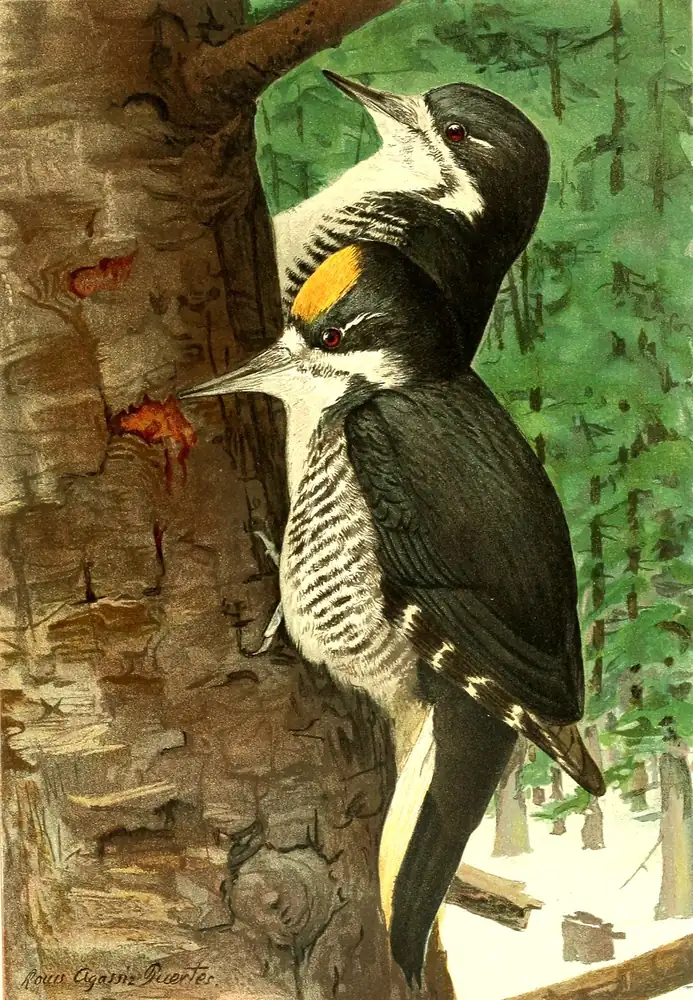
In 2001 the Black-backed nested in several Upper Peninsula counties and on Isle Royale, and turned up now and then in the northern Lower Peninsula. Michigan had it then as a local summer resident and an uncommon winter visitor. The male wears the yellow cap, as in the Fuertes painting at the top of this page.
A Red-cockaded on a Muskegon golf course, and Michigan's other strays
Michigan's first Red-cockaded Woodpecker, a federally threatened bird of Southern pine forests, turned up at Oak Ridge Golf Club in Muskegon County on July 1, 2022. On July 24 one appeared at Ludington, in Mason County: "possibly the same bird," the records committee wrote, though it treated the two as separate records. It was one of five species added to the state list in 2022, the committee's 33rd annual report says.
Less than seven weeks earlier, the same county had a visitor from the other direction. A Lewis's Woodpecker, a bird of the West, stayed at Muskegon from May 16 to 26, 2022: Michigan's fourth record of the species.
The third accidental, the Golden-fronted, is a bird of Texas and Mexico; we couldn't read the details of its Michigan record. The casual one, the American Three-toed Woodpecker, belongs to the north woods, and the 2001 checklist placed it in the Upper Peninsula only. For the places where Red-cockadeds really live, see woodpeckers in Texas and woodpeckers in Florida.
Which Michigan woodpeckers leave for the winter?
The Yellow-bellied Sapsucker and most Northern Flickers go south, though a few of each stay in southern Michigan; the Downy, Hairy, Red-bellied and Pileated stay all year.
Flickers are easiest to see on the move: "large numbers migrate along Lake Michigan," the 2001 checklist says. The Red-headed is a summer resident and migrant. Two northern specialists do the opposite of leaving: the Black-backed is an uncommon winter visitor as well as a local nester, and the American Three-toed an occasional winter visitor. For feeding the ones that stay through the cold months, see which woodpeckers stay for winter.
Seney, Isle Royale and the Metroparks: Michigan's best woodpecker places
| Place | Woodpeckers | Notes |
|---|---|---|
| Seney National Wildlife Refuge, Upper Peninsula | Black-backed | Many visitors come hoping to see one |
| Whitefish Point Unit, Seney National Wildlife Refuge | Migrants | 337 bird species documented |
| Isle Royale National Park | Black-backed | It has nested on the island |
| Ottawa National Forest, western Upper Peninsula | Black-backed | The 2007 burn study |
| Oakwoods Metropark | Pileated | A nesting pair |
| The Muskegon County lakeshore | Strays | Where 2022's Lewis's and Red-cockaded turned up: a story, not a promise |
Fuertes's woodpeckers of the north woods
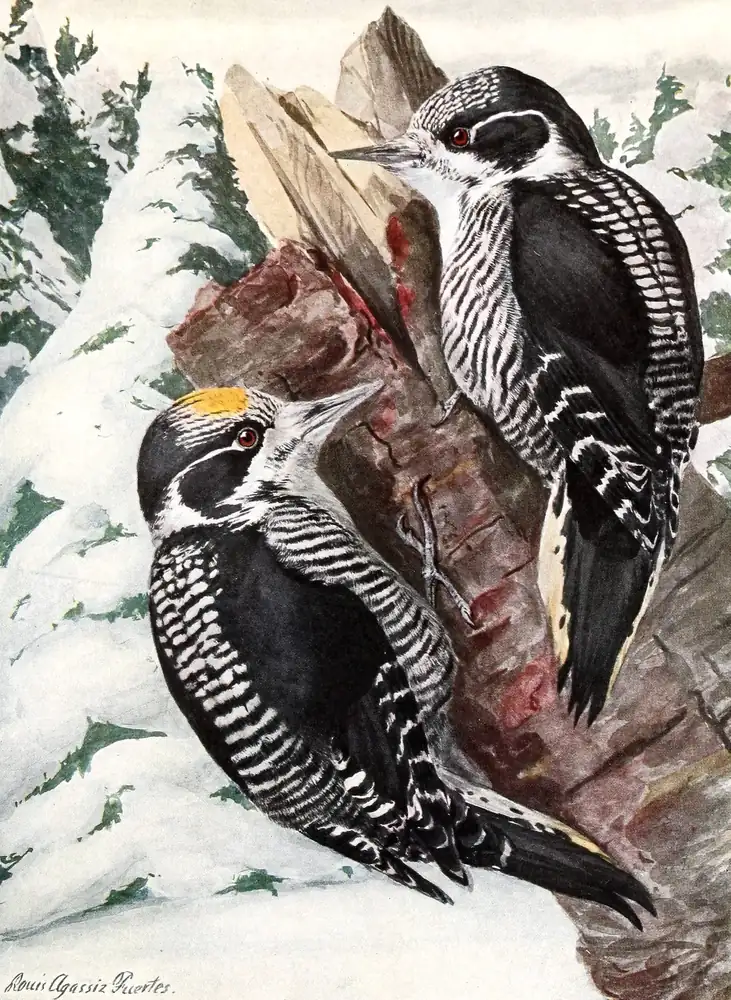
Both paintings on this page are by Louis Agassiz Fuertes, who signed each in the lower left corner. The Black-backeds at the top, a yellow-capped male in front of a plain-capped female with spruce woods and snow behind, illustrated a New York state report of 1901. The American Three-toeds, again a yellow-capped male with a female, sit on a broken stump in deep snow in a plate from 1912. More about the painter is in our Fuertes guide.
If the Black-backed finally showed for you at Seney, it belongs on your life list, and a Birdfolio puts every sighting on that list next to a classic painting like these: your life list, bound as a book.
Questions people ask
Is it good to have woodpeckers in your yard?
Yes, for the rest of the woods. Old woodpecker holes become homes for "owls, weasels, squirrels, wood ducks, and even more woodpeckers," the Huron-Clinton Metroparks say. If one is drilling your siding instead, the woodpecker guide explains why.
What bird looks like a woodpecker but isn't?
Nuthatches and the Brown Creeper, which climb tree trunks in much the same way. Here's how to tell them apart.
How old can a Michigan woodpecker get?
A Michigan Red-headed holds its species' age record. Banded in 1926, it was found dead in 1935, at least 9 years and 11 months old, by the USGS Bird Banding Laboratory's count. The other species' records are on the oldest wild birds page.
Are woodpeckers protected in Michigan?
Yes. Every native woodpecker in Michigan is covered by the federal Migratory Bird Treaty Act. The records committee's rule that rarities be documented is a birding custom, not a law.