Reference
How many bird species are in Georgia?
Georgia has 426 bird species on its official list (Georgia Ornithological Society Checklist and Records Committee, 2023), the 42nd highest count of the 48 states with a verified count. The society prints no total, so 426 is our count; four species the committee accepted in 2021-2022, the Atlantic Puffin among them, aren't on the checklist.
Georgia’s state bird is the Brown Thrasher: our Georgia state bird page tells how it was chosen.
Updated
What are the most common birds in Georgia?
In summer, the 25 most common birds in Georgia are led by the Northern Cardinal, at about 61 birds per survey route, then the Western Cattle-Egret and the American Crow, by the USGS Breeding Bird Survey’s counts for 2021–2025. Together these 25 made up 68% of all the birds counted on Georgia’s 86 survey routes.
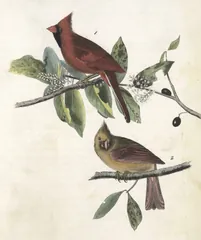
John James Audubon, The Birds of America (1840–44) about 61 per routeon 100% of routesno clear trend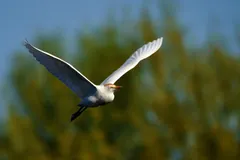
Photo: Bill Levine, CC BY 4.0 2 Western Cattle-Egretabout 54 per routeon 57% of routesno clear trend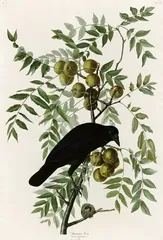
John James Audubon, The Birds of America (1827–38) 3 American Crowabout 50 per routeon 99% of routesfalling since 2015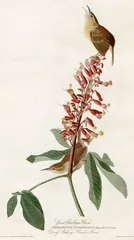
John James Audubon, The Birds of America (1827–38) about 43 per routeon 100% of routesno clear trend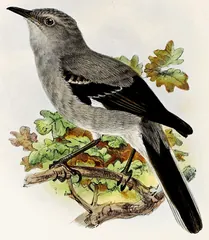
John Gerrard Keulemans, Onze Vogels in Huis en Tuin (1869–76) about 43 per routeon 100% of routesno clear trend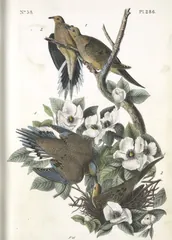
John James Audubon, The Birds of America (1840–44) about 40 per routeon 100% of routesno clear trend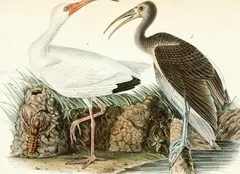
John James Audubon, The Birds of America (1840–44) about 28 per routeon 42% of routesno clear trend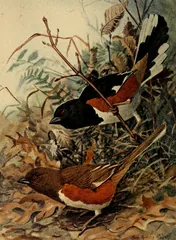
Louis Agassiz Fuertes, True Bird Stories from My Note-Books (1903) 8 Eastern Towheeabout 27 per routeon 100% of routesfalling since 2015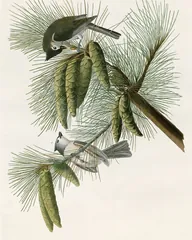
John James Audubon, The Birds of America (1827–38) about 24 per routeon 100% of routesno clear trend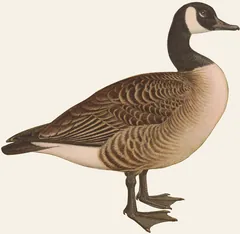
Marinus Adrianus Koekkoek, E. D. van Oort's Ornithologia Neerlandica (1922) 10 Canada Gooseabout 22 per routeon 52% of routesno clear trend
Show all 25
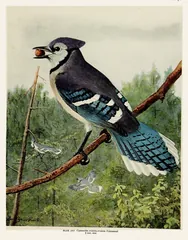
Louis Agassiz Fuertes, Elon H. Eaton's Birds of New York (1910–14) 11 Blue Jayabout 22 per routeon 99% of routesfalling since 2015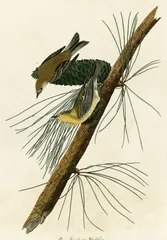
John James Audubon, The Birds of America (1827–38) 12 Pine Warblerabout 19 per routeon 100% of routesfalling since 2015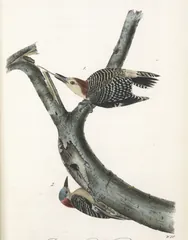
John James Audubon, The Birds of America (1840–44) about 19 per routeon 100% of routesno clear trend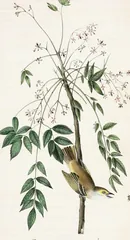
John James Audubon, The Birds of America (1840–44) 14 White-eyed Vireoabout 18 per routeon 99% of routesrising since 2015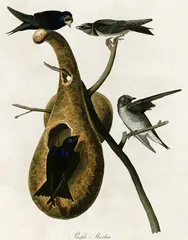
John James Audubon, The Birds of America (1827–38) 15 Purple Martinabout 16 per routeon 93% of routesfalling since 2015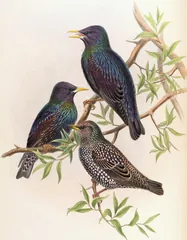
John Gould and Henry Constantine Richter, The Birds of Asia, vol. 5 (1850–83) 16 European Starlingabout 16 per routeon 86% of routesno clear trendintroduced species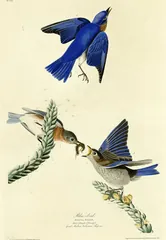
John James Audubon, The Birds of America (1827–38) about 15 per routeon 99% of routesno clear trend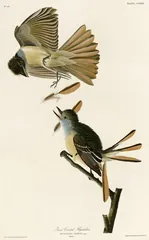
John James Audubon, The Birds of America (1827–38) 18 Great Crested Flycatcherabout 15 per routeon 98% of routesno clear trend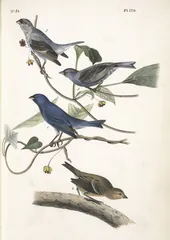
John James Audubon, The Birds of America (1840–44) 19 Indigo Buntingabout 15 per routeon 99% of routesfalling since 2015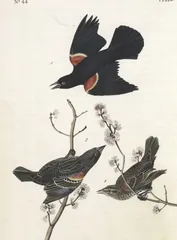
John James Audubon, The Birds of America (1840–44) about 14 per routeon 90% of routesno clear trend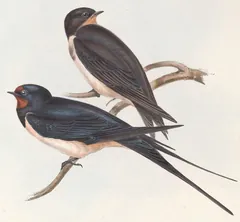
John and Elizabeth Gould, The Birds of Europe (1832–37) 21 Barn Swallowabout 14 per routeon 98% of routesno clear trend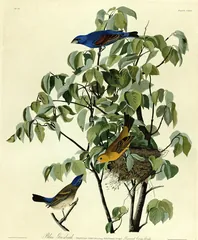
John James Audubon, The Birds of America (1827–38) 22 Blue Grosbeakabout 13 per routeon 98% of routesno clear trend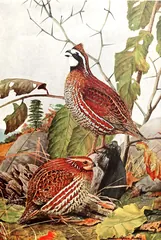
Louis Agassiz Fuertes, Elon H. Eaton’s Birds of New York (1910–14) 23 Northern Bobwhiteabout 12 per routeon 79% of routesno clear trend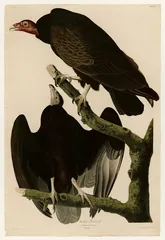
John James Audubon, The Birds of America (1827–38) about 11 per routeon 94% of routesno clear trend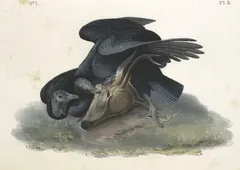
John James Audubon, The Birds of America (1840–44) about 11 per routeon 93% of routesno clear trend
From the Northern Cardinal to the Black Vulture, these are Georgia’s common summer birds; for the rest of its 426 species, our guide to the best bird guide books compares the five big North American guides, Sibley’s and Peterson’s among them.
What is the most common bird in Georgia?
The Northern Cardinal leads Georgia’s summer survey: about 61 a route on average in 2021–2025, ahead of the Western Cattle-Egret at about 54, seen on every one of the 86 routes. USGS finds no clear rise or fall in its Georgia numbers since 2015.
The Northern Cardinal, Mourning Dove, Carolina Wren, Carolina Chickadee and American Robin are among the 21 species on Birds Georgia's poster of the state's common birds. The cardinal stays all year, the New Georgia Encyclopedia notes, while the Indigo Bunting comes up from Central and South America and the Caribbean only to nest.
Sources: Common Birds of Georgia, poster (Birds Georgia); Birds (New Georgia Encyclopedia, Georgia Humanities and the University of Georgia Press, last edited September 13, 2018), read October 22, 2026.
How was this list made?
Each of Georgia’s 86 routes is a roadside count, 50 stops along about 25 miles, run once a year in early summer by a volunteer. We took USGS’s yearly estimate for each species in Georgia, the number of birds a typical route records, averaged it over the five latest survey years (there was no survey in 2020) and ranked the birds by it. To keep the list to birds you’re likely to meet across Georgia, we left out species recorded on fewer than one in five of its routes, and those USGS can only estimate very roughly, which usually means big flocks or colonies on a few routes.
For Georgia that left out the Cliff Swallow.
The share of routes is our own count from USGS’s route data for Georgia, using only counts that met the survey’s standards; “rising” and “falling” are USGS’s trends for the state since 2015, named only where it finds a clear change. Roadside counts on early-summer mornings miss most of Georgia’s owls and waterbirds, and its winter visitors aren’t here at all.
Georgia’s counts come from two USGS data releases, the North American Breeding Bird Survey Analysis Results 1966–2025 (Hostetler et al., 2026) and its Dataset 1966–2025 (Ziolkowski et al., 2026), gathered by volunteer observers and free for anyone to use; Birdfolio isn’t connected with the USGS.
How many bird species are in Georgia?
| Official count | 426 species |
|---|---|
| List’s date | 2023 |
| Kept by | Georgia Ornithological Society Checklist and Records Committee |
| Total printed | None: 426 is our count of the checklist's species lines |
| Review species | 100 on the checklist, plus 7 provisional species kept off it (our count) |
| Birds now gone | 1 counted, the Ivory-billed Woodpecker |
| Last amended | November 2023, says the committee's review list |
| Among US states | 42nd highest of the 49 US lists (50 states and DC) with a verified count |
| Official list | GOS 2023 Checklist (Georgia Ornithological Society) |
What does Georgia’s count include?
- One line per species with a blank to tick, from the Black-bellied Whistling-Duck onward, and no total, status codes or other marks: 426 lines, our count.
- The Ivory-billed Woodpecker, once a bird of the Okefenokee Swamp, which the state encyclopedia names among the birds Georgians can no longer see. The Passenger Pigeon, Carolina Parakeet and Bachman's Warbler, gone from Georgia too, aren't on it (our check).
- Birds brought from elsewhere that now live wild, such as the European Starling, House Sparrow and Eurasian Collared-Dove, and the Plain Chachalaca, released on Sapelo Island in the mid-1920s.
- 100 species rare enough that the committee asks for a written report of every sighting, from the Fulvous Whistling-Duck to the Lazuli Bunting (our count of its Regular Review List).
- Not counted: 7 Provisional species, known from fewer than 4 accepted sightings without a photo or specimen, such as the Mexican Violetear and Painted Redstart; the Hypothetical list of unproven or possibly escaped birds; and the Rock Wren, Fork-tailed Flycatcher, Atlantic Puffin and Hammond's Flycatcher, accepted in 2021-2022 but missing from the checklist (our check).
Why do other sources give a different number?
Georgia's earlier checklists and its state encyclopedia give smaller totals:
- 423. Our count of the society's 2019 checklist, which the committee's page still links as its Regular List. The 2023 edition added the Trumpeter Swan, Mountain Bluebird and Lazuli Bunting and gave two birds new names, which makes 426. Source: GOS 2019 Checklist (Georgia Ornithological Society).
- 407. The Regular Species List in the society's Annotated Checklist of Georgia Birds, published in 2003. That book covers 446 species in all, with the range, status and dates of each. Source: Publications: Annotated Checklist of Georgia Birds, Occasional Publication No. 14, 2003 (Georgia Ornithological Society).
- 347. Species that live in Georgia for at least part of their lives, by the New Georgia Encyclopedia's estimate. It counts the birds that make their homes here rather than every species ever accepted, and the article was last revised in 2018. Source: Birds (New Georgia Encyclopedia, Georgia Humanities and the University of Georgia Press, last edited September 13, 2018).
Georgia’s list follows its own committee’s rules, and so does every other state’s: see why the counts differ from state to state.
Georgia records, from a list of 273 birds in 1849 to a puffin far offshore
- Georgia's first bird list, from the LeConte family of Liberty County, named 273 species and was printed in 1849 in George White's Statistics of the State of Georgia. More than a century earlier, from 1730 to 1748, Catesby's Natural History of Carolina, Florida, and the Bahama Islands had pictured 109 birds from Georgia. Source: Birds (New Georgia Encyclopedia, Georgia Humanities and the University of Georgia Press, last edited September 13, 2018), read October 22, 2026.
- On March 2, 2013, a longspur turned up at a sod farm near Marshallville, in Macon County, and the committee accepted it as a McCown's Longspur. The 2023 checklist carries the species under its new name, Thick-billed Longspur. Sources: GCRC Activity 2013 (Georgia Ornithological Society Checklist and Records Committee); GOS 2023 Checklist (Georgia Ornithological Society), read October 21, 2026.
- Three species joined the checklist between its 2019 and 2023 editions (our comparison): a Trumpeter Swan at Piedmont National Wildlife Refuge in December 2017, a Mountain Bluebird at Bush Field in Richmond County in March 2018, and a Lazuli Bunting at a home in Dougherty County in March 2019. Sources: GCRC Activity 2018 (Georgia Ornithological Society Checklist and Records Committee); GCRC Activity 2019 (Georgia Ornithological Society Checklist and Records Committee); GOS 2019 Checklist (Georgia Ornithological Society); GOS 2023 Checklist (Georgia Ornithological Society), read October 21, 2026.
- From photos, the committee accepted a Fork-tailed Flycatcher at Fort Pulaski National Monument on October 5, 2021, a Rock Wren at Unicoi State Park later that month, an Atlantic Puffin seen from a boat far offshore on February 27, 2022, and a Hammond's Flycatcher on Sea Island that October. None of the four is on the 2023 checklist. Sightings at sea are placed by the committee's “Closest Point of Land” rule, adopted unanimously in January 2013. Sources: GCRC Activity 2021 (Georgia Ornithological Society Checklist and Records Committee); GCRC Activity 2022 (Georgia Ornithological Society Checklist and Records Committee); GOS 2023 Checklist (Georgia Ornithological Society); GCRC Current Activity (Georgia Ornithological Society Checklist and Records Committee), read October 21, 2026.
- Georgia had no Bald Eagle nests in 1979; after fifteen years of restoration, 81 nests raised 97 young in 2003. Peregrine Falcons, wiped out in the eastern United States by the pesticide DDT, came back too, and in 1996 a pair began nesting on a building ledge in downtown Atlanta. Source: Birds (New Georgia Encyclopedia, Georgia Humanities and the University of Georgia Press, last edited September 13, 2018), read October 22, 2026.
Questions people ask about Georgia’s birds
Which US state has the most bird species?
California, with 696 species, leads every state; its records committee last updated the checklist on October 20, 2026, and Texas is second with 678. Georgia's 426, our count of the society's 2023 checklist, place it 42nd of the 48 states with a verified count in our table, two behind New Hampshire and Arkansas and six ahead of Indiana.
Sources: Official California Checklist, updated October 20, 2026 (California Bird Records Committee, Western Field Ornithologists); Texas State List, last updated June 7, 2026 (Texas Bird Records Committee, Texas Ornithological Society); GOS 2023 Checklist (Georgia Ornithological Society), read October 21, 2026.
What is the rarest bird in Georgia?
The Ivory-billed Woodpecker, a bird Georgians can no longer see in the Okefenokee Swamp, says the New Georgia Encyclopedia; the society's 2023 checklist still carries it, and the committee still asks for a report of any sighting. Among living birds, the rarest are 7 Provisional species, such as the Northern Fulmar, Mountain Plover and Painted Redstart, each with fewer than 4 accepted sightings and kept off the checklist. Another 100 on the checklist are rare enough that the committee wants every sighting written up (our count).
Sources: Birds (New Georgia Encyclopedia, Georgia Humanities and the University of Georgia Press, last edited September 13, 2018); GOS 2023 Checklist (Georgia Ornithological Society); Review List, amended November 2023 (Georgia Ornithological Society Checklist and Records Committee), read October 21, 2026.
What are common backyard birds in Georgia?
Robins, cardinals, Carolina Chickadees, Tufted Titmice, House Finches, mockingbirds and Eastern Bluebirds fill the first page of the University of Georgia's guide to common birds in Athens, and its second adds the Barred Owl, Turkey Vulture and Red-tailed Hawk. Birds Georgia's statewide poster adds the American Goldfinch, Pine Warbler and both the White-breasted and Brown-headed Nuthatches.
Sources: A Guide to Common Birds in Athens, Georgia (EcoReach, Odum School of Ecology, University of Georgia); Common Birds of Georgia, poster (Birds Georgia), read October 22, 2026.
Where can I find a list of Georgia birds?
On the Georgia Ornithological Society's website, under Birding: the GOS 2023 Checklist is a single web page of 426 species, one per line with a blank to tick them off (our count). Beside it, the Review List page names the rarities the committee wants reported, and the society's Annotated Checklist of Georgia Birds, a 2003 book, gives each species' range, status and dates.
Sources: GOS 2023 Checklist (Georgia Ornithological Society); Review List, amended November 2023 (Georgia Ornithological Society Checklist and Records Committee); Publications: Annotated Checklist of Georgia Birds, Occasional Publication No. 14, 2003 (Georgia Ornithological Society), read October 21, 2026.
What is the state bird of Georgia?
The Brown Thrasher, which the New Georgia Encyclopedia calls the state songbird; Georgia's second official bird, its game bird, is the Northern Bobwhite, or quail. Both are on the society's 2023 checklist, where the bobwhite is the only species under the heading New World quail (our check).
How Georgia's schoolchildren picked the Brown Thrasher, and why it took until 1970
Sources: Birds (New Georgia Encyclopedia, Georgia Humanities and the University of Georgia Press, last edited September 13, 2018); GOS 2023 Checklist (Georgia Ornithological Society), read October 21, 2026.
Which birds live in Georgia?
Birds of the mountains, the Piedmont, the Coastal Plain and the coast: about 347 species live in Georgia for at least part of their lives, the New Georgia Encyclopedia estimates. The Blue Ridge, the state's coldest and wettest corner, has about 130 nesting species, and Canada Warblers, Veeries and Dark-eyed Juncos nest in Georgia only above 3,500 feet. The rolling Piedmont has 110 to 115, among them birds that have spread in from the north over the past half century.
The Coastal Plain, the southern half of the state, has about 110 nesting species, from Red-cockaded Woodpeckers in longleaf pine to heron and egret colonies with more than 30,000 nests. Okefenokee National Wildlife Refuge, set up in 1937, covers about 407,000 acres, the largest refuge east of the Mississippi, and about 232 kinds of birds have been found in its swamp. In southwest Georgia, winter has brought Burrowing Owls, Vermilion Flycatchers and Say's Phoebes, and Eufaula National Wildlife Refuge counts almost 300 species.
On the coast, Fort Pulaski National Monument, a stop on Georgia's Colonial Coast Birding Trail, supports 200 species, from Clapper Rails and Seaside Sparrows in the marsh to Painted Buntings that nest there in spring and summer. Cumberland Island National Seashore, with 18 miles of undeveloped beach, counts over 300.
Sources: Birds (New Georgia Encyclopedia, Georgia Humanities and the University of Georgia Press, last edited September 13, 2018); Okefenokee National Wildlife Refuge: About Us (U.S. Fish and Wildlife Service); Birding in Southwest Georgia, Jimmy Carter National Historical Park (National Park Service, last updated July 21, 2023); Birds, Fort Pulaski National Monument (National Park Service, last updated September 13, 2025); Animals, Cumberland Island National Seashore (National Park Service, last updated March 14, 2022), read October 21, 2026.
Why do Wood Storks nest on an old Army airfield on the Georgia coast?
Because the airfield became a wildlife refuge. In 1943 the federal government condemned 2,687 acres at Harris Neck, in McIntosh County, for a World War II airfield where fighter pilots headed for Europe trained in aerial gunnery; building it destroyed much of Harris Neck's Gullah community, the Fish and Wildlife Service's refuge page says. In 1948 the government gave the land to the county for an airport; it returned to federal hands in 1961, and in 1962 it became Harris Neck National Wildlife Refuge.
Its best-known residents are Wood Storks, which nest in a large colony on Woody Pond. In 2011 the service told Congress it was the largest breeding colony in Georgia, with nearly 500 nesting pairs, and one of the most stable and productive in the country. In all, 342 species of birds have been seen on the refuge and 83 nest there, the Painted Bunting among them.
Sources: Harris Neck National Wildlife Refuge: About Us (U.S. Fish and Wildlife Service); Ownership Rights Concerning the Harris Neck National Wildlife Refuge, testimony to the House Natural Resources Committee (U.S. Fish and Wildlife Service, December 15, 2011), read October 22, 2026.
How did a Mexican bird end up on Georgia's barrier islands?
A Detroit car engineer brought it. Howard Coffin, who bought Sapelo Island in 1912 for $150,000, released Plain Chachalacas there and on nearby Blackbeard Island in the mid-1920s, by the reckoning of a 1941 Fish and Wildlife Service report. In the United States the bird was native only to southern Texas; an adult is “about the size of a half-grown Leghorn chicken,” the report said.
The birds came from families in Guatemala and Mexico who made pets of them, and they were so tame that they would climb all over anyone who let them, picking at shiny buttons and even at people's eyes. That tameness made them easy prey, and only a few turned wary in time. The society's 2023 checklist counts the chachalaca among Georgia's birds, and the Sapelo Island reserve's birding guide, revised in 2019, still shows it, marked as introduced.
Coffin's island had famous guests in those years: Presidents Calvin Coolidge and Herbert Hoover and the aviator Charles Lindbergh. The Depression forced him to sell in 1934, to the tobacco heir Richard J. Reynolds Jr.
Sources: Mexican Bird, Rare in States, Doing Well on Wildlife Refuge (U.S. Fish and Wildlife Service news release, February 2, 1941); Sapelo Island (New Georgia Encyclopedia, last edited December 2, 2019); Sapelo Island Coastal Birding Field Guide, revised October 2019 (Sapelo Island National Estuarine Research Reserve); GOS 2023 Checklist (Georgia Ornithological Society), read October 21, 2026.
Where is the official Georgia bird list, and how often is it updated?
On the Georgia Ornithological Society's website, under Birding: the GOS 2023 Checklist, a plain web page with one species per line and no total, and the Review List, which the committee amends every year on that page, most recently in November 2023. The committee's own page still points to the 2019 checklist as its Regular List, and as of October 21, 2026, its activity page still showed a round of votes due to finish on December 30, 2023, with no results posted.
The Checklist and Records Committee has a chair and at least five voting members on two-year terms, capped at six years in a row, and works under a handbook approved in 1996. It reviews about 40 reports of rare birds a year; a report is accepted with no more than one vote against and rejected with three, and the files go to the University of Georgia. Changes to the list can be published in The Oriole, the society's journal, first thought up on an Atlanta streetcar in 1935.
Sources: GOS 2023 Checklist (Georgia Ornithological Society); Review List, amended November 2023 (Georgia Ornithological Society Checklist and Records Committee); Checklist and Records Committee (Georgia Ornithological Society); GCRC Current Activity (Georgia Ornithological Society Checklist and Records Committee); Bylaws, Article VIII, Section 5: the Checklist and Records Committee (Georgia Ornithological Society); History, written for the society's 75th anniversary meeting, January 2011 (Georgia Ornithological Society), read October 21, 2026.
How do you count your own Georgia list?
Your Georgia list is every species you’ve seen in Georgia. If you log your sightings in eBird, it lets you filter your life list by place, Georgia included (eBird’s My eBird help page, updated March 28, 2025), and the data download you can ask for gives the state of every sighting: our guide shows how to download your own eBird data. On paper, count the species you’ve seen in Georgia; what is a life list? explains how birders keep their lists.
If you’d like your whole life list in print, Georgia birds and all, our guide shows how to print your bird life list, free ways included, and Birdfolio turns it into a hardcover book, each species beside a classic painting.
Georgia’s state bird
Georgia’s state bird is the Brown Thrasher, the state bird since 1970. Its story, the state flower and animal, and a free picture card for a report are on our Georgia state bird page.
Birding festivals in Georgia
Our birding festivals calendar lists one festival in Georgia, with dates from its own website:
- Georgia Bird Fest, Atlanta / statewide: dates not announced yet; expected in April 2027 (2026 festival: April 10–May 10, 2026)
Christmas Bird Count in Georgia
Georgia had 32 Christmas Bird Count circles on Audubon’s map last winter, each counted on a single day between December 14 and January 5. Our guide shows where to find Georgia’s counts and how to join one; it’s free, and beginners are welcome.
More about bird counts
- How many bird species are in each state: Georgia beside all 50 states, DC and Canada.
- Bird lists of nearby states: Alabama, Florida, North Carolina, South Carolina and Tennessee.
- State birds of all 50 states, Georgia’s Brown Thrasher among them
- How many bird species are in the US and Canada
- Bird splits and lumps
If you’re shopping for a birder in Georgia, our gift guide for birders and our pick of coffee table bird books are good places to start.